The Speed at Which You Eat
A locked-ward experiment revealed the real reason packaged food overfeeds us, and it isn't sugar.
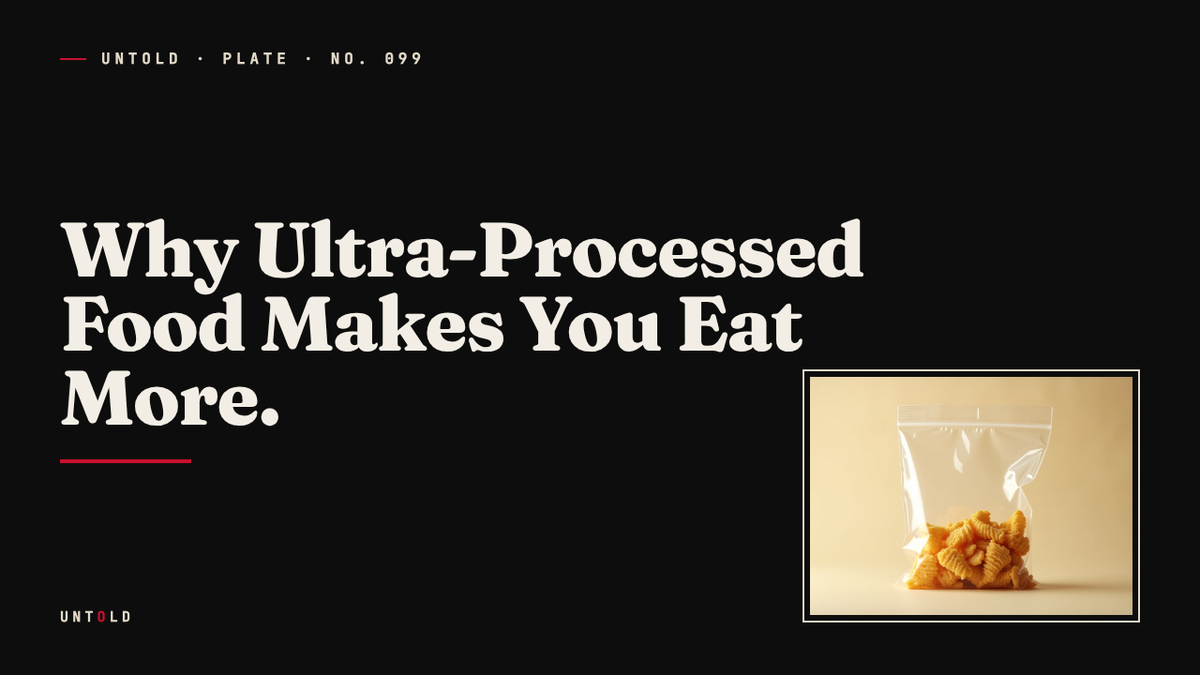
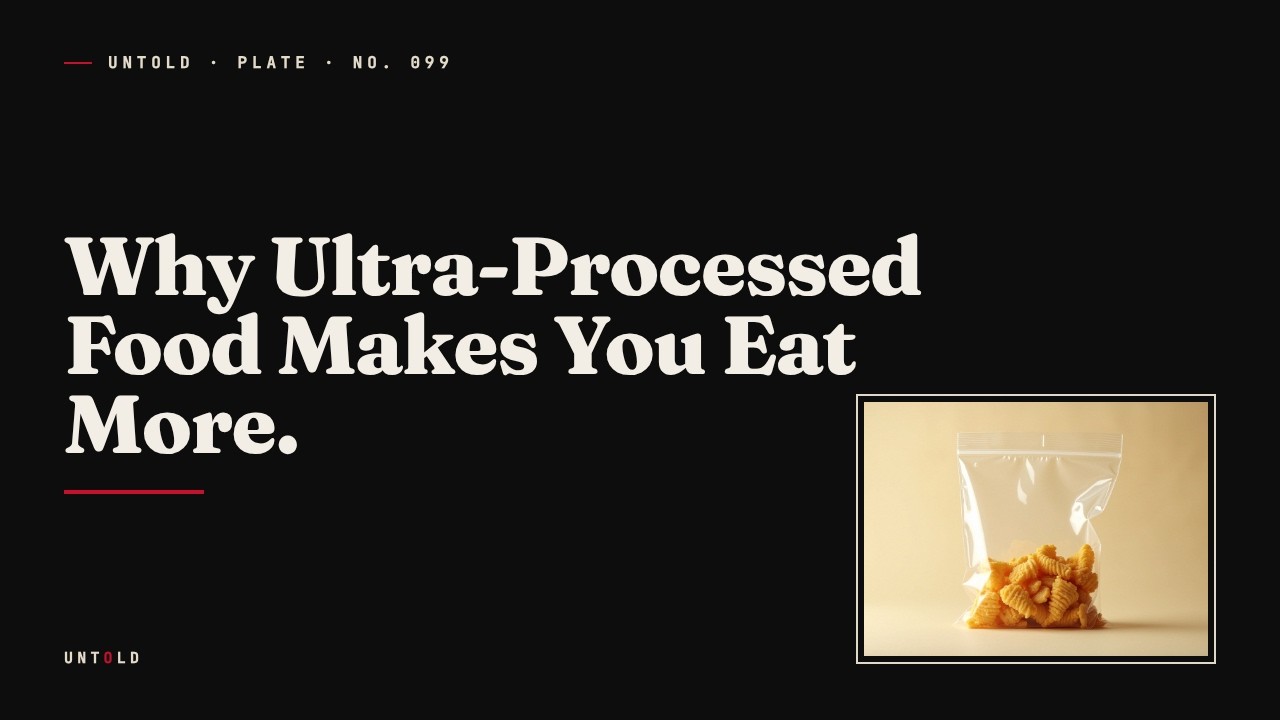
Take a single potato crisp and put it in your mouth. Before you have quite registered the act of chewing, it is gone: dissolved, swallowed, absent. Now take a raw carrot and do the same. The carrot resists. It fights the molars, demands a dozen deliberate chews, sits stubbornly on the tongue long after you wish it would leave. Two foods, the same instruction, wildly different speeds.
That difference in speed sounds trivial. It is not. It may be the single most underappreciated variable in the modern epidemic of overeating, and for years it hid in plain sight while the public conversation fixated on the usual suspects: sugar, fat, and the moral failing we politely call a lack of willpower.
The standard story about ultra-processed food runs along one of two tracks. The first is a story of character. People overeat crisps and biscuits and frozen meals because they are weak, undisciplined, unable to resist temptation. The second is a story of chemistry. Packaged food is overloaded with sugar and fat and salt, and those ingredients hijack the reward circuits of the brain, so of course we eat too much of it. Both stories feel intuitively right. Both, it turns out, are incomplete, and the experiment that exposed their limits was one of the most tightly controlled feeding trials ever conducted.
The Man Who Distrusted the Data
Kevin Hall is a physicist by training who ended up studying human metabolism at the National Institutes of Health in Bethesda, Maryland. His specialty is energy balance: the arithmetic of calories in and calories out, and the surprisingly complicated biology that governs both sides of the ledger. For years, epidemiologists had been publishing large observational studies linking diets heavy in ultra-processed food to weight gain, metabolic disease, and early death 1. The correlations were strong and consistent. But Hall was not satisfied.
The problem with observational studies is that they follow people through the chaos of ordinary life. The person who eats a lot of packaged food is, on average, different from the person who cooks from scratch in a hundred ways that have nothing to do with food. They may earn less money. They may sleep less, work longer hours, live under more stress, exercise less, or lack access to fresh produce entirely. Any of those differences, or all of them tangled together, could drive the association between processed food and poor health. Correlation, as every scientist is taught to recite, is not causation.
To isolate cause, Hall needed something the messy real world could never provide: total control. He needed to hold everything else constant, so that the only thing changing was the food itself. And to do that, he needed a place where he could feed people, watch them, weigh their meals, and account for every calorie that entered and left their bodies. He found it inside the NIH Clinical Center, a research hospital where volunteers could live for weeks under continuous observation.
What he built there, and published in the journal Cell Metabolism in May 2019, would become one of the most cited nutrition experiments of the decade 2.
Four Weeks Inside a Sealed Room
Twenty adults volunteered. They were, by design, ordinary: weight-stable, with a mean age of thirty-one and a mean body mass index of twenty-seven, right at the edge between healthy and overweight. They moved into the Clinical Center and stayed for four uninterrupted weeks. Nobody slipped out for a snack. Nobody grazed on food the researchers could not see. Every gram of everything they ate was weighed before it was served and weighed again after, so that intake could be calculated to the calorie.
The design was a crossover trial, which is the closest thing nutrition science has to a fair fight. For two weeks, each volunteer ate a diet built almost entirely from ultra-processed foods: the packaged, industrially formulated products that dominate the modern supermarket. For the other two weeks, the same volunteer ate a diet built from minimally processed whole foods: fresh meat and fish, vegetables, fruit, grains, and pulses prepared in the research kitchen. Half the participants did the processed weeks first, half did the whole-food weeks first, and the order was assigned at random. Because every person served as their own control, the study sidestepped the problem of comparing one group of people to another entirely different group.
Then came the part that made the experiment legendary. Before serving, Hall and his team matched the two menus with obsessive precision. On paper, at the moment the plates went down, the ultra-processed meals and the whole-food meals delivered the same number of calories, the same grams of sugar, the same fat, the same fibre, the same sodium 2. If the sugar-and-fat theory were the whole truth, the two diets should have behaved identically, because on those axes they were identical.
And crucially, food was offered without limit on both arms of the trial. Volunteers were told, plainly, to eat as much or as little as they wanted. Three meals a day were presented, each providing roughly double what a person would need, plus snacks available around the clock. There was no rationing, no instruction to restrain themselves, no target to hit. The only thing being measured was appetite: how much would people freely choose to eat when the nutrition on the plate was matched but the food was not?
If the diets were truly equivalent, intake should have been equivalent too.
Five Hundred and Eight Calories
It was not equivalent. It was not even close.
During the two weeks of ultra-processed meals, the same people ate, on average, 508 more calories every single day than they did during the whole-food weeks 2. Five hundred calories is not a rounding error. It is a whole extra meal, consumed invisibly, day after day, by people who were not told to eat more and did not feel that they had. They simply cleared more from the plate.
The bodies followed the mouths. On the ultra-processed diet, volunteers gained close to a kilogram of weight in two weeks. On the whole-food diet, they lost almost exactly the same amount 2. Same person. Same building. Same rules, the same open invitation to eat freely. Opposite outcomes, driven by nothing except the nature of the food itself.
This is where the two comfortable explanations began to fall apart. The willpower theory could not survive the result, because everyone had been given exactly the same instruction and the same freedom, and their intake still diverged sharply depending on which food was in front of them. Willpower did not change between the two weeks; only the food did. The sugar-and-fat theory could not survive it either, because sugar and fat had been deliberately matched. Whatever was making people overeat, it was not the macronutrients the headlines always blamed.
So Hall stopped asking what people were eating and how much, and started asking a stranger question: how fast?
The Clock in the Gut
When the team examined the pace of eating, the pattern was immediate and unmistakable. On the ultra-processed meals, people ate significantly faster. The difference worked out to roughly seventeen more calories entering the body every minute of eating 2. That number sounds abstract until you understand what it collides with: the timekeeping of the human gut.
The body does have a system for telling the brain that it has had enough. It just runs on a delay. When food arrives in the stomach and intestines, a cascade of signals begins. Stretch receptors in the stomach wall report on volume. Hormones such as leptin, released from fat tissue over the longer term, and gut peptides like PYY and GLP-1, released during a meal, travel to the brainstem and hypothalamus to register satiety. But this messaging system is not instantaneous. The consensus estimate is that it takes on the order of twenty minutes for the brain to fully register the fullness of a meal 34.
Twenty minutes is a slow speed limit. Now picture eating faster than that message can travel. If a meal can be consumed in ten or twelve minutes, then by the time the brain finally receives the signal to stop, the plate is already empty and a good deal more has already gone down than the body ever needed. The overeating is not a decision. It is a timing failure. The gut simply cannot get a word in before the meal is over.
This is where processing does its quiet, decisive work. Ultra-processed food is engineered, whether deliberately or as a byproduct of manufacturing, to be soft, dense, and easy to swallow. Grains are milled to fine flour. Fibre is stripped or pulverized. Textures are smoothed, emulsified, and softened. The result is food that requires almost no chewing and slides down with minimal resistance. Whole foods do the opposite. They make you work. The raw carrot fights back. It demands time, and in demanding time, it hands the gut its twenty minutes.
The food was matched. The eating was not. That single sentence is the hinge of the entire study.
An Engineering Problem, Not a Moral One
What Hall’s experiment quietly did was reframe overeating from a question of character into a question of engineering. If the real agent is the physical form of the food, its softness and density and the speed at which it can be consumed, then the modern struggle to eat less is not primarily a battle of willpower being lost. It is a battle in which the terms have been set by the design of the food itself.
And it is design. Whether or not any given manufacturer set out to defeat human satiety, the commercial incentives all pull in one direction. Food that goes down fast and easy is food that gets eaten in greater quantity, more often, and it tends to be cheap to produce, long-lasting on the shelf, and highly palatable. The market rewards products that outrun the body’s slow warning system, and it has produced an entire supermarket full of them. The consumer, meanwhile, is left holding a body whose fullness signals were calibrated over hundreds of thousands of years of eating things that fought back.
This helps explain why the advice we hear most often, some version of “just eat less,” fails so reliably. It treats overeating as a matter of intention, when the study suggests it is often a matter of pace. You can fully intend to eat a moderate amount and still overshoot by hundreds of calories, simply because the food left your plate before your gut could object. Restraint is being asked to compensate, in real time, for a mismatch between how fast food now enters the body and how slowly the body reports that it is full.
The practical implications are modest but real, and they do not require demonizing every packaged product or achieving monastic discipline. Slowing down may matter as much as what is on the plate. Chewing longer gives the twenty-minute clock a chance to run. Choosing foods that resist you a little, that carry their fibre and structure intact, does some of that work automatically by forcing a slower pace. None of this is a moral prescription. It is simply working with the biology instead of against it.
It is worth keeping the study in proportion. Twenty people, four weeks, one carefully engineered comparison. Hall himself has been careful to note that his diets differed in ways beyond speed alone, and that eating rate is one mechanism among several likely at play, including energy density and the sheer availability of calories per bite 2. Later work continues to probe exactly how ultra-processing drives overconsumption. But the central finding has held up as a landmark precisely because of its rigor: under conditions where everything else was locked down, the form of the food alone shifted intake by the equivalent of an entire extra meal a day.
So the next time a snack vanishes before you have quite tasted it, before your brain has caught up to your hand, it is worth noticing the speed. The crisp was gone almost before you began. The carrot was still fighting. Somewhere in the gap between those two speeds sits the difference between a body that knows when to stop and one that never gets the chance.
Sources
- Hall, K. D. et al., ‘Ultra-Processed Diets Cause Excess Calorie Intake and Weight Gain: An Inpatient Randomized Controlled Trial of Ad Libitum Food Intake,’ Cell Metabolism, 2019. — https://www.cell.com/cell-metabolism/fulltext/S1550-4131(19)30248-7
- Monteiro, C. A. et al., ‘Ultra-processed foods, diet quality, and health using the NOVA classification system,’ FAO, 2019. — https://www.fao.org/documents/card/en/c/ca5644en/
- Cummings, D. E. & Overduin, J., ‘Gastrointestinal regulation of food intake,’ Journal of Clinical Investigation, 2007. — https://www.jci.org/articles/view/30227
- Klok, M. D., Jakobsdottir, S. & Drent, M. L., ‘The role of leptin and ghrelin in the regulation of food intake and body weight in humans,’ Obesity Reviews, 2007. — https://onlinelibrary.wiley.com/doi/10.1111/j.1467-789X.2006.00270.x
- Hall, K. D., National Institute of Diabetes and Digestive and Kidney Diseases, NIH Laboratory of Biological Modeling. — https://www.niddk.nih.gov/about-niddk/staff-directory/biography/hall-kevin
- Robinson, E. et al., ‘A systematic review and meta-analysis examining the effect of eating rate on energy intake and hunger,’ American Journal of Clinical Nutrition, 2014. — https://academic.oup.com/ajcn/article/100/1/123/4576434
Related reading