The Pleasure of the Safe Scream
Why millions pay to trigger an alarm their bodies evolved to dread.
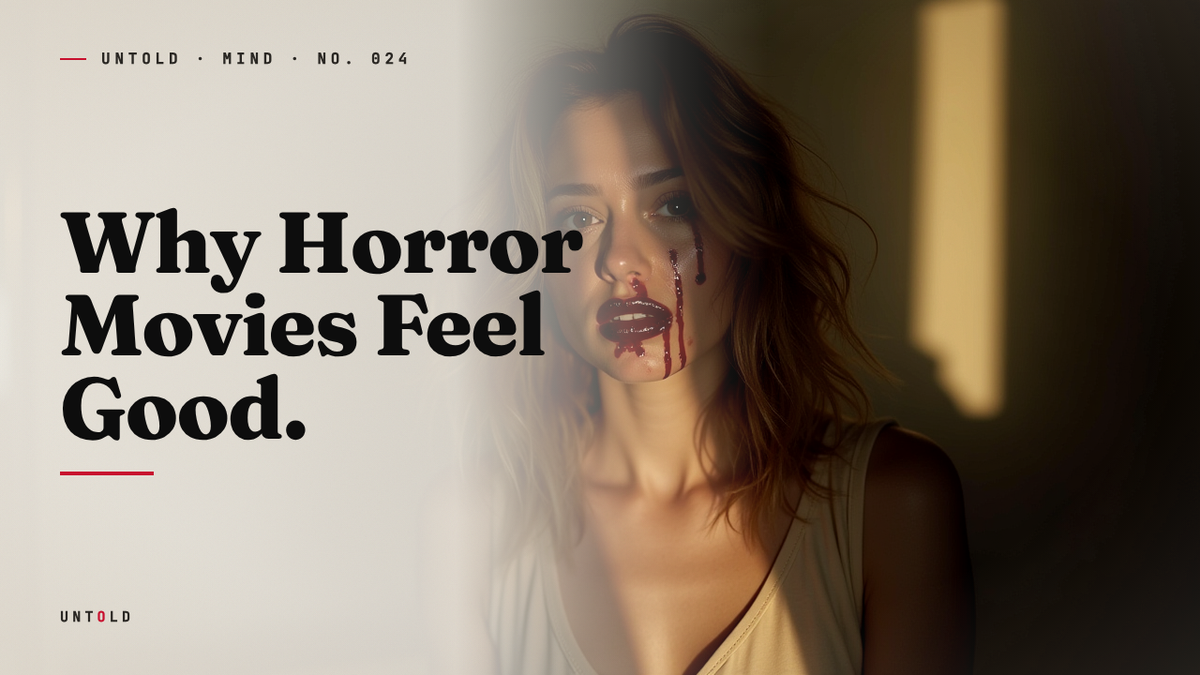
The killer steps from the shadows. The strings shriek. And in the half-second before the blade comes down, an entire theater inhales at once, a hundred strangers gripping their armrests in the dark. Then the cut, the scream, the spray of stage blood. And something genuinely strange happens. The crowd laughs. People exhale, slap their knees, turn to a neighbor they have never met and grin. They are, by every physiological measure, terrified. Hearts pounding, palms damp, stomachs in free fall. And they are having the time of their lives.
This is one of the more durable puzzles in human behavior. Fear is not a neutral sensation. It is an emergency. The entire apparatus exists to wrench us away from threat, to flood the body with the chemistry of escape. By any straightforward evolutionary logic, we should flee the thing that frightens us, not buy a ticket to it, not queue around the block on opening weekend, not pay extra for the seats that rumble. Yet the global horror box office has cleared a billion dollars in a single year, and the genre keeps minting hits with budgets a tenth the size of the blockbusters they outearn. Millions of people, in full possession of their faculties, choose to be scared on purpose. And then they do it again.
The question is not why horror sells. The question is what, exactly, we are buying.
The chemistry of a scream
To understand the appeal, you have to start with the body, because the body is where it all happens first, and where it happens without permission. When your brain registers a threat, real or apparent, it does not pause to deliberate. The amygdala, a small almond-shaped structure deep in the temporal lobe, fires before the conscious mind has assembled a single coherent thought. It signals the hypothalamus, which triggers the sympathetic nervous system, which dumps adrenaline and cortisol into the bloodstream. This is the fight-or-flight cascade, and it is fast, faster than awareness.
Within moments, the heart accelerates, sometimes by thirty beats per minute or more during a well-built scare. Blood is rerouted from the skin and the digestive organs toward the large muscles of the arms and legs, which is why fear can make you pale and why your stomach seems to drop. Pupils dilate to gather more light. Airways open. Glucose floods into the system for fuel. The body is, in the space of a breath, preparing to do something violent and necessary: to run, or to fight, for its life.
This machinery is ancient. The core architecture of the threat response is shared across the vertebrates and predates the primates by a very long stretch, an inheritance perhaps two hundred million years deep 1. It was built for a world of genuine predators, for the rustle in the grass that might be wind or might be a leopard. It evolved to err on the side of false alarms, because the cost of mistaking a leopard for wind is death, while the cost of mistaking wind for a leopard is a wasted sprint. The system is therefore exquisitely tuned to be triggered, and it is not picky about whether the trigger is real.
Which is precisely the loophole horror exploits. In a darkened theater, you are in no danger whatsoever. The monster is light on a screen. The blade is a prop. But the older parts of the brain, the parts that handle the alarm, cannot read the marquee. They process the shape lunging out of the dark, the sudden noise, the music that has been carefully engineered to mimic the acoustic signatures of distress, and they respond as they were built to respond. The body reacts. The mind, sitting one level up, knows better. That gap between what the body believes and what the mind knows is the entire engine of recreational fear.
What the haunted house revealed
The sociologist Margee Kerr spent years inside one of the more unusual field sites in fear research: an extreme haunted attraction, the kind that signs liability waivers and turns visitors loose into a multi-story labyrinth of staged terror. Rather than ask people in the abstract whether they enjoyed being frightened, she wired them up and measured what actually happened to their bodies and their moods as they went through it 2.
The findings ran against intuition. Many participants emerged from the experience reporting that they felt better than when they went in: happier, calmer, less anxious, lighter. And the effect was dose-dependent in a way that should give the skeptic pause. The people who reported the most intense fear during the run tended to report the largest improvements in mood afterward. The scarier the experience, the better people felt once it was over. Kerr described volunteers walking out almost glowing, wrung out and exhilarated at the same time, the way one might feel after a hard workout or a fit of helpless laughter.
That comparison is not casual. The relief phase of fear recruits some of the same reward circuitry that lights up during exercise, sex, and laughter. When the threat passes and the brain registers safety, the sympathetic surge gives way to a flood of reward chemistry. Dopamine, the molecule of anticipation and reward. Endorphins, the body’s own opioids, which can produce a genuine high lasting minutes after the danger has cleared. The terror, in other words, was the setup. The relief was the payoff. You spend the first ninety minutes in a state of heightened arousal, and the dividend arrives when your nervous system finally gets the all-clear and rewards you for having survived a threat that was never real.
This is why the structure of a horror film matters as much as its content. A scare without release is just stress. The dread has to build, peak, and resolve, again and again, each cycle priming the body for the chemical reward that follows. The best horror is essentially a machine for manufacturing relief.
The Goldilocks zone of fear
If relief were the whole story, the most frightening experience imaginable would also be the most pleasurable. It is not. Push the fear far enough and pleasure curdles into something else entirely: panic, dissociation, the desperate wish to be anywhere else. There is a ceiling, and finding where it sits has become a serious research question.
Mathias Clasen, a literature scholar at Aarhus University in Denmark, founded the Recreational Fear Lab to study exactly this. His team set up shop inside a commercial haunted house called Dystopia, where they tracked hundreds of guests through the attraction, measuring heart rates and asking people, moment by moment, how much they were enjoying themselves 3. What emerged was a curve, and the shape of that curve is the key to the whole phenomenon.
Enjoyment did not rise in a straight line with fear. It rose, peaked, and fell. People had the least fun when the experience was too tame, when nothing much happened and boredom set in. They also had little fun when the fear became overwhelming, when the arousal tipped over into genuine distress. The peak of enjoyment sat in between, in a narrow band where fear was intense but not unbearable, right at the edge of too much without crossing it. Clasen and his colleagues described it as a sweet spot, a Goldilocks zone where the scare is calibrated just so 4.
The finding clarifies something that horror fans know intuitively but rarely articulate. The pleasure is not in the fear itself, and it is not in the absence of fear. It is in the precise tension between the two, in riding the line. A great horror film is one that takes you to the edge of overwhelm and holds you there, repeatedly, without ever quite letting you fall. The skill of the form is calibration, and the audience’s pleasure is a function of how well the filmmaker reads the curve.
Fear with a seatbelt
None of this would work without a precondition so obvious it is easy to overlook: safety. The reason the body can treat a deadly threat as a game is that some part of the mind always knows it is a game. Psychologists have a name for this. They call it the protective frame, the cushion of certainty that surrounds the experience and converts what would otherwise be raw terror into something playable 5.
The frame is what separates a horror movie from an actual emergency. The arousal is real. The adrenaline is real. The pounding heart is real. But it all sits inside a structure that guarantees you will walk out unharmed. You know the monster cannot reach you. You know the lights will come up. You know, somewhere underneath the fear, that this ends with popcorn and a drive home. That knowledge does not cancel the fear. It licenses it. It lets the body run its ancient survival program in full while the conscious mind sits back, arms folded, and enjoys the show. Fear with a seatbelt.
Remove the frame and the whole thing collapses. The same sensory inputs that thrill in a theater would devastate in a dark parking lot. What we are paying for, then, is not danger but the simulation of danger, the experience of having our survival machinery fully engaged with none of the consequences. It is the difference between a flight simulator and a falling plane. The instruments read the same. Only one of them can kill you.
That metaphor is not accidental. The psychologist Coltan Scrivner, who studies morbid curiosity and our attraction to threatening content, has argued that horror functions as a kind of flight simulator for the dangers of real life 6. By rehearsing fear in a controlled setting, his theory goes, we may be quietly training the mind to handle the genuine article. Watching a character navigate a nightmare, feeling our own pulse climb as we do, lets us practice the regulation of fear without ever being in real peril.
The theory found a natural experiment in the spring of 2020. As the pandemic descended and the world filled with a diffuse, grinding dread, Scrivner and his colleagues surveyed people about their viewing habits and their psychological state. Horror fans, and especially fans of so-called prepper or pandemic fiction, reported coping somewhat better with the actual crisis. A 2021 study linked horror fandom and morbid curiosity to greater psychological resilience during the lockdowns 7. Those who had spent years rehearsing catastrophe in fiction seemed, in some modest measurable way, more ready for the real one. The flight simulator, it appeared, had been logging hours.
Terror is social
There is one more reason the theater matters, beyond the dark and the big screen, and it is the strangers. Anyone who has watched a horror film alone at home and then seen the same film with a packed, screaming crowd knows the experience is not the same. Shared fear does something to people. It binds them.
This, too, has deep roots. For most of human history, the moments when a group felt fear together were moments of genuine collective threat: the predator at the edge of the firelight, the rival band over the ridge, the storm rolling in. Fear was a social signal, a call to close ranks. The physiological arousal that fear produces appears to lower the threshold for bonding, which is why a frightening experience shared with another person can forge a sense of connection out of all proportion to how long you have known them. Couples on a first date have understood this intuitively for generations; the scary movie is a courtship ritual hiding in plain sight. When a theater screams as one and then laughs as one, it is performing, in miniature, something our ancestors did around fires for a hundred thousand years. The monster on the screen is, briefly, a common enemy, and a common enemy makes a crowd into a tribe.
When the wiring says no
For all of this, it would be dishonest to pretend the pleasure is universal. It is not. For a substantial share of people, the same chemistry that delights the horror fan registers as pure distress, and no amount of explanation about protective frames and dopamine rewards will change the fact that they hate every second of it. Roughly half of people, by some estimates, say they genuinely enjoy being scared for fun. The other half, broadly, do not 4.
The difference seems to come down to interpretation, to how a given nervous system reads its own arousal. A racing heart and a flush of adrenaline are, physiologically, ambiguous. The same signals accompany excitement and threat, anticipation and dread. Some brains, encountering that surge in a horror theater, label it thrilling. Others label it dangerous. The body’s report is identical; the mind’s caption is not. And that caption, written below the level of choice, largely determines whether you reach for the next ticket or leave at the first jump scare.
There is no wrong answer here, no superior wiring. The horror lover is not braver than the person who covers their eyes, and the person who covers their eyes is not more sensible than the one who grins through the carnage. They are simply running different software on the same ancient hardware, reading the same alarm and reaching opposite conclusions about what it means.
What is worth noticing is what the experience does for those who do love it. Each jump, each gasp, each held breath in the dark is a small, voluntary encounter with the thing we spend most of our lives arranging not to think about. From a soft chair, with the certainty of the lights coming up, we get to rehearse mortality and walk away. The next time the music swells and the dread gathers in your chest and your body braces for a danger that is only light and sound, consider what is actually happening. Some old and faithful part of you believes it is fighting for survival. And every single time, it wins.
Sources
- LeDoux, J. E., The Emotional Brain: The Mysterious Underpinnings of Emotional Life, Simon & Schuster, 1996. — https://www.simonandschuster.com/books/The-Emotional-Brain/Joseph-Ledoux/9780684836591
- Kerr, M., Scary Close: Why We Love to Be Frightened (research summarized in Greater Good Magazine), University of Pittsburgh, 2018. — https://greatergood.berkeley.edu/article/item/why_do_we_like_to_be_scared
- Andersen, M. M., Schjoedt, U., Price, H., Rosas, F. E., Scrivner, C., & Clasen, M., “Playing With Fear: A Field Study in Recreational Horror,” Psychological Science, 2020. — https://journals.sagepub.com/doi/10.1177/0956797620972116
- Clasen, M., Why Horror Seduces, Oxford University Press, 2017. — https://global.oup.com/academic/product/why-horror-seduces-9780190666514
- Apter, M. J., The Dangerous Edge: The Psychology of Excitement (protective frame theory), Free Press, 1992. — https://www.reversaltheory.net/
- Scrivner, C., “The Psychology of Morbid Curiosity,” New Ideas in Psychology, 2021. — https://www.sciencedirect.com/science/article/abs/pii/S0732118X21000040
- Scrivner, C., Johnson, J. A., Kjeldgaard-Christiansen, J., & Clasen, M., “Pandemic practice: Horror fans and morbidly curious individuals are more psychologically resilient during the COVID-19 pandemic,” Personality and Individual Differences, 2021. — https://www.sciencedirect.com/science/article/pii/S0191886920307091
Related reading