The Liquid Paradox of Joy
Why the happiest moments of human life leak out through the corners of our eyes.
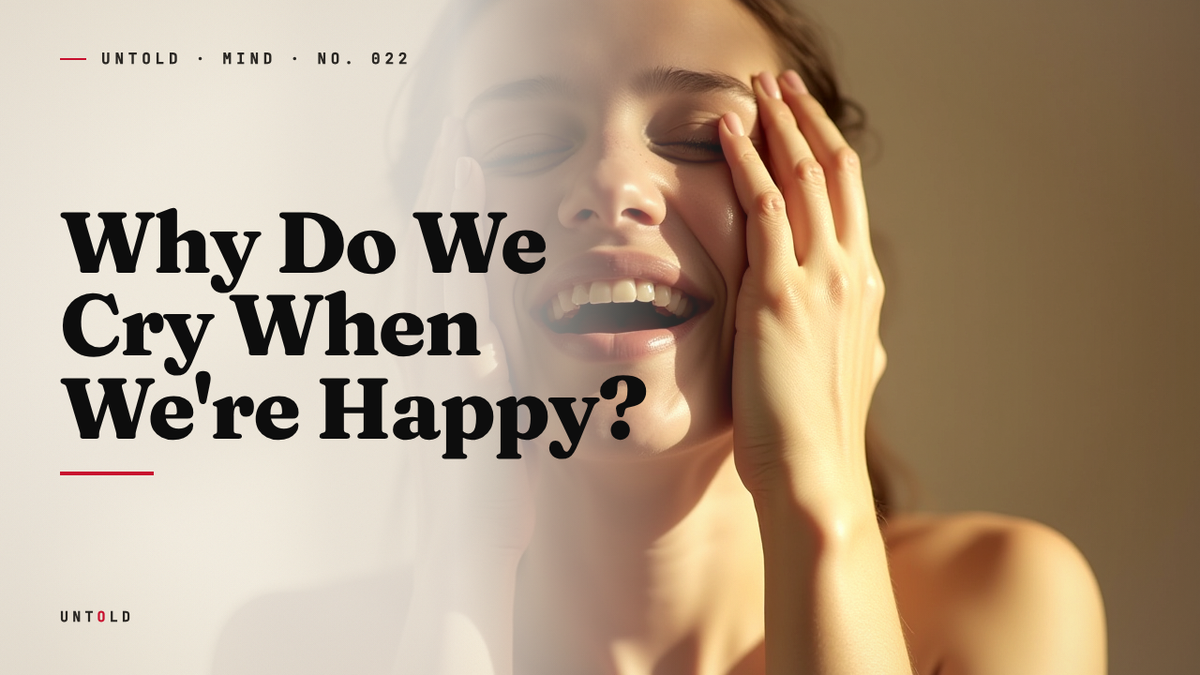
A bride walks toward an altar and her father, a man not given to displays, finds his vision blurring. A runner crosses a finish line after months of training and dissolves into sobs before catching her breath. A soldier steps off a plane, and the people waiting for him weep openly while smiling so hard their faces ache. In each case, nothing is wrong. Nothing hurts. No loss has occurred. And yet the body weeps.
This is one of the stranger facts of human life, hidden in plain sight precisely because it is so common. Crying is supposed to mean something has gone wrong. It is the infant’s first language, the universal signal of pain, hunger, fear, and grief. We cry at funerals and after heartbreak. We cry when the body is overwhelmed by sorrow. So why does the same response, the same salty water rising from the same glands, show up at graduations and reunions and the first time we hold a newborn?
Stranger still, we appear to be alone in this. Many animals produce tears to lubricate and protect the eye. Elephants and some other mammals have been observed in states that look like distress. But the deliberate, emotionally triggered weeping that humans do, the kind that arrives unbidden at a wedding or a reunion, has no clear parallel in the animal kingdom. As far as the evidence goes, we are the only species that cries from grief, from joy, and from the overwhelming experience of beauty. For most of recorded history this puzzle sat at the edge of science, unexamined: a liquid mystery leaking from the corners of the human story.
Three Kinds of Water
To understand the tears of joy, it helps to know that not all tears are the same. The eye produces three distinct varieties, and they differ in chemistry as well as in cause.
The first are basal tears, the quiet, constant film that bathes the cornea every waking second. They are the maintenance crew, keeping the surface of the eye smooth and clear, defending it against infection. You never notice them, which is exactly the point. The second are reflex tears, the flood that arrives when you slice an onion, when grit blows into your eye, when a cold wind stings. These are a flushing mechanism, a way of washing irritants from the surface before they can do damage. Both kinds are essentially plumbing.
The third kind is the strange one. Emotional tears, the ones that come with grief or joy, appear to carry something the others do not. In the 1980s, the biochemist William Frey set out to test this idea in his laboratory in Minnesota 1. He collected tears from volunteers under two conditions. In one, they shed reflex tears by being exposed to freshly cut onions. In the other, they wept while watching emotionally affecting films. When Frey compared the two samples, he reported that the emotional tears contained higher concentrations of certain proteins and stress-related hormones than the reflex tears did 2.
Frey took this as a clue. Perhaps crying was not merely an expression of feeling but a kind of excretion, a way of physically flushing stress chemicals out of the body the way sweat flushes out heat. It was an appealing notion, and it fit the intuition that a good cry leaves you feeling cleansed. But it ran straight into the puzzle that motivates this essay. If tears exist to purge stress, why on earth would we shed them at the happiest moments of our lives? Nobody at a joyful reunion is trying to detoxify. The chemistry might describe the fluid, but it did not explain the joy.
When Expression Contradicts Feeling
The most illuminating answer to that question came not from chemistry but from psychology, and it began with an observation about something most people do without ever thinking about it. We see an impossibly cute baby and we want to squeeze it, to pinch its chubby cheeks, even to playfully say we could just eat it up. We are, in that moment, sweetly delighted. So why does the urge come out as something that looks faintly aggressive?
The psychologist Oriana Aragón, working at Yale, gave this phenomenon a name: dimorphous expression 3. The idea is that our outward expression sometimes directly contradicts the feeling underneath it. We pinch the babies we adore. We cry at weddings we have longed for. We laugh when we are terrified. The expression and the emotion point in opposite directions.
In a series of studies published in 2015, Aragón and her colleagues showed people images of extremely cute infants and measured their reactions 3. The pattern was striking. The more overwhelmed a person reported feeling by the cuteness, the more they wanted to squeeze, to grit their teeth, even to cry. The intensity of the positive feeling predicted the appearance of a seemingly negative expression. Aragón proposed that these contradictory displays serve as a kind of emotional thermostat. When a feeling runs too hot, the body throws a counter-emotion to cool it down, nudging the person back toward equilibrium. As she put it, people seem to want to keep an even keel 4.
Seen this way, happy tears are not a malfunction. They are a recovery mechanism. Joy floods in, the nervous system spikes, and the tears help pull the person back toward balance. The wedding does not make you sad. It makes you so intensely happy that your body reaches for the brake. The crying is the brake.
The Reset Button
If Aragón’s work explained the why, the physiology fills in the how. The body does not store emotion in some abstract reservoir. It runs it through nerves and glands and the racing of the heart, and much of that traffic passes along a single remarkable pathway: the vagus nerve.
The vagus is the longest of the cranial nerves, wandering down from the brainstem to touch the heart, the lungs, the gut, and a web of other systems. It is a central conductor of the parasympathetic nervous system, the branch responsible for calming the body after arousal, for slowing the heart and settling the breath. When a strong emotion surges, this whole system shifts in an instant. The throat tightens. The chest heaves. The heart races. And the tear glands, wired into the same broad circuitry of arousal and recovery, release.
What researchers have noticed is the timing. Happy crying tends to arrive not at the peak of fear or anticipation but just after it, as the nervous system swings from high arousal back toward calm. This is why people so often cry once the danger has passed rather than during it. You hold yourself together through the frightening wait for a diagnosis, and then, when the doctor finally says the word benign, the tears come. You hold steady through the tense moments before a reunion, and then, the instant you see the face you have been waiting for, you fall apart. The crying is the body cashing in the tension, releasing the brake on a system that has been straining to hold steady. Relief, as much as joy, is what opens the floodgates.
A Wordless Cry for Closeness
There is one more dimension to the mystery, and it may be the deepest. For decades, the Dutch researcher Ad Vingerhoets has devoted himself to a single deceptively simple question: why do humans cry at all 5? He is among the foremost scholars of weeping, and one of his central findings cuts against the purely chemical view. We very rarely cry when we are completely alone. We cry in front of others, or we cry while thinking about others, about the people we love and the bonds between us.
This points toward crying as a social signal rather than a private discharge. The argument, which Vingerhoets has developed in his book Why Only Humans Weep, is that tears evolved as a wordless cry for connection 6. The infant’s cry is the original version. A baby’s tears bring a parent running, summoning care from across a room. Adult tears, the theory goes, do something structurally similar. They broadcast vulnerability and need to the people nearby, and they invite closeness in return.
The evidence is suggestive. In experiments where people were shown faces digitally altered to add or remove tears, the tearful faces were consistently rated as sadder and as more in need of help and support 7. Tears, in other words, function as an honest signal of emotional state, one that disarms others and pulls them toward us. This reframes the tears at a wedding in a way that feels immediately true. They are not a private leak of excess feeling. They are a message to everyone in the room. They say: I am moved, I am here, this matters, I belong. The crying knits the witnesses to the moment together.
This social reading also explains why context matters so much to how crying feels. A flood of tears alone in a bathroom, where no one comes, can deepen distress. The same tears in the arms of someone who responds with comfort can transform the experience entirely. The signal only does its work when there is someone present to receive it. Crying, on this view, is less a thing the body does to itself than a thing the body does between people.
The Overflow
Put these strands together and a quiet, slightly unsettling conclusion emerges. Happy tears are not, in any simple sense, happy. They are the body managing an emotion that has grown too large to hold inside the ordinary channels of expression. Joy, grief, awe, relief, and overwhelming tenderness all overflow through the very same outlet. The tears are the overflow, and the water itself does not care which feeling sent it.
This is why a single moment can produce tears that seem to belong to opposite worlds. Consider what is actually happening inside a parent watching a child marry. There is joy, certainly. But there is also loss, the end of one phase of a relationship. There is memory, the small child folded inside the grown one. There is the awareness of time passing, of mortality, of the years that brought everyone to this room. The brain almost never serves up a single, clean emotion. It feels several at once, layered and braided together, and when their combined intensity exceeds what the face and the voice can carry, the body opens a different valve.
This may be the truest function of emotional crying: it is the body’s way of metabolizing the unspeakable. There are experiences for which language is simply too narrow an instrument, moments so saturated with meaning that no sentence could hold them. When words run out, water flows. The tear is a kind of pressure release for feelings that have no other adequate form.
Surveys of criers tend to confirm the sense of relief that follows, though with important caveats. Most people report feeling calmer and lighter after a good cry 8. But researchers who study this carefully, Vingerhoets prominent among them, stress that the catharsis is not automatic. Whether crying actually makes a person feel better depends heavily on what the crying was about, whether the situation resolved, and crucially on who was nearby and how they responded. A cry that is met with comfort soothes. A cry that is met with rejection or shame can do the opposite. The relief, like the tears themselves, is at least partly a social transaction.
When Feeling Becomes Water
We began with a paradox: crying seems to mean that something is wrong, yet we do it at the best moments of our lives. The resolution is not that happy tears are a glitch but that they were never really about happiness in isolation. They are about intensity, about feeling that has crested past the level the ordinary face can express, about the nervous system reaching for balance and the heart reaching, wordlessly, toward other people.
That we are apparently the only animals who do this is worth sitting with. Whatever else crying is, it appears to be bound up with the things that make human social life what it is: our capacity to be moved by another’s joy, to feel the weight of time inside a single celebration, to need one another and to say so without speaking. So the next time your eyes sting at a graduation or a homecoming or the sight of two people promising their lives to each other, there is no reason to fight it and no need to be embarrassed. Your body is doing something quietly extraordinary, something it shares with no other creature on earth. It is taking a feeling too large for words and turning it, gently, into water.

Sources
- Frey, W. H., Crying: The Mystery of Tears, Winston Press, 1985. — https://archive.org/details/cryingmysteryoft0000frey
- Frey, W. H. et al., “Effect of stimulus on the chemical composition of human tears,” American Journal of Ophthalmology, 1981. — https://pubmed.ncbi.nlm.nih.gov/7294109/
- Aragón, O. R. et al., “Dimorphous Expressions of Positive Emotion,” Psychological Science, 2015. — https://journals.sagepub.com/doi/10.1177/0956797614561044
- Aragón, O. R., interview on dimorphous expressions, Yale News, 2015. — https://news.yale.edu/2015/01/22/why-cute-things-make-us-go-aggressive
- Vingerhoets, A. J. J. M., “Why only humans weep,” research overview, Tilburg University. — https://research.tilburguniversity.edu/en/persons/ad-vingerhoets
- Vingerhoets, A. J. J. M., Why Only Humans Weep: Unravelling the Mysteries of Tears, Oxford University Press, 2013. — https://global.oup.com/academic/product/why-only-humans-weep-9780198570240
- Balsters, M. J. H. et al., “Emotional tears facilitate the recognition of sadness and the perceived need for social support,” Evolutionary Psychology, 2013. — https://journals.sagepub.com/doi/10.1177/147470491301100114
- Gračanin, A., Bylsma, L. M., Vingerhoets, A. J. J. M., “Is crying a self-soothing behavior?” Frontiers in Psychology, 2014. — https://www.frontiersin.org/articles/10.3389/fpsyg.2014.00502/full
Related reading