The Architecture of Forgetting
Why crossing a threshold can erase the very thought that sent you walking.
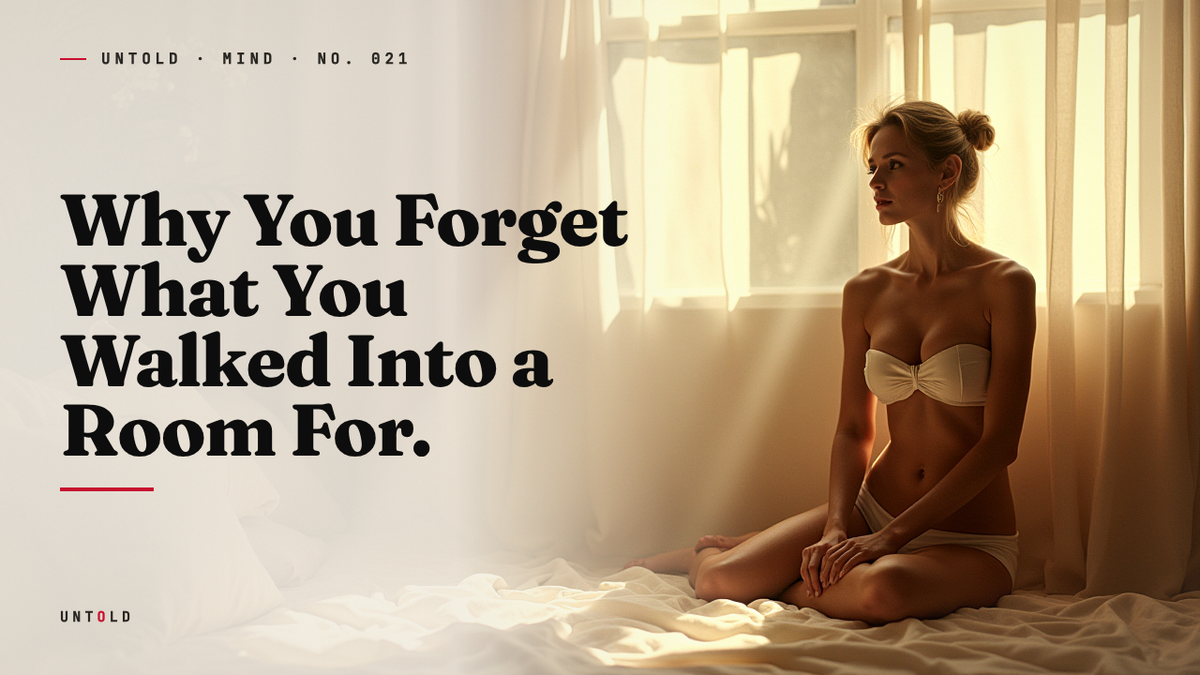
You stand up from the couch with a clear purpose. The scissors. They are in the kitchen drawer, and you need them now. You cross the living room, you turn the corner, you pass through the doorway, and there, standing in the middle of the kitchen with the overhead light humming, you have absolutely no idea why you came.
The thought is simply gone. Not buried, not fuzzy, but vanished, as if someone reached into your head and deleted the file while you were not looking. You stand there feeling faintly ridiculous, opening a drawer at random in the hope that the sight of forks might jolt something loose. Eventually you give up and walk back to the living room, and the instant you arrive, it returns. Scissors. Of course. The whole errand snaps back into focus the moment you stand where it began.
Most people, when this happens, reach for the most unflattering explanation available. They blame their age, their stress, the early creep of some cognitive decline. It feels like a glitch, a small but ominous sign that the machinery is wearing out. But the research tells a stranger and more reassuring story. This particular brand of forgetting is not a failure of memory at all. It is a feature of how memory is built. And the culprit, improbably, is the door.
A threshold that closes a chapter
The phenomenon has a name in the psychological literature: the doorway effect, or sometimes the location-updating effect. The basic finding is almost comically simple. Walking through a doorway makes you more likely to forget what you were doing, and the doorway itself, the act of crossing a boundary, appears to be doing the work. Not the distance you walked. Not the time that passed. The threshold.
To understand why a piece of architecture should have any say over your memory, it helps to abandon a metaphor most of us carry around without examining it. We tend to imagine memory as a recording device, a camera running continuously, capturing the stream of our lives in one unbroken reel. If that were true, forgetting would be a matter of the tape degrading or the footage getting lost. But that is not how the mind works.
Memory is not a continuous recording. It is a sequence of chunks. Your brain takes the seamless flow of experience and slices it into discrete units, and cognitive psychologists call these units event models. An event model is a kind of mental container for the present moment. It holds your immediate surroundings, the objects around you, the people in the room, and crucially, your goals and intentions. The thought “I need the scissors” does not float in your mind as a free-standing fact. It is bound into the event model of the room you were standing in when you formed it.
This chunking is not a bug. It is what allows experience to be organized at all. If every moment of your life were stored as one undifferentiated continuum, you would have no way to find anything in it. By breaking time into events, the brain creates handles, separate packages it can file, retrieve, and reason about. The trouble begins when one of those packages closes before you are finished with it.
The man who blamed the door
Gabriel Radvansky, a psychologist at the University of Notre Dame, became interested in a question most of us have only ever muttered in frustration. Why do we keep forgetting things while moving around our own homes, in spaces we know intimately, on errands that should take seconds? His suspicion turned toward the boundaries between rooms, the moments when one setting gives way to another.
In 2011 he and his colleagues built a virtual environment to test the idea. 1 Volunteers navigated a series of rooms on a computer screen, picking up objects from one table, carrying them across the space, and setting them down on another. Sometimes the destination table sat in the same room. Sometimes it sat in a different room, which meant passing through a doorway to reach it. Periodically the program would interrupt and quiz the participant about the object they were carrying or had just carried. What was it? Could they still hold it in mind?
The people who had walked through a doorway forgot far more often than the people who had walked an equivalent distance within a single room. The physical effort was the same. The elapsed time was the same. The only difference was the threshold, and the threshold was enough to degrade their memory measurably.
A careful skeptic might object that virtual rooms are not real rooms, that something about the artificial environment was producing the effect. Radvansky anticipated this and ran the study again, this time in the physical world, with real tables, real boxes, and real doors made of wood and steel. 1 The forgetting reappeared. Crossing an actual doorway in an actual building produced the same drop in recall as crossing a virtual one.
Then came the more interesting objection. Perhaps people forgot simply because the new room contained new things to look at, fresh distractions that crowded out the original thought. If that were the case, the new scenery would be the problem, not the boundary. So Radvansky devised a clean test to separate the two. He had volunteers walk through a doorway into a second room, and then walk back through into the original room where they had started. If the distracting new environment was responsible, then returning to the familiar first room should restore the lost memory.
It did not. Returning to the original room barely helped. 1 The door had already done its damage on the way out, and walking back through a second time did nothing to undo it. This was a striking result, because it pointed away from the obvious explanation. The new scenery was not erasing the memory. The act of crossing a boundary was.
What a scanner sees at the edge of an event
If Radvansky showed that boundaries disrupt memory, the work of Jeffrey Zacks at Washington University in St. Louis helped explain what the brain is actually doing at those boundaries. Zacks spent years studying event segmentation, the process by which the mind decides where one event ends and the next begins. 2 Using brain imaging, he watched the moment of segmentation happen in real time.
What he found was that the brain does not parse events in a leisurely, after-the-fact way. It does it continuously, predicting what will happen next and registering a kind of jolt when the prediction breaks down. When the scene changes, when a goal is completed, when something unexpected interrupts the flow, regions of the brain show a surge of activity. 3 These surges line up with the points where people, asked to mark the boundaries of an ongoing activity, say one event has ended and another has begun.
A doorway is one such boundary. So is a scene change in a film, a shift in conversation, the completion of a task. At each of these points the brain appears to do something like filing the old event away and opening a fresh one. This is enormously useful. It is what keeps separate moments from bleeding into one another, what lets you remember the argument you had at breakfast as distinct from the argument you had at dinner. Without these boundaries, memory would be a smear.
But the filing has a cost, and the cost is access. Once the brain seals an event and starts a new one, the contents of the old event become harder to reach. Memory for the moments just before a boundary drops in a measurable way. 3 And your intention, your plan to grab the scissors, was bound into the event model of the living room. When you crossed into the kitchen, the brain treated the living room as a finished chapter and tidied it away. The scissors went with it. The thought is not destroyed. It is filed, sealed in a container you have just closed.
This is why standing in the kitchen produces nothing, and why walking back works like a charm. Returning to the living room reinstates the cues of the original event model, and the intention, still attached to that model, comes back with them. The room that holds the memory hands it back the moment you stand inside it.
The door was never really the point
For a decade the doorway effect was one of those tidy findings that made the rounds in popular science writing, the kind of fact that feels both surprising and immediately useful. But science is rarely so tidy, and in 2021 a group of researchers complicated the picture in a way that turns out to be more illuminating than the original story.
Working to replicate and extend the effect, the team discovered that doorways, on their own, often did nothing at all. 4 In some of their experiments, people walked through doors and remembered just fine. The threshold by itself was not the reliable memory-eraser the earlier work seemed to suggest. Something else had to be present for the forgetting to strike.
That something was mental load. The doorway effect appeared most reliably when participants were already cognitively overloaded, juggling a demanding task, holding too much in mind at once. 4 When the mind had spare capacity, crossing a threshold barely registered. When the mind was stretched thin, the boundary became the straw that broke the memory. The door was not the cause. It was a trigger, and it only fired when the system was already strained.
This reframing actually deepens the underlying idea rather than overturning it. The mechanism was never really about doors. It was about boundaries, and a doorway is simply one of the most vivid examples of a boundary in everyday life. The same disruption can be produced by any number of things that close one event and open another, provided your mind is busy enough to be vulnerable.
Boundaries everywhere
Once you see the doorway as a stand-in for the more general category of event boundaries, the everyday experience of forgetting starts to make more sense. A phone notification is a boundary. A switch from one task to another is a boundary. A stray thought that pulls you onto a different track, a change of subject in a conversation, even a sudden shift in your own goals, all of these can act like a threshold, prompting the brain to close one chapter and start another.
This explains the version of the experience that has nothing to do with rooms at all. You are typing an email, you remember you meant to look something up, you open a new tab, and by the time it loads you have forgotten what you were searching for. No door was involved. But a boundary was crossed, a goal was set aside in favor of a new one, and the original intention was filed away with the event it belonged to.
The lesson is not that boundaries are dangerous and should be avoided. They cannot be avoided, and you would not want to live without them. The constant closing of chapters is precisely what lets you give your full attention to whatever comes next. A clean break frees the mind from the clutter of the previous moment. The forgetting that occasionally results is not a defect in the system. It is the small, unavoidable price of an organizational scheme that mostly serves you well.
There is also some comfort in the data on recovery. The intentions lost to a boundary are not gone for good. Most of them return on their own within a minute or two, surfacing again as the brain drifts back toward the unfinished event. And if you cannot wait, the remedy is absurdly simple. Walk back. Return to the place where the thought was born, and the cues of that original room will reach into the file you closed and pull the intention back out.
So the next time you find yourself stranded in the middle of a room with no memory of why you came, resist the urge to read it as a symptom of decline. You have not lost your mind. Your mind has merely done what it is built to do, which is to take the endless flow of your life and break it into pieces small enough to hold. One of those pieces happened to contain the scissors. Cross back over the threshold, and it will be waiting for you exactly where you left it.

Sources
- Radvansky, G. A., Krawietz, S. A., & Tamplin, A. K., Walking through doorways causes forgetting: Further explorations, Quarterly Journal of Experimental Psychology, 2011. — https://journals.sagepub.com/doi/10.1080/17470218.2011.571267
- Zacks, J. M., & Swallow, K. M., Event segmentation, Current Directions in Psychological Science, 2007. — https://journals.sagepub.com/doi/10.1111/j.1467-8721.2007.00480.x
- Zacks, J. M. et al., Event perception: A mind-brain perspective, Psychological Bulletin, 2007. — https://pubmed.ncbi.nlm.nih.gov/17338596/
- Pettijohn, K. A. & Radvansky, G. A., Walking through doorways causes forgetting: Recall (replication and boundary conditions), Memory & Cognition / related 2021 work. — https://link.springer.com/article/10.3758/s13421-018-0810-z
- Lawrence, Z. & Peterson, D., Mentally walking through doorways causes forgetting: The location updating effect and imagination, Memory, 2016. — https://www.tandfonline.com/doi/full/10.1080/09658211.2014.980429
- Radvansky, G. A. & Copeland, D. E., Walking through doorways causes forgetting: Situation models and experienced space, Memory & Cognition, 2006. — https://link.springer.com/article/10.3758/BF03193261
Related reading