The Pleasant Screen and the Quiet Cost
How an app you genuinely enjoy can leave the evening feeling emptier than it found you.
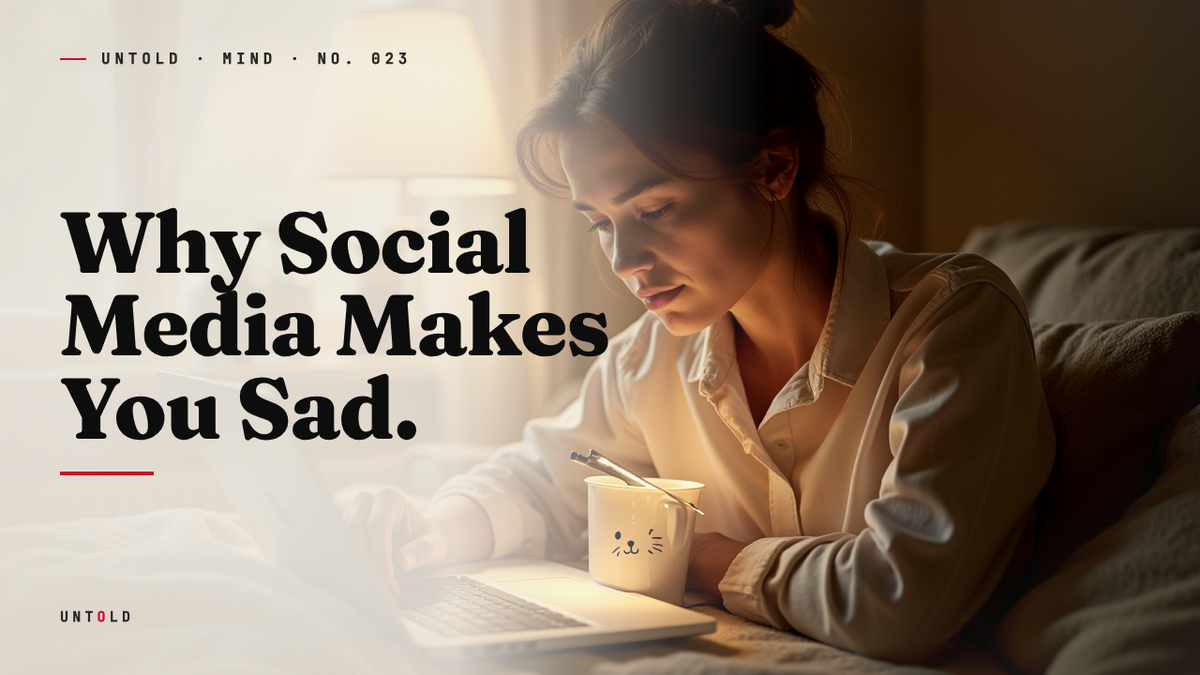
Consider the ordinary arithmetic of an evening. You reach for the phone tired and a little restless, hoping to be lifted. You open the app. Something flickers awake inside you almost immediately, a small bright alertness, and you scroll. Twenty minutes pass, then forty. You laugh at a clip, you envy a stranger’s kitchen, you read three sentences of an argument you will never resolve. Then you set the phone down. The room is the same room. But the evening feels thinner than it did, as if some quantity of it has been spent without being enjoyed.
This is the puzzle that interests psychologists, and it resists the easy moral story. The easy story says social media is poison and that the people who use it are either weak or deluded. But the experience most people report is stranger and more honest than that. They enjoyed it. They would do it again. And they feel worse. Enjoyment and depletion arrive in the same package, and the second one is quieter, slower, and harder to trace back to its source.
The average person checks their phone around a hundred and forty times a day, a number that sounds absurd until you notice yourself doing it in the gaps between sentences. Each check is brief and mostly pleasant. None of them feels like a problem. The problem, if there is one, lives in the aggregate and in the aftermath, in the space between how you felt before you opened the app and how you feel after. To understand why that gap exists, you have to look at two very different mechanisms, one ancient and chemical, the other ancient and social. Neither was built for the device in your hand.
The Chemistry of Wanting
The first mechanism is the one everyone has heard about and almost everyone misunderstands. Dopamine is routinely described as the brain’s pleasure chemical, the molecule of reward. This is wrong in a way that matters. Dopamine is not what pleasure feels like. It is what wanting feels like.
The neuroscientist Robert Sapolsky has spent much of his career studying the systems that govern motivation, and one of the most instructive findings he describes concerns the timing of dopamine release. In experiments with primates trained to press a lever for a reward, the dopamine spike does not arrive when the reward is delivered. It arrives in anticipation, during the work, while the animal is reaching toward something it expects to get. Dopamine is the chemistry of the pursuit, not the catch.1
This distinction reframes the entire experience of the feed. The bright alertness you feel when you open the app is not satisfaction. It is appetite. It is your brain leaning forward toward a reward that has not yet arrived, and the reason it leans so hard has to do with a second feature of the system, one that turns a useful survival mechanism into something closer to a trap.
Sapolsky and others have shown that dopamine spikes most violently not when reward is certain but when it is uncertain. If a monkey learns that pressing a lever always yields a treat, the dopamine response settles into a modest, predictable rhythm. But if the treat arrives only some of the time, on no schedule the animal can learn, the dopamine response roughly doubles.1 Uncertainty is the accelerant. The brain pays the closest attention, and reaches the hardest, when it cannot predict what comes next.
Behavioral psychologists named this principle long before anyone scanned a brain. B. F. Skinner, working with pigeons and levers in the middle of the twentieth century, mapped out which patterns of reward produced the most persistent behavior. The answer was not steady reward. It was what he called variable ratio reinforcement: a payoff delivered on an unpredictable schedule, after an unpredictable number of attempts.2 An animal trained on this schedule will keep pressing the lever long after the rewards stop, far longer than an animal that was always rewarded and then suddenly was not. Uncertainty does not just hook attention. It makes the habit extraordinarily difficult to extinguish.
This is precisely the schedule a slot machine runs. You pull the handle, and most of the time nothing happens, and occasionally something does, and you can never tell which pull will be which. It is also, with uncanny precision, the schedule of an infinite feed. You swipe, and most of the time you get something forgettable, and occasionally you get something genuinely delightful, and you never know in advance which swipe will deliver it. The next post might be a friend’s good news, a joke that lands perfectly, a piece of writing that stops you cold. It might also be an advertisement for shoes. The not-knowing is the whole engine.
It is tempting to call this a flaw in the design, an unfortunate side effect of engineers chasing engagement. It is the opposite. It is the design working exactly as intended. The feed is not broken when it leaves you reaching. Reaching is the product. The pleasant flicker that pulls your thumb across the screen before your conscious mind has decided anything is the most reliable hook that behavioral science has ever identified, refined and deployed at a scale Skinner could not have imagined.
The Oldest Habit
But dopamine only explains why you keep scrolling. It does not explain why scrolling leaves a residue of sadness. For that, you have to look away from the chemistry of individual swipes and toward something far older than any screen, a habit so deeply human that we rarely notice we are doing it.
In 1954, the social psychologist Leon Festinger published a paper laying out what he called social comparison theory. Its central claim was disarmingly simple. Human beings have a fundamental drive to evaluate themselves, to know whether they are doing well or badly, whether their lives are succeeding or falling short. And in the absence of objective measures, we satisfy this drive the only way available to us: we compare ourselves to other people.3
There is nothing pathological about this. It is how we calibrate. You cannot know whether your salary is good, your home is comfortable, your body is healthy, or your life is going well in any absolute sense. You can only know these things in relation to others, and so the mind is always quietly measuring, ranking, situating itself in a landscape of other people. For almost the entire span of human existence, this worked reasonably well, because the landscape was small. The people you compared yourself to were the few dozen members of your village or your tribe, a manageable sample of real, three-dimensional lives whose struggles were as visible as their successes.
The feed dismantles that arrangement in two ways at once, and the combination is corrosive. First, it expands the comparison set from a few dozen people to a functionally infinite one. You are no longer measuring yourself against your neighbors but against millions of strangers, which means that no matter how well your life is going, someone in your feed is doing better. Second, and more importantly, it strips away the three-dimensionality. You no longer see whole lives. You see what people choose to publish, which is to say their highlight reels, their best meals and best vacations and best angles, curated and filtered into something that bears only a passing resemblance to the texture of an actual life.
Festinger’s own research distinguished between comparing yourself to those who seem worse off, which tends to feel reassuring, and comparing yourself upward, against those who seem better off, which tends to sting.3 The architecture of social media is almost perfectly engineered to produce upward comparison and almost nothing else. People do not post the afternoon they spent crying, or the argument with their partner, or the ordinary Tuesday spent doing laundry. They post the wedding, the promotion, the sunset. And so you sit with your own unedited reality, the full unflattering footage of your own life, and you measure it against a thousand other people’s best moments. The comparison is rigged, and some part of you knows it is rigged, and it stings anyway.
What the Studies Found
For a long time this remained a plausible theory in search of evidence. The link between social media and unhappiness was easy to assert and surprisingly hard to prove, because correlation is slippery. Perhaps unhappy people simply use social media more, rather than social media making people unhappy. To settle the question you need an experiment, and a few researchers built one.
In 2018, the psychologist Melissa Hunt and her colleagues at the University of Pennsylvania ran a controlled study with a group of undergraduates. One group was asked to limit their use of Facebook, Instagram, and Snapchat to ten minutes per platform per day. The other group continued using social media as they normally would. The study ran for three weeks, with the students’ wellbeing measured before and after.4
The results were striking in their clarity. The students who limited their use showed significant reductions in loneliness and depression compared to the control group, with the largest improvements among those who had been the most depressed to begin with. Notably, both groups saw drops in anxiety and fear of missing out, an effect the researchers attributed simply to the self-monitoring the study required, to the act of paying attention to one’s own usage. Hunt’s conclusion was carefully worded and worth quoting: “Using less social media than you normally would leads to significant decreases in both depression and loneliness.”4
What makes this finding so useful is what the students did not do. They did not quit. They did not delete their accounts or swear off their phones. They simply used less, and that alone was enough to move the needle on their mood. The harm, in other words, was not binary. It scaled with the dose.
A broader and more contested body of work comes from the psychologist Jean Twenge, who has spent years analyzing large national surveys of American adolescents. In her data, something shifts around 2012, the year that smartphone ownership crossed fifty percent in the United States. Beginning then, measures of teen depression, loneliness, and self-reported unhappiness start climbing, and they climb most steeply among the heaviest users of screens and social media.5 The generation that came of age with a feed in their pocket reported more sleeplessness, less in-person socializing, and more sadness than the generation just before it.
Twenge is careful, and her critics are right to insist on the caveat: correlation is not causation, and the years after 2012 contained many things besides smartphones. But the timing is difficult to wave away, and it converges with the experimental evidence from Hunt and the theoretical scaffolding from Festinger into a single uncomfortable picture. The tool built explicitly to connect people coincided with a rise in the feeling of being alone.
The Substitution
Here the story takes a turn that is easy to miss, because it inverts the usual accusation. The most plausible reading of the evidence is not that social media directly injects sadness into your brain. The flicker of dopamine is genuinely pleasant. The clips are genuinely funny. The harm is subtler and more structural than poisoning. The problem is not what social media adds. It is what it replaces.
Every hour spent scrolling is an hour not spent doing something else, and the something else it most reliably displaces happens to be the very category of activity that humans depend on for durable wellbeing. Time scrolling is time not spent in conversation with a friend, not spent walking outside, not spent sleeping, not spent in the slow, effortful, unglamorous work of building a real relationship or a real skill. The feed does not need to make you miserable. It only needs to be slightly more immediately rewarding than the alternatives, and to be available at every idle moment, and over enough idle moments it quietly crowds the alternatives out.
This is why the dopamine mechanism and the comparison mechanism matter together rather than separately. The variable-ratio reward is what keeps you reaching for the phone in the first place, filling the small gaps of the day that connection used to fill. The upward comparison is what ensures that the time you spend there does not nourish you the way the displaced activities would have. You are pulled in by appetite and left with envy, and the things that would have actually restored you, a face, a voice, a walk, a full night of sleep, go undone.
This is the deeper meaning of the gap between how you feel before opening the app and how you feel after. That gap is not measuring whether you enjoyed yourself. You did. It is measuring opportunity cost, the invisible ledger of what the time could have been. The enjoyment is real and immediate. The cost is real and delayed, which is exactly why it is so hard to learn from, because the brain is poorly equipped to connect a vague evening emptiness to a pleasant afternoon swipe.
What Noticing Buys You
The useful conclusion is not the dramatic one. You do not have to throw the phone in a lake or take a vow of digital silence, and the evidence does not demand it. Hunt’s students improved by using less, not by quitting, and the single intervention that helped every group in her study was simply paying attention to their own behavior.4 The most powerful tool available is also the cheapest: notice.
Notice how you feel in the moment before you open the app, and notice how you feel in the moment after you close it. That gap is the truest signal you have, more honest than the pleasure of any individual swipe, because it integrates the whole experience rather than just the bright parts. If you watch it for a while, you start to feel the cost in something close to real time, and the feeling itself begins to loosen the grip. You cannot easily resist a hook you cannot see. You can resist one you have learned to recognize.
The alternatives have a different texture, and it is worth naming it precisely. The slower rewards, the conversation that runs long, the walk with no destination, the friend who calls instead of posts, do not spike. There is no flicker, no variable-ratio thrill, nothing that pulls your thumb before your mind has decided. That is exactly why they feel less urgent and exactly why they are worth more. They do not leave a residue. The evening they fill stays full.
The next time the feed leaves you a little hollow, the thing to remember is that the hollowness is not a personal failing or a sign that you used it wrong. It is the predictable output of a system doing precisely what it was built to do, running the oldest reward schedule in behavioral science on top of the oldest social instinct in human nature. You were not weak. You were reached for, by a design that knew exactly where to reach. Knowing that is not a cure. But it is the beginning of getting some of your evenings back.

Sources
- Sapolsky, R. M., Behave: The Biology of Humans at Our Best and Worst, Penguin Press, 2017. — https://www.penguinrandomhouse.com/books/314928/behave-by-robert-m-sapolsky/
- Skinner, B. F., Schedules of Reinforcement (with C. B. Ferster), Appleton-Century-Crofts, 1957. — https://psycnet.apa.org/record/2005-06701-000
- Festinger, L., A Theory of Social Comparison Processes, Human Relations, 1954. — https://journals.sagepub.com/doi/10.1177/001872675400700202
- Hunt, M. G. et al., No More FOMO: Limiting Social Media Decreases Loneliness and Depression, Journal of Social and Clinical Psychology, 2018. — https://guilfordjournals.com/doi/10.1521/jscp.2018.37.10.751
- Twenge, J. M., iGen: Why Today’s Super-Connected Kids Are Growing Up Less Rebellious, More Tolerant, Less Happy, Atria Books, 2017. — https://www.simonandschuster.com/books/iGen/Jean-M-Twenge/9781501151989
- Twenge, J. M. et al., Increases in Depressive Symptoms, Suicide-Related Outcomes, and Suicide Rates Among U.S. Adolescents, Clinical Psychological Science, 2018. — https://journals.sagepub.com/doi/10.1177/2167702617723376
- Schultz, W., Predictive Reward Signal of Dopamine Neurons, Journal of Neurophysiology, 1998. — https://journals.physiology.org/doi/full/10.1152/jn.1998.80.1.1
Related reading