The Slot Machine in Your Pocket
The compulsion to check your phone was engineered in a Harvard lab full of pigeons.
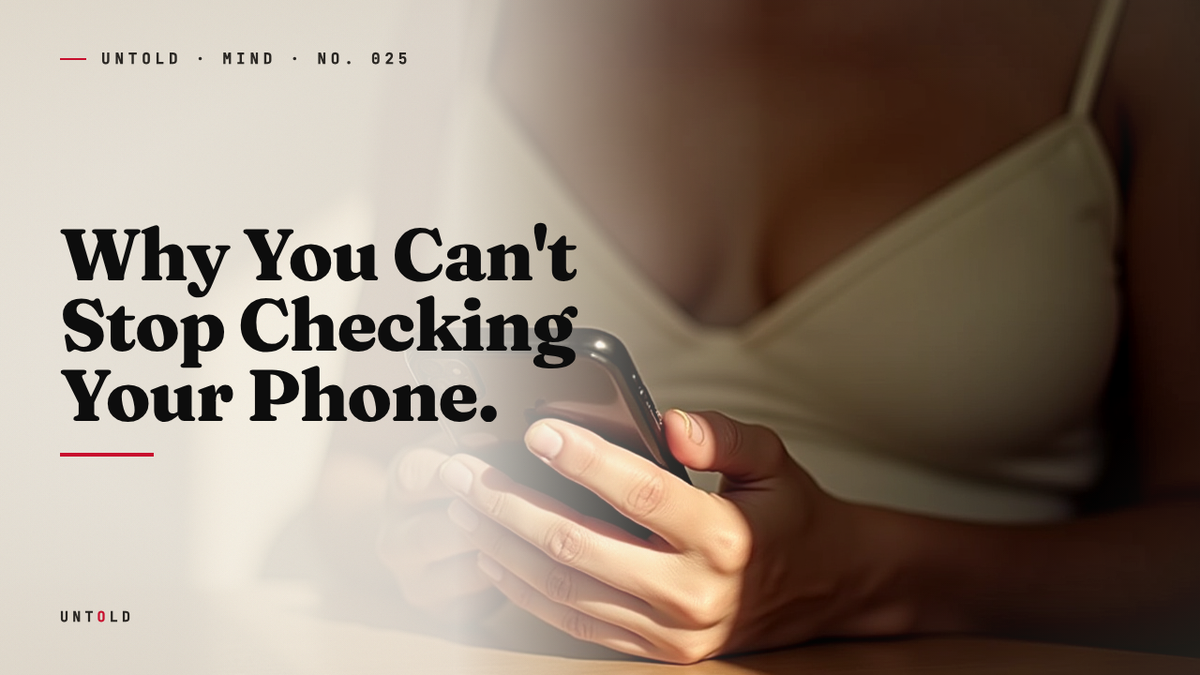
You just checked your phone. There was no notification, no buzz, no reason. Your hand reached for it before any conscious thought formed, fished it out of your pocket, woke the screen, and found nothing. Then it slid the device back, and within minutes the whole sequence began again.
This is not a moral failing. It is not, despite what a thousand wellness columns insist, a question of discipline. The average smartphone user touches their device more than two thousand times a day, a figure that researchers at the software firm Dscout arrived at by instrumenting the phones of ordinary people and counting every tap, swipe, and click. 1 Heavy users crossed five thousand. Numbers that large do not describe a habit a person could simply decide to break. They describe a system operating below the level of choice.
The more honest way to put it is this: the device in your hand was built to be checked this often. The behavior was anticipated, modeled, and optimized for, and the blueprint did not originate in Silicon Valley. It came from a laboratory at Harvard in the 1930s, from a young behaviorist, a series of hungry animals, and a metal box with a single lever.
The Box That Explained You
In 1930, the psychologist B. F. Skinner built an apparatus that would later carry his name. The operant conditioning chamber, the Skinner box, was a deceptively simple thing: an enclosure with a lever, a food dispenser, and a hungry rat. Press the lever, receive a pellet. The animal learned the contingency quickly and behaved exactly as you would expect. It pressed when it was hungry and ignored the lever when it was not. The reward was reliable, so the rat treated it like a tool, used only as needed.
Then Skinner introduced uncertainty, and everything changed.
He began varying when the lever paid out. Sometimes a press produced a pellet, sometimes it produced nothing, and the pattern was unpredictable. The animal could not learn a rule because there was no rule to learn. What Skinner observed in response was not a slackening of effort but its opposite. The pressing intensified. The rats worked the lever with a relentlessness Skinner had not seen under any reliable schedule, and crucially, they kept pressing long after the rewards stopped entirely. 2
He called this arrangement the variable ratio schedule, and across decades of work he established it as the most powerful reinforcement pattern known to behavioral science. In his own dry phrasing, it produced the greatest resistance to extinction: the behavior that was hardest to stop. The unpredictability was not a flaw that weakened the reward. It was the engine. An organism that knows precisely when the payoff arrives can relax between payoffs. An organism that never knows cannot afford to stop trying.
Anyone who has stood in front of a slot machine has met this principle in its purest commercial form. The casino did not invent the variable ratio schedule. It discovered, by trial and profit, the same thing Skinner found in his rats. The machine pays out unpredictably, and the unpredictability is what keeps the hand pulling long past the point of pleasure.
Pull to Refresh
Now consider the gesture you make dozens of times a day. You open an app and drag your thumb downward. The screen stretches, releases, and refreshes. You do not know what it will return. Perhaps a message from someone you have been waiting to hear from. Perhaps a notification that your post was liked. Perhaps a piece of news, a photograph, a small jolt of something. Or perhaps nothing at all, the same feed you saw thirty seconds ago.
That uncertainty is not incidental to the design. It is the design. The pull-to-refresh gesture, introduced to mobile software by the developer Loren Brichter in 2009 for a Twitter client, physically resembles the arm of a slot machine, and it functions on the identical logic. Brichter himself later expressed ambivalence about what he had built, noting that he had no children but that if he did, he would want there to be boundaries around it. The feature he created has since been described, accurately, as one of the most addictive interactions ever shipped to a billion phones.
The reason the maybe works on you, rather than simply annoying you, lies one layer deeper than behavior, in the chemistry of anticipation. And here the science took a turn that surprised even the people conducting it.
The Chemistry of Almost
In the early 1990s, the neuroscientist Wolfram Schultz was recording the activity of individual dopamine neurons in the brains of monkeys. Dopamine had long been understood, in the popular imagination and in much of the field, as the pleasure chemical, the molecule the brain released as a reward for getting what it wanted. Schultz set out to watch that reward arrive.
He gave the monkeys juice and measured the dopamine response. The spike came, as expected. But when he looked more carefully at the timing, the picture inverted. As the monkeys learned that a particular cue, a light or a tone, reliably preceded the juice, the dopamine surge migrated backward in time. It stopped firing at the moment of the reward and began firing at the moment of the cue, at the moment of prediction. The neurons were not signaling pleasure. They were signaling expectation. 3
More striking still was what happened when Schultz made the reward uncertain. When the juice arrived only half the time, unpredictably, the dopamine neurons fired hardest of all, sustaining their activity through the entire window of waiting. The chemical was not tracking how good the reward felt. It was tracking the gap between what the brain expected and what it received, a quantity Schultz named the reward prediction error. 3 Surprise, not satisfaction, was the trigger. A reward you fully anticipate produces almost nothing. A reward you might or might not receive produces the largest signal the system can generate.
This is the neural account of why the slot machine and the refreshing feed exert the pull they do. Every time you reach for the phone, your brain is not anticipating a known reward. It is gambling on a prediction error, betting that something better than expected might appear. The maybe is precisely the condition under which dopamine peaks. You are not, in any straightforward sense, chasing pleasure. You are chasing the possibility of pleasure, which is a far more potent and far less satisfiable thing.
The Engineers of Habit
None of this would matter much if the people building consumer software had remained ignorant of it. They did not. The translation of behavioral science into product design happened deliberately, in plain view, and at one of the most prestigious universities in the world.
In 1998, the psychologist B. J. Fogg founded what he called the Persuasive Technology Lab at Stanford. Fogg studied, and taught, how technology could be designed to change human behavior. His model was elegant and reductive: a behavior occurs when three elements converge at the same moment, namely motivation, ability, and a trigger. Make a desired action easy enough, motivate the user, and place a well-timed prompt in front of them, and the behavior will follow. The framework was morally neutral on its face. It could be used to help people exercise or to help companies extract attention. In practice, the second application proved far more lucrative.
Among Fogg’s students were people who would go on to shape the products now sitting on your home screen. One of them, the entrepreneur and author Nir Eyal, distilled the persuasive design philosophy into a four-stage loop he called the Hook Model. 4 It runs like this. A trigger, external or internal, prompts you to act. The action is made as frictionless as possible. The action delivers a variable reward, Skinner’s schedule rendered in software, unpredictable by design. And finally you make an investment, you post something, follow someone, build a streak, store data, which both increases the value of the product to you and loads the next trigger. The loop is self-reinforcing. The more you put into it, the harder it becomes to walk away.
It would be comforting to imagine these mechanisms as accidental, emergent properties of complex systems no one fully controls. The testimony of the designers themselves forecloses that comfort. Tristan Harris, who worked as a design ethicist at Google before leaving to warn the public about the industry he came from, has described the situation in stark terms. A small number of people, he has argued, working at a handful of technology companies, shape the daily thoughts and attention of billions of others, and they do so using techniques honed in laboratories. 5 Harris has detailed how features that feel like neutral conveniences, the red notification badge, the infinite scroll that never reaches a bottom, the autoplay that begins the next video before you decide, were chosen because they work, because they keep the eyes on the screen. The red badge in particular he singled out as a small masterpiece of compulsion, a color the visual system is wired to treat as urgent, attached to a count the mind feels obligated to clear.
Each notification, in this framing, is not a message. It is an interruption engineered to reset your attention and demand a response, a manufactured prediction error delivered to your pocket several hundred times a day.
Wanting Without Liking
Here the story bends back on itself, and the most important distinction in it comes into view. The phrase phone addiction is misleading, because it implies that the device is the object of desire. It is not. The phone is the lever. What you are addicted to is the search itself, the act of reaching, refreshing, checking, the wanting. And wanting, neuroscience has discovered, is not the same as liking.
For decades these two things were assumed to be one. To want something was, presumably, to anticipate enjoying it. The neuroscientist Kent Berridge, working at the University of Michigan, spent much of his career demonstrating that this assumption is false. Through careful experiments, Berridge and his colleagues showed that the brain runs two separable systems. One generates wanting, the motivational pull toward a reward, which is heavily dopaminergic. The other generates liking, the actual hedonic pleasure of consuming it, which depends on different circuits and different chemicals entirely. 6
The two can be pulled apart, and when they are, the results are unsettling. Berridge found that he could amplify an animal’s wanting for a reward while leaving its liking untouched, or even diminished. An organism could be driven to pursue something it no longer enjoyed, to crave intensely while taking no pleasure in the having. Wanting, in other words, can outlive liking and operate on its own.
This is the precise condition the phone produces. The hundredth check of the day delivers no pleasure. The feed is the same, the dopamine of novelty has long since flattened, and the experience is, if anything, faintly depleting. Yet the wanting persists, undiminished, because the wanting was never about the pleasure. It was about the maybe, and the maybe is always there. Endless wanting, fading pleasure. You keep pulling a lever that has stopped paying out, exactly as Skinner’s rats did when the rewards ran dry.
The Cost and the Choice
The damage is easy to underestimate, because each individual check costs only a few seconds. But the seconds are not the real expense. Research by Gloria Mark, an informatics professor at the University of California, Irvine, found that after an interruption it takes an average of around twenty-three minutes to return to the original task at full concentration. 7 The cost of a check is not the glance. It is the cratered depth of attention that follows, the work that never quite gets back to where it was, the thought that never fully forms. A day fractured by hundreds of these interruptions is a day in which sustained attention becomes nearly impossible, not because the mind is weak but because it is never given the uninterrupted stretch it requires.
And yet the situation is not hopeless, precisely because the science explains where the leverage lies. The compulsion runs through Fogg’s loop, and the loop depends on the trigger. Remove the trigger and the chain cannot begin. This is why turning off notifications is not a minor hygiene tip but a structural intervention. It does not strengthen your willpower. It eliminates the prompt that willpower would otherwise have to resist. It makes the maybe disappear at its source, before it can fire the prediction error that sets the reach in motion.
The reach itself is automatic. The hand drifts toward the pocket before the mind votes on it, and no amount of resolve will make that initial impulse vanish. But automatic is not the same as inevitable. Between the impulse and the action there remains a sliver of awareness, and into that sliver a single question can be inserted. The next time the hand begins its familiar journey, the most useful thing a person can do is pause and ask which system is in control. Not whether you should check, which invites a negotiation you will usually lose, but something more diagnostic. Am I wanting, or am I liking? The honest answer, most of the time, dissolves the compulsion on contact, because the machinery in your pocket was built to exploit a confusion between the two, and naming the difference is the one move the design never accounted for.

Sources
- Winnick, M., “Putting a Finger on Our Phone Obsession,” Dscout Research, 2016. — https://blog.dscout.com/mobile-touches
- Skinner, B. F., “The Behavior of Organisms: An Experimental Analysis,” Appleton-Century, 1938. — https://en.wikipedia.org/wiki/The_Behavior_of_Organisms
- Schultz, W., Dayan, P., Montague, P. R., “A Neural Substrate of Prediction and Reward,” Science, 1997. — https://www.science.org/doi/10.1126/science.275.5306.1593
- Eyal, N., “Hooked: How to Build Habit-Forming Products,” Portfolio/Penguin, 2014. — https://www.nirandfar.com/hooked/
- Harris, T., “How a handful of tech companies control billions of minds every day,” TED, 2017. — https://www.ted.com/talks/tristan_harris_how_a_handful_of_tech_companies_control_billions_of_minds_every_day
- Berridge, K. C., Robinson, T. E., “Parsing reward,” Trends in Neurosciences, 2003. — https://www.cell.com/trends/neurosciences/fulltext/S0166-2236(03)00233-9
- Mark, G., Gudith, D., Klocke, U., “The Cost of Interrupted Work: More Speed and Stress,” CHI Proceedings, 2008. — https://www.ics.uci.edu/~gmark/chi08-mark.pdf
Related reading