The Long Half-Life of a Nobel Laureate's Mistake
How Linus Pauling convinced a generation that vitamin C could stop a cold, and why the science never followed.
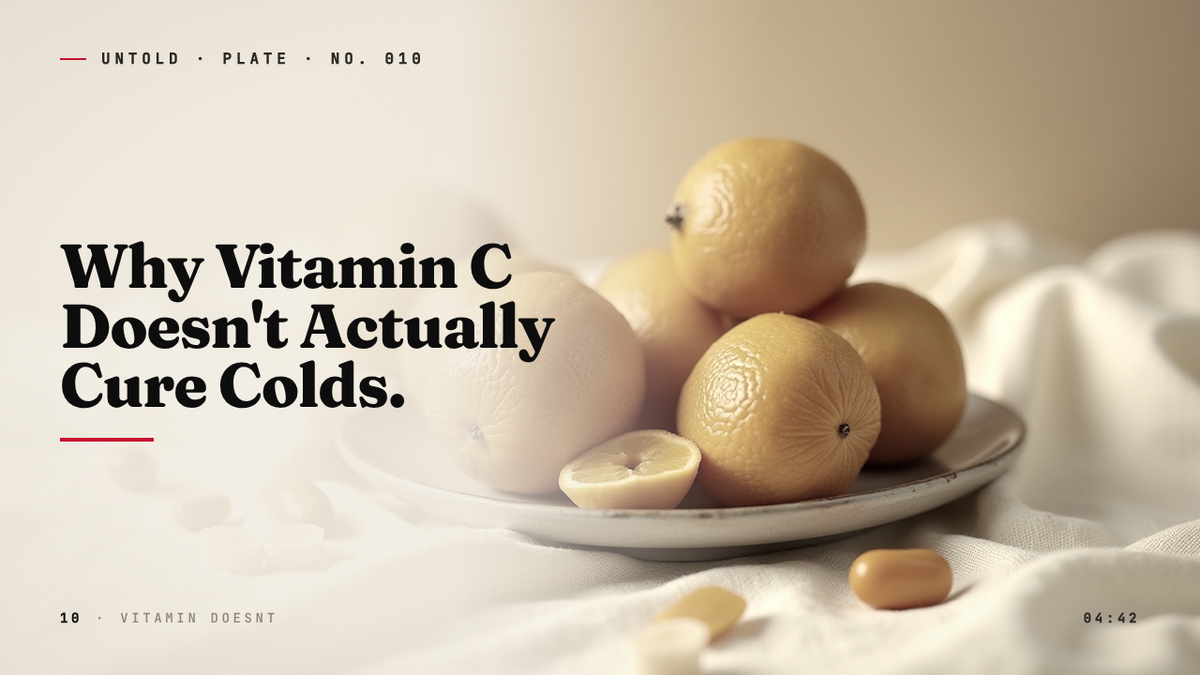
The first scratch in the throat arrives like a small civic emergency. Somewhere in the kitchen, a ritual begins. The orange juice carton is retrieved. The white plastic bottle of effervescent tablets is shaken from the back of a cupboard. A glass fizzes on the counter, releasing the faint metallic smell of ascorbic acid dissolving in water. The patient drinks. The patient feels, if not better, at least responsible.
This is one of the most widely practiced rituals in modern Western medicine, and it is almost entirely useless. Survey data suggests that the overwhelming majority of American adults reach for vitamin C at the first sign of a cold, and they have been doing so, in one form or another, for more than fifty years. They have been doing so because a two-time Nobel laureate, near the end of an otherwise extraordinary scientific career, became convinced of something the evidence has never supported. He wrote a small book. The book sold millions of copies. The belief outlived him by decades.
The story of vitamin C and the common cold is not really a story about a vitamin. It is a story about how a single charismatic scientist, operating at the edge of his expertise, can shape the medicine cabinet of an entire civilization. It is also a story about how hard it is to dislodge a belief once it has been blessed by genius.
A Chemist at the Height of His Powers
Linus Pauling was, by almost any reasonable measure, one of the most accomplished scientists of the twentieth century. He published the foundational work on the nature of the chemical bond in the 1930s, an achievement that won him the Nobel Prize in Chemistry in 1954.1 He was an early and outspoken critic of atmospheric nuclear testing, and his campaign helped pressure the United States and the Soviet Union toward the 1963 Partial Test Ban Treaty. For that, he received the Nobel Peace Prize in 1962, becoming the only person in history to win two unshared Nobels.2
By the mid-1960s Pauling was in his sixties, professionally untouchable, and looking for a new problem. He found one, or rather, one found him. In 1966 a biochemist named Irwin Stone, whom Pauling had met at a banquet, wrote him a letter recommending that he take large daily doses of vitamin C. Stone, who had no medical degree but had spent decades developing an unorthodox theory about ascorbic acid, claimed the vitamin could extend life by as much as twenty-five years.3
Pauling, then sixty-five, began experimenting on himself. He started with three grams a day, roughly fifty times the recommended intake. He reported feeling more energetic, sharper, less prone to the seasonal colds that had dogged him for decades. The plural of anecdote is not data, as the saying goes, but to a chemist who had spent his career trusting his own intuition about molecules, the personal evidence was persuasive. By the end of the decade he had begun to talk about vitamin C in public, often, and with the confidence of a man who had been right about most things.
In 1970, W. H. Freeman published Vitamin C and the Common Cold, a slim hardcover with a sky-blue dust jacket and Pauling’s name above the title in modest serif type.4 The book argued that doses far exceeding the official recommended daily allowance could prevent colds in most people and shorten them in everyone else. It was written for the lay reader, full of the kind of plainspoken confidence that scientific celebrities can deploy when they wish. It became a bestseller almost immediately.
The market responded as markets do. American vitamin C sales surged through the early 1970s, with some pharmacies reporting that they could not keep ascorbic acid tablets on the shelves. A vitamin that had been associated, in the public mind, mostly with scurvy and citrus suddenly carried the imprimatur of a Nobel laureate. The cultural shift was so complete that within a few years, the idea that vitamin C fought colds had passed out of debate and into folk knowledge, the way most of us know that chicken soup helps or that going outside with wet hair is unwise.
The First Doubts
The medical establishment, which had not been consulted, was less enthusiastic. The claims in Pauling’s book rested on a small handful of studies, several of them poorly controlled, and on his own extrapolations from biochemistry. The randomized controlled trial, by 1970, was already the gold standard for evaluating medical claims, and the trials that existed on vitamin C did not, on close reading, say what Pauling said they said.
One of the first systematic challenges came from Thomas Chalmers, an American physician and a pioneering figure in the development of clinical trial methodology. In the mid-1970s Chalmers conducted what was effectively an early meta-analysis, pooling the results of eight randomized trials of vitamin C against the common cold.5 His conclusion was unambiguous. There was no convincing evidence that vitamin C prevented colds in the general population. Whatever effects existed on cold duration were small, inconsistent across studies, and possibly explained by the placebo effect, particularly in trials where participants could easily guess whether they were taking the real pill or a dummy.
Pauling responded the way scientists sometimes do when their cherished beliefs are challenged. He attacked the analysis, questioned the methodology, and increased his own dose. By the early 1980s he was reportedly taking eighteen grams of vitamin C per day, roughly three hundred times the recommended intake. He extended his claims as well, suggesting that megadoses of ascorbic acid could be useful against cardiovascular disease, against viral infections more generally, and, eventually, against cancer.6
The cancer claim was particularly contentious. Pauling collaborated with a Scottish surgeon, Ewan Cameron, on studies suggesting that high-dose vitamin C could extend the lives of terminal cancer patients. Researchers at the Mayo Clinic, attempting to replicate the work under more rigorous double-blind conditions, found no benefit at all.7 Pauling dismissed the Mayo trials and their authors with the same energy he had brought to defending the cold hypothesis. The medical mainstream, by this point, had largely concluded that he had wandered, late in life, into territory where his usual brilliance no longer protected him.
What the Vitamin Actually Does
It helps, here, to step back and consider what vitamin C is and what it does in the body. Ascorbic acid is a water-soluble molecule that the human body cannot synthesize on its own, a metabolic quirk humans share with guinea pigs and certain primates but not with most other mammals. It is essential for the production of collagen, the structural protein that holds skin and connective tissue together. Its absence produces scurvy, a disease whose horrific progression, including bleeding gums, loose teeth, and eventually death, dogged sailors for centuries until the British navy began issuing citrus rations in the late eighteenth century.
The amount required to prevent scurvy is small. About ten milligrams a day will do it. The current official recommendations in most countries hover around seventy-five to ninety milligrams, a margin chosen to keep tissue levels comfortably saturated. That target is met by a single orange, a half cup of red bell pepper, or a handful of strawberries. It is met, in practice, by virtually every adult in any country with a reliable food supply, even those who eat poorly.
What happens when you exceed this amount, as the supplement industry would prefer that you do? The pharmacokinetics are well understood. Above roughly two hundred milligrams a day, the body’s absorption efficiency drops sharply. The kidneys, which filter blood plasma continuously, begin excreting the excess in urine within hours.8 At Pauling’s dose of three grams a day, the body absorbs perhaps a few hundred milligrams of what it can use. The rest, as one researcher memorably put it, becomes expensive urine. At eighteen grams, the figure is comically inefficient. The body is essentially a one-way passage for ascorbic acid above a certain threshold, with little ability to store or stockpile the excess against future need.
This is the first and most fundamental problem with the megadose hypothesis. The intuition that more of a beneficial substance must be more beneficial does not hold for water-soluble vitamins, which the body has evolved to discard rather than hoard. The second problem is that even the small fraction that is absorbed does not appear to do what Pauling claimed.
The Cochrane Verdict
The most rigorous and frequently updated assessment of the vitamin C and cold question comes from the Cochrane Collaboration, an international network of researchers who specialize in pooling and analyzing clinical trial data. Their review on vitamin C for preventing and treating the common cold has been updated several times over the past two decades. The 2013 version, which remains the most comprehensive, drew on twenty-nine randomized controlled trials involving more than eleven thousand participants.9
The findings are worth reading in their original, deflating language. For the general population, regular daily vitamin C supplementation did not reduce the incidence of colds in any meaningful way. A person who took vitamin C every day for years caught roughly the same number of colds as a person who did not. The reduction in incidence among ordinary adults was essentially zero.
What about cold duration? Here the review found a small effect. Among adults taking vitamin C prophylactically, cold episodes were about eight percent shorter on average. Eight percent of a typical seven-day cold works out to a little over half a day. Among children, the effect was somewhat larger, around fourteen percent. These are real numbers, statistically significant in the technical sense, but they describe what the review’s authors and most subsequent commentators have called a clinically trivial benefit. A person hoping to feel better by Wednesday instead of Thursday is unlikely to notice the difference.
The results for taking vitamin C after symptoms begin, which is what most people actually do, were worse still. Trials of therapeutic vitamin C, started at the first scratch in the throat, found no consistent benefit at all. The pill you reach for when you feel the cold coming on, the ritual that has structured American sniffle behavior for fifty years, is the version of the intervention with the least evidentiary support.
This is the central, awkward fact of the vitamin C story. Pauling was not entirely wrong, in the strictest sense. There is a small, measurable effect on cold duration among regular daily users. He was, however, wrong about its magnitude, wrong about its mechanism, and wrong about the most common way people use the supplement. The cure is not in the glass. There is no cure. There is a marginal statistical whisper, audible only to those analyzing trial data.
The Marathon Exception
The Cochrane review contains one finding that is genuinely surprising and that has, perhaps inevitably, been seized on by the supplement industry as vindication. Among a small subset of participants, the effect of vitamin C was not trivial. It was substantial.
The subset is unusual. It consists of people undergoing extreme, sustained physical stress, the kind of stress that depletes the body’s ordinary reserves and disrupts immune function. The studies in question included marathon runners, ultramarathon competitors, soldiers on winter exercises in subarctic conditions, and skiers training at altitude. Among these populations, regular vitamin C supplementation reduced the incidence of colds by roughly half.9
Why this group, and why this effect? The mechanism is not perfectly understood, but the likely explanation involves the way prolonged exertion affects the immune system. Endurance exercise temporarily suppresses certain immune functions, opens what sports physiologists call an open window of vulnerability after a hard effort, and depletes circulating antioxidants. In people running themselves into the ground for hours at a time, ascorbic acid may serve a function that simply does not apply to someone sitting at a desk.
It is a real finding, and it complicates any flat dismissal of Pauling’s hypothesis. But it is also a finding with a very narrow domain of application. The population that benefits is, by definition, a population already operating at the edge of human physical capacity. For the ordinary person reaching for tablets at the office, the marathon exception does not apply. The cellular conditions that make ascorbic acid useful for an ultramarathoner are not present in someone working at a laptop with a tickle in the throat.
Why the Myth Endures
If the science is this clear, and has been this clear for so long, the obvious question is why the belief persists. Why does an orange juice carton still carry an implicit medical claim? Why do otherwise reasonable people, when they feel a cold coming, still reach for the bottle?
Part of the answer is institutional. Pauling’s authority, even after his death in 1994, carried enormous weight.10 He was not a crank, and he could not be dismissed as one. When a two-time Nobel laureate writes a book recommending a substance, the substance acquires a cultural halo that is difficult to remove. The clinical literature can update; the supplement aisle does not.
Part of the answer is commercial. The global market for vitamin C supplements is enormous. Brands have spent decades reinforcing the association between ascorbic acid and immunity in advertising, packaging, and product placement. The juice industry has been more than happy to ride along. The economic infrastructure built on Pauling’s hypothesis has its own momentum, independent of whether the underlying claim survives scrutiny.
Part of the answer is psychological, and probably the most important part. Colds, on average, last about a week. A person who takes a vitamin C tablet on day one and feels better by day seven will, with some confidence, credit the tablet. The same person, taking nothing, would also have felt better by day seven. The illness has a natural arc, and most interventions taken along that arc will appear to work, because the arc would have ended anyway. This is the same logic that has sustained dozens of folk remedies through the centuries. It is the engine of placebo.
There is also a deeper, perhaps almost ceremonial dimension. Reaching for the tablet, mixing the powder, drinking the cloudy orange water, all of this is a way of doing something in a situation where there is, medically speaking, very little to do. The common cold is caused by a heterogeneous family of viruses against which medicine has no specific treatment. Rest, fluids, time. That is the entire effective intervention. The vitamin C ritual fills the void left by genuine therapeutic impotence. It gives the patient a role to play.
The Coda
Linus Pauling died in 1994, at his ranch in Big Sur, of prostate cancer. He was ninety-three. He had been taking eighteen grams of vitamin C per day for most of the previous two decades, and he believed, in his final months, that the regimen had added years to his life and would have added more had he started earlier.11 He never publicly retracted any of his claims about ascorbic acid. The book was still in print.
There is a temptation, in summarizing a story like this, to render it as a parable about expertise and humility, about how even great scientists can be wrong outside their narrow domains. That is true enough. But the more useful lesson is probably about the fragility of evidence in the face of charisma. Pauling did not falsify data or invent results. He simply argued, persistently and confidently, for a hypothesis that the evidence did not support, and the public found him persuasive because of who he was rather than what he showed. The trials came later, and they said what they said, and almost no one was listening by then.
The orange juice in the morning is fine. It is delicious, and it contains, among other things, a small amount of a vitamin that the body genuinely requires in small amounts. The pepper in the salad is also fine. The strawberries are fine. The cold, when it comes, will run its course in roughly a week, with or without intervention, and the throat will heal, and the energy will return. Whatever ritual accompanies that recovery is the patient’s own business. The cure, however, is not in the glass. It never was. It was, for a brief and remarkable moment in the middle of the twentieth century, in the confidence of one man who had been right about so many other things that he could not quite believe he might be wrong about this.

Sources
- Nobel Foundation, ‘Linus Pauling: Facts,’ Nobel Prize Outreach, 1954. — https://www.nobelprize.org/prizes/chemistry/1954/pauling/facts/
- Nobel Foundation, ‘Linus Pauling: Nobel Peace Prize,’ Nobel Prize Outreach, 1962. — https://www.nobelprize.org/prizes/peace/1962/pauling/facts/
- Hager, Thomas, ‘Linus Pauling and the Vitamin Controversy,’ Oregon State University Special Collections, 1995. — https://scarc.library.oregonstate.edu/coll/pauling/blood/narrative/page31.html
- Pauling, Linus, Vitamin C and the Common Cold, W. H. Freeman, 1970. — https://archive.org/details/vitamincandthecommoncold
- Chalmers, T. C., ‘Effects of ascorbic acid on the common cold: An evaluation of the evidence,’ American Journal of Medicine, 1975. — https://pubmed.ncbi.nlm.nih.gov/1099967/
- Offit, Paul A., ‘The Vitamin Myth: Why We Think We Need Supplements,’ The Atlantic, 2013. — https://www.theatlantic.com/health/archive/2013/07/the-vitamin-myth-why-we-think-we-need-supplements/277947/
- Moertel, C. G. et al., ‘High-dose vitamin C versus placebo in the treatment of patients with advanced cancer who have had no prior chemotherapy,’ New England Journal of Medicine, 1985. — https://www.nejm.org/doi/full/10.1056/NEJM198501173120301
- Levine, M. et al., ‘Vitamin C pharmacokinetics in healthy volunteers,’ Proceedings of the National Academy of Sciences, 1996. — https://www.pnas.org/doi/10.1073/pnas.93.8.3704
- Hemilä, H. and Chalker, E., ‘Vitamin C for preventing and treating the common cold,’ Cochrane Database of Systematic Reviews, 2013. — https://www.cochranelibrary.com/cdsr/doi/10.1002/14651858.CD000980.pub4/full
- Linus Pauling Institute, ‘About Linus Pauling,’ Oregon State University. — https://lpi.oregonstate.edu/about/linus-pauling-biography
- Severo, Richard, ‘Linus C. Pauling Dies at 93; Chemist and Voice for Peace,’ The New York Times, 1994. — https://www.nytimes.com/1994/08/21/obituaries/linus-c-pauling-dies-at-93-chemist-and-voice-for-peace.html
Related reading