The Sixty-Year Argument Over a Steak
How one Minnesota physiologist, a misread WHO bulletin, and a methodological civil war turned dinner into a verdict.
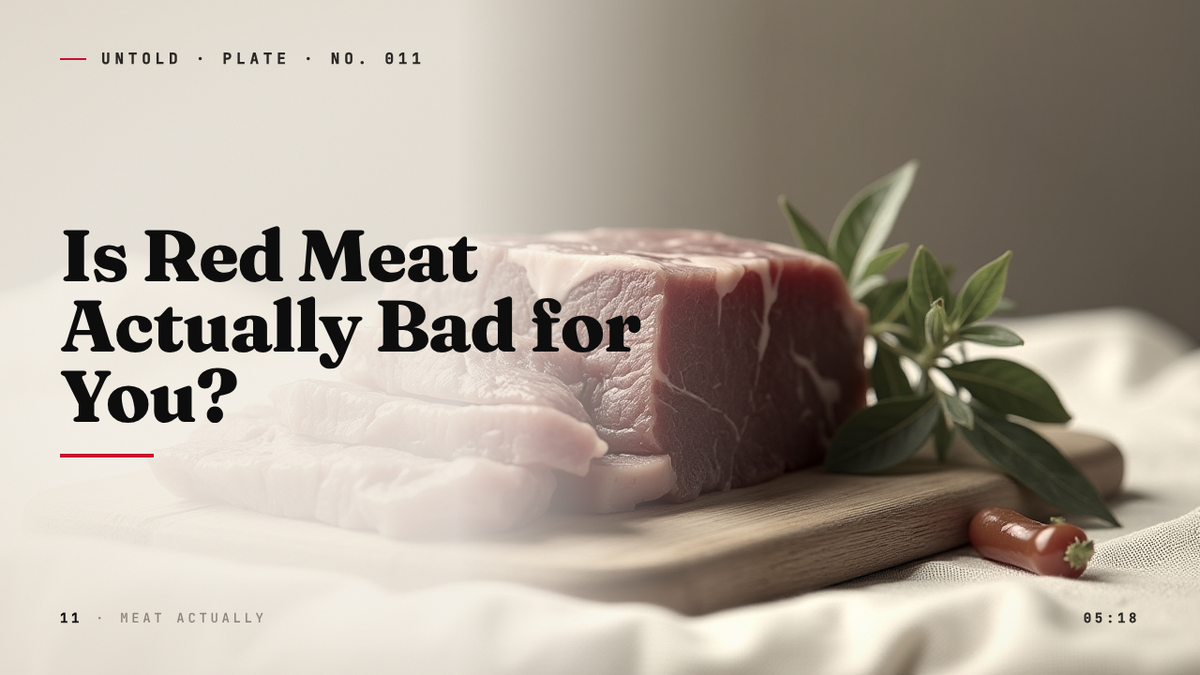
A thick cut of beef hits cast iron and the kitchen fills with the smell of browning fat. Somewhere, at the same moment, a news alert pings on a phone with a headline that calls the same steak a slow-motion heart attack. The two impressions belong to the same culture, and they cannot both be entirely right.
Americans eat roughly 220 pounds of meat per person each year, and red meat still makes up a substantial share of that figure 1. Yet after six decades of research, a clear sentence about whether that habit is shortening lives, lengthening them, or doing neither has been impossible to write. The reason is not that scientists are lazy or compromised. It is that the question itself, once you look closely, splinters into a dozen smaller questions that the headlines almost never separate. What kind of meat. How much. How cooked. Alongside what. In whose body. The argument over red meat is one of the longest-running fights in nutritional science, and it has produced a public consensus that is far more confident than the underlying evidence.
A Minnesota Laboratory and a Sticky Idea
The modern suspicion of red meat begins in the early 1950s, in a basement laboratory at the University of Minnesota, where a physiologist named Ancel Keys was trying to understand why middle-aged American executives were dropping dead of heart attacks at rates that alarmed insurance companies. Keys, who would later live to be a hundred, was an unusually persuasive scientist. He had already invented the K-ration that fed American soldiers in the Second World War. He believed, with the certainty of a man who had been right before, that the answer lay in the artery walls, and that the substance fouling them was saturated fat 2.
In 1958 he launched what became known as the Seven Countries Study, an ambitious cross-cultural comparison of diet and cardiovascular disease that followed roughly 12,000 men in Finland, the Netherlands, Italy, the former Yugoslavia, Greece, Japan, and the United States 3. The correlation Keys reported was striking. Populations that ate more saturated animal fat tended to die more often of heart disease. Red meat, the most visible carrier of that fat in the American diet, became the suspect that needed no introduction.
The Seven Countries Study was real research, and much of it has held up. But Keys had a problem he never fully acknowledged. Data existed on more than seven countries, and the broader set told a less tidy story. Critics, most prominently the biostatistician George Mann, pointed out that France, where saturated fat consumption was high and heart attacks rare, had been left out of the headline analysis 4. Keys argued the omission was methodological rather than convenient. The argument has never been fully settled. What is settled is the message that escaped the seminar room: animal fat clogs arteries, and red meat is its delivery vehicle.
By 1977, the United States Senate Select Committee on Nutrition and Human Needs, chaired by George McGovern, had translated the Keys hypothesis into national policy. The first federal dietary guidelines told Americans, in plain language, to eat less red meat 5. Beef consumption in the United States, which had peaked at about 89 pounds per person in 1976, began a long descent, falling nearly forty percent over the following decades. Chicken, leaner and politically safer, took its place. Margarine sales boomed. And yet the diseases the guidelines were meant to suppress did not retreat. Obesity rates climbed. Type 2 diabetes climbed faster. Heart disease remained the leading cause of death. Something in the equation was off, though it would take decades to identify which terms had been miscounted.
The WHO Bulletin That Broke the Internet
For most of the late twentieth century, the case against red meat was carried forward not by a single dramatic study but by a slow accumulation of epidemiology. Then, in October 2015, the World Health Organization made the argument loud again. The International Agency for Research on Cancer, the WHO’s cancer arm, convened a working group of twenty-two scientists in Lyon to evaluate the evidence linking meat consumption to cancer. Their conclusion, when it came, was treated by much of the press as a guilty verdict on the entire food group 6.
The nuance, which almost no one reproduced faithfully, mattered enormously. The IARC placed processed meat, the category that includes bacon, ham, hot dogs, and most sausages, into Group 1, its highest classification of carcinogenicity. That is the same category that contains tobacco smoke and asbestos. The classification refers to the strength of the evidence that a substance can cause cancer, not the size of the risk it imposes. Smoking a pack of cigarettes a day and eating a strip of bacon are both Group 1 exposures, but they are not remotely comparable hazards. The IARC’s own figures suggested that consuming fifty grams of processed meat daily, roughly two slices of bacon, was associated with an eighteen percent relative increase in colorectal cancer risk, raising a lifetime risk of about five percent to something closer to six 7.
Unprocessed red meat received a softer designation, Group 2A, meaning probably carcinogenic. The probably was the word that broke the coverage. In the compressed grammar of a news ticker, probably becomes definitely, and definitely becomes poison. By the end of the week, the steakhouse and the smoking section had been rhetorically merged in the public imagination, even though the underlying report had taken pains to distinguish them.
What Walter Willett Found
The most influential single body of work behind the IARC’s conclusion was not generated in Lyon but in Boston, at the Harvard School of Public Health, where the epidemiologist Walter Willett has spent his career assembling some of the largest dietary cohorts ever studied. The Nurses’ Health Study, which Willett directs, has followed more than 120,000 American women since 1976, recording what they eat and what happens to them 8. A parallel study, the Health Professionals Follow-Up Study, has done the same for tens of thousands of men.
In 2012, Willett and his colleagues published an analysis of these cohorts in the Archives of Internal Medicine that received enormous attention. People in the highest brackets of red meat consumption, the paper reported, had an all-cause mortality rate about thirteen percent higher than those in the lowest brackets. For processed meat, the figure rose to about twenty percent 9. The findings were consistent with a broader pattern across dozens of similar cohorts in other countries.
Thirteen percent is a real number, and across populations of millions it represents a real shadow. But it is also a small number by the standards of epidemiology, and that smallness is the seam where the argument has lived ever since. Risk ratios in the range of 1.1 to 1.3, which are typical of nutritional cohort studies, are notoriously vulnerable to what statisticians call residual confounding: the lingering influence of variables the researchers did not measure, or measured imperfectly. People who eat the most red meat in American cohorts also tend, on average, to smoke more, drink more, exercise less, weigh more, and have less formal education. Adjusting for these differences statistically is standard practice. Adjusting for them perfectly is almost impossible.
The contrast with the evidence on tobacco is instructive. Smoking multiplies the risk of lung cancer by a factor of fifteen to thirty, depending on the population studied. A signal that large cannot be erased by any plausible confounder. A signal of 1.13 can.
A Civil War in the Cafeteria
In the autumn of 2019, the methodological discomfort that had simmered under the surface of nutritional epidemiology erupted into open warfare. A consortium of researchers led by Bradley Johnston, then at Dalhousie University, published a series of systematic reviews in the Annals of Internal Medicine that did something almost no previous review had done. It applied the GRADE framework, a tool developed in clinical medicine to grade the certainty of evidence, to the entire literature on red and processed meat 10.
The verdict was startling. The certainty of the evidence linking red meat to cancer, heart disease, and mortality was, in the consortium’s judgment, low or very low. The recommendation that followed was even more startling. Adults, the panel concluded, could continue their current consumption of red and processed meat without strong justification to change. The headlines wrote themselves.
The reaction from established nutritional science was immediate and ferocious. Willett’s group at Harvard issued a public letter calling for the paper’s retraction, arguing that the GRADE framework, designed for evaluating drug trials, was inappropriate for dietary evidence, where randomized controlled trials of decades-long eating patterns are essentially impossible to conduct 11. Other prominent researchers questioned Johnston’s prior funding disclosures, noting an earlier industry-linked study on sugar. Johnston’s defenders countered that the standard practice of treating low-certainty observational data as actionable was itself the problem, and that the field had been overstating the strength of its own conclusions for decades.
The fight, stripped of its personalities, was about something genuinely fundamental. If randomized trials of human diet across a lifetime are impossible, what counts as evidence strong enough to issue a public health recommendation? There is no settled answer. There may never be one. The Annals dispute did not resolve the science. It exposed the fact that the science had been carrying a heavier burden of certainty than its methods could comfortably support.
What the Biology Actually Says
Alongside the epidemiology, a parallel line of research has been trying to identify mechanisms, the biological pathways by which red meat, if it really is harmful, might do its damage. Three candidates have emerged with the most consistent evidence.
The first is heme iron, the form of iron that gives red meat its color and that is absorbed more readily by the human gut than the non-heme iron in plants. Heme iron is a genuine nutritional asset, particularly for menstruating women and for the elderly, but in high concentrations it can catalyze the formation of N-nitroso compounds in the colon, some of which are known to damage DNA 12.
The second is L-carnitine, an amino acid abundant in red meat. A 2013 study led by Stanley Hazen at the Cleveland Clinic showed that gut bacteria metabolize L-carnitine into a compound called trimethylamine N-oxide, or TMAO, which in animal models accelerates atherosclerosis 13. Subsequent work has found that TMAO levels in humans correlate with cardiovascular events, though the causal chain remains contested.
The third is the cooking itself. When muscle meat is exposed to high temperatures, particularly the temperatures of grilling, broiling, and pan-frying, it forms heterocyclic amines and polycyclic aromatic hydrocarbons, compounds that are demonstrably mutagenic in laboratory assays 14. The charred crust on a well-seared steak is chemically not the same substance as the interior. A slow-braised pot roast and a blackened grill mark deliver very different molecular packages.
None of these mechanisms is fictional. None of them, in isolation, has been shown to produce the magnitude of harm that the early epidemiology implied. They suggest, instead, that dose, preparation, and context are not incidental details. They are most of the story.
The Distinction Almost No One Makes on Television
Here is the part that consistently fails to survive the trip from journal to news segment. Most of the strongest evidence of harm in the meat literature comes from processed meat, not from fresh, unprocessed cuts. The IARC reviewers were explicit about this distinction. So were Willett and his collaborators. Yet in public conversation, the category red meat has tended to absorb the sins of the category processed meat, as if a grass-fed sirloin and a convenience-store hot dog were the same biochemical object.
They are not. Processed meats are typically cured with sodium nitrite, smoked or otherwise treated to extend shelf life, and consumed in forms that combine high sodium loads with the heterocyclic amine residues of high-temperature cooking. Several large meta-analyses in the past decade have found that when processed meat is statistically separated from unprocessed red meat, the risk signal for the unprocessed category shrinks substantially, and in some analyses disappears altogether 15.
This is not an exoneration. It is a clarification. The American Heart Association now recommends lean cuts, modest portions, and a sharp reduction in cured and processed products rather than a wholesale ban on beef, lamb, or pork 16. The nutritional density of unprocessed red meat is genuinely difficult to replicate. A three-ounce serving of beef provides roughly half the daily requirement of vitamin B12, along with substantial amounts of zinc, selenium, and bioavailable iron. For populations at risk of deficiency, particularly older adults and women of reproductive age, those nutrients are not trivial.
What an Honest Answer Looks Like
The question that opened this essay, whether red meat is bad for you, turns out to be the wrong shape for the evidence we actually have. The evidence is not a verdict. It is a set of conditional statements whose terms most public conversation strips away.
Processed meat, eaten daily in substantial quantities, raises the risk of colorectal cancer by a modest but reproducible amount. Unprocessed red meat, eaten in moderate portions as part of a diet that includes vegetables, whole grains, and limited refined carbohydrates, has not been shown to do nearly as much damage as the headlines have implied, and in some analyses has not been shown to do measurable damage at all. Cooking method matters. Quantity matters. Context matters. The body of the person eating it matters. None of these qualifications fits comfortably on a chyron.
The sixty-year argument has, in the end, taught us less about red meat than about the limits of the science we use to study food. Long-term randomized trials of human diet are nearly impossible to conduct. Observational cohorts are powerful but noisy, and they cannot fully separate the steak from the smoker, the bacon from the sedentary life. The mechanisms are real but small. The risks are real but modest. The benefits are real and, for some people, considerable.
What remains is something less dramatic than a verdict and more useful than a slogan. Nutrition is not a courtroom. It is a daily conversation between a body and its environment, conducted in thousands of small decisions about portion and preparation and pairing, conducted across decades. The next time a headline arrives announcing that steak is killing you, or that steak has been vindicated, the most honest response is probably the one that fits on no chyron at all. It depends. On the meat. On the amount. On the cooking. On the life around it. The answer has always been there, hidden in plain sight under the noise of certainty.

Sources
- U.S. Department of Agriculture, Economic Research Service, Per Capita Availability of Meat and Poultry, 2023. — https://www.ers.usda.gov/data-products/food-availability-per-capita-data-system/
- Oransky, I., ‘Ancel Keys, 100, Promoter of Mediterranean Diet, Dies,’ The New York Times, 2004. — https://www.nytimes.com/2004/11/23/us/ancel-keys-100-promoter-of-mediterranean-diet-dies.html
- Keys, A., et al., ‘The Seven Countries Study: 2,289 deaths in 15 years,’ Preventive Medicine, 1984. — https://pubmed.ncbi.nlm.nih.gov/6739443/
- Teicholz, N., The Big Fat Surprise: Why Butter, Meat and Cheese Belong in a Healthy Diet, Simon and Schuster, 2014. — https://www.simonandschuster.com/books/The-Big-Fat-Surprise/Nina-Teicholz/9781451624427
- U.S. Senate Select Committee on Nutrition and Human Needs, Dietary Goals for the United States, 1977. — https://naldc.nal.usda.gov/download/1759572/PDF
- Bouvard, V., et al., ‘Carcinogenicity of consumption of red and processed meat,’ The Lancet Oncology, 2015. — https://www.thelancet.com/journals/lanonc/article/PIIS1470-2045(15)00444-1/fulltext
- World Health Organization, Q&A on the carcinogenicity of the consumption of red meat and processed meat, 2015. — https://www.who.int/news-room/questions-and-answers/item/cancer-carcinogenicity-of-the-consumption-of-red-meat-and-processed-meat
- Harvard T.H. Chan School of Public Health, Nurses’ Health Study overview. — https://nurseshealthstudy.org/
- Pan, A., Sun, Q., Bernstein, A. M., et al., ‘Red meat consumption and mortality: results from 2 prospective cohort studies,’ Archives of Internal Medicine, 2012. — https://jamanetwork.com/journals/jamainternalmedicine/fullarticle/1134845
- Johnston, B. C., et al., ‘Unprocessed Red Meat and Processed Meat Consumption: Dietary Guideline Recommendations,’ Annals of Internal Medicine, 2019. — https://www.acpjournals.org/doi/10.7326/M19-1621
- Kolata, G., ‘Eat Less Red Meat, Scientists Said. Now Some Believe That Was Bad Advice,’ The New York Times, 2019. — https://www.nytimes.com/2019/09/30/health/red-meat-heart-cancer.html
- Bastide, N. M., Pierre, F. H., Corpet, D. E., ‘Heme iron from meat and risk of colorectal cancer,’ Cancer Prevention Research, 2011. — https://aacrjournals.org/cancerpreventionresearch/article/4/2/177/49832/
- Koeth, R. A., et al., ‘Intestinal microbiota metabolism of L-carnitine, a nutrient in red meat, promotes atherosclerosis,’ Nature Medicine, 2013. — https://www.nature.com/articles/nm.3145
- National Cancer Institute, Chemicals in Meat Cooked at High Temperatures and Cancer Risk. — https://www.cancer.gov/about-cancer/causes-prevention/risk/diet/cooked-meats-fact-sheet
- Lescinsky, H., et al., ‘Health effects associated with consumption of unprocessed red meat: a Burden of Proof study,’ Nature Medicine, 2022. — https://www.nature.com/articles/s41591-022-01968-z
- American Heart Association, Meat, Poultry, and Fish: Picking Healthy Proteins. — https://www.heart.org/en/healthy-living/healthy-eating/eat-smart/nutrition-basics/meat-poultry-and-fish-picking-healthy-proteins
Related reading