The Gasp Before Dawn: What Cold Water Does to a Sleeping Body
A cold shower does not wake you. Something far older, buried in your nervous system, does.
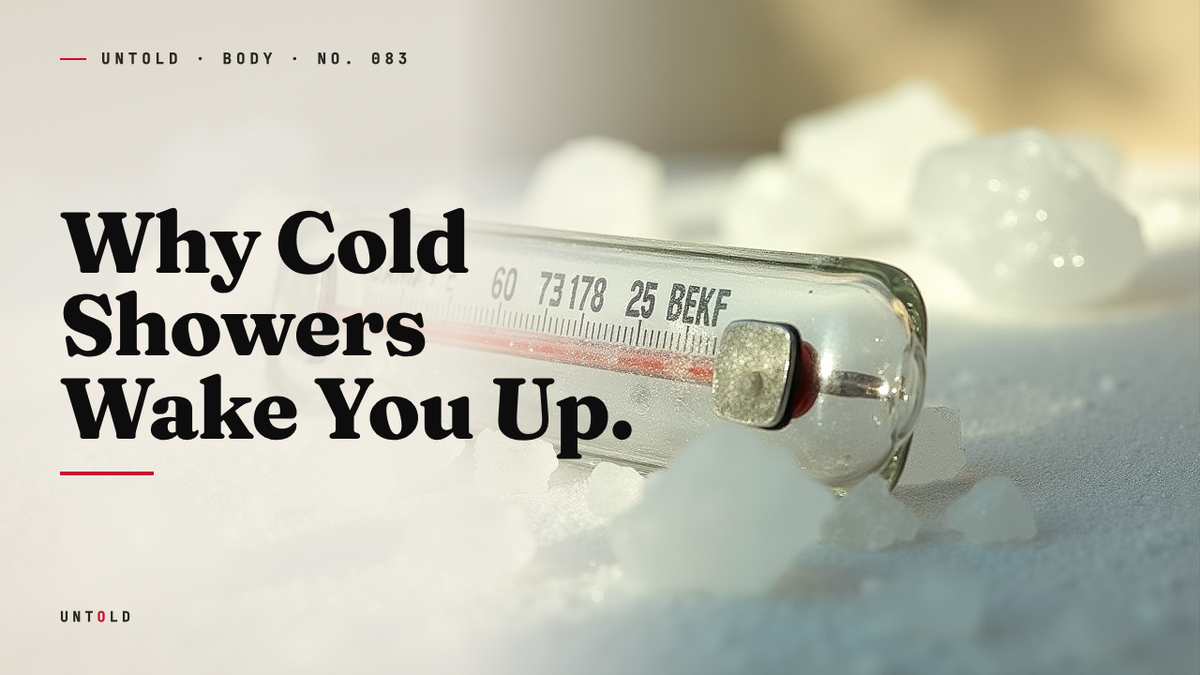
The water hits, and for one long second the body forgets how to breathe. The chest locks. The lungs, mid-cycle, seize as if a hand has closed around them. Then comes the gasp, sharp and involuntary, dragging in air that was not asked for. And in the space of that gasp, something has changed. The fog of sleep, the syrupy reluctance that clung to every limb thirty seconds ago, is simply gone. Not fading. Gone.
No coffee produced this. No alarm, no slow ritual of stretching and blinking. Just water a few degrees colder than the body wanted, and a transformation so abrupt it feels less like waking than like being switched on. The question worth asking is not whether cold water wakes people up. Anyone who has stepped under it knows the answer in their skin. The question is what, exactly, happened in that first freezing second, and why the body responds to a stream of cold water the way it might respond to falling through ice.
The short version is that the cold did not wake anyone. Something far older did, a reflex the body has carried across millions of years of evolution, and the water was merely the thing that pulled the trigger.
The Reflex Built for Drowning
The human skin is not a passive envelope. It is an instrument, dense with sensors, and among the most numerous are the cold receptors: nerve endings that fire the instant the temperature at the surface begins to fall. There are roughly a quarter of a million of them scattered across the body. When cold water arrives, it does not trigger them one by one. It floods thousands of them at once, in a fraction of a second, and the resulting signal races toward the brain faster than conscious thought can follow.
What that signal sets off has a name. Physiologists call it the cold shock response, and its most reliable feature is the gasp, that helpless intake of breath the moment cold water covers the skin. Much of what is known about it comes from the work of Michael Tipton, a British physiologist who spent decades studying why people die in cold water, often within the first minute of immersion and long before hypothermia could possibly be to blame. 1
Tipton’s research reframed a grim mystery. For years it was assumed that cold-water drownings were a matter of muscles failing and body heat leaking away. But the timing was wrong. People were dying too fast. What Tipton and his colleagues established was that the danger lived at the very beginning, in the initial shock. Immerse a person in cold water and the skin temperature can plunge by as much as ten degrees Celsius in under half a minute. The nervous system reads that plunge not as discomfort but as emergency, and it responds with a cascade of automatic reactions: the gasp, a surge in heart rate, a spike in breathing rate, a sudden rise in blood pressure. 1
For a body suddenly submerged in open water, this is a lethal combination. The involuntary gasp can pull water straight into the lungs. The racing heart, the clamping vessels, the hyperventilation all conspire to overwhelm a person before they have even begun to swim. The cold shock response is, in the wild, one of the most dangerous things the human body does to itself.
But a shower is not the sea. Standing safely on a bathroom floor, the same reflex that drowns swimmers becomes something else entirely: the most sudden and total alarm the nervous system can sound. The gasp is not a choice, and neither is the alertness that follows it. Both are the body doing what it was built to do when cold arrives without warning. It wakes up completely, because for most of human history, cold water meant a threat to survival, and a threatened body cannot afford to be groggy.
The Chemical of Attention
Behind the gasp stands a whole physiological apparatus, and its commander is the sympathetic nervous system. This is the network commonly labeled fight-or-flight, the ancient circuitry that prepares an animal to run or fight when danger appears. It is not a system built for comfort. It is built for emergencies, and it has one setting when it engages: everything, all at once.
Cold water flips it on like a switch. Within seconds of the first shock, the adrenal glands begin flooding the bloodstream with catecholamines, the family of stress chemicals that includes adrenaline and, crucially, noradrenaline. Noradrenaline is not merely a stress hormone. In the brain it functions as a neurotransmitter of attention, the molecule most directly responsible for sharpening focus, quickening reactions, and clearing the mental fog that hangs over the half-asleep. When noradrenaline rises, the mind snaps into a state of vigilance. It is, in a very literal sense, the chemistry of being awake.
Just how dramatically cold water raises it was measured in a study conducted at a Czech laboratory around the turn of the millennium. Volunteers were immersed in water held at fourteen degrees Celsius for a full hour, and their blood was sampled throughout. The results were striking. Noradrenaline concentrations more than doubled, and in some measures the rise in circulating catecholamines climbed several times above baseline. 2 The subjects were not merely cold. Their bloodstreams had been transformed into something resembling the state of a person mid-crisis, except that they were sitting still in a controlled tank.
That finding caught the attention of a researcher named Nikolai Shevchuk, who in 2008 published a hypothesis that pushed the idea further. If cold water could reliably flood the brain with alertness signals, he reasoned, it might do more than banish morning grogginess. It might have therapeutic value for low mood. His paper described the effect in vivid terms: cold immersion, he wrote, sends an overwhelming quantity of electrical impulses from peripheral nerve endings to the brain, and this deluge of signaling could produce an antidepressant effect. 3
Shevchuk’s proposal was speculative, based on physiological reasoning rather than large clinical trials, and it should be read as a hypothesis rather than a settled conclusion. But it captured something real about the scale of what cold does to the nervous system. The alertness that follows a cold shower is not a vague feeling. It is the downstream consequence of a measurable chemical storm.
Blood Sent Inward
Alertness, though, is only half the story. The body does not merely sharpen the mind when cold hits. It reorganizes the flow of blood itself.
The response is called vasoconstriction, and it is one of the oldest tricks in the thermoregulatory book. When cold touches the skin, the small blood vessels near the surface clamp shut. The logic is protective. Blood carries heat, and heat near the surface is heat about to be lost. By constricting the peripheral vessels, the body pulls its warm blood inward, away from the cooling skin and toward the vital organs of the core. It is choosing to sacrifice the temperature of the extremities in order to defend the heart, the lungs, the brain.
But squeezing shut a vast network of vessels has consequences for the whole circulatory system. When the peripheral vessels constrict, the same volume of blood is suddenly forced through a smaller space, and pressure rises accordingly. The heart, meanwhile, beats faster and harder to keep that pressurized blood moving. In the first moments of cold immersion, heart rate can climb by twenty to thirty beats per minute, part of the same cold shock cascade that Tipton mapped. 1 The cardiovascular system shifts, all at once, into a high gear it does not use during ordinary waking life.
Breathing joins the surge. The initial gasp is followed by a spell of rapid, deep respiration, hauling in far more oxygen than a resting body needs. That oxygen, driven by the racing heart and the elevated pressure, reaches the brain in abundance. More fuel, more flow, more pressure: three systems firing in concert. The mind is being flooded with the chemistry of alertness at the same moment that the body is delivering an unusual surge of oxygenated blood to the very organ doing the thinking.
This is why grogginess does not so much fade under cold water as vanish. Fading is what happens when caffeine slowly raises the level of a stimulant in the blood over the course of twenty minutes. The cold shower does something different and far more abrupt. It commandeers the emergency systems of the body, the ones evolution reserved for genuine threats, and it points all of them, briefly, at the simple task of being awake.
The Long Afterglow
There is a coda to the immediate jolt, and it lingers longer than the shock itself. Beyond noradrenaline and adrenaline, cold exposure appears to reach into the brain’s reward circuitry as well.
Some research has measured a substantial rise in dopamine following cold immersion. In the same broad body of laboratory work exploring cold-water physiology, dopamine concentrations were reported to climb by around two hundred and fifty percent, a rise both large and unusually sustained. 2 Where adrenaline spikes and then fades within minutes, the dopamine elevation can persist for a considerable stretch afterward. Dopamine is the molecule of motivation and drive, bound up in mood and in the sense of clean, energized well-being that so many cold-shower enthusiasts describe long after they have toweled off.
This afterglow, the elevated mood that outlasts the cold by hours, may be the single most seductive feature of the practice, and it is chemically distinct from the initial alarm. The gasp and the racing heart are over in seconds. The dopamine tide rolls in slower and recedes slower, which is why people step out of a cold shower not merely alert but faintly euphoric, and why the memory of that feeling is enough to send them back under the cold water the next morning despite everything their body did to resist it.
The Trigger and the Power
Here is where the intuition of most cold-shower devotees quietly misleads them. It is easy to believe the cold itself is doing the work, that low temperature is some external force injecting energy into the body. But the temperature is only the trigger. The power was there all along, coiled inside the nervous system, waiting for a reason to fire.
The evidence for this lies in what happens when the shock is removed while the cold remains. Practitioners of controlled breathing methods have long claimed that a person can enter cold water calmly, override the gasp, and blunt the whole cascade. The physiology supports the claim. The cold shock response is precisely that, a response to shock, and much of it can be habituated or suppressed by a mind and body that have learned not to read the cold as an emergency. 1 Regular cold-water swimmers show a measurably diminished cold shock response over time. The same fourteen-degree water that floors a novice barely stirs a seasoned swimmer, because their nervous system has stopped sounding the alarm.
This is the twist that reframes the entire experience. The cold does not wake anyone. The stress response does, and the cold is merely the most convenient way to summon it. Relax into the water, breathe slowly, refuse to let the body treat the cold as a threat, and the alertness surge fades along with the sense of emergency. It is the shock, not the temperature, that does the real work.
None of this makes the practice universally advisable. Scientists continue to debate the long-term benefits of habitual cold exposure, and the risks are not trivial. That same sudden spike in heart rate and blood pressure, harmless in a healthy body, can be dangerous for a heart already under strain. The cold shock response has killed people, and it deserves respect rather than casual enthusiasm. Anyone with a cardiovascular condition, and arguably anyone planning to make cold plunging a regular habit, would be wise to consult a doctor first.
But the jolt of clarity itself is entirely real, and it is worth understanding for what it is. The next time cold water steals the breath and the fog lifts in an instant, the sensation is not punishment and not some mystical infusion of energy from outside. It is the body doing precisely what a body threatened by cold has always done. It is an ancient alarm, wired for survival, firing on cue. The water only pulled the trigger. Everything that followed, the gasp, the racing pulse, the flood of alertness, the strange clean euphoria, came from within.

Sources
- Tipton, M. J., et al., “Cold water immersion: kill or cure?”, Experimental Physiology, 2017. — https://physoc.onlinelibrary.wiley.com/doi/full/10.1113/EP086283
- Šrámek, P., Šimečková, M., Janský, L., et al., “Human physiological responses to immersion into water of different temperatures,” European Journal of Applied Physiology, 2000. — https://link.springer.com/article/10.1007/s004210050065
- Shevchuk, N. A., “Adapted cold shower as a potential treatment for depression,” Medical Hypotheses, 2008. — https://www.sciencedirect.com/science/article/abs/pii/S0306987707005464
- Tipton, M. J., “The initial responses to cold-water immersion in man,” Clinical Science, 1989. — https://portlandpress.com/clinsci/article/77/6/581/76626
- Datta, A., Tipton, M., “Respiratory responses to cold water immersion: neural pathways, interactions, and clinical consequences,” Journal of Applied Physiology, 2006. — https://journals.physiology.org/doi/full/10.1152/japplphysiol.00157.2006
- Tipton, M. J., Collier, N., Massey, H., et al., “Cold water immersion: kill or cure?”, Experimental Physiology, 2017. — https://pubmed.ncbi.nlm.nih.gov/28833689/
Related reading