The Expert Who Forgot How to Move
The science of why practiced skill collapses at the exact moment it matters most.
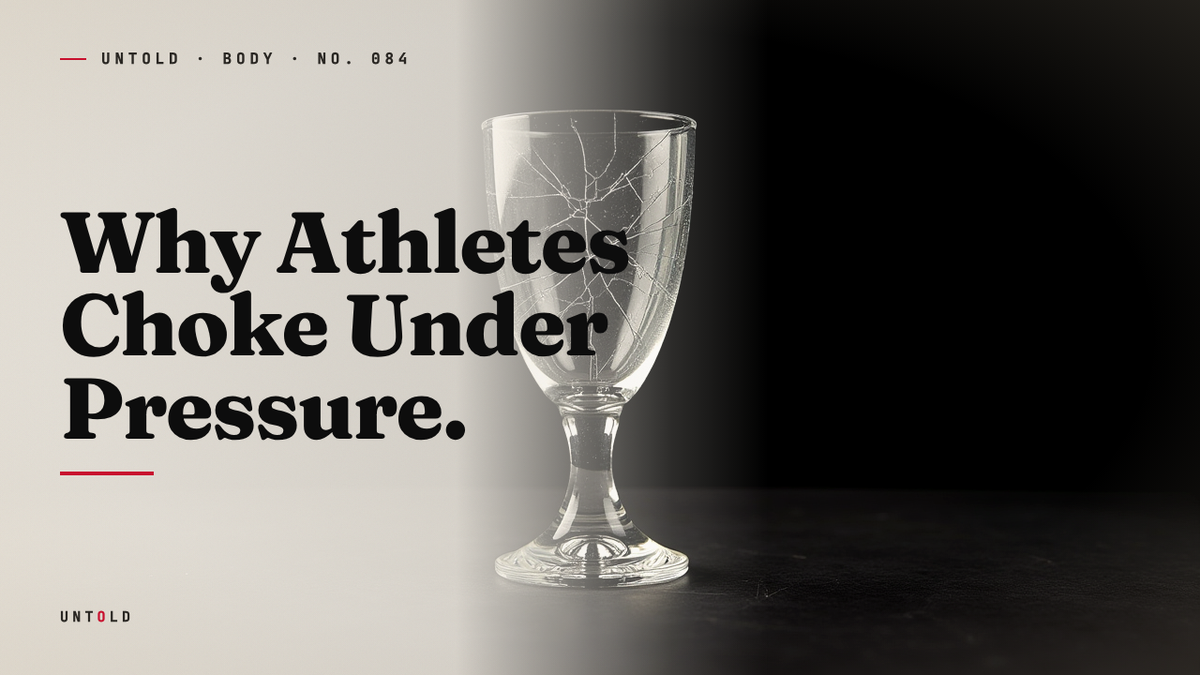
The stadium holds its breath. One shot decides everything. The player at the line has made this motion perhaps ten thousand times, in empty gyms at dawn, in the quiet repetition that turns a movement into a reflex. The mechanics are not in question. She could do this half-asleep. And then, with the whole world watching, she misses. Not by inches. By a margin that looks almost deliberate, as if some other person had briefly borrowed her body and did not know how to work it.
We have a word for this. We say she choked. It is a satisfying word, blunt and physical, and it explains absolutely nothing. It names the outcome and hides the mechanism. Because what happened in that instant was not a lapse of effort, or a failure of nerve, or bad luck arriving at the worst moment. It was something stranger and more specific: a well-trained system doing exactly what it was built to do, and being sabotaged from the inside by the very brain that trained it.
The question of what breaks, and why it breaks precisely when the stakes are highest, has occupied psychologists for four decades. The answer they have arrived at is unsettling. Choking is not the opposite of skill. In a sense, it is a consequence of it.
What Pressure Actually Means
Before anyone could study choking, someone had to define it in a way a laboratory could measure. That someone was Roy Baumeister, a social psychologist who, in 1984, ran a series of experiments that gave the phenomenon its scientific footing. 1
Baumeister’s contribution was deceptively simple. He defined pressure not as a vague feeling but as any factor that increases the importance of performing well. Money on the line, an audience watching, a reward promised for success: each of these raises the stakes, and Baumeister showed that raising the stakes reliably lowered the score. His subjects performed a task, and then he offered some of them a cash reward for doing it better. The ones with the most to gain got worse.
This is the first counter-intuitive turn in the story, and it sets up all the others. A reward should sharpen performance. Motivation is supposed to help. Yet Baumeister found the opposite: the incentive that made people care more was the same incentive that made them fail. Caring, it turned out, was not neutral. Caring changed where the mind put its attention, and attention, in the end, is the whole game.
Baumeister framed choking as “performance decrements under pressure circumstances,” a dry phrase that carries a sharp edge. A decrement is not a total collapse. It is a measurable slide, a degradation of something that was working fine a moment before. The word implies a system that has not stopped functioning but has stopped functioning well, and only under a particular kind of load. That specificity is what makes choking a scientific problem rather than a moral one.
Two Theories Enter the Ring
Once researchers accepted that pressure predictably degrades performance, the obvious next question was: through what channel? Two explanations emerged, and they have been fighting ever since.
The first is called distraction. The idea is that pressure fills the mind with worry, and worry consumes the mental resources a task needs to run. Working memory, the mental workspace where we hold and manipulate information, is finite. When anxiety floods it with intrusive thoughts about failure and consequence, there is simply less room left for the actual calculation. This theory explains choking in mental tasks beautifully. Under pressure, chess players miss combinations they would spot instantly at home, and students blank on exam questions they could answer in the hallway an hour later. The worry crowds out the work.
But sports pose a problem for distraction theory, and it is a revealing one. A free throw does not require much conscious calculation. There is nothing to hold in working memory. The body already knows the motion; it has been rehearsed into something closer to a reflex than a decision. If choking were only about distraction stealing mental resources, then skills that require no conscious thought should be immune. They are not. Elite athletes choke on precisely the movements they have automated most thoroughly. Something else must be at work.
That something is the second theory, and it belongs largely to the cognitive scientist Sian Beilock, who spent years at the University of Chicago dismantling the intuition that thinking harder helps. Her explanation runs directly against common sense. Pressure, she argued, does not make skilled athletes think too little. It makes them think too much. 2
Beilock called this explicit monitoring theory. The idea is that a practiced skill runs best when it runs silently, without the conscious mind narrating or steering. Under pressure, the athlete begins to watch the skill: to attend to the individual components of a motion that should unfold as a single fluid whole. She starts to control her wrist, her elbow, her follow-through, each step consciously managed. And conscious control is slow. It is clumsy. It is the mental equivalent of trying to describe how you walk down a flight of stairs while you are walking down it, which is a reliable way to trip.
Athletes have a phrase for this that predates the science by decades. They call it paralysis by analysis. The mind interrupts what the body already knows, and in the interrupting, ruins it.
The Golfers Who Watched Themselves
Beilock did not leave this as an elegant hypothesis. She tested it, and the results are among the most quietly devastating in the psychology of performance.
In a set of experiments, she had golfers putt under two conditions. In the first, they were distracted by a secondary task, something to occupy the conscious mind and pull it away from the stroke. In the second, they were told to attend closely to their own movement, to monitor the mechanics of the putt as they made it. Then she compared experts to novices.
The results split cleanly along the line of skill. Novices improved when they focused on their hands. This makes sense: a beginner is still assembling the skill, still figuring out the steps, and conscious attention helps them build it. But the experts got worse when they monitored themselves, and better when they were distracted. In some measures, skilled golfers made roughly twice the errors when forced to watch their own stroke. 2
The attention that helped the beginner was poison to the master. This is the crux of the whole matter. Skill, once trained, migrates. It moves out of the deliberate, step-by-step system that beginners rely on and into procedural memory, a fast and wordless system that runs without conscious supervision. The expert’s advantage is precisely that she no longer has to think about the motion. Pressure undoes this migration. It drags the skill back into conscious control, forcing an expert brain to operate like a nervous beginner’s. Choking, in Beilock’s account, is regression: an accomplished performer briefly demoted to novice by the act of paying too much attention.
The pattern is not confined to the putting green. The sports scientist Rob Gray found the same brutal logic in baseball. When he asked skilled batters to monitor their swing, to attend to the movement of the bat, their timing fell apart. 3 Hitting a baseball is one of the most demanding acts of anticipation in all of sport, a decision made in a fraction of a second on trajectory information the conscious mind cannot process fast enough. Ask the batter to think about it, and the whole delicate machine seizes. Gray’s hitters, forced to watch themselves, collapsed under exactly the load that pressure imposes in a real game.
What the Brain Reveals
The behavioral evidence is one thing. The neural evidence sharpens it. Brain imaging of performers under pressure shows a telling signature: the prefrontal cortex, the seat of deliberate, effortful control, over-activates. The region that plans and reasons and second-guesses fires up at precisely the moment a smooth automatic motion is trying to run. 4 The control center, in other words, hijacks a process that was doing perfectly well without it.
The body wants to flow. The mind keeps grabbing the wheel. And this grabbing is not free. Inserting conscious control into an automated skill adds a delay, a few hundred milliseconds of hesitation as the deliberate system inserts itself where it was not needed. In everyday life, a fraction of a second is nothing. In elite sport, where a swing must connect with a ball moving faster than the eye can track, that delay is the entire distance between a clean strike and a missed one. The interference is small in absolute terms and catastrophic in effect.
There is a second front in this collapse, and it belongs to the body rather than the mind. Pressure triggers the stress response, the ancient fight-or-flight cascade that floods the system with adrenaline and cortisol. The heart races. Breathing shortens. The hands tremble faintly. Vision narrows into a tunnel, sacrificing the periphery for a locked focus straight ahead. This response evolved to save our ancestors from predators, and for that purpose it was superb. It readies the large muscles for explosive effort and dulls attention to everything but the threat.
But a putt does not require explosive effort. It requires the opposite: steady hands, soft focus, exquisitely fine motor control. The body, sensing high stakes, prepares to fight or flee when all it needs to do is execute a delicate, practiced movement. The adrenaline that would help you sprint from danger makes your fingers shake over a two-foot putt. The tunnel vision that would help you fixate on a charging animal strips away the peripheral awareness a quarterback needs to read a field.
So choking is a double betrayal, two systems turning on their owner at once. The mind clamps down on a skill that runs best when left alone. The body braces for a physical crisis that is not coming. Together they take an athlete who has done this ten thousand times and hand her, for the length of a single crucial moment, someone else’s nervous, over-thinking, adrenaline-soaked body.
The Cruelty of Caring
Here is the twist that reframes the whole phenomenon. Choking is not a character flaw. It is not weakness, or a lack of grit, or evidence that someone did not want it badly enough. If anything, it is the reverse. The athletes most vulnerable to choking are often the ones who care most, because caring is what loads the whole system in the first place.
Think back to Baumeister’s finding. It was the reward, the raised stakes, the sheer importance of the outcome that produced the failure. The mechanism runs through motivation. You monitor your own stroke because the shot matters. You flood with adrenaline because your brain has correctly identified this as a moment of consequence. The person who does not care cannot choke, because they never engage the machinery that choking exploits. In this light, a choke is not the mark of someone who wanted it too little. It is the signature of someone who wanted it too much, and whose desire recruited exactly the conscious, effortful, high-arousal systems that automated skill cannot survive.
This reframing matters, and not only for athletes. It means the standard advice, try harder, focus more, want it more, is not just useless but actively counterproductive. Trying harder means monitoring harder, and monitoring is the disease. The instruction to bear down and concentrate, offered by well-meaning coaches everywhere, is a prescription for the very self-focus that breaks the skill. The fix is not more effort. It is less thought.
Learning to Think Less
If the problem is conscious interference, the solutions all point in the same direction: keep the deliberate mind occupied so the trained body can run free.
The first strategy is to train under the conditions you fear. Beilock’s research suggested that athletes who practice under mild pressure, with crowds, with stakes, with real consequences, build a kind of immunity. Performing while anxious becomes familiar, and familiarity strips pressure of its novelty. The nervous system learns that a racing heart and a watching crowd are not, in fact, a signal to seize up. An athlete who has only ever practiced in calm cannot expect her skill to survive its first encounter with chaos. The remedy is to make chaos ordinary.
The second strategy is stranger and more direct: give the conscious mind something harmless to do. Hum a tune. Fix on a single external target and hold it. This is why golfers whistle, why free-throw shooters cycle through the same fixed ritual before every attempt, the identical bounce, the identical breath, the identical release. The ritual is not superstition. It is a decoy. It occupies the prefrontal cortex with a simple external focus so that it cannot micromanage the motion. A single point of attention outside the body keeps the control center from reaching in and grabbing the wheel. One external cue can prevent the entire spiral.
There is a third, quieter lever: speed. The less time an athlete has to think, the less time there is for conscious control to insert itself. Many performers report that their best moments come when there was no room to deliberate, when the play happened faster than thought and the trained body was simply allowed to act. Hesitation is the enemy, because hesitation is a window through which the monitoring mind climbs back in.
The Familiar Machinery of Failure
Choking wears a uniform on television, but it is not confined to athletes. The same machinery runs in an exam hall, on a stage, across the table on a first date, in every rehearsed sentence that suddenly deserts you in the meeting that matters. Anywhere a practiced ability meets a moment of consequence, the loop can close: the stakes raise attention, attention turns inward, the smooth thing becomes clumsy, and the harder you try to fix it, the more thoroughly you break it. It is one of the most democratic of human failures, and one of the least understood by the people it happens to.
What the science offers is not a cure but a diagnosis, and diagnosis is its own kind of relief. The next time you freeze at the moment it matters, it is worth remembering what is actually happening. You have not forgotten how. The skill is intact, waiting exactly where you left it. The trouble is only that you are watching yourself too closely, and the watching is the thing that breaks the spell. The way out is not to look harder. It is to look away.
Sources
- Baumeister, R. F., “Choking under pressure: Self-consciousness and paradoxical effects of incentives on skillful performance,” Journal of Personality and Social Psychology, 1984. — https://psycnet.apa.org/record/1984-31119-001
- Beilock, S. L. & Carr, T. H., “On the fragility of skilled performance: What governs choking under pressure?” Journal of Experimental Psychology: General, 2001. — https://psycnet.apa.org/record/2001-01018-002
- Gray, R., “Attending to the execution of a complex sensorimotor skill: Expertise differences, choking, and slumps,” Journal of Experimental Psychology: Applied, 2004. — https://psycnet.apa.org/record/2004-12800-002
- Beilock, S. L., Choke: What the Secrets of the Brain Reveal About Getting It Right When You Have To, Free Press, 2010. — https://www.simonandschuster.com/books/Choke/Sian-Beilock/9781416596189
- DeCaro, M. S. et al., “Choking under pressure: Multiple routes to skill failure,” Journal of Experimental Psychology: General, 2011. — https://psycnet.apa.org/record/2011-06712-001
- Yu, R., “Choking under pressure: The neuropsychological mechanisms of incentive-induced performance decrements,” Frontiers in Behavioral Neuroscience, 2015. — https://www.frontiersin.org/articles/10.3389/fnbeh.2015.00019/full
Related reading