The Coldest Revolution in Your Kitchen
How a humming metal box quietly rewrote what billions of people eat every day.
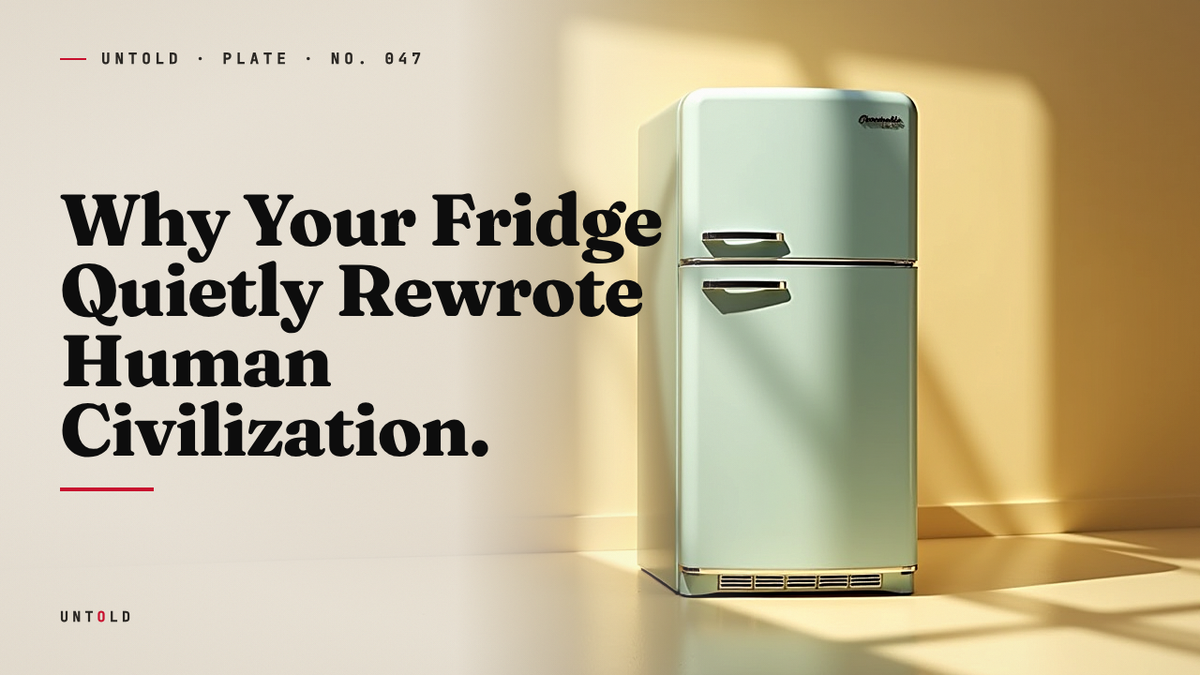
Open the door and the light comes on. Inside, arranged on wire shelves, is a small inventory of things that should not exist together in the same place at the same time. Strawberries in January. Salmon a thousand miles from the nearest coast. Milk that has stayed sweet for a week. Butter that will not turn. A carton of eggs beside a bag of spinach beside a jar of something pickled by habit rather than necessity. None of it is remarkable to the person reaching in for a snack. All of it would have astonished nearly every human being who ever lived.
For most of history, food was a race against rot. You ate it, or you lost it. The refrigerator is the machine that ended that race, and in doing so it reshaped the human diet more thoroughly than any single crop, any trade route, any cookbook. It killed local eating. It built the supermarket. It changed the size of families and the shape of cities. It even, quietly, altered the diseases we die of. And almost nobody talks about it, because it hums in the corner and asks nothing of us but electricity.
The world before cold
In 1800, keeping food meant defeating it. Preservation was a form of controlled damage: you salted meat until it was armored against decay, smoked fish until it tasted of the fire, pickled vegetables in vinegar strong enough to sting, or dried everything into leather that could be reconstituted later with water and hope. Spices, so prized that empires organized themselves around their trade, were valued partly because they masked the flavor of food already turning. Milk soured within hours in a warm room. Meat was a gamble measured in days.
The wealthy had one weapon the poor did not: ice. In cold climates, workers cut blocks from frozen lakes and rivers in winter and buried them in insulated pits called icehouses, layered in straw or sawdust, where they could last through summer. It was a seasonal luxury, dependent on geography and weather. A mild winter meant a poor harvest of ice, and a poor harvest of ice meant spoiled food and lost fortunes.
Out of this fragility grew one of the stranger industries of the nineteenth century. A Boston entrepreneur named Frederic Tudor, remembered as the Ice King, built a business shipping New England lake ice to the tropics. His first cargo, sent to the Caribbean in 1806, was met with ridicule. Nobody knew what to do with it, and much of it melted before it could be sold. Tudor spent years refining insulation, teaching bartenders to serve chilled drinks, and cultivating a taste for cold in hot places. By the 1850s his ships were carrying blocks of frozen New England to Cuba, to South America, and remarkably to Calcutta, insulated in sawdust across the equator 1.
It worked, but it was absurd, a system that depended on cutting winter out of one hemisphere and carrying it to another. Ice melted. Winters failed. The obvious solution was cold that did not depend on the season at all. The problem was that nobody knew how to manufacture it.
The long road to artificial cold
The underlying secret had been understood, at least in outline, for a surprisingly long time. When a liquid evaporates, it draws heat from its surroundings. Sweat cools the skin by exactly this principle. If you could force a liquid to evaporate on demand, you could pull heat out of a room and leave cold behind.
In 1755, the Scottish physician and chemist William Cullen demonstrated the effect in a laboratory at the University of Glasgow. He boiled a volatile liquid in a partial vacuum and watched, as the vapor carried heat away, a thin skin of ice form on the vessel 2. It was the first artificial refrigeration in recorded history, and for nearly a century it remained exactly that: a demonstration. A parlor curiosity with no engine, no purpose, no path to the kitchen.
The man who tried to give it a purpose was an American physician named John Gorrie, working in Apalachicola, Florida, in the 1840s. Gorrie was fighting yellow fever and malaria in a hot, swampy town, and he had convinced himself, on the medical theories of his day, that cooling the air might ease his patients’ fevers. To cool the air, he built a machine that compressed and then expanded gas to produce ice. He patented it in 1851, one of the earliest patents for mechanical refrigeration in the United States 3.
Gorrie believed the technology could remake the world. “Ice can be made cheaper than nature provides it,” he insisted, imagining a future where cold was manufactured rather than harvested. But the ice-trade interests had no reason to help a man threatening their business, investors mocked him as a crank, his principal backer died, and Gorrie’s project collapsed. He died in 1855, broke and largely forgotten, his machine decades ahead of any market that could use it.
What finally pulled refrigeration out of the realm of eccentric invention was not medicine or comfort. It was beer.
Breweries, railcars, and the industrial cold chain
Brewing lager demands steady, low temperatures during fermentation, and German brewers, unwilling to depend on natural ice, had money and motive to fund a reliable machine. The engineer they backed was Carl von Linde, a professor in Munich who turned refrigeration from a fragile experiment into industrial equipment. In 1876 Linde patented an ammonia-based compression system that actually worked at scale, running continuously and predictably 4. It was the breakthrough that Cullen’s ice skin and Gorrie’s failed patent had only gestured toward.
Linde’s machines spread with startling speed, and not only through breweries. Meatpackers saw the possibilities immediately. So did shipping companies. And the transformation that followed was less about the home kitchen than about the entire architecture of how food moved across a continent.
Before refrigeration, cattle raised on the plains had to walk to the cities, or ride the rails alive, arriving lean, bruised, and expensive to feed along the way. Refrigerated railcars changed the calculus entirely. Now animals could be slaughtered in central hubs like Chicago, chilled, and shipped as dressed meat across the country without spoiling. By the turn of the twentieth century, refrigerated rail was moving enormous tonnages of meat annually, and the great slaughterhouses of the American Midwest had become industrial machines of a kind the world had never seen 5. The cost of meat fell. The geography of the diet detached from the geography of the farm.
This was the birth of what logisticians now call the cold chain: an unbroken sequence of refrigeration from the place food is produced to the place it is eaten. Cold moved from the icehouse to the factory to the railcar to the ship. There was only one place it had not yet reached. The home was still warm.
Bringing cold into the kitchen
Well into the twentieth century, the ordinary household still relied on the icebox, an insulated wooden cabinet cooled by a block of ice delivered by a horse-drawn wagon. It dripped. It ran out. It required a stranger to visit your kitchen every few days. The mechanical cold that had transformed industry had not yet been shrunk to fit a home, and the early attempts to shrink it were dangerous.
The first domestic refrigerators used the same refrigerants as industry: ammonia, sulfur dioxide, methyl chloride. These gases were toxic, and refrigerators leaked. Through the 1920s there were reports of families poisoned in their sleep by fumes seeping from the machine meant to protect their food. A device that killed the people it served could never become a fixture of every household. Something in the chemistry had to change.
The change came from a chemist named Thomas Midgley Jr., who in 1928 synthesized a new compound, dichlorodifluoromethane, marketed as Freon 6. It was stable, non-flammable, non-toxic to breathe, and odorless. Almost overnight, the domestic refrigerator became safe. (Freon carried a hidden cost that would not be understood for another half century, when chlorofluorocarbons were found to be destroying the ozone layer and were phased out under the Montreal Protocol. But that reckoning belonged to the future.)
With safety solved, the appliance became a mass-market dream. General Electric and Frigidaire competed to put a humming white box in every American kitchen, and the country bought them at extraordinary speed. By the mid-1940s, roughly 85 percent of American homes owned a refrigerator, a saturation few technologies have ever matched so quickly 7.
And the moment the machine crossed the threshold into the home, it began to change how people ate.
The diet the refrigerator built
Before home refrigeration, shopping was a daily errand. You bought what you would eat that day because you had no way to keep it longer. The refrigerator collapsed that rhythm. Families could now shop once a week, buying in bulk and storing what they bought. The corner grocer, who had weighed out small quantities of perishables by hand, gave way to a new kind of store built around cold storage and self-service: the supermarket. Refrigerators and supermarkets grew together, each making the other possible. Home cold made bulk buying practical; bulk buying made the vast, chilled supermarket viable.
Into the space the freezer opened stepped a former fur trader and naturalist named Clarence Birdseye. Working in Labrador in the 1910s, Birdseye had watched Inuit fishermen pull fish from the water into air so cold it froze them almost instantly, and he noticed something. Fish frozen fast, at very low temperatures, tasted fresh when thawed, while fish frozen slowly turned mushy. The difference, he realized, was the size of the ice crystals: quick freezing formed crystals too small to rupture the cell walls of the food. Birdseye spent the 1920s engineering a flash-freezing process and, in 1930, brought frozen packaged foods to American grocery stores 8.
It was a quiet revolution in what a plate could hold. Peas in winter. Fish deep inland. Vegetables picked at ripeness, frozen at the peak of their season, and eaten months later in a landlocked city. The frozen dinner, the gallon of ice cream, the bag of vegetables that never spoiled: all of it flowed from that observation on the Labrador ice. Today the global cold chain moves well over thirteen billion tons of food a year, an invisible refrigerated infrastructure that most people never think about but could not live the way they do without 9.
The health revolution nobody planned
Here is the part that almost no one expects. The refrigerator did not merely preserve food. It quietly rewired human health, and it did so through a mechanism that had nothing to do with anyone’s intention.
For centuries, the dominant method of preserving meat and fish was salt, and lots of it. Heavy salt preservation meant that populations consumed enormous quantities of sodium and of the nitrogen compounds that formed in salted, smoked, and cured foods. Epidemiologists have long noted that stomach cancer was once among the most common fatal cancers in the industrialized world, and that its rates fell dramatically over the twentieth century, well before any deliberate medical campaign against it. One of the leading explanations for that decline is the refrigerator. As cold storage replaced salt as the primary means of keeping food, salt intake fell, consumption of fresh fruits and vegetables rose year-round, and the chronic irritation and carcinogen exposure that drove stomach cancer diminished 10. The falling curve of stomach cancer tracks, across many countries, the rising curve of refrigeration.
So the machine that let you keep leftovers also, without anyone designing it that way, lengthened lives. Less salt meant less hypertension and fewer of the diseases that follow it. More reliable access to fresh produce meant better nutrition across the calendar. It was preventive medicine delivered by an appliance.
But the ledger has another column. The same cold that reduced our salt gave us the highly processed, shelf-engineered, year-round abundance that defines the modern food landscape, with its frozen dinners and its bottomless variety and its detachment from any sense of season. We gained safety, we gained choice, and we lost something harder to name: the rhythm of eating what was ripe and nearby, the knowledge that certain foods belonged to certain months, the anticipation that came from scarcity. Strawberries in January feel ordinary now. Two centuries ago they would have been a miracle, or a lie.
The quietest machine that changed a species
There is something fitting in how little attention the refrigerator receives. Great inventions are supposed to announce themselves: the engine roars, the screen glows, the rocket leaves the ground. The refrigerator hums. It does its enormous work in silence, in a corner, behind a door that opens onto a manufactured winter no one questions anymore.
And yet inside that door sits the accumulated history of how we learned to eat. Cullen’s skin of laboratory ice, Gorrie’s ruined ambition, Tudor’s sawdust-packed ships, Linde’s ammonia compressors, the Chicago slaughterhouses and the refrigerated rail, the poisoned families of the 1920s and the chemistry that saved them, Birdseye watching fishermen on the ice, the supermarket and the falling curve of stomach cancer. All of it is folded into the cold that keeps your milk sweet. The next time you open that door, half-awake, reaching for something without thinking, it is worth remembering that you are reaching into one of the great quiet revolutions of the human story, the one that finally won the oldest race there was: the race against rot.

Sources
- Weightman, Gavin, The Frozen Water Trade: A True Story, Hyperion, 2003. — https://en.wikipedia.org/wiki/Frederic_Tudor
- Cullen, William, Essay on the Cold Produced by Evaporating Fluids, University of Glasgow, 1755. — https://en.wikipedia.org/wiki/William_Cullen
- Gorrie, John, U.S. Patent 8080: Improved Process for the Artificial Production of Ice, 1851. — https://en.wikipedia.org/wiki/John_Gorrie
- Linde, Carl von, biography and 1876 ammonia refrigeration patent, ASHRAE / Linde Group. — https://en.wikipedia.org/wiki/Carl_von_Linde
- Cronon, William, Nature’s Metropolis: Chicago and the Great West, W. W. Norton, 1991. — https://en.wikipedia.org/wiki/Refrigerator_car
- Midgley, Thomas Jr., and the synthesis of Freon, American Chemical Society, 1928. — https://en.wikipedia.org/wiki/Freon
- Cowan, Ruth Schwartz, More Work for Mother, Basic Books, 1983. — https://en.wikipedia.org/wiki/Refrigerator
- Kurlansky, Mark, Birdseye: The Adventures of a Curious Man, Doubleday, 2012. — https://en.wikipedia.org/wiki/Clarence_Birdseye
- International Institute of Refrigeration, The Role of Refrigeration in the Global Economy, IIF-IIR, 2021. — https://iifiir.org/en/encyclopedia-of-refrigeration
- Coggon, D., et al., “Stomach cancer and the decline in salt preservation,” and related epidemiological reviews on refrigeration and gastric cancer, various journals. — https://www.ncbi.nlm.nih.gov/pmc/articles/PMC2683009/
Related reading