The Long Argument Over Who Eats the Most Cheese
France built a civilization on curdled milk, but the crown for consumption is stranger than any menu suggests.
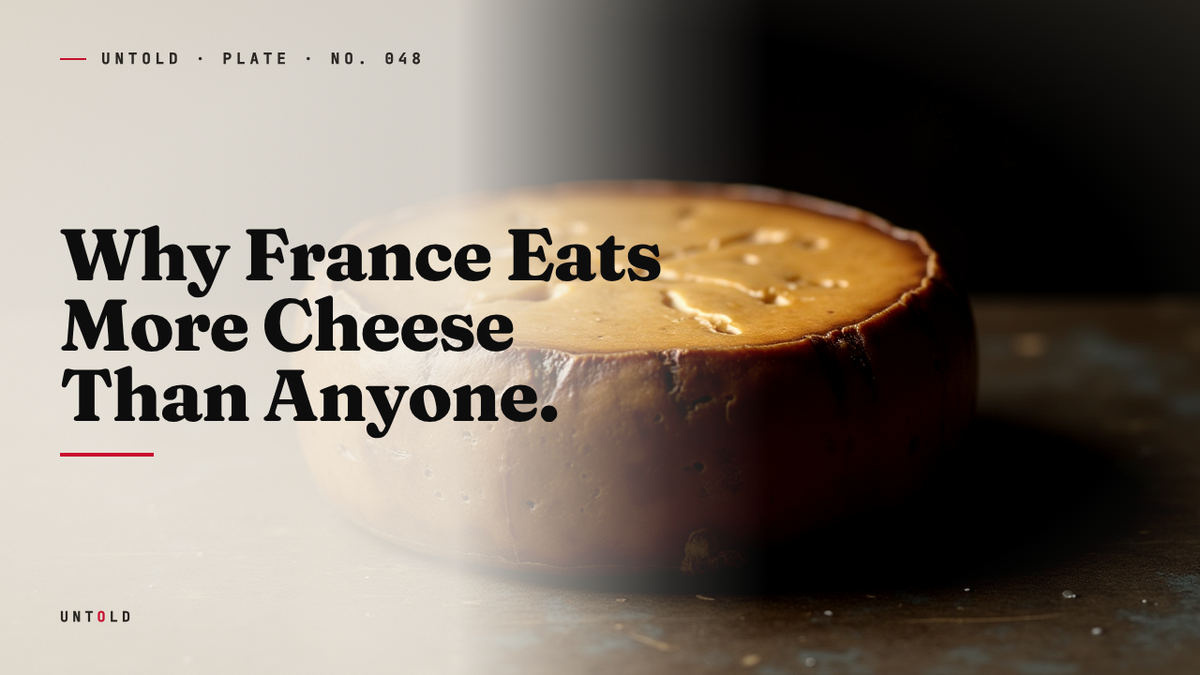
Somewhere right now, a person is finishing their twenty-eighth kilogram of cheese for the year. That is roughly half the body weight of an average adult, rendered into curds, aged in caves, crumbled over salads, folded into gratins, and eaten in slivers after dinner. It sounds like the diet of an eccentric. It is, in fact, the national average of a wealthy modern country, and the identity of that country tells us something unexpected about how food becomes culture, how culture becomes law, and how a single spoiling liquid became one of the most jealously guarded treasures in the human larder.
The obvious guesses are wrong. Not Italy, with its wheels of Parmigiano-Reggiano aged for years in humidity-controlled warehouses and struck with a hammer to test for cracks. Not Greece, where feta bobs in brine on every table across the Aegean. The country most people associate with cheese fanaticism, and the one that has done more than any other to turn dairy into a matter of national self-definition, is France. The French eat their way through something close to sixty pounds of cheese per person every year, more than twice the global average.1 But the truly interesting question is not how much. It is why this happened at all, and whether France still deserves the crown it has worn for so long.
A nation that cannot agree on itself
Charles de Gaulle, exasperated by the difficulty of leading a fractious postwar republic, is supposed to have asked how anyone could govern a country that produces two hundred and forty-six varieties of cheese.2 The quotation exists in several forms, with the number shifting from telling to telling, which is fitting, because the real figure was always a moving target. Depending on how you define a distinct cheese, France makes somewhere between four hundred and more than a thousand.2 De Gaulle’s point was political. A nation with that many cheeses is a nation with that many regions, that many stubborn local loyalties, that many ways of doing the same thing differently and insisting its way is correct.
To understand France, you have to understand its almost impossible geography of dairy. Each region produces its own varieties, shaped by soil, altitude, climate, breed of animal, and the accumulated habits of generations. Roquefort ripens in limestone caves in the south, threaded with the blue mold Penicillium roqueforti, ventilated by natural fissures in the rock called fleurines that draw cool, damp air through the aging cellars. Comté matures for months, sometimes years, in the cold air of the Jura mountains, its flavor traceable to the alpine grasses the cows graze. Munster comes from the Vosges, Cantal from the volcanic plateaus of the Massif Central, Camembert from the pastures of Normandy. Each is a small argument about place, a claim that this hillside and this herd and this cellar produce something that cannot be reproduced anywhere else.
France produces more distinct cheese varieties than any other nation on Earth, and this abundance did not appear overnight. Its roots stretch back thousands of years, to a time long before anything called France existed, when the people living on this land were already turning perishable milk into something that could last through winter. The story of French cheese is really the story of a much older human discovery, one that France simply refused to let go of.
An accident with a stomach
Cheese was almost certainly born by accident. The most durable theory holds that early herders, needing to carry milk across long distances, stored it in containers made from the stomachs of young animals. Those stomachs still contained rennet, an enzyme complex whose active ingredient, chymosin, evolved to help nursing mammals digest their mothers’ milk. Rennet does something remarkable to milk. It causes the proteins to coagulate, separating the liquid into solid curds and watery whey. A herder who opened a milk-filled stomach pouch after a day’s walking would have found the beginnings of cheese: firm, tangy, and far more resistant to spoiling than the milk that went in.
For early farmers, this was not a delicacy. It was survival. Fresh milk in a warm climate turns quickly, and it also carries a problem invisible to the people drinking it. Most adult humans in the ancient world could not digest lactose, the sugar in milk, without discomfort. The act of turning milk into cheese solves both problems at once. It concentrates fat and protein into a storable form, and it consumes much of the lactose in the process, making the result far easier on the gut. Cheese was, in effect, a technology for extracting durable calories from an unreliable resource.
Just how old that technology is became clear through the work of the archaeologist Melanie Salque and her colleagues, who in 2012 published an analysis of ancient pottery from the Kuyavia region of Poland.3 The vessels were riddled with small holes, resembling sieves, and had puzzled researchers for years. Salque’s team analyzed the fatty residues absorbed into the clay and found the chemical signatures of milk fat. The perforated pots were cheese strainers, used to separate curds from whey, and they were nearly seven thousand years old. The design so closely matched strainers still used in parts of Europe today that the continuity was startling. “These early farmers,” Salque and her colleagues concluded, were processing milk into cheese in the sixth millennium BC, among the oldest evidence for the practice anywhere.3 Traces even older, pushing toward eight thousand years, have since emerged from other sites across the Near East and the Mediterranean.
So the raw invention was not French. Cheese predates France by millennia and belongs to no single culture. The real question is why the people of this particular corner of Europe took the craft so much further than anyone else, refining it into hundreds of named varieties and building an entire national identity around it.
The patient work of monks
Much of the answer lies in the medieval monastery. From roughly the sixth century onward, the abbeys of France and the wider Christian world became the great laboratories of European cheese-making. Monks had exactly the resources the craft demanded. They had land and livestock, granted by nobles seeking spiritual favor. They had cool stone cellars ideal for the slow, patient business of aging. Above all they had time, and a discipline that valued repetition and record-keeping. Where a peasant household made cheese by memory and habit, monks wrote things down, refined their techniques over decades, and passed the accumulated knowledge from one generation of the order to the next.
The results still fill French cheese counters. Munster, whose name derives from monasterium, was developed by monks in the Vosges valleys. Maroilles, one of the oldest French cheeses still made, traces its origin to an abbey in the north around the tenth century. Countless washed-rind and blue cheeses across the country carry the fingerprints of monastic invention. For the monasteries, cheese was more than food. It was a permitted source of protein during the frequent fasts when meat was forbidden, a spiritual discipline of patience and attention, and, not least, a reliable source of income. Monastic cheeses were sold at market and traded across regions, spreading both the product and the methods that made it.
By the late Middle Ages, France was already home to dozens of distinct regional cheeses, each with its own partisans and its own claim to superiority. Cheese had moved from a survival food to a cultural artifact, something a place could be known for, something worth defending. And before long, the French did exactly that. They defended it with the law.
The invention of protected origin
In 1411, a charter issued in the name of King Charles VI granted the people of the village of Roquefort-sur-Soulzon an extraordinary privilege. Only cheese aged in the natural caves beneath their village could legally bear the name Roquefort.4 It is one of the earliest examples anywhere of a food being legally tied to a specific place, a recognition that the caves themselves, with their peculiar molds and airflows, were part of what made the cheese what it was. Roquefort could not simply be manufactured elsewhere and given the famous name. The name belonged to the ground.
That charter was a seed. Over the following centuries, and especially in the twentieth, France built an entire legal architecture around the idea that certain foods are inseparable from their origins. The system is known as the Appellation d’Origine Contrôlée, or AOC, and it began with wine before extending to cheese. Roquefort became the first cheese to receive AOC protection in 1925.4 To carry the name today, a cheese must be made from the milk of specific sheep breeds, follow traditional methods, and be ripened in those particular caves. The rules are exacting and enforced.
The French model was so influential that the European Union adopted a version of it for the entire continent, the Protected Designation of Origin. Today more than forty French cheeses hold protected origin status under these overlapping systems.5 This legal armor did something subtle and powerful. It turned each cheese into a piece of guarded heritage, a small monument to a place and a way of life. To make Comté or Roquefort or Camembert de Normandie was to participate in a tradition the state itself had certified as worth preserving. Cheese became, quite literally, a matter of national law.
Cheese as a daily rite
Law and history explain the abundance of French cheese. They do not, on their own, explain why the French eat so much of it. That comes down to something less grand and more habitual: the structure of a meal.
In France, cheese is not a snack grabbed from the fridge. It is a course, with its own place in the sequence of eating. Traditionally it arrives after the main dish and before, or instead of, dessert, offered on a board with bread and perhaps a little fruit. This is not reserved for special occasions. A typical French household keeps several cheeses on hand as a matter of course, and cheese appears on the table across the great majority of days.1 The ritual has a whole supporting economy behind it: open-air markets, dedicated fromageries, and the affineurs, specialists who buy young cheeses and age them in their own cellars until they reach precisely the ripeness they judge ideal. To be an affineur is to treat aging itself as a craft, coaxing a wheel toward its peak with the care of a sommelier.
All of this adds up to a culture in which cheese is woven into ordinary life rather than saved for indulgence. It is eaten deliberately, appreciated, discussed, and matched to the season and the occasion. That daily presence, multiplied across a nation of sixty-odd million people, is what produces those astonishing per-person figures. The French eat a great deal of cheese not because they binge on it, but because they eat a little of it, thoughtfully, almost every day.
The crown that will not sit still
And here is where the tidy story complicates itself. For all its history and ritual and legal pageantry, France is not always the world’s top cheese-eater. Depending on the year and the source, that title has slipped to Denmark, and in some rankings to Iceland, where per-person consumption has surged past traditional strongholds.6 The Nordic countries, less romantic about the subject, have quietly overtaken the nation that made cheese into a philosophy.
The reason exposes how slippery the whole question is. The crown for “most cheese” depends entirely on how you count. Some surveys measure only cheese eaten as cheese, the wedge on the board, the slice on the plate. Others include cheese hidden inside processed food: the mozzarella melted across a frozen pizza, the cheddar folded into a packaged sauce, the processed slices in a fast-food sandwich. Northern and industrial food cultures consume enormous quantities of cheese this second way, as an ingredient rather than a course. Measure total tonnage, including everything melted and mixed and manufactured, and the ranking looks very different from a measure of cheese eaten with intention.
So there are two different questions wearing the same crown. France leads, and has always led, in variety and ritual, in the sheer diversity of what it makes and the cultural care with which it eats. Other countries may lead in raw volume, in the industrial appetite for cheese as a component of modern convenience food. The true champion depends on whether you value tradition or tonnage, the aged wheel in the affineur’s cellar or the shredded bag in the supermarket freezer. Both are cheese. They are barely the same thing.
The taste of accumulated time
Strip away the rankings and something more durable remains. Long before nations or laws or monasteries, a herder somewhere discovered that milk carried in a dead animal’s stomach came out transformed, firmer, tangier, and slow to spoil. That accident, repeated and refined across eight thousand years, became one of humanity’s great acts of preservation, a way of holding the fat of summer through the hunger of winter. France did not invent it. France did something arguably rarer. It refused to let the craft flatten into commodity, protecting hundreds of local versions by law and habit until each became a small argument about where it came from. The next time you cut into a wedge of something aged and complicated, that is what you are tasting. Not just fat and salt and mold, but time itself, and the long human patience that learned to make spoiling milk last.

Sources
- CNIEL (French Dairy Interprofessional Center), cheese consumption statistics, 2020 — https://www.filiere-laitiere.fr/en
- Charles de Gaulle quotation, in Ernest Mignon, Les Mots du Général, 1962 — https://en.wikipedia.org/wiki/Charles_de_Gaulle
- Salque, M. et al., ‘Earliest evidence for cheese making in the sixth millennium BC in northern Europe,’ Nature, 2013 — https://www.nature.com/articles/nature11698
- Roquefort AOC history, Confédération Générale de Roquefort — https://en.wikipedia.org/wiki/Roquefort
- European Commission, Geographical Indications and Quality Schemes (PDO/AOC cheeses) — https://agriculture.ec.europa.eu/farming/geographical-indications-and-quality-schemes/geographical-indications-and-quality-schemes-explained_en
- International Dairy Federation, world cheese consumption per capita figures, 2021 — https://fil-idf.org/
Related reading