The Clock on Your Plate
Three meals a day feels like nature. It is closer to an accident of machines and marketing.
It is noon. Somewhere a clock ticks past the hour, and across an entire timezone, millions of stomachs begin to stir. The sensation feels urgent, biological, beyond argument: hunger, the body’s plain demand. But it is worth asking a quietly subversive question before reaching for lunch. Is that hunger honest, or did the clock invent it?
The answer is less obvious than it seems. The three-meal day arrives with such force of habit that it passes for a law of nature, like sleep or thirst. We rarely interrogate it. Breakfast, lunch, dinner: the structure feels as ancient as eating itself. Yet for most of human history, people did not eat this way. The schedule we treat as instinct is a recent invention, assembled out of religion, labor, profit, and a few extraordinarily effective advertising campaigns. The stomach does not own a watch. Somebody handed it one.
The shame of the morning meal
To see how strange our arrangement is, it helps to travel back to ancient Rome, where the rules governing the table looked nothing like ours. The Romans organized their day around a single substantial meal, the cena, taken in the afternoon or early evening. It was the social and culinary center of the day, the moment families and guests gathered. Eating much before it was regarded with suspicion.1
Morning eating in particular carried a faint odor of disgrace. To break one’s fast early, especially with anything more than bread dipped in wine, was associated with gluttony, with a lack of restraint, with the sort of person who could not master his appetites. The Roman physician and the Roman moralist agreed on this much: the disciplined body waited. Food taken too soon was the mark of weakness.
This suspicion did not die with Rome. Medieval Europe inherited and amplified it, and the Christian church gave it moral weight. To eat before attending to prayer, before completing the morning’s labor, before the sun had climbed, suggested an undisciplined soul governed by the body rather than the spirit. The very word breakfast, the breaking of the night’s fast, implies a fast worth maintaining. Eating early was something to apologize for. Among the devout and the respectable, the real meal came later, and it came together.2
The historian of food who examines these centuries finds no stable three-meal pattern at all. The number of meals, their size, their timing, all shifted with class, season, region, and creed. The peasant ate differently from the lord, the monk differently from the merchant. What unites these worlds is the absence of the rigid clockwork we now take for granted. People ate when food was available, when work paused, when daylight allowed. The schedule bent to circumstance. It had not yet hardened into rule.
Fields, fires, and the rising sun
If breakfast carried shame for so long, how did it climb back onto the table and eventually claim the title of the most important meal of the day? The first part of the answer lies in the field, with the laborer who rose before dawn.
For the agricultural worker, the logic of the heavy early meal was inescapable. The day’s labor was physical to a degree most modern office workers can scarcely imagine: hours of mowing, hauling, digging, and lifting, all powered by nothing but muscle and bread. When the human body is the engine, it must be stoked before the work begins. A substantial morning meal was not indulgence. It was fuel for survival. As more of Europe and then America became a working agricultural society, the early meal slowly lost its association with sin and gained a reputation for sturdy practicality.3
Still, this was eating organized around the sun and the season. The farmer ate when light allowed and labor demanded, and the rhythm varied with the calendar. Summer days stretched long; winter shortened the working hours and the meals along with them. The structure was loose, responsive, tied to the natural world. What rigidified it, what fixed the three-meal day into the unbending grid we now inhabit, was not the field at all. It was the factory.
The whistle that fixed the day
The Industrial Revolution did many things to the human body, and one of the least examined was what it did to eating. As the eighteenth century gave way to the nineteenth, millions of people were drawn out of the fields and into the mills, factories, and mines of the new industrial economy. With them came a new master of time: not the sun, not the season, but the clock and the factory whistle.
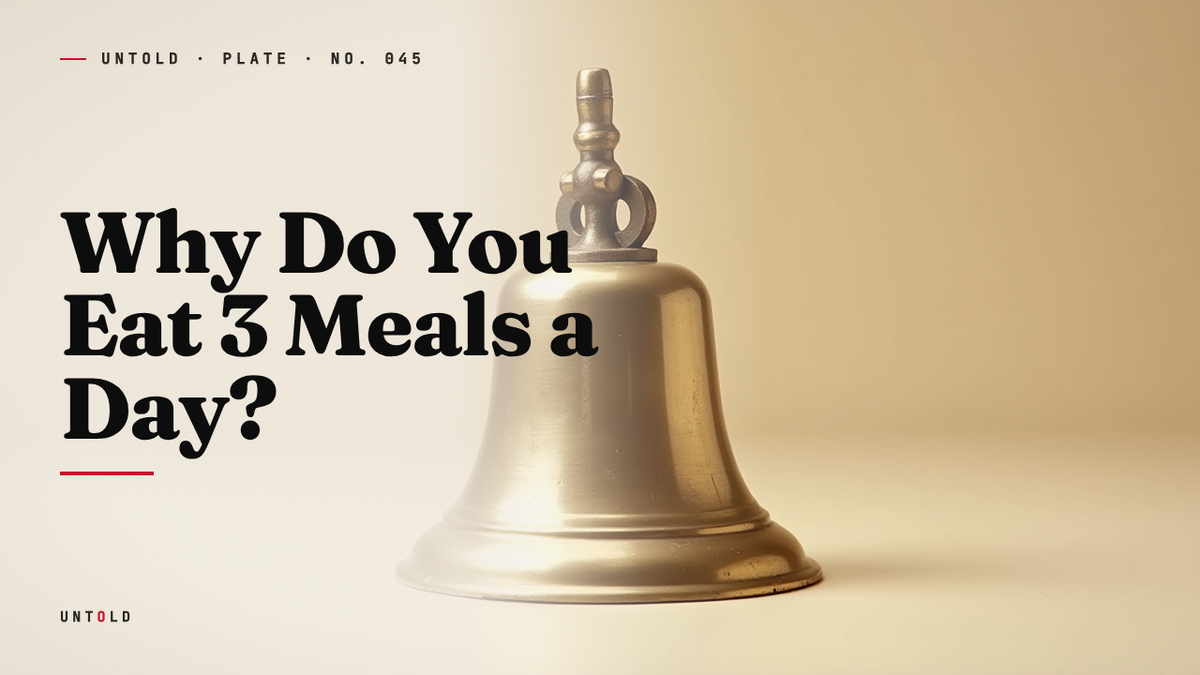
Industrial labor demanded synchronization. A machine cannot pause when one worker grows hungry and resume when another finishes lunch. The whole apparatus had to start and stop together, which meant the workers had to start and stop together. The factory bell sliced the day into rigid, identical blocks, and meals had to be wedged into the gaps the schedule allowed.4 A meal before the morning shift. A short, regimented break at midday. A larger meal after the whistle finally released the workforce into the evening.
Here is the crucial point, and it is easy to miss because the arrangement feels so natural to us now. The three-meal day was not designed for human health, nor for human appetite, nor for any property of the digestive system. It was designed for the production line. It served the rhythm of the machine. The body’s hunger was made to conform to the timetable of capital, and over a few generations the timetable came to feel like hunger itself. The bell became the appetite.
The historian Abigail Carroll, in her study Three Squares: The Invention of the American Meal, traces precisely this transformation in the American context. Her central argument is bracing in its simplicity: the meals we treat as inherited from nature were in fact constructed by culture, economy, and aggressive commerce.5 We did not discover three meals a day. We engineered them, and then we forgot we had done so. What feels like biology, Carroll shows, is in large part a social artifact, shaped by the same forces that shaped the workday and the marketplace.
The man who sold you cereal
Once breakfast had been rehabilitated and rescheduled by industry, it found something even more powerful than habit to cement its place: an industry of its own.
By the late nineteenth century, the prosperous American was eating a breakfast that would alarm a modern cardiologist. The morning table groaned with meat, fried eggs, sausage, and bread. Predictably, the nation complained of chronic indigestion, sluggishness, and frayed nerves. The heavy meaty breakfast was widely blamed for the dyspepsia of the age, a condition discussed with the same anxious seriousness we now reserve for cholesterol or blood sugar.6
Into this discontent stepped John Harvey Kellogg, the eccentric and zealous director of the Battle Creek Sanitarium in Michigan. Kellogg was a physician, a vegetarian, and a man of fierce convictions about the digestive consequences of diet. He preached a lighter, grain-based morning meal as a cure for the nation’s troubled stomachs and overstimulated nerves. In pursuit of an easily digestible health food, he and his brother Will experimented endlessly with grains. In 1894, by way of an accident involving a batch of stale boiled wheat left out too long, they discovered that the dough could be rolled into thin flakes and toasted.7 Flaked cereal was born.
What began as a sanitarium health experiment became, within a remarkably short time, one of the largest businesses on earth. Will Kellogg, the more commercially minded brother, grasped the potential, added sugar over his brother’s objections, and built an empire. Cereal turned the morning meal into a billion-dollar industry, and an industry with a billion dollars on the line does not leave the question of whether you eat breakfast to chance.
Advertising completed the work that history had begun. Cereal companies did not merely sell a product. They sold the necessity of the occasion the product filled. Breakfast was reframed as sacred, as the foundation of the day, as a meal no responsible person would skip. The famous slogan, breakfast is the most important meal of the day, did not emerge from a laboratory or a clinic. It was popularized in the early twentieth century by those with cereal to sell, and it has outlived its origins so completely that most people now repeat it as settled medical fact.8
A sales pitch dressed as science
The cereal box was not the only thing on the breakfast table to arrive by way of a marketing department. Consider bacon, that supposed icon of the traditional American morning. Its rise to breakfast prominence owes a remarkable debt to a single public relations campaign in the 1920s.
The campaign was orchestrated by Edward Bernays, a nephew of Sigmund Freud and the man often called the father of public relations. Bernays understood, more clearly than almost anyone of his era, that you do not sell a product by praising the product. You sell it by reshaping the world in which the product is consumed. Hired by a company with a surplus of pork to move, Bernays did not advertise bacon directly. Instead he commissioned a physician to ask thousands of doctors a simple question: did they believe a hearty breakfast was better for health than a light one?9
A majority, unsurprisingly, agreed that a substantial morning meal was wholesome. Bernays publicized the result widely, framing the hearty breakfast as the considered opinion of the medical profession. And what could be more hearty, the implication ran, than bacon and eggs? Sales climbed. The morning plate had been engineered once again, this time by a man who openly regarded the manipulation of public desire as a science. The breakfast that generations of Americans would come to regard as timeless and natural was, in significant part, a sales pitch wearing the costume of medical advice.
This is the genuinely unsettling realization at the center of the story. The three-meal day, and the special reverence reserved for breakfast within it, is not biology. It is a structure built by labor schedules, commercial interests, and marketing campaigns, and then handed down across generations as though it had always been there. Tradition, in this case, is mostly advertising that has aged into invisibility.
What the body actually wants
None of this would matter much if the science had since caught up and confirmed the rule. But the evidence for the proposition that everyone must eat three meals a day, with breakfast as the most important, turns out to be considerably weaker than its cultural authority suggests.
Many of the studies most often cited to prove the health benefits of breakfast were observational rather than controlled, meaning they noted that breakfast eaters tended to be healthier without establishing that breakfast caused the difference. People who eat a regular breakfast may simply differ in other ways: they may be wealthier, less prone to erratic schedules, more health-conscious in general. And a notable share of nutrition research on meal timing has been funded, directly or indirectly, by the food and cereal companies with the most to gain from the conclusion.10 This does not make the findings worthless, but it does invite caution about a rule so often presented as beyond question.
More recent research points toward a more nuanced and more humane conclusion. Studies of intermittent fasting and time-restricted eating suggest that some people function perfectly well, and sometimes better, on fewer meals consumed within a shorter window of the day.11 Others genuinely feel steadiest with smaller, more frequent meals. The growing consensus is that what matters most for health is the total quantity and quality of what a person eats over time, rather than the precise hour the eating occurs or the number of distinct sittings it is divided into. Bodies differ. Metabolisms differ. Lives and work and appetites differ. There is no single eating schedule stamped into the species.
The point is not that breakfast is secretly bad, nor that skipping it is a virtue, nor that any one regimen is the correct one. People who love their morning meal should eat it without guilt. The point is subtler and, in its way, more freeing. The rule itself was never truly ours. It was assembled by forces with their own purposes, the factory bell and the cereal box and the publicist, and then it was installed so deeply that it now masquerades as the voice of the body.
So when noon arrives and the stomach gives its familiar signal, it is worth pausing for a single moment before obeying. The hunger may be real, the body’s honest request for fuel. Or it may be something else: a habit so old and so well rehearsed that it has learned to imitate instinct. Your ancestors ate when there was food, work, and daylight. You eat, more often than you might like to admit, when a schedule built long ago by people you never met tells you that it is time.
Sources
- Carroll, Abigail, Three Squares: The Invention of the American Meal, Basic Books, 2013. — https://www.basicbooks.com/titles/abigail-carroll/three-squares/9780465025534/
- Anderson, Heather Arndt, Breakfast: A History, AltaMira Press, 2013. — https://rowman.com/ISBN/9780759121645/Breakfast-A-History
- Wilson, C. Anne, Food and Drink in Britain: From the Stone Age to the 19th Century, Academy Chicago Publishers, 1991. — https://archive.org/details/fooddrinkinbrit00wils
- Thompson, E. P., ‘Time, Work-Discipline, and Industrial Capitalism,’ Past & Present, 1967. — https://www.jstor.org/stable/649749
- Wilson, Bee, ‘Breakfast: how the most important meal was sold,’ The Guardian, 2018. — https://www.theguardian.com/news/2018/nov/28/breakfast-the-most-important-meal-of-the-day-myth
- Markel, Howard, The Kelloggs: The Battling Brothers of Battle Creek, Pantheon, 2017. — https://www.penguinrandomhouse.com/books/216896/the-kelloggs-by-howard-markel/
- Tye, Larry, The Father of Spin: Edward L. Bernays and the Birth of Public Relations, Crown, 1998. — https://archive.org/details/fatherofspinedwa0000tyel
- Brown, A. W. et al., ‘Belief beyond the evidence: using the proposed effect of breakfast on obesity to show research biases,’ American Journal of Clinical Nutrition, 2013. — https://academic.oup.com/ajcn/article/98/5/1298/4577128
- de Cabo, R. & Mattson, M. P., ‘Effects of Intermittent Fasting on Health, Aging, and Disease,’ New England Journal of Medicine, 2019. — https://www.nejm.org/doi/full/10.1056/NEJMra1905136
- Bernays, Edward, Propaganda, Horace Liveright, 1928. — https://archive.org/details/Propaganda_201509
Related reading