The Jar That Never Stopped Working
How a 9,000-year-old survival trick became modern medicine's quiet obsession.
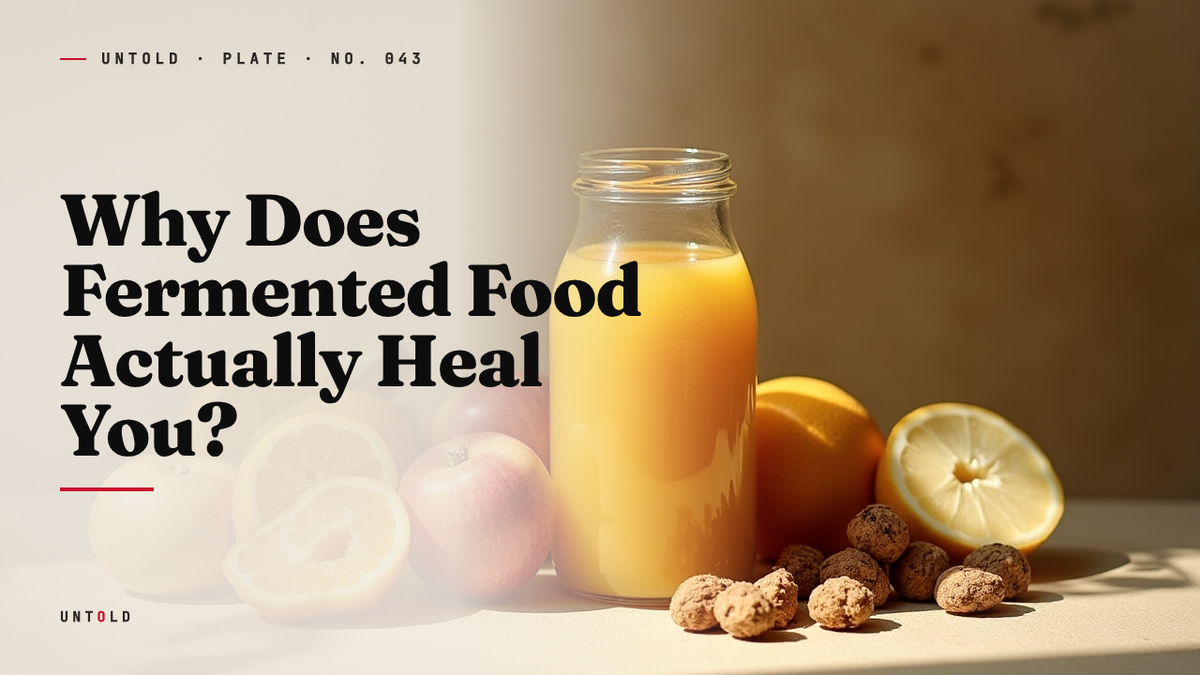
Somewhere in your kitchen, behind the milk and the leftover takeout, there may be a jar that is alive. Not metaphorically. Literally. Inside a vessel of kimchi or kefir or properly made sauerkraut, trillions of microbes are working a slow, silent shift. They breathe. They eat. They release faint bubbles of carbon dioxide that, if you press your ear close, you can sometimes hear. This is not spoilage. It is the oldest form of biotechnology humans ever invented, and for roughly a century, we did our best to kill it off.
Then something strange happened. The food our great-grandmothers fermented out of necessity became fashionable. Kombucha colonized the refrigerated aisle. Kimchi appeared on restaurant menus thousands of miles from Korea. Kefir, miso, and live-culture yogurt turned into objects of genuine consumer desire. One market analysis projected the global fermented foods sector to climb past 989 billion dollars by the early 2030s.1 The trend looks, at first, like another wellness fad. But the explanation runs deeper than marketing, and it begins with a question that took science nine thousand years to answer: why does rotting food, done right, make us healthier?
A technology older than writing
Fermentation is, at its core, a controlled act of decay. Microbes (yeasts, molds, and bacteria) consume the sugars in food and convert them into acids, gases, and alcohol. Milk thickens into yogurt. Cabbage sours into sauerkraut. Grapes turn into wine; flour and water become sourdough. The transformation preserves the food and changes its chemistry, often making it more digestible and more nutritious than the raw ingredient ever was.
Humans have been doing this for an extraordinarily long time. Residue analysis of pottery from the Neolithic Chinese village of Jiahu, dated to around 7000 BCE, revealed a fermented beverage made from rice, honey, and fruit.2 That makes fermentation older than the wheel, older than written language, older than most of what we call civilization. And remarkably, nearly every human culture invented it independently. Koreans fermented vegetables into kimchi. Japanese cultivated miso and natto from soybeans. Ethiopians soured teff flour into injera. South Indians fermented rice and lentils into dosa batter. Europeans pressed and aged milk into thousands of varieties of cheese. The food anthropologist Sandor Katz has called fermentation humanity’s oldest and most universal preservation art, a kind of cultural fingerprint that appears wherever people settled and stored food.3
What is striking is that for almost all of that history, nobody had any idea why it worked. People knew that leaving cabbage in salt brine kept it edible through winter, that milk left to sour did not poison them, that grape juice given time became something intoxicating. But the mechanism remained invisible. Fermentation was treated as a quirk of nature, a useful kind of rot, and the line between food that nourished and food that killed was learned through generations of careful, sometimes fatal, trial and error.
The chemist who found life inside the barrel
The person who finally explained it was Louis Pasteur. In the 1850s, working in the wine-producing regions of France, Pasteur was asked to investigate why some batches of fermentation went sour and ruined. The prevailing scientific view held that fermentation was a purely chemical reaction, the spontaneous breakdown of organic matter, a phenomenon of dead chemistry rather than living biology.4
Pasteur disagreed, and through a series of meticulous experiments he proved that fermentation was the work of living microorganisms. Yeast cells turned sugar into alcohol. Different bacteria produced different results: some made the clean acids of good wine, others the off-flavors of spoiled batches. Life, not chemistry alone, was doing the labor. The discovery was foundational, and it pointed toward something larger. If invisible organisms could transform a vat of grape juice, perhaps invisible organisms could also transform a human body. Within a few decades, germ theory had reshaped medicine, and the world understood for the first time that microbes caused disease.
That understanding saved untold millions of lives. It also produced an unexpected and lasting side effect. Once humanity learned that bacteria could kill, it declared war on bacteria of every kind.
The war on microbes
The twentieth century became, in a sense, an extended campaign against the microscopic world. Pasteurization heated milk and beer to destroy pathogens, and in doing so destroyed the beneficial cultures too. Sterilization became the gold standard of food safety. Refrigeration replaced fermentation as the dominant method of preservation, and there was no longer any survival reason to keep a living crock of vegetables souring in the cellar. Industrial food production favored the sterile, the shelf-stable, and the predictable. Canned, cooked, and chemically preserved foods pushed the living jar to the margins of the modern diet.
In the rush toward cleanliness, something quiet was lost. The traditional ferments that had accompanied human meals for millennia thinned out of everyday eating. Antibiotics, an enormous medical triumph, added another front to the war, wiping out bacterial colonies inside the body without discriminating between the harmful and the helpful. We had learned that some microbes were enemies and concluded, wrongly, that all of them were.
What that conclusion overlooked is that the human body is not a fortress to be kept sterile. It is an ecosystem. You carry an estimated 38 trillion bacterial cells, roughly as many as your own human cells, the great majority of them clustered in the large intestine.5 This community, the gut microbiome, is not a passive passenger. It helps digest food your own enzymes cannot break down. It synthesizes vitamins. It trains the immune system to distinguish friend from foe. And, through a dense network of nerves and chemical signals, it carries on a constant conversation with the brain. To wage total war on bacteria, it turned out, was to wage war on part of ourselves.
The Bulgarian villagers and a stubborn idea
The first scientist to take that partnership seriously was Élie Metchnikoff, a Russian-born biologist who won the Nobel Prize in 1908 for his work on immunity. Late in his career, Metchnikoff became fascinated by the long-lived peasants of rural Bulgaria, who consumed large quantities of fermented milk. In 1907 he proposed that the lactic-acid bacteria in their yogurt might suppress the harmful bacteria he believed were slowly poisoning the human gut and accelerating aging.6
Metchnikoff’s specific theory was, by modern standards, rough and in places wrong. He overstated the toxicity of normal gut flora and the power of yogurt to reverse it. But the seed of his idea, that the microbes we eat might shape the microbes we host, and that this in turn might shape our health, proved durable. It hibernated for most of the twentieth century while the war on germs raged. Then, as tools for sequencing bacterial DNA matured in the early 2000s, scientists could finally see the gut microbiome in detail, and Metchnikoff’s intuition came back to life.
What the Stanford experiment found
The most striking modern evidence came from a Stanford laboratory led by the microbiologists Justin and Erica Sonnenburg, working with the immunologist Christopher Gardner. In 2021, their team published the results of a carefully controlled ten-week dietary trial in the journal Cell.7 They took healthy adults and divided them into two groups. One group ate a diet high in fiber, the kind of plant-rich eating nutritionists have championed for decades. The other group ate a diet high in fermented foods: yogurt, kefir, fermented cottage cheese, kimchi and other fermented vegetables, vegetable brine drinks, and kombucha.
The fiber, oddly, did not move the needle much on its own over the study period. But the fermented-food group produced results that surprised even the researchers. The diversity of their gut microbiomes increased measurably, and the more fermented food a person ate, the greater the increase. Diversity matters because a richer, more varied microbial community is generally associated with better metabolic and immune health, while a depleted one is linked to disease.
The more dramatic finding lay in the blood. The researchers tracked dozens of markers of inflammation, and in the fermented-food group, nineteen of them declined. Among the molecules that dropped was interleukin-6, a signaling protein associated with chronic inflammatory conditions including rheumatoid arthritis and type 2 diabetes.7 In ten weeks, with nothing but a change in diet, the participants’ immune systems grew measurably calmer. Erica Sonnenburg described the effect as a powerful and somewhat unexpected reduction in inflammation, achieved through food alone.
Why a pickle can quiet the blood
The mechanism behind that result is still being worked out, but its outlines are clear enough. Fermented foods deliver several things at once. They contain live microbes, many of which survive the journey into the gut. They contain what scientists call postbiotics: the metabolic byproducts those microbes leave behind, including short-chain fatty acids and other compounds that the cells lining the intestine use as fuel and as signals. And they contain the acids and altered nutrients produced by fermentation itself, some of which the resident gut bacteria are well equipped to feed on.
The leading hypothesis is that this combination enriches the gut ecosystem, and a more diverse, well-fed ecosystem produces fewer of the molecular signals that trigger systemic inflammation. The gut lining grows more robust; the immune cells stationed along it become less reactive. The effect ripples outward, because chronic low-grade inflammation is now understood to be a common thread running through many of the defining illnesses of modern life, from heart disease and type 2 diabetes to certain cancers and even depression.8 If something as simple as a daily serving of live sauerkraut can lower that background hum of inflammation, it touches an astonishing range of conditions at once.
The strangest frontier of this research concerns the brain. The gut and the brain are connected by the vagus nerve and by a steady traffic of chemical messengers, the so-called gut-brain axis. Roughly 90 percent of the body’s serotonin, the neurotransmitter most associated with mood, is produced not in the brain but in the gut, where specialized cells manufacture it with help from resident bacteria.9 This has led researchers to investigate whether altering the microbiome through fermented foods might influence anxiety and mood. The evidence here is younger and far less settled than the inflammation findings, and scientists are careful not to oversell it. But the question itself, whether what you ferment in a jar might reach as far as your emotional life, would have sounded absurd a generation ago. It no longer does.
The dead jar problem
Here is where the story turns, and where most enthusiasm goes wrong. The benefits described above depend on the food being alive. And much of what is sold under the banner of fermentation is not.
The industrial food system, built for safety and shelf life, tends to kill the very thing that makes a ferment valuable. Most supermarket pickles are not fermented at all; they are cucumbers soaked in vinegar and then heat-treated, with no living culture involved. Many shelf-stable kombuchas and canned sauerkrauts have been pasteurized, a process that, by design, destroys the microbes. The jar may say fermented. The contents may be biologically inert.
The difference between living and dead ferments is usually visible if you know where to look. Live products are almost always refrigerated, because the cold slows the microbes without killing them. They often carry a label noting live or active cultures. Real sauerkraut sits in the chilled section, not on a warm canned-goods shelf, and it tends to bubble faintly when disturbed. A can of kraut that has been boiled into stability tastes of vinegar and salt but offers none of the living benefit. The lesson is not to abandon fermented food but to read it carefully.
The homecoming
There is a quiet democracy to all of this. The microbes that may calm your immune system cannot be patented or priced out of reach. You can grow them yourself, in a clean jar, for almost nothing. Sauerkraut requires four ingredients: cabbage, salt, water, and time. Pack shredded cabbage in salt brine, keep it submerged and away from heat, and within a week or two the wild lactic-acid bacteria already living on the leaves will have transformed it into something sour, fizzing, and alive. Humans did this for thousands of years without understanding a word of the chemistry. The bacteria did not need us to understand them.
A reasonable caution applies. For most healthy people, adding live fermented foods to the diet is safe and, on the current evidence, likely beneficial. But anyone with a compromised immune system, a serious illness, or a specific medical condition should talk to a clinician before making large dietary changes, since live cultures behave differently in a vulnerable body. Enthusiasm is not a substitute for medical advice.
What the fermented-food revival really represents is less a discovery than a recovery. For a century, armed with the genuine truth that some microbes kill, we treated all of them as enemies and quietly impoverished the ecosystems inside us. Now, with better instruments and more humility, we are learning that the living jar in the cellar was not a relic of ignorance. It was a partnership our ancestors maintained by instinct, a daily exchange between human bodies and the invisible organisms that have always shared them. The comeback of fermented food is not a trend so much as a homecoming. The next time you open a jar of kimchi and hear that faint, persistent fizz, it is worth remembering what the sound is. It is an ancient collaboration, never quite extinguished, still patiently feeding you.

Sources
- Global Market Insights, Fermented Foods Market Size Report, 2024 — https://www.gminsights.com/industry-analysis/fermented-foods-market
- McGovern, P. E. et al., Fermented beverages of pre- and proto-historic China, PNAS, 2004 — https://www.pnas.org/doi/10.1073/pnas.0407921102
- Katz, S. E., The Art of Fermentation, Chelsea Green Publishing, 2012 — https://www.wildfermentation.com/the-art-of-fermentation/
- Pasteur, L., Mémoire sur la fermentation alcoolique, Annales de chimie et de physique, 1860 — https://en.wikipedia.org/wiki/Louis_Pasteur
- Sender, R., Fuchs, S., Milo, R., Revised Estimates for the Number of Human and Bacteria Cells in the Body, PLOS Biology, 2016 — https://journals.plos.org/plosbiology/article?id=10.1371/journal.pbio.1002533
- Metchnikoff, É., The Prolongation of Life: Optimistic Studies, G. P. Putnam’s Sons, 1908 — https://en.wikipedia.org/wiki/%C3%89lie_Metchnikoff
- Wastyk, H. C., Sonnenburg, E. D., et al., Gut-microbiota-targeted diets modulate human immune status, Cell, 2021 — https://www.cell.com/cell/fulltext/S0092-8674(21)00754-6
- Furman, D. et al., Chronic inflammation in the etiology of disease across the life span, Nature Medicine, 2019 — https://www.nature.com/articles/s41591-019-0675-0
- Yano, J. M. et al., Indigenous bacteria from the gut microbiota regulate host serotonin biosynthesis, Cell, 2015 — https://www.cell.com/cell/fulltext/S0092-8674(15)00248-2
Related reading