The Five Notes Your Tongue Can Actually Play
Most of what you call flavor happens in your nose. The mouth speaks a far smaller language.
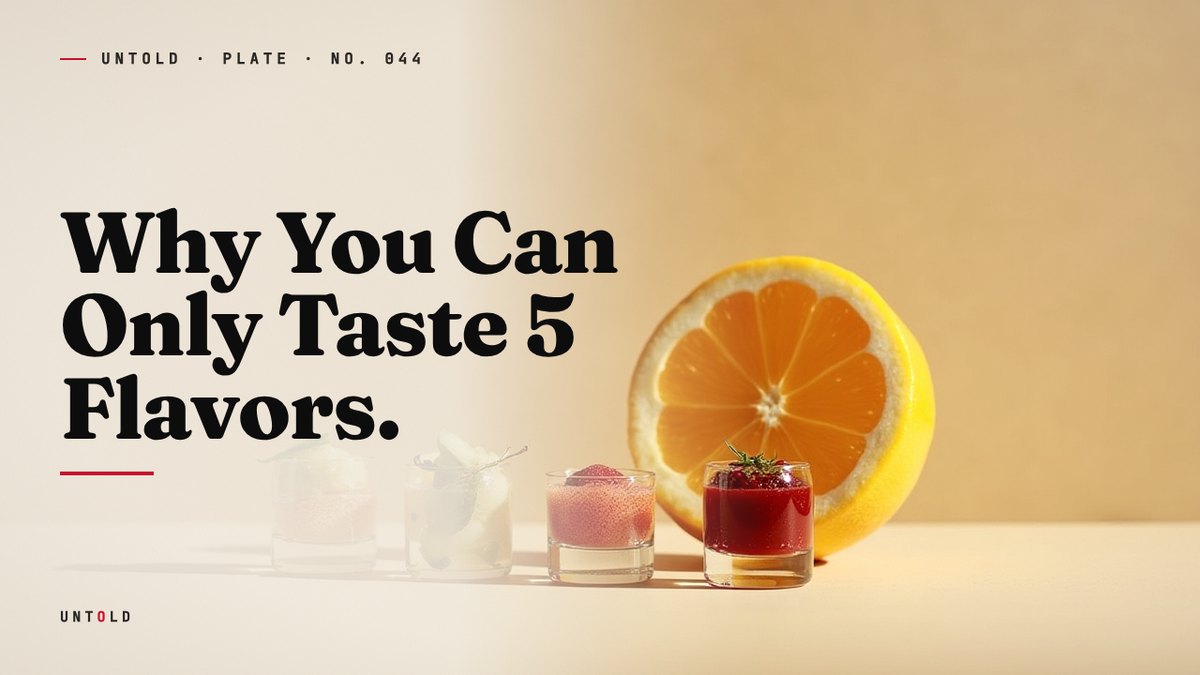
Sit with a strawberry on your tongue for a moment and notice how much seems to be happening. There is brightness, a hint of green, a floral edge, the suggestion of warmth, the faint memory of summer. It feels like a small symphony, dozens of instruments playing at once. The intuition is overwhelming and it is almost entirely wrong.
The tongue, that crowded organ running its thousands of tiny chemistry experiments every second, is far more limited than it feels. It does not perceive strawberry. It does not perceive coffee, or basil, or smoke. It detects, at most, five things: sweet, salty, sour, bitter, and a savory quality the world spent ninety years refusing to acknowledge. Everything else you experience as flavor, the green and the floral and the smoke, arrives through your nose, assembled by a brain that is very good at hiding its own machinery.
This is the strange truth at the center of taste. The sensation we treat as the most immediate and bodily of pleasures turns out to be a collaboration, and the tongue is the junior partner. Understanding why we can taste only a handful of qualities, and why scientists now suspect there may be a sixth, means tracing a story that runs from a German psychologist’s obsession with measurement to a bowl of seaweed broth in early-twentieth-century Tokyo, and into laboratories that are still, today, redrawing the map.
A Rosette of Listening Cells
The human tongue carries somewhere in the neighborhood of ten thousand taste buds, and they are not the small bumps you can see in a mirror. Those visible bumps are papillae, structures that house the buds. Each individual taste bud is a tiny rosette, a cluster of fifty to a hundred elongated cells packed together like segments of an orange, opening through a pore at the surface. These cells are not permanent. They wear out and regenerate on a cycle of roughly one to two weeks, which is why a tongue scalded by hot coffee recovers its sensitivity within days 1.
What these cells do, at the molecular level, is listen for chemicals. When food dissolves in saliva, individual molecules drift down to the taste pore and meet the receptor proteins studding the cell membranes. Some of these receptors work like locks waiting for a specific key. Others function more like channels, simply letting charged particles pass through. The cell, when triggered, fires a signal that travels along the cranial nerves to the brainstem and onward to the gustatory cortex, where it is registered as one of a small set of qualities.
The crucial point is how few qualities there are. The receptors are tuned to detect categories of chemistry, not individual substances. A sweet receptor responds to sugars but also to certain proteins and to artificial sweeteners that share no obvious resemblance to sugar. A bitter family of receptors, the most numerous of all, responds to an enormous range of compounds that happen to share the structural fingerprint of toxicity. The tongue, in other words, is not built to identify foods. It is built to sort molecules into a handful of survival-relevant bins.
The Tetrahedron and the Broth
For most of recorded history, taste resisted counting. Philosophers and physicians listed qualities by the dozen, mixing what we would now call taste with temperature, texture, and smell. The sense seemed too rich, too continuous, to break into discrete parts.
The modern shift came from the German psychologist Hans Henning, who in 1916 belonged to a generation determined to measure the senses with the precision of physics. Henning proposed that taste could be captured by a geometric figure, a tetrahedron, with four pure qualities at its corners: sweet, salty, sour, and bitter 2. Every real taste, he argued, was a blend that lived somewhere on the surface of that shape. It was an elegant idea, and the four-quality model settled into textbooks where it would remain, largely unquestioned, for the better part of a century.
But Henning’s tetrahedron had a problem already hiding in plain sight, half a world away. Eight years before he drew his figure, a chemist in Tokyo had tasted something that did not fit any of the four corners.
In 1908 Kikunae Ikeda, a professor at Tokyo Imperial University, was eating a bowl of his wife’s dashi, the kelp broth that forms the foundation of Japanese cooking. The broth was savory and deeply satisfying in a way he found hard to name. It was not sweet, not salty, not sour, not bitter, yet it carried an unmistakable taste of its own 3. A more ordinary diner would have let the moment pass. Ikeda took the broth to his laboratory.
There he boiled down kilograms of kelp, chasing the molecule responsible for the sensation. What he isolated was glutamate, a common amino acid, present in its free form in the seaweed. He had found the chemical signature of savoriness, and he gave the taste a name: umami, from the Japanese for deliciousness. He noticed, too, that the same quality ran through foods as different as asparagus, tomatoes, aged cheese, and meat, all of them rich in free glutamate.
Ikeda did more than describe the taste. He patented a method for producing it as a seasoning, monosodium glutamate, and founded the company Ajinomoto to sell it. The white crystalline powder that would later become both a kitchen staple and a target of suspicion in the West was, at its origin, the purified essence of a fifth taste.
Ninety Years of Doubt
Ikeda’s discovery should have ended the four-taste consensus. Instead it was quietly ignored outside Japan for the better part of a century. Part of this was the friction of language and distance; Ikeda published in Japanese, and his findings reached Western science slowly and in fragments. Part of it was something less innocent.
Western researchers were not prepared to accept a fifth basic taste on the strength of a description, however careful. The standard for a true basic taste was high: there had to be a dedicated receptor on the tongue, a physical lock into which the molecule fit like a key, and a dedicated channel to the brain. Sweet, salty, sour, and bitter were assumed to have such machinery. Umami was treated as a kind of intensifier, a quality that merely deepened the other four rather than standing on its own. For decades it sat in scientific limbo, neither confirmed nor refuted, more myth than fact in the laboratories of Europe and America.
The MSG controversy that erupted in the late twentieth century did not help. A 1968 letter to a medical journal coined the phrase “Chinese restaurant syndrome,” attributing a cluster of vague symptoms to the seasoning, and a moral panic followed that tangled the science of umami with anxieties about additives and, uncomfortably, about Asian food itself. Rigorous studies later failed to find any consistent reaction to MSG in controlled, blinded conditions, but the damage to umami’s reputation lingered 4. The fifth taste was guilty by association.
Resolution required the tools of molecular biology, and they did not arrive until the turn of the millennium. At the University of California, the neuroscientist Charles Zuker and his collaborators set out to map the actual receptor proteins responsible for each taste. In 2000 and the years immediately following, their work and that of allied teams identified the receptor for savory taste: a pairing of two proteins, T1R1 and T1R3, that together respond to glutamate 5. The lock existed. Ikeda had been right all along, ninety-two years after he isolated the molecule in his kelp broth.
The Map That Was Never Real
The same revolution in taste science demolished another idea that generations of schoolchildren had been taught as fact: the tongue map. You may remember the diagram, a tongue divided into territories, sweet detected at the tip, salty and sour along the sides, bitter lurking at the back. It appeared in biology textbooks for most of the twentieth century, confident and precise.
It was a mistake born of translation. A German researcher, D. P. Hänig, published a paper in 1901 measuring slight regional differences in sensitivity across the tongue 6. His data showed only that some areas were marginally more responsive to certain tastes than others, a matter of degree. When his findings were rendered into English and redrawn, the subtle gradients hardened into rigid zones, and the caricature took on a life of its own.
The truth is that every region of the tongue can detect every basic taste. The receptors for sweet, salty, sour, bitter, and umami are distributed across the whole surface, with only minor variation in density. There are no zones. You can taste sweetness at the back of your tongue and bitterness at the tip. The famous map, repeated in classrooms for the better part of a hundred years, described a tongue that does not exist.
Five Ancient Instructions
Why these five and not some other set? The answer lies in what each taste meant for survival, long before it meant pleasure. The basic tastes are best understood not as aesthetic categories but as the body’s oldest chemical alarms and invitations.
Bitterness is a warning. A great many plant toxins and alkaloids register as bitter, and the tongue carries more than two dozen distinct bitter receptors, far more than for any other quality, precisely because the space of dangerous molecules is so large 7. The reflexive grimace a child makes at bitter greens is the trace of an ancient defense, a built-in suspicion of anything that might poison.
Sourness signals acidity, which in the natural world often means unripeness or microbial spoilage. The pucker of a lemon or of milk on the turn is a flag raised against food that may not be safe or ready to eat. Saltiness, by contrast, is an invitation, guiding the body toward the sodium and other minerals it needs to maintain the delicate electrical balance of nerves and muscles. Too little salt is dangerous, and the tongue rewards us for seeking it, though only up to a point; very high concentrations tip into unpleasantness, a built-in brake against overdose.
Sweetness is the promise of energy. Sugars meant calories, and calories meant survival, in a world where they were scarce and hard-won. The craving for sweet that feels like a modern weakness is in fact a deep evolutionary inheritance, perfectly adaptive for an ancestor who rarely encountered concentrated sugar and could not afford to refuse it.
And umami, the latecomer, is the signal of protein. Free glutamate accumulates in foods rich in amino acids, in aged and fermented and cooked things, in meat and broth and ripe tomatoes. The savory pull of umami is the tongue’s way of pointing toward the building blocks the body cannot manufacture and must eat. Each of the five tastes, read this way, is less a flavor than a verdict: dangerous, spoiled, mineral, energy, protein.
The Sixth That May Be Whispering
Here the story refuses to settle. Five may not be the final number, because a serious candidate for a sixth taste has been gathering evidence for over a decade.
The quality in question is the taste of fat. For years, the richness of fatty food was attributed entirely to texture, the creamy, coating sensation in the mouth, rather than to any genuine taste. But at Purdue University, the nutrition scientist Richard Mattes and his colleagues argued that the tongue can detect fat as a distinct chemical taste, separate from its feel. In 2015 they proposed a name for it, oleogustus, the taste of free fatty acids 8. When the fats in food break down into their component acids, the team showed, people can perceive a quality that is recognizably its own, and not a pleasant one in isolation; pure fatty acids taste rancid and faintly repellent, which would make oleogustus, like bitter and sour, a kind of warning rather than a reward. There is even a candidate receptor, a protein called CD36, found in taste tissue and known to bind fatty acids.
Fat is not the only contender waiting at the door. Some researchers have argued for a taste of calcium, detected through its own receptors and possibly explaining the faint chalkiness of certain mineral-rich foods. Others point to a metallic taste, a starch taste distinct from the sweetness of the sugars starch eventually becomes, and even a perception of carbonation that may engage taste cells directly rather than acting only through touch and the burn of dissolved gas. None of these has cleared the demanding bar that umami eventually met, the bar of a confirmed receptor and a confirmed pathway, and they remain, for now, candidates rather than members. But the map of taste is plainly still being drawn.
A Single Experience, Assembled
There is a small experiment that exposes the whole arrangement. Pinch your nose closed, then bite into a jellybean. The sweetness is there, flat and unmistakable, but the fruit is gone. There is no cherry, no lemon, no apple, only sugar. Release your nose and the flavor floods back in an instant, the cherry reassembling itself as air carrying the aromatic molecules reaches the receptors high in your nasal cavity.
That reflux of scent from the back of the mouth up into the nose, called retronasal olfaction, is where most of what we call flavor actually lives. The tongue supplies a handful of pure notes, the five or perhaps six basic qualities. The nose supplies the hundreds of aromatic dimensions that distinguish a strawberry from a raspberry, a coffee from a cocoa. And the brain, drawing on memory and expectation and the texture and temperature of the food, fuses all of it into a single seamless experience that feels as though it is happening entirely in the mouth.
The deception is total and it is generous. We taste far less than we think, and we experience far more, because the brain is forever composing a richer whole out of sparse and ancient signals. The next time a meal genuinely moves you, the chemistry on your tongue deserves only a small share of the credit. Five quiet messengers do their narrow, vital work, sorting the world into danger and energy and protein. And somewhere beneath them, a sixth may already be murmuring its name.
Sources
- Chaudhari, N. and Roper, S. D., “The cell biology of taste,” Journal of Cell Biology, 2010. — https://rupress.org/jcb/article/190/3/285/35862/The-cell-biology-of-taste
- Henning, H., “Die Qualitatenreihe des Geschmacks,” Zeitschrift fur Psychologie, 1916. — https://en.wikipedia.org/wiki/Hans_Henning
- Ikeda, K., “New seasonings” (translation), Chemical Senses, 2002 (orig. 1909). — https://academic.oup.com/chemse/article/27/9/847/271940
- Freeman, M., “Reconsidering the effects of monosodium glutamate: a literature review,” Journal of the American Academy of Nurse Practitioners, 2006. — https://pubmed.ncbi.nlm.nih.gov/16999713/
- Nelson, G., Zuker, C. S. et al., “An amino-acid taste receptor,” Nature, 2002. — https://www.nature.com/articles/nature726
- Hanig, D. P., “Zur Psychophysik des Geschmackssinnes,” Philosophische Studien, 1901; discussed in Wanjek, C., Smithsonian, 2018. — https://www.smithsonianmag.com/arts-culture/neat-and-tidy-map-tastes-on-tongue-you-learned-school-all-wrong-180963407/
- Meyerhof, W. et al., “The molecular receptive ranges of human TAS2R bitter taste receptors,” Chemical Senses, 2010. — https://academic.oup.com/chemse/article/35/2/157/271097
- Running, C. A., Craig, B. A. and Mattes, R. D., “Oleogustus: the unique taste of fat,” Chemical Senses, 2015. — https://academic.oup.com/chemse/article/40/7/507/331076
Related reading