The Brain You Were Never Introduced To
Half a billion neurons line your gut, and they were thinking long before your skull learned how.
Take a length of intestine out of a living animal, strip away every nerve that once tethered it to the spinal cord, drop it into a warm bath of oxygenated fluid, and watch what happens. It keeps moving. Slow, rhythmic waves travel down its length, the same muscular contractions that push food through a body. The tissue has no brain attached. It has no spinal cord, no commanding voice from above. And yet it organizes itself, senses its own contents, decides when to contract and when to relax, and carries on as if nothing had been amputated at all.
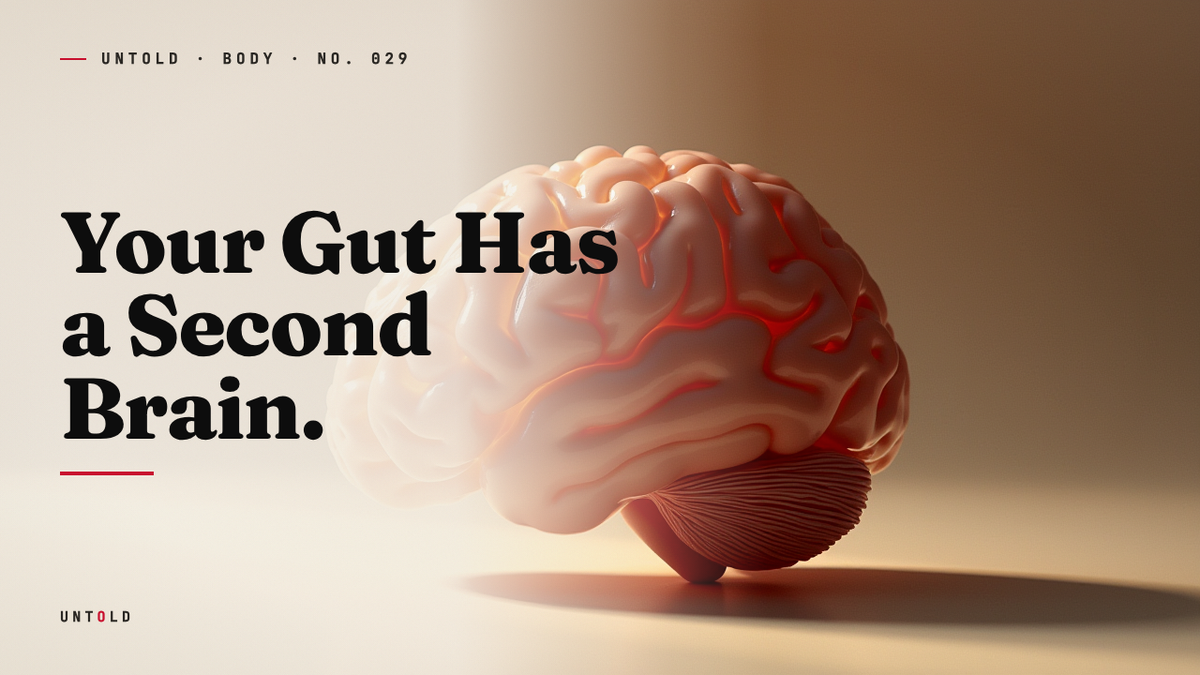
This is not a parlor trick. It is one of the more disorienting facts in human physiology, and for most of the last two centuries almost nobody took it seriously. The wall of your gut contains a nervous system of roughly 500 million neurons, more than the entire spinal cord, woven into the tissue in two delicate layers that run from the esophagus to the rectum 1. It senses, it computes, it remembers patterns, and it acts. It does most of its work without ever consulting the organ behind your eyes. Scientists have taken to calling it the second brain, though as we will see, the ranking may be backward.
The forgotten nerves
The story begins, as so many physiological stories do, in 19th-century Germany, with two anatomists peering through brass microscopes at the lining of the intestine. In the 1860s, Georg Meissner described a dense network of nerve fibers and ganglia sitting in the submucosa, the layer just beneath the gut’s inner surface. Around the same period, Leopold Auerbach mapped a second, deeper web running between the muscle layers of the gut wall 2. Both networks survive in the modern anatomical vocabulary under their discoverers’ names: the submucosal, or Meissner’s, plexus, and the myenteric, or Auerbach’s, plexus.
The anatomists could see the wiring. What they could not explain was the purpose. A nervous structure this elaborate, lining the entire digestive tract, seemed wildly out of proportion to the job of moving food through a tube. The prevailing assumption of the era was that nerves were essentially relay cables, conduits carrying instructions from the brain and spinal cord out to the obedient organs. By that logic the gut plexuses ought to be little more than the last few inches of telephone wire before the receiver. The idea that they might constitute an independent thinking apparatus did not occur to most physiologists, and where it did occur, it was dismissed.
Then came a more stubborn investigator. John Newport Langley, a physiologist at Cambridge who spent decades dissecting the architecture of the involuntary nervous system, looked harder at what Meissner and Auerbach had found. By 1921, in his book The Autonomic Nervous System, Langley had done something nobody had bothered to do: he estimated the sheer number of neurons hidden in the gut wall 3. The figure rivaled the count in the entire spinal cord. That was not the profile of a passive relay station.
Langley argued that this system deserved a category of its own, separate from the sympathetic and parasympathetic divisions that physiologists already recognized. He named it the enteric nervous system, from the Greek word for intestine, and described it as possessing, in effect, a nervous organization of its own. It was a quietly radical claim. And then, for the better part of the 20th century, it was largely forgotten. The grand projects of neuroscience marched toward the cerebral cortex, toward language and memory and the seat of consciousness, and the strange thinking tissue in the belly was left to the digestion specialists, who treated it as plumbing.
The brain that works alone
What makes the enteric nervous system genuinely peculiar is its autonomy. Almost every organ in the body depends on instructions from the central nervous system. Sever the connection and the organ falters. The gut is the great exception. Cut the vagus nerve and every other link between the brain and the intestine, and digestion continues, largely unbothered. The gut senses the arrival of food, gauges its consistency and chemistry, decides the pattern of muscular waves required to move it along, and times each contraction. It does all of this with its own circuitry, its own sensory neurons, its own interneurons, and its own motor neurons. It is the only part of the peripheral nervous system capable of generating reflexes and acting on them entirely independently of the brain and spinal cord 1.
The chemistry is just as striking as the anatomy. The enteric nervous system speaks in more than thirty neurotransmitters, and they are not exotic gut-specific molecules. They are the same chemical messengers your brain uses: acetylcholine, dopamine, serotonin, and many more. The vocabulary of thought, it turns out, is shared between the organ in your head and the organ in your belly.
The most quoted statistic concerns serotonin, the molecule popularly associated with mood and well-being. Around 95 percent of the body’s serotonin is produced not in the brain but in the gut, manufactured largely by specialized cells in the intestinal lining and modulated by the surrounding microbial population 4. The chemical of happiness, the one whose absence antidepressants are designed to correct, is overwhelmingly a product of the organ you digest with, not the one you think with. That single fact rearranges the usual hierarchy of mind and body in an uncomfortable way.
The man most responsible for dragging the enteric nervous system back into scientific respectability was Michael Gershon, a neurobiologist at Columbia University. For years Gershon had argued, against considerable skepticism, that serotonin functioned as a signaling molecule in the gut and that the enteric system deserved to be understood as a genuine integrative network rather than a peripheral afterthought. In 1998 he gathered the case into a book with a title that did not hedge: The Second Brain 5. The phrase was deliberate and provocative, and it landed.
Some colleagues laughed. A thinking gut sounded like the stuff of folk wisdom rather than neuroscience. But the laughter grew quieter as the evidence accumulated. Year after year, studies confirmed the density of the neural networks, the independence of the reflexes, the breadth of the neurotransmitter toolkit. What had been a fringe enthusiasm became a recognized field. Today the enteric nervous system is a standard subject in neurogastroenterology, and the second brain is no longer a metaphor that requires an apology.
The wandering nerve
If the gut runs its own affairs, why does it ever bother to communicate with the head at all? The two brains are not entirely separate; they are connected, principally, by a single remarkable nerve. The vagus nerve, whose name comes from the Latin for wandering, earns its title. It emerges from the brainstem and meanders down through the neck and chest and into the abdomen, branching to the heart, the lungs, and the digestive organs along the way. It is the longest of the cranial nerves and the main physical cable between the brain and the gut.
Here lies the detail that quietly upends our intuitions about who is in charge. We tend to imagine the brain issuing commands and the body obeying, a chain of orders running from top to bottom. But the vagus nerve carries traffic in both directions, and the traffic is lopsided in a surprising way. Roughly 80 to 90 percent of its fibers are afferent, meaning they carry information upward, from the gut to the brain, rather than downward 6. The wiring is built mostly for the gut to report and the head to listen. The conversation is dominated by the organ we usually think of as the silent partner.
This asymmetry helps explain something everyone has felt and nobody can quite locate. The flutter in the abdomen before walking onstage, the sinking sensation on hearing bad news, the knot that tightens before a decision you are dreading. These are not poetic figures of speech imposed on a neutral organ. They are the upward signals of the enteric nervous system, registered by the brain as sensation and emotion. The butterflies are real, and they are talking.
Then came the bacteria
For a long time the story of the second brain was a story about neurons and chemistry. Then the picture grew more crowded, because the gut is not only nervous tissue. It is also the home of an immense microbial population. Trillions of bacteria, along with viruses, fungi, and other organisms, inhabit the human intestine, collectively known as the gut microbiota. And it gradually became clear that these residents were not silent tenants. They were participants in the conversation.
Gut bacteria produce a steady stream of chemical compounds, many of which are neuroactive. They synthesize neurotransmitters and their precursors, they generate short-chain fatty acids that influence the nervous and immune systems, and through these molecules they whisper to the nerves and cells of the gut wall. The microbes, in effect, have a voice in the dialogue between the two brains, and researchers began to suspect that voice mattered more than anyone had imagined.
The most arresting evidence came from a deceptively simple experiment. John Cryan, a neuroscientist at University College Cork and one of the leading figures in this field, worked with germ-free mice, animals raised in sterile conditions with no gut bacteria at all. These mice were not merely unusual digesters. They behaved differently. Compared with normal mice, the germ-free animals showed altered stress responses and changes in anxiety-related behavior, along with differences in brain chemistry and development 7. Strip away the microbes and you do not just disturb digestion. You disturb the behavior of the animal.
More striking still was the reverse. In a landmark study, Cryan and his collaborators fed mice a single strain of bacterium, Lactobacillus rhamnosus, and found that the animals displayed reduced anxiety- and depression-related behavior, along with changes in the receptors of a key calming neurotransmitter in the brain 8. Crucially, when the researchers cut the vagus nerve, the effect vanished. The bacteria were sending their message along the very cable that links the two brains. A microbe in the gut was reaching up and adjusting the emotional state of the animal, and it was doing so through the wiring Langley had described nearly a century before.
The gut, in other words, was never just digesting. It was sensing, signaling, and, in concert with its microbial inhabitants, helping to shape behavior. The implications run in directions that researchers are still mapping. Disturbances in the gut-brain axis are now studied in connection with anxiety and depression, with irritable bowel syndrome, and even with neurodegenerative disease. Some of the earliest pathological changes in Parkinson’s disease, for instance, appear in the enteric nervous system and the vagus nerve, raising the possibility that certain conditions long considered purely cerebral may have their origins, or at least their early signatures, lower down 9.
The order was backward
Here the framing that gave the field its catchy name begins to wobble in an interesting way. We call the gut the second brain because we discovered it second, because it sits beneath the organ we prize, and because we instinctively assume the head came first. Evolution suggests otherwise.
The earliest animals with nervous systems were simple tubes. A creature whose entire existence was organized around a gut needed, above all, a way to sense food and move it through the body. Nerve nets capable of coordinating digestion appeared very early in animal evolution, long before anything resembling a centralized brain. The neural apparatus for managing a digestive tube is, in evolutionary terms, ancient bedrock. The cerebral brain, with its capacity for vision, memory, and abstraction, came later, an elaboration built on top of a body already capable of feeding itself.
From that vantage, the names are reversed. The brain in your belly is not the sequel. It is closer to the original, the founding nervous system around which the rest of the animal, eventually including the thinking head, was assembled. Your so-called second brain may have a better claim to being first.
Coda
The phrase listen to your gut has lived for centuries as folk wisdom, the kind of saying we use without believing it describes anything physical. We now know it was more literal than anyone intended. Beneath your ribs runs a genuine nervous system, hundreds of millions of neurons strong, manufacturing the body’s serotonin, conferring with a vast microbial population, and reporting upward through a nerve built largely to carry its voice to your head. That flutter before a hard decision, the knot before bad news, the unease you cannot quite explain: these are signals from an organ that has been paying attention all along. It thought before you thought. And every second of your life, without asking permission, it keeps thinking.

Sources
- Furness, J. B., The enteric nervous system and neurogastroenterology, Nature Reviews Gastroenterology & Hepatology, 2012. — https://www.nature.com/articles/nrgastro.2012.32
- Brookes, S. & Costa, M., Historical overview of the enteric nervous system, in Innervation of the Gastrointestinal Tract, 2002. — https://www.ncbi.nlm.nih.gov/pmc/articles/PMC3198219/
- Langley, J. N., The Autonomic Nervous System (Part I), W. Heffer & Sons, 1921. — https://archive.org/details/autonomicnervous00lang
- Yano, J. M. et al., Indigenous bacteria from the gut microbiota regulate host serotonin biosynthesis, Cell, 2015. — https://www.cell.com/cell/fulltext/S0092-8674(15)00248-2
- Gershon, M. D., The Second Brain, HarperCollins, 1998. — https://www.harpercollins.com/products/the-second-brain-michael-d-gershon
- Berthoud, H. R. & Neuhuber, W. L., Functional and chemical anatomy of the afferent vagal system, Autonomic Neuroscience, 2000. — https://pubmed.ncbi.nlm.nih.gov/11189015/
- Sudo, N. et al., Postnatal microbial colonization programs the hypothalamic-pituitary-adrenal system for stress response in mice, The Journal of Physiology, 2004. — https://physoc.onlinelibrary.wiley.com/doi/10.1113/jphysiol.2004.063388
- Bravo, J. A. et al. (Cryan lab), Ingestion of Lactobacillus strain regulates emotional behavior and central GABA receptor expression via the vagus nerve, PNAS, 2011. — https://www.pnas.org/doi/10.1073/pnas.1102999108
- Braak, H. et al., Staging of brain pathology related to sporadic Parkinson’s disease, Neurobiology of Aging, 2003. — https://pubmed.ncbi.nlm.nih.gov/12498954/
Related reading