The Acid That Refuses to Eat Its Host
Your stomach holds a fluid strong enough to corrode steel, and the story of why it spares you runs through a frontier gunshot wound and a self-experimenting Nobel laureate.
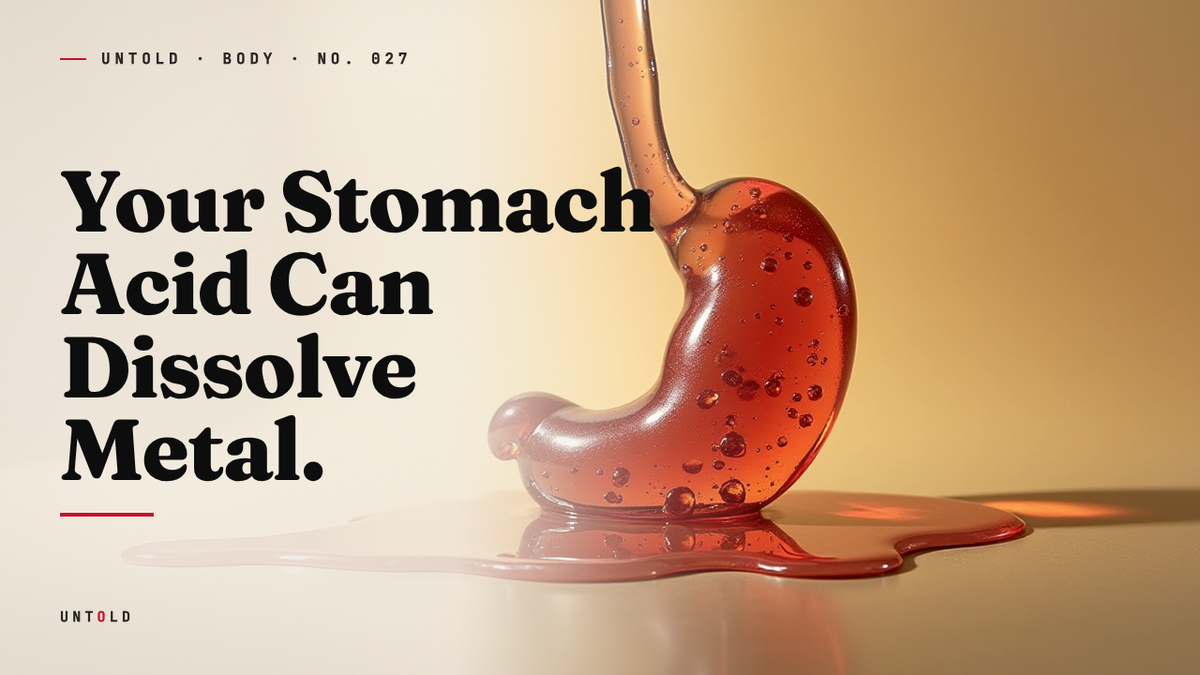
Drop a stainless steel razor blade into a beaker of human gastric juice and wait. Within a day or two the bright edges begin to cloud. Within a week the metal is visibly pitted, the surface eaten away as if by slow rust. This is not a thought experiment dressed up as fact. Gastrointestinal physicians have watched it happen, and the medical literature contains case reports of swallowed razor blades partially corroded by the time they passed through a patient. The fluid responsible sits, right now, in the pouch beneath your ribs. It holds a chemistry violent enough to dissolve iron, blister skin, and reduce a meal to molecular rubble.
Its strength clusters around a pH of two. On the logarithmic scale chemists use, that places it roughly three million times more acidic than pure water, in the neighborhood of car battery acid and well within the range that laboratories flag with hazard placards. And your body manufactures nearly two liters of it every single day, refreshing the supply meal after meal, year after year, with no instruction from you.
Which raises the question that haunted anatomists for centuries. If this acid can corrode steel and digest a strip of raw meat, why does it not digest the soft, living tissue that contains it? Why does the stomach not consume itself?
A Window Into a Living Stomach
For most of medical history, the inside of a working stomach was a sealed mystery. Anatomists could open a corpse, but a dead stomach does not digest. The chemistry of life vanished the moment the patient did. What physiologists needed was a way to watch the process happen in a living person, and in the summer of 1822 an accident on Mackinac Island, in the strait between Lakes Huron and Michigan, provided exactly that.
Alexis St. Martin was a French-Canadian voyageur, a fur trapper working the trade routes of the upper Great Lakes. At close range, a musket discharged into his side, tearing a hole in his abdomen and stomach wide enough that a contemporary observer described breakfast spilling out through the wound. By every expectation of the era, he should have died. He did not. A U.S. Army surgeon stationed at Fort Mackinac, William Beaumont, treated him, and over months the wound healed in an unusual way. Rather than sealing shut, it fused into a permanent flap, a fistula that opened directly into the stomach. Beaumont could lift the flap and look inside.
Beaumont recognized what he was holding. Here was a living human stomach he could observe at work, an opportunity unprecedented in the history of medicine. Beginning in the late 1820s and continuing for years, he ran a series of experiments that remain landmarks of physiology. He tied small pieces of food, beef, cabbage, stale bread, raw and cooked meat, to lengths of silk thread, lowered them through the fistula into St. Martin’s stomach, and withdrew them at intervals to record exactly how far digestion had progressed.1 He drew off samples of the raw gastric juice and watched, in a glass vial held at body temperature, the same fluid dissolve food outside the body entirely.
The finding was decisive. Digestion was not, as some had argued, merely a mechanical grinding, the stomach pulverizing food through muscular churning. It was chemical. “The gastric juice,” Beaumont wrote in 1833, “is the great solvent of food.”1 Across roughly 238 separate experiments conducted through that single open wound, he established that a corrosive secretion, not motion alone, broke food down.1 The relationship between the two men was fraught, marked by St. Martin’s repeated departures and Beaumont’s evident regard for him as a research subject more than an equal. But the science endured. Beaumont had proven that the stomach ran on a powerful solvent. What he could not yet say was what that solvent was made of.
The Chemistry of a Controlled Storm
The active ingredient is hydrochloric acid, the same compound that arrives in industrial drums for cleaning metal and treating swimming pools. The stomach makes its own. Embedded in the gastric lining are millions of specialized cells called parietal cells, and each functions as a microscopic acid pump. Using molecular machinery in their membranes, these cells shuttle hydrogen ions into the stomach cavity against an enormous concentration gradient, building the acidity inside the stomach to roughly three million times that of the bloodstream just millimeters away. It is one of the steepest ionic gradients the human body maintains anywhere.
This acid is not a blunt instrument. It does several distinct jobs at once. The first is the one Beaumont saw: it breaks food apart, unfolding the tightly wound proteins in meat and unlocking nutrients that would otherwise pass through untouched. The acid also activates pepsin, a protein-shredding enzyme that the stomach secretes in an inactive form precisely so it does not begin digesting the tissue that produces it. Only in the presence of strong acid does pepsin switch on and start cleaving proteins into smaller, absorbable fragments.
The second job is defensive. Food does not arrive sterile. Every bite carries a passenger load of bacteria, and the acid functions as a chemical checkpoint, a moat of hydrochloric acid that most swallowed microbes cannot cross. The overwhelming majority of pathogens riding in on a meal are killed within moments of reaching the stomach. People who produce too little stomach acid, whether through age, disease, or long-term use of acid-suppressing drugs, show measurably higher rates of certain gut infections, a reminder that the acid is not an unfortunate byproduct of digestion but a frontline immune barrier.
Which returns us to the puzzle. If the fluid dissolves meat and metal and kills bacteria on contact, the stomach wall is itself made of living protein. Why does it not become just another meal?
The Quarter-Millimeter Shield
The answer is a defense so thin it would be invisible if you held it up to the light. The cells lining the stomach secrete a dense, gel-like mucus that coats the entire inner surface, and within this layer a remarkable bit of chemistry keeps the tissue alive. The mucus barrier is only about a quarter of a millimeter thick, roughly the width of two or three sheets of paper. Yet across that sliver of gel, the acidity drops dramatically. At the open face of the mucus, where it meets the stomach cavity, the environment is the full battery-acid pH of two. At the bottom, where the mucus meets living cells, it is close to neutral.
The mucus achieves this in part because the cells beneath it release bicarbonate, the same alkaline compound found in baking soda, directly into the gel. As acid tries to diffuse inward, the bicarbonate neutralizes it, holding a chemical front line right at the cell surface. The stomach, in effect, builds a tiny zone of calm against its own corrosive output, a buffered film standing between the storm and the tissue.
Even this is not enough on its own, because the barrier takes constant damage. So the stomach does something extraordinary: it simply replaces itself. The surface cells of the gastric lining are sloughed off and regenerated so rapidly that the entire inner surface renews itself every three to four days. The stomach you are digesting lunch with this week is not, at the cellular surface, the stomach you had last week. It is a wall under continuous reconstruction, shedding battered cells faster than the acid can break through and rebuilding from a reservoir of stem cells below. The old physiologists captured the riddle in a single line that circulated for generations: the stomach digests everything but itself. The resolution, it turned out, was a film of mucus, a current of bicarbonate, and a lining that never stops being rebuilt.
The Ulcer That Everyone Misdiagnosed
For most of the twentieth century, doctors thought they understood what happened when this defense failed. The disease in question was peptic ulcer, a raw, painful sore in the stomach or upper intestine, and the prevailing explanation was almost folkloric in its simplicity. Ulcers, the textbooks held, were caused by stress and diet. The harried executive, the spicy meal, the acid temperament: these wore down the stomach wall until the acid ate through it. Treatment meant bland food, rest, antacids, and sometimes surgery to cut the nerves that triggered acid production. The acid was cast as the villain, eroding a wall weakened by modern life.
The trouble was that the theory did not fit what some doctors were seeing under the microscope. In Perth, Australia, a pathologist named Robin Warren kept noticing something that, according to everything medicine believed, could not be there. In tissue samples from inflamed stomachs, he repeatedly spotted curved, spiral-shaped bacteria living in the lining itself.2 This made no sense. The stomach was supposed to be one of the most hostile environments in the body, a vat of acid that sterilized everything passing through. Nothing was supposed to live there. Most of his colleagues dismissed the bacteria as contamination or irrelevant bystanders.
A young physician named Barry Marshall took Warren’s observation seriously. Together they began to build a case that the spiral bacterium, eventually named Helicobacter pylori, was not a passenger but a cause, that the inflammation and ulcers tracked with the presence of the microbe.2 The medical establishment was unmoved. The idea that an infection drove a disease everyone attributed to stress and acid struck many as absurd, and the bar for proof was high. A textbook on the subject would later open by noting how thoroughly the bacterial theory had been resisted.
The Scientist Who Drank the Bacteria
Marshall could not satisfy the skeptics with cultures and biopsies alone, in part because he could not reliably infect an animal model to demonstrate causation. So in 1984 he turned the experiment on himself. He prepared a broth swarming with cultured Helicobacter pylori and drank it.3
The effect was not immediate, then it arrived all at once. Within days Marshall was vomiting, his appetite gone, his breath foul. An endoscopy and biopsy confirmed what he had set out to prove: his previously healthy stomach was now severely inflamed, colonized by the bacterium, the early picture of the disease he was trying to explain.3 He had given himself gastritis on purpose, collapsing patient, scientist, and experimental subject into one body to demonstrate that the microbe caused stomach disease.
The mechanism, once understood, was its own marvel. Helicobacter pylori does not defeat the acid by brute force. It exploits the very defense that protects the stomach. The bacterium burrows down into the protective mucus layer, sheltering in the same buffered, near-neutral zone that keeps the host’s cells alive. There, hidden beneath the gel, it is shielded from the full strength of the acid. It also produces an enzyme that generates ammonia, an alkaline compound that neutralizes acid in the immediate pocket around the microbe, carving out a livable bubble in a fluid that should kill it instantly. The impossible inhabitant of the stomach survived not by being tougher than the acid, but by hiding inside the shield built to repel it.
The consequences for medicine were enormous. Most peptic ulcers, it turned out, were not the product of stress or temperament at all. They were an infection, treatable with a course of antibiotics rather than a lifetime of bland diets and surgery. A disease that had been managed for decades as a chronic affliction of modern living was, in many cases, curable in weeks. In 2005, Barry Marshall and Robin Warren received the Nobel Prize in Physiology or Medicine for the discovery of Helicobacter pylori and its role in gastritis and peptic ulcer disease.4
The Fragile Balance Beneath Every Meal
The lasting lesson is not that the acid was innocent and the bacterium guilty, though that reframing was the heart of the Nobel-winning work. It is that the stomach runs on a balance far more delicate than its violent chemistry suggests. The acid is genuinely one of the most extreme environments in the human body, corrosive enough to dissolve bone, lethal to most pathogens, essential for prying loose the nutrients that keep you alive. And yet its power is held in check by a film of mucus a quarter-millimeter thick and a lining replaced every few days.
Tip the balance in either direction and trouble follows. Too little acid, and the chemical moat fails: dangerous bacteria that should have died on arrival survive the passage into the gut, and infection rates climb. Too much acid, or a breach in the mucus shield, and the wall begins to lose to its own secretion, the territory where reflux, gastritis, and ulcers take hold. The body holds this equilibrium continuously, meal after meal, with no conscious effort from you. Across a single lifetime, the stomach produces something on the order of tens of thousands of liters of acid, an unbroken chemical storm contained by an unbroken act of maintenance.
So the next time hunger rumbles beneath your ribs, it is worth remembering what is actually happening down there. A fluid strong enough to corrode steel, manufactured by the liter, kept from devouring its own container by nothing more dramatic than a layer of mucus, a trickle of bicarbonate, and a wall that quietly rebuilds itself faster than the acid can tear it down. The stomach is not a passive bag. It is a controlled catastrophe, and the fact that you never notice it working is the most impressive thing about it.

Sources
- Beaumont, William, Experiments and Observations on the Gastric Juice and the Physiology of Digestion, F. P. Allen, 1833. — https://www.gutenberg.org/ebooks/52301
- Warren, J. R. and Marshall, B. J., “Unidentified curved bacilli on gastric epithelium in active chronic gastritis,” The Lancet, 1983. — https://doi.org/10.1016/S0140-6736(83)92719-8
- Marshall, B. J. et al., “Attempt to fulfil Koch’s postulates for pyloric Campylobacter,” Medical Journal of Australia, 1985. — https://doi.org/10.5694/j.1326-5377.1985.tb113443.x
- The Nobel Prize in Physiology or Medicine 2005, Barry J. Marshall and J. Robin Warren, Nobel Foundation, 2005. — https://www.nobelprize.org/prizes/medicine/2005/summary/
- Allen, A. and Flemström, G., “Gastric duodenal mucus bicarbonate barrier: protection against acid and pepsin,” American Journal of Physiology, 2005. — https://doi.org/10.1152/ajpcell.00102.2004
- Schubert, M. L. and Peura, D. A., “Control of gastric acid secretion in health and disease,” Gastroenterology, 2008. — https://doi.org/10.1053/j.gastro.2008.05.021
- Roth, S. H., “William Beaumont and Alexis St. Martin: a case study in medical history,” Canadian Medical Association Journal / historical review, various. — https://en.wikipedia.org/wiki/Alexis_St._Martin
Related reading