The Cat Inside the Rat
How a single-celled parasite rewires the brains of its hosts, and what it might be doing in ours.
A rat steps into the open. It moves with the unhurried confidence of an animal that has nothing to fear, pausing to investigate the corners of the enclosure, lingering where it should not linger. In one corner sits a scent that, for any healthy rat, would trigger an immediate and total collapse into panic: the smell of cat. Cat urine is, to a rat, the chemical signature of death. Millions of years of evolution have wired the rodent brain to flee it without thought, without hesitation, the way a hand recoils from fire.
This rat does not flee. If anything, it is drawn closer. It sniffs at the odor with something that looks, to the researchers watching, uncomfortably like curiosity. The animal has not gone mad. It has not lost its other fears. Drop a sudden shadow over the enclosure and it will startle like any rat. Introduce a strange object and it will approach with the usual caution. Only this one terror has been switched off, surgically, as if someone reached into its skull and clipped a single wire.
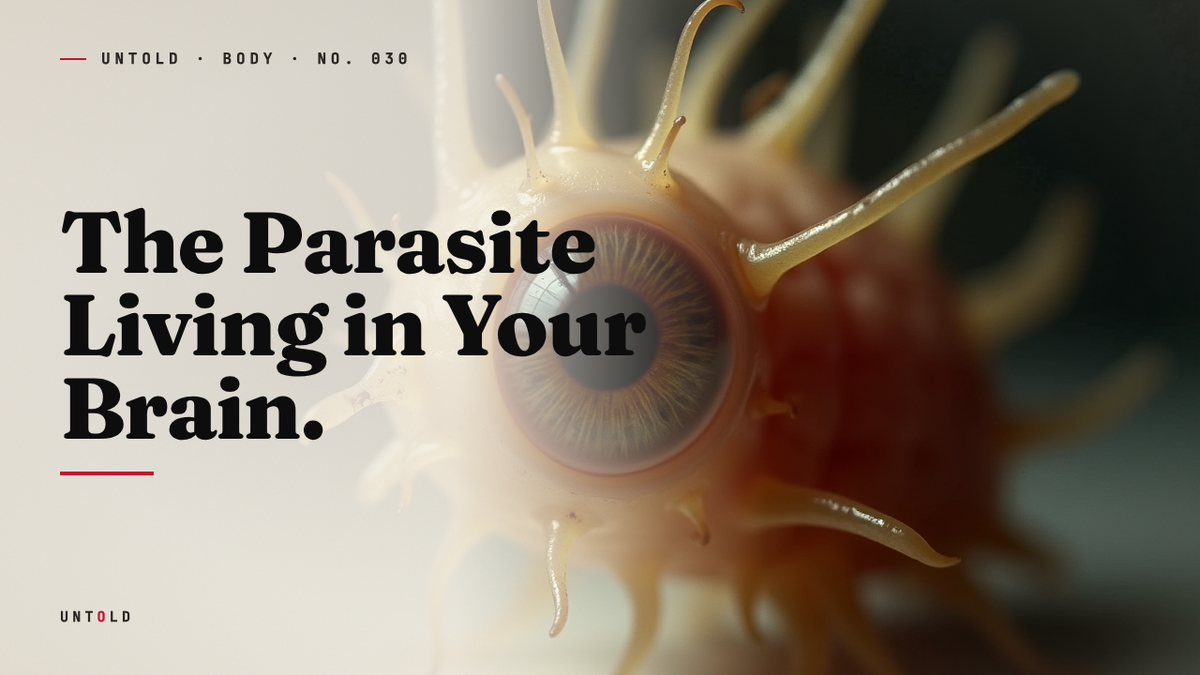
Something has. Inside the rat’s brain lives a passenger with an agenda. A single-celled organism, invisible to the eye, has taken up residence in the very neural circuitry that governs fear, and it has rewritten the animal’s instinct for survival in service of its own reproduction. The parasite needs this rat to be eaten by a cat. So it has made the rat want to be eaten by a cat. Its name is Toxoplasma gondii, and by most estimates it lives in roughly two billion human beings as well. It may be inside your skull as you read this.
A passenger with a single destination
The story begins, as so many parasite stories do, in an unglamorous place. In 1908, working in Tunisia, the French physician Charles Nicolle and his colleague Louis Manceaux isolated a curious organism from a small North African rodent called the gundi.1 Under the microscope the parasite appeared crescent-shaped, a tiny arc of life, and so they named it for its form: Toxoplasma, from the Greek for “arc” and “shape,” and gondii for the animal that carried it. Nicolle, who would later win a Nobel Prize for unrelated work on typhus, suspected he had found something important. For decades, almost no one agreed.
For most of the twentieth century, Toxoplasma was treated as a footnote, a minor infection that the vast majority of people contracted, carried, and never noticed. And in the strict sense, that remains true. In a healthy adult, an immune system quickly corners the parasite, forces it into a dormant, walled-off state, and holds it there, quiet and harmless, often for the rest of the person’s life. The infection rarely announces itself. Many who carry it will die of old age never knowing they shared their bodies with anything at all.
But the parasite’s apparent modesty concealed an extraordinary life. Toxoplasma can infect virtually any warm-blooded animal: rats, mice, birds, sheep, humans. Yet it can only complete its reproductive cycle, only generate the offspring that perpetuate the species, inside a single family of hosts. The cat. Only in the feline gut does Toxoplasma produce the hardy egg-like oocysts that pass out in feces, contaminate soil and water, and wait to be swallowed by the next host.2
This biological fact created a problem of logistics, and the solution to that problem is the most remarkable thing about the organism. Picture the loop the parasite must close. A cat sheds oocysts. A rat, foraging in contaminated soil or eating contaminated matter, ingests them. The parasite spreads through the rat’s tissues and settles in. Now it must get from rat back into cat. And here lies the obstacle. Rats are not in the habit of presenting themselves to cats. Evolution has spent eons teaching them precisely the opposite. The parasite, to complete its journey, has to overcome one of the most deeply ingrained survival behaviors in the animal kingdom.
It does.
The fatal attraction
The experiment that revealed how began in the 1990s at Oxford, where the parasitologist Joanne Webster set about testing infected rats with a deceptively simple apparatus.3 She built an enclosure with scents placed in different corners. One corner carried the rat’s own bedding, familiar and safe. Another held a neutral smell. Another held the odor of a rabbit, a non-threatening animal. And one corner held cat urine, the chemical embodiment of predation.
Uninfected rats behaved exactly as evolution dictated. They explored the safe corners, tolerated the neutral ones, and avoided the cat odor as though their lives depended on it, which, in the wild, they would. The infected rats behaved differently, and the difference was startling for its specificity. They moved normally around the enclosure. They showed every other ordinary fear and preference. But their aversion to cat odor had collapsed. Some of them spent more time near the cat scent than away from it. The parasite had not damaged the rats’ general intelligence or made them indiscriminately reckless. It had erased one terror and left everything else untouched.
Webster gave the phenomenon a name that captured its strange precision: fatal attraction.3 The infected rat was not merely unafraid of the thing that would kill it. It was, in some measurable sense, drawn toward it. This was not the blunt instrument of a sick animal stumbling into danger. It was a targeted edit, a single deleted fear in an otherwise intact mind, and it pointed the rat directly toward the one outcome the parasite required.
The precision was almost more disturbing than the manipulation itself. A microbe with no brain, no nervous system, no eyes, had reached into the architecture of a far larger and more complex organism and altered a specific behavioral circuit while leaving the surrounding wiring alone. How a single cell could perform such delicate neurosurgery became the central puzzle, and answering it required tracing exactly where the parasite went.
A cyst in the fear center
At Stanford, the neuroscientist Robert Sapolsky and his colleagues took up the question of mechanism. Where does Toxoplasma actually settle, and what does it do once it gets there? When the parasite enters the brain of a host and is driven dormant by the immune system, it forms tissue cysts: small, durable structures that lodge in neural tissue and persist for the life of the animal. The Stanford work, along with related research, found that these cysts are not distributed randomly. They show a distinct tendency to accumulate in the amygdala, the almond-shaped structure that sits at the heart of the brain’s fear and threat-processing machinery.4
The amygdala is, among other things, where the smell of a predator gets translated into the bodily experience of dread. It is the relay station that takes a sensory signal, cat, and converts it into a command, run. By concentrating in this region, the parasite positions itself precisely at the junction it needs to manipulate. Sapolsky’s group found evidence that infection altered the activity of the neural pathways linking the detection of cat odor to the fear response. The signal still arrived. The dread no longer followed. In some experiments, the circuitry that should have produced avoidance instead engaged pathways associated with attraction and reward. As one description of the effect put it, the parasite takes a hardwired aversion and turns it inside out.
But the location alone did not explain how the switch was thrown. The deeper clue came from the parasite’s own genome. Researchers discovered that Toxoplasma carries genes encoding enzymes for the production of dopamine, the neurotransmitter that governs reward, motivation, and the sense that a given experience is worth pursuing.5 Dopamine is one of the great levers of the vertebrate brain. It tells an animal what is good, what is desirable, what to move toward. And here was a parasite apparently capable of synthesizing it.
Studies found that brain tissue infected with Toxoplasma, and specifically the cysts themselves, could contain markedly elevated levels of dopamine.5 The implication was striking. The parasite was not merely sitting in the fear center. It was, in effect, dosing its immediate neural neighborhood with a chemical that rewrites what the host finds rewarding. A microbe was drugging its host from the inside, raising the reward signal in exactly the region responsible for converting a predator’s scent into terror. The terror became, instead, a pull. The rat walked toward the cat not despite the danger but, in some chemical sense, because the danger had been reassigned to the category of things worth approaching.
This was not an accident of infection, not the random misfiring of a diseased brain. It was strategy, written into the parasite’s genes over evolutionary time, a mechanism for engineering its own delivery into a cat’s stomach. And once researchers had grasped the elegance of the trick, an obvious and considerably more uncomfortable question presented itself.
The question of us
Humans are not part of Toxoplasma’s natural cycle. We are what biologists call a dead-end host. A parasite that nudges a human toward predation accomplishes nothing, because no cat is going to eat us. Whatever manipulations evolved to serve the rat-to-cat journey were never selected for their effect on people. And yet we are infected constantly. We eat undercooked meat carrying tissue cysts. We dig in gardens where contaminated soil hides oocysts. We change litter boxes. In some countries, depending on diet and climate and hygiene, more than half the population carries the parasite.6
The same dopamine-producing organism that lodges in the rat amygdala lodges in the human brain. So the question naturally followed: if the parasite can subtly rewire a rodent’s behavior, does it do anything to ours?
The scientist who pursued that question most relentlessly came to it through himself. Jaroslav Flegr, an evolutionary biologist at Charles University in Prague, noticed over the years that his own behavior had drifted in ways he could not explain.7 He took risks he once would have avoided. He felt strangely calm in situations that should have alarmed him, crossing busy streets without urgency, ignoring the sound of gunfire during a period of civil unrest. When he learned that he was infected with Toxoplasma, he began to wonder whether the parasite reputed to manipulate rats might be quietly shaping him.
Flegr turned the suspicion into a research program, surveying thousands of people and comparing the personalities and behaviors of those who carried the parasite against those who did not. His studies reported subtle but consistent differences. Infected men tended to score differently on measures of personality than uninfected men, and infected women differently again, sometimes in opposite directions. More provocatively, he found that infected people appeared overrepresented among those involved in traffic accidents.7 In follow-up work, infected drivers showed elevated accident rates, an effect that some researchers have linked to slower reaction times and a greater tolerance for risk. The reflexes that keep a person from being killed in traffic, it seemed, might be slightly dulled in those carrying the parasite, much as the reflexes that keep a rat from being killed by a cat are dulled in infected rodents.
Other researchers pushed further still, examining whether Toxoplasma infection might correlate with certain psychiatric conditions, including schizophrenia. Some studies found associations. The parasite’s ability to manipulate dopamine, a neurotransmitter central to several mental illnesses, lent the idea a plausible mechanism.
The thin line
All of this demands caution, and the most responsible scientists in the field are the first to insist on it. Correlation is not causation. People who garden, eat raw meat, or live in particular regions differ from those who do not in countless ways beyond their Toxoplasma status, and untangling the parasite’s effect from the tangle of confounding factors is genuinely hard. The reported behavioral shifts, where they appear at all, are small. They are the kind of statistical signal that emerges across thousands of people but vanishes inside any single life. No one is turned into a different person. No one is reduced to a puppet.
The overwhelming majority of the two billion infected human beings live entirely ordinary, healthy lives and will never experience a single consequence of their hidden tenant. Their immune systems will keep the parasite walled away in its dormant cysts for decades, perhaps permanently, and the organism will whisper nothing audible at all. We are not zombies. At most, if the human effects are real, we may be very gently nudged, the dial of personality turned a fraction of a degree by a passenger we never invited and cannot evict.
And yet even that modest possibility carries a quiet weight. We are accustomed to thinking of our choices, our temperaments, our appetites for risk and caution as ours, as expressions of a self that sits behind the eyes making decisions. The rat in the arena believed the same thing, if it believed anything. It approached the cat freely, on what felt to it like its own initiative, never suspecting that the initiative had been authored elsewhere, by a single cell with an agenda older than the rat itself. The parasite did not announce its presence. It simply changed what the rat wanted, and let the rat experience the wanting as its own.
The boundary between who we are and what is happening inside our biology is thinner than we like to imagine. Most of the time we never see it, and most of the time it does not matter. But somewhere in the muscle and the brain of perhaps a third of humanity, something small and patient is waiting, locked away, quiet. Only the parasite knows what, if anything, it whispers. The next time a cat fixes you with its unblinking stare, it is worth remembering the rat in the arena, walking calmly toward the thing that would devour it, certain to the last that the choice was entirely its own.

Sources
- Nicolle, C. & Manceaux, L., “Sur une infection à corps de Leishman (ou organismes voisins) du gondi,” Comptes Rendus de l’Académie des Sciences, 1908. — https://en.wikipedia.org/wiki/Toxoplasma_gondii
- Dubey, J. P., “The History of Toxoplasma gondii: The First 100 Years,” Journal of Eukaryotic Microbiology, 2008. — https://pubmed.ncbi.nlm.nih.gov/19120791/
- Berdoy, M., Webster, J. P. & Macdonald, D. W., “Fatal attraction in rats infected with Toxoplasma gondii,” Proceedings of the Royal Society B, 2000. — https://royalsocietypublishing.org/doi/10.1098/rspb.2000.1182
- Vyas, A., Kim, S. K., Giacomini, N., Boothroyd, J. C. & Sapolsky, R. M., “Behavioral changes induced by Toxoplasma infection of rodents are highly specific to aversion of cat odors,” PNAS, 2007. — https://www.pnas.org/doi/10.1073/pnas.0608310104
- Prandovszky, E. et al., “The neurotropic parasite Toxoplasma gondii increases dopamine metabolism,” PLoS ONE, 2011. — https://journals.plos.org/plosone/article?id=10.1371/journal.pone.0023866
- Pappas, G., Roussos, N. & Falagas, M. E., “Toxoplasmosis snapshots: global status of Toxoplasma gondii seroprevalence,” International Journal for Parasitology, 2009. — https://pubmed.ncbi.nlm.nih.gov/19433092/
- Flegr, J., “Effects of Toxoplasma on human behavior,” Schizophrenia Bulletin, 2007. — https://academic.oup.com/schizophreniabulletin/article/33/3/757/1859090
Related reading