The Waiter Who Forgot Your Bill the Moment You Paid
A Vienna cafe, a young psychologist, and the strange grip unfinished tasks hold on the human mind.
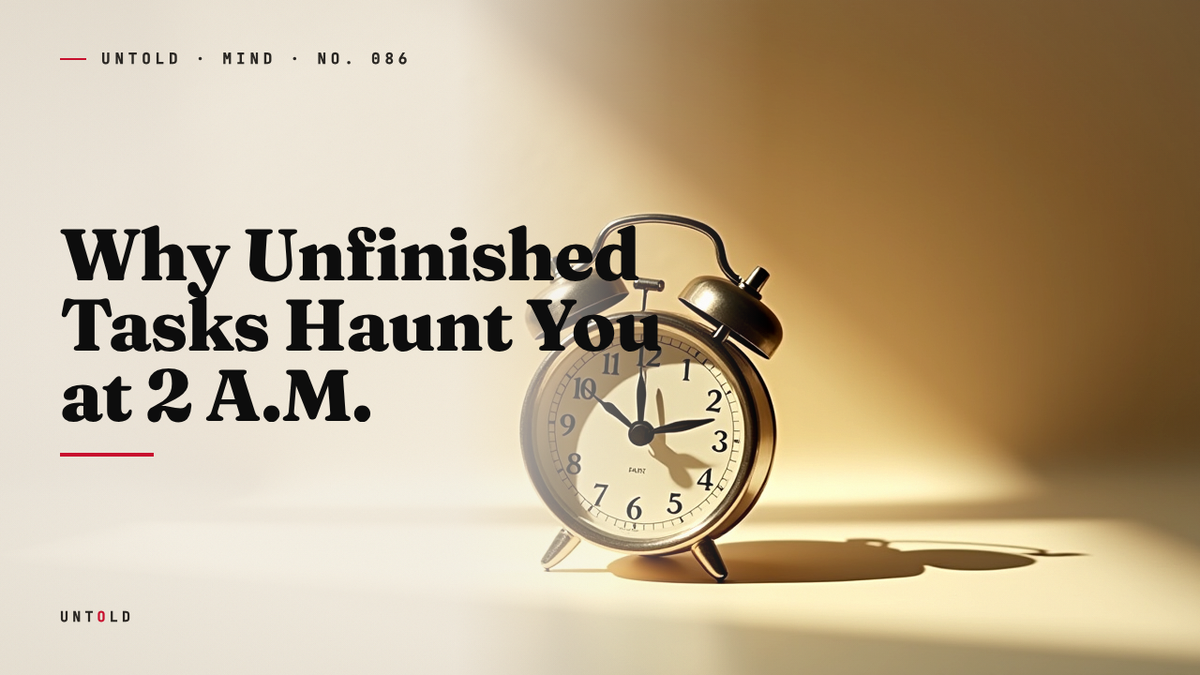
It is two in the morning. The house is quiet, the day is over, and yet the mind refuses to follow the body into sleep. What keeps it awake is not the large fear, the mortgage or the mortality or the argument with a friend. It is something absurdly small: a half-written email sitting in the drafts folder, a dish abandoned in the sink, a phone call promised and not returned. These trivial fragments circle back in the dark with a persistence that seems out of all proportion to their importance.
There is a curious asymmetry here, and once you notice it you cannot unsee it. The tasks you finished during the day have vanished almost entirely. You could not tell someone, without effort, what you completed at eleven that morning. But the things left hanging, the loops you failed to close, keep announcing themselves. They have a strange kind of stickiness. The mind holds onto what it did not finish and lets go of what it did.
This is not a personal failing or a symptom of an anxious temperament. It is one of the most reliably observed phenomena in the psychology of memory, and it has a name. It is called the Zeigarnik effect, after a young woman who noticed it, of all places, in a busy Viennese cafe nearly a century ago.
A Peculiarity Among the Waiters
Bluma Zeigarnik was born in 1901 in Prienai, a small town in what is now Lithuania, then part of the Russian Empire. She was academically formidable from the start, and in the early 1920s she made her way to Berlin, which had become one of the great capitals of a booming new science. Psychology was young, ambitious, and full of the sense that the interior life of the mind might finally yield to experiment. Berlin was its beating heart, home to the Gestalt psychologists who insisted that the mind must be understood as a whole rather than broken into isolated reflexes.
In Berlin, Zeigarnik joined the circle of Kurt Lewin, a restless and brilliant thinker who would later be called the founder of social psychology 1. Lewin had a habit of drawing his biggest ideas from ordinary life, and the origin story of the Zeigarnik effect is fittingly domestic. The group would gather in a cafe, and on one occasion Lewin pointed out something odd about the waiter who served them.
The waiter could hold an unpaid order in his head with perfect clarity. He knew exactly what each table owed, carrying a running tally without notes. But the moment a bill was settled, the information seemed to evaporate. Ask him minutes later what the table had ordered, and he could not tell you. The account, once closed, was gone 2.
It is the kind of observation most people would let pass as a charming quirk of the service trade. Zeigarnik did not. She wondered whether the waiter’s peculiar memory pointed to something general about the mind, and whether it could be pinned down in the controlled conditions of a laboratory. So she designed an experiment to find out.
The 1927 Experiment
Zeigarnik’s method, published in 1927, was elegant in its simplicity 3. She gathered volunteers and gave them a series of small, manageable tasks. There were puzzles to solve, arithmetic problems to work through, clay figures to mold, boxes to assemble. Each was easy to begin and easy, in principle, to complete. The point was not difficulty. The point was interruption.
For roughly half the tasks, she allowed her subjects to finish. For the other half, she interrupted them partway through, pulling them off one job and steering them toward the next before the first was done. The interruptions were engineered to feel abrupt, as if the person had been caught mid-thought. Then, at the end of the session, she asked a single deceptively plain question. Which of these tasks do you remember?
The results were striking. Her subjects recalled the interrupted tasks about twice as well as the ones they had completed 3. The unfinished stuck; the finished slipped away. The same asymmetry the waiter displayed at the cafe was now visible under experimental conditions, measurable and repeatable. What had been an anecdote was now a finding.
Zeigarnik reached for her mentor’s framework to explain it. Lewin thought of the mind in terms of tension systems. When a person takes up a goal, he argued, a kind of psychological tension forms, a pressure that seeks release. Completing the task discharges the tension, and the associated memory, no longer under pressure, fades into the background. Interrupt the task, and the tension remains active, humming quietly beneath conscious awareness, keeping the unfinished business accessible and alive 13. The memory does not persist because the task was important. It persists because it was left open.
The Pull to Return
One of Zeigarnik’s colleagues took the idea a step further. In 1928, Maria Ovsiankina, another member of Lewin’s circle, ran a variation that isolated a different aspect of the phenomenon 4. Rather than measuring memory, she measured behavior. Ovsiankina interrupted her subjects in the middle of a task and then simply left them alone, giving them no instruction to continue and no obvious reason to.
What she found was that people returned to the interrupted task of their own accord, even when nothing required it. Given the freedom to walk away, most drifted back to close the loop, sometimes without quite noticing they were doing it. The unfinished task exerted a pull that was almost impossible to resist. This became known as the Ovsiankina effect, the behavioral cousin of Zeigarnik’s memory finding 4. Together, the two women had described something twofold: unfinished tasks are not only remembered better, they generate a persistent drive toward their own completion.
It is worth sitting with how much of ordinary life this quietly explains. Consider the cliffhanger, the oldest trick in storytelling. Charles Dickens serialized his novels in monthly installments and ended each one at a moment of maximum suspense, leaving readers to stew for weeks over an unresolved fate. The technique predates any formal psychology, but it works on precisely the mechanism Zeigarnik described. An unfinished story is an open loop, and the mind keeps it lit until it closes. The modern streaming platform that autoplays the next episode is exploiting the same tension, engineering a state of mild incompletion that the viewer feels compelled to resolve by watching just one more.
Advertisers learned the same lesson. A campaign that poses a question and withholds the answer, or that begins a narrative it does not finish, leaves a residue in the mind that the eventual product is positioned to satisfy. The open loop is a hook, and the mind snags on it whether or not it wants to.
The Effect Turns Fragile
For all its intuitive appeal, the Zeigarnik effect had a difficult middle age. As psychology matured and researchers began attempting to reproduce the original finding, the results proved slippery. Some experiments confirmed the effect handsomely; others found nothing, or found it reversed. The clean doubling of recall that Zeigarnik reported did not always appear when others went looking for it.
The reasons turned out to be many. Whether the effect showed up depended heavily on how motivated the subjects were, on whether they cared about the tasks, on how the interruption was framed, and on the emotional state they brought to the room. Under stress, for instance, people sometimes remembered completed tasks better, as if the pressure of the situation reorganized their priorities. The tension system Lewin had described was real enough, but it was sensitive to context in ways the original account did not capture 5. For several decades the Zeigarnik effect occupied an uncomfortable position in the literature: too compelling to discard, too inconsistent to trust. It was the kind of idea that appears in every introductory textbook and quietly worries every careful researcher.
What Baumeister and Masicampo Found
Then, in 2011, two psychologists at Florida State University reopened the question and gave it an answer that reframed the whole phenomenon. Roy Baumeister, well known for his work on willpower and self-control, and his colleague E. J. Masicampo ran a series of studies on what happens to the mind when a goal is left unfulfilled 6.
Their early experiments confirmed the intuition behind Zeigarnik’s finding, but in a more precise and modern form. When people were asked to think about an important task they had not yet completed, the unfinished goal did not sit quietly. It intruded. It leaked into unrelated activities, degrading performance on tasks that had nothing to do with it. In one setup, participants who had an unfinished goal on their minds performed worse on a subsequent word puzzle, as if part of their cognitive capacity had been quietly commandeered by the open loop 6. The unfinished task was not merely remembered better; it was actively taxing the mind, running as a background process that consumed attention.
This alone would have been a useful confirmation. But the researchers then found something no one had predicted, and it is the part of the story that changes how you might think about your own two-in-the-morning ceiling.
The Off-Switch That Is Not Completion
The conventional assumption, running all the way back to Lewin’s tension model, was that only completion could discharge the pressure. Finish the task, release the tension, and the mind moves on. But Baumeister and Masicampo asked whether there might be another way to close the loop without actually closing it.
So they had some participants make a specific, concrete plan for the unfinished task. Not do it. Just decide, in detail, how and when and where they would get it done. And the effect was dramatic. Making the plan reduced the intrusive thoughts almost as effectively as finishing the task itself would have. The word-puzzle performance recovered. The mind, having been given a plan, released its grip on the goal and returned to full function 6.
The implication is quietly profound. The brain does not, it turns out, require completion to let go. It requires a credible promise of completion. An unfinished task nags because the mind treats it as unmanaged, an open commitment with no path to resolution. The moment a plan exists, a plan the mind judges to be real and specific, the task is reclassified as handled. The tension eases not because anything got done, but because the uncertainty about whether it would get done has been resolved.
This reframes something we all half-knew but could not explain. It is why writing a to-do list produces a feeling of relief before a single item is crossed off. It is why the mere act of scheduling a dreaded chore for Tuesday afternoon can lift a weight that had been pressing since the weekend. The list does not do the work. It offloads the work from the mind’s anxious holding pattern into a trusted plan, and the mind, satisfied, stops rehearsing it. Later research on the psychology of planning and habit has echoed the same principle: the specificity of the plan matters enormously, because a vague intention does not reassure the mind the way a concrete one does 6.
What began as a curiosity about a waiter’s memory had, after eighty years, become practical wisdom. The unfinished task haunts you because your mind is holding it open, waiting for evidence that it will be closed. You do not have to close it tonight. You have to convince yourself that you will.
Coda
There is something faintly comic in the distance between the problem and its solution. The mind, that vast and intricate organ, lies awake at two in the morning over a dish in the sink, and the remedy is not to wash the dish, nor to reason with the anxiety, nor to medicate it away. The remedy is to make a promise the mind believes. Decide, precisely, when you will return to the thing, write it down where you can see it, and the loop closes itself. Bluma Zeigarnik watched a waiter forget a paid bill and glimpsed a law of memory in it. The deeper truth, uncovered generations later, is gentler than she could have known: the mind is not asking you to finish everything. It is only asking to be told that you will.
Sources
- Marrow, A. J., The Practical Theorist: The Life and Work of Kurt Lewin, Basic Books, 1969. — https://archive.org/details/practicaltheoris0000marr
- Zeigarnik, A. V., “Bluma Zeigarnik: A Memoir,” Gestalt Theory, 2007. — https://www.gestalttheory.net/archive/zeigarnik.pdf
- Zeigarnik, B., “Das Behalten erledigter und unerledigter Handlungen (On finished and unfinished tasks),” Psychologische Forschung, 1927. — https://doi.org/10.1007/BF02409755
- Ovsiankina, M., “Die Wiederaufnahme unterbrochener Handlungen (The resumption of interrupted actions),” Psychologische Forschung, 1928. — https://doi.org/10.1007/BF02411405
- Van Bergen, A., Task Interruption, North-Holland Publishing, 1968. — https://www.worldcat.org/title/task-interruption/oclc/459176
- Masicampo, E. J., & Baumeister, R. F., “Consider It Done! Plan Making Can Eliminate the Cognitive Effects of Unfulfilled Goals,” Journal of Personality and Social Psychology, 2011. — https://doi.org/10.1037/a0024192
Related reading