The Summer They Manufactured a War
In 1954 a psychologist turned two dozen ordinary boys into enemies, then tried to make them friends again.
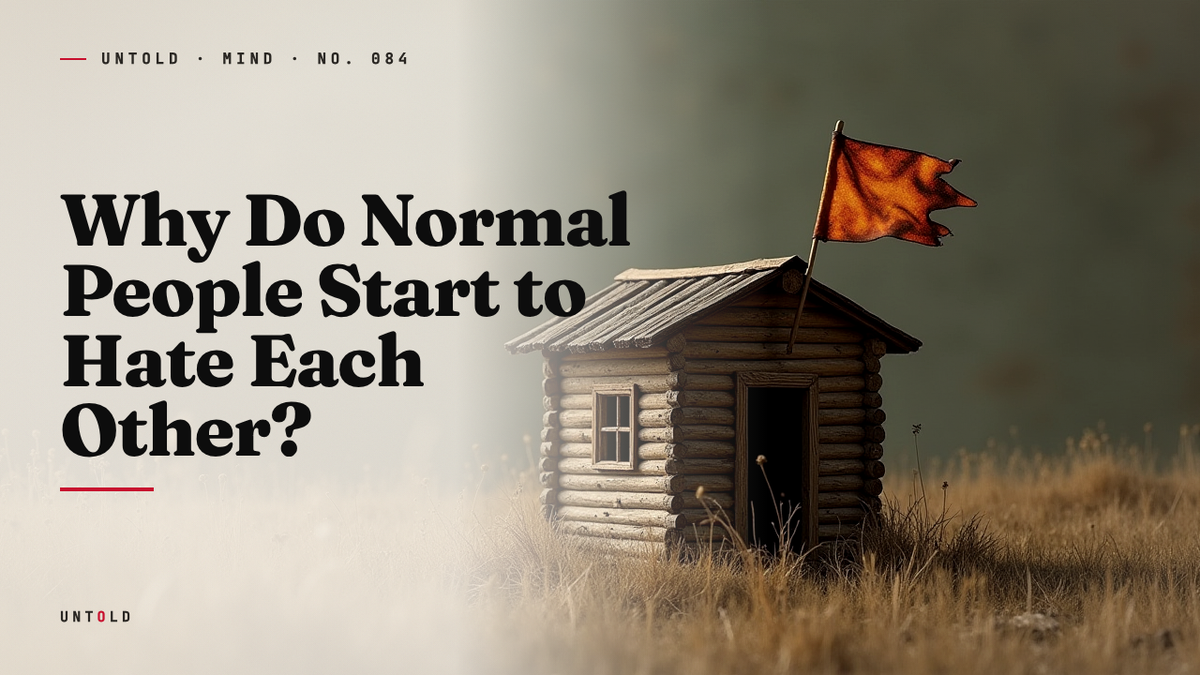
In the summer of 1954, twenty-two boys stepped off two buses at a Boy Scout camp inside Robbers Cave State Park in southeastern Oklahoma. They were eleven years old. They came from stable, middle-class Protestant homes in Oklahoma City. Their school records were unremarkable, their IQs a little above average, their behavior free of anything a teacher might flag. They had been screened precisely for this: for being unremarkable. None of them knew they had been selected. None of them knew they were about to become the raw material of one of the most famous, and most troubling, experiments in the history of social psychology.
Within a week, some of these boys would be filling socks with stones. They would raid one another’s cabins in the dark, overturn beds, steal and burn a rival group’s flag, and speak of the other boys as cowards and cheaters. Nothing in their pasts predicted this. Nothing about them was broken. The only variable that had changed was the situation an adult had built around them.
That adult was Muzafer Sherif, and he had a hypothesis he intended to prove not in the abstract but in the flesh. His question was old and enormous. Where does group hatred come from? His answer, radical for its time, was that you did not need hateful people to produce hatred. You only needed the right arrangement of circumstances. Give him good children and a scarce prize, he believed, and he could manufacture a small war. Then, if he was right about its causes, he could take it apart again.
The man who had seen it happen
Sherif was not a detached theorist working from a comfortable distance. He had watched intergroup violence with his own eyes. Born in Izmir, in what was then the Ottoman Empire, in 1906, he grew up amid the collapse of empires and the ethnic bloodletting that followed the First World War and the Greco-Turkish conflict. As a young man he witnessed Greek soldiers killing people around him, an experience that, by his own account, marked him permanently.1 The memory did not make him despair of human nature. It made him suspicious of the easy explanation that some people are simply born cruel.
He emigrated to the United States and earned a doctorate at Columbia, where in the 1930s he produced pioneering work on how people form shared norms. Using an optical illusion called the autokinetic effect, in which a stationary pinpoint of light in a dark room appears to move, he showed that individuals placed in groups quickly converged on a common estimate of how far the light had traveled, and then carried that group standard with them even when tested alone.2 The finding sounds modest until you sit with its implication: people manufacture a shared reality out of ambiguity, and then treat that invented reality as fact. Norms are not discovered. They are built, socially, and then internalized as truth.
By the 1950s Sherif had turned this insight toward the darker end of human behavior. The dominant theories of prejudice at the time leaned heavily on personality. The influential 1950 study The Authoritarian Personality argued that bigotry lived inside certain rigid, fearful individuals, a defect of character shaped by harsh upbringing. Sherif found this unsatisfying, even evasive. It located the problem in a supposedly deviant minority and left everyone else feeling safe. His counterproposal came to be known as realistic conflict theory. Hostility between groups, he argued, arises not from the flaws of individuals but from the objective structure of their relations. When two groups compete for a resource that only one can win, hostility follows almost mechanically. Cooperation toward a shared end, by contrast, breeds goodwill. The people, in either case, might be exactly the same.
To test this he needed a world he could control from the inside, a place where he could assign roles, engineer scarcity, and observe the results without the subjects ever suspecting a hand was steering them. A summer camp for boys was nearly perfect. It was isolated, self-contained, and staffed entirely by his research team, who posed as counselors, a camp director, and a caretaker. The boys believed they were simply at camp.
Building the tribes
The design unfolded in three deliberate stages. The first was group formation, and it began with separation. The twenty-two boys were divided into two groups of eleven, matched carefully so the groups were roughly equal in size, athletic ability, and temperament. They arrived on separate buses and were housed at opposite ends of the park. For the first week, neither group knew the other existed.3
Left to themselves, each set of strangers did what human beings reliably do. They became a group. They hiked and swam and prepared meals together. They discovered a shared swimming hole and a hidden waterfall. They faced small hardships together, and hardship shared is glue. Leaders emerged. Norms took hold. Boys who slacked were disciplined by the others; boys who showed courage were praised. Each group gave itself a name. One became the Rattlers, the other the Eagles. They stenciled these names onto shirts and flags. They developed private jokes, in-group slang, and rituals of belonging.
What is striking is the speed. In a matter of days, out of nothing but proximity and a common task, two distinct social worlds had formed, each with a hierarchy, a set of values, and a sense of itself. There was, at this point, no rival to define themselves against. Group identity had crystallized purely from within. This alone was a meaningful finding. But it was only the platform for what Sherif really wanted to observe.
The collision
Stage two introduced the other. The researchers arranged for each group to become aware that a second group of boys shared the park. The reaction, before the two groups had even met, was territorial and immediate. The Rattlers, hearing the Eagles at the ball field, began speaking of it as “our” field and demanded a challenge. The Eagles felt the same. The mere existence of an out-group was enough to sharpen the edges of belonging.
Sherif obliged their appetite with a tournament, and here he applied the decisive ingredient of his theory: competition over a prize that only one side could take. The two groups met in a series of contests, baseball, tug of war, tent pitching, a treasure hunt. Points accumulated toward a single reward. The winning team would receive a trophy, and each of its members a coveted prize, a medal and a multi-bladed pocket knife. The losers would get nothing. Sherif had engineered a situation in which one group’s gain was, by design, precisely the other’s loss.3
The descent was swift. It began, as these things do, with jeering and name-calling across the field. It did not stay there. After losing a game, the Eagles seized the Rattlers’ flag and burned it. The next morning the Rattlers retaliated in kind. Cabins were raided after dark, beds flipped, belongings scattered and stolen. Boys collected rocks. Some filled socks with them, fashioning improvised weapons for a confrontation that felt, to them, inevitable and justified. The counselors, who were of course the researchers, had to physically intervene to prevent serious injury.4
Each group now narrated the other in the flat vocabulary of enmity. The outsiders were cheaters. They were cowards. They were sneaks who could not be trusted. Each group, meanwhile, saw itself as brave and fair. When the boys were asked to rate the two teams, they inflated their own and disparaged the rivals, even on matters unrelated to the actual contests. The war had generated its own justifying mythology, exactly as real conflicts do.
Less than a week earlier, these had been interchangeable eleven-year-olds, sorted arbitrarily into two piles. Now they were tribes prepared to fight. Sherif had his first result, and it was chilling in its cleanliness. Competition over scarce resources, applied to ordinary boys, had manufactured hatred out of nothing. No pathology required. No history of grievance. Just a name, a flag, and a prize that could not be shared.
Why simply meeting failed
Then came the harder half of the question, the one that gives the experiment its enduring weight. Hatred is easy to make. Can it be unmade?
Sherif’s first attempt reflected the reigning optimism of the era, the belief that prejudice is a product of ignorance and that familiarity dissolves it. This was the intuition behind the “contact hypothesis,” the idea that simply bringing hostile groups into proximity would let them discover one another’s humanity. So he arranged pleasant shared activities. The Rattlers and Eagles ate in the same dining hall, watched films together, set off fireworks on the Fourth of July.
It failed, and not quietly. The shared meals became arenas. Boys hurled food, insults, and eventually more than that. Proximity did not soften the hostility; it supplied fresh occasions to express it. The lesson was uncomfortable and remains relevant: contact between groups, absent anything to unite them, can deepen conflict rather than heal it.5 Put enemies in the same room with nothing to do together and you have merely reduced the distance a thrown cup must travel.
The engineering of a common goal
Sherif’s second strategy was the one his theory actually predicted, and it required him to manipulate the boys more deliberately than ever. If competition over a shared resource produces conflict, then cooperation toward a shared goal should produce its opposite. But the goal had to be one neither group could achieve alone. He called these “superordinate goals,” ends that overshadowed the boundary between the groups because reaching them demanded both.
He manufactured a series of crises. First, the camp’s water supply failed. The staff explained that vandals might have damaged the line, and that the problem had to be found and fixed or everyone would go thirsty. Boys from both groups fanned out along the pipeline, inspecting it together, and eventually located and repaired the trouble at the tank. For a moment, Rattler and Eagle worked side by side toward something that mattered to all of them.3
The crises continued. The boys wanted a film, and were told the camp could afford it only if both groups pooled their money, which they did. On an outing, a truck that was to fetch food stalled and would not start. The only solution was to pull it, and the rope the boys used was the very same tug-of-war rope that had days earlier been an instrument of their rivalry. This time they hauled on it together, in the same direction, and the truck lurched to life.
No single episode broke the spell. That is the part worth dwelling on. Reconciliation did not arrive as an epiphany or a handshake. It accumulated. Each joint effort chipped at the enmity a little more, and only after a sequence of them did the hostility genuinely recede. By the final days the change was unmistakable. Boys who had armed themselves with rocks were sharing snacks and treating one another to milkshakes. Friendships crossed the old lines. When it came time to go home, the boys asked to travel on a single bus, together, rather than in their separate groups. On the ride, one group used prize money it had won to buy malts for everyone.4
What the boys were never told
It is tempting to end there, on the redemptive note, and much popular retelling does. But the experiment carries shadows that the tidy summary omits, and honesty requires naming them.
The first is ethical. These were children, and they never consented, because they could not have consented to something they were not permitted to understand. Their parents were told it was a study of camp life, but the boys themselves were kept in the dark throughout, deliberately deceived, deliberately provoked into fear and aggression, some to the point of readying weapons. There was no meaningful debriefing that could reach into an eleven-year-old and remove the memory of a war he had been made to fight. Research today operates under ethical review boards and informed-consent requirements that grew, in part, precisely because of studies like this one. Robbers Cave would not be approved now, and that is not a small footnote. It is part of what the experiment teaches.
The second shadow is scientific, and it complicates the clean story of a hypothesis confirmed. Robbers Cave was not Sherif’s first attempt. In 1953 he had run an earlier version of the study at a site in upstate New York, and it collapsed. The boys in that trial grew suspicious. They noticed the adults nudging events, sensed they were being observed and steered, and rather than turning on each other they turned on the researchers, uniting against the very people trying to divide them. The intended conflict never took hold. Sherif, by some accounts, was despondent over the failure. He set that trial aside and tried again the following summer at Robbers Cave, this time refining his procedures and screening the boys even more carefully.6
That buried failure matters more than it might seem. It suggests the boys’ hostility was not a pure, spontaneous eruption of realistic conflict theory but something the researchers had to work to elicit, and that could be spoiled if subjects saw the strings. Later scholars, drawing on the study’s own archives, have argued that the counselors sometimes actively encouraged aggression, and that the 1954 success owed something to a more careful staging than the published account admits.6 The result is real, but it is not the immaculate demonstration it is often presented as. It is a made thing, in more senses than one.
The thin line
And yet the core finding has survived decades of scrutiny and a great deal of replication in other forms, because it keeps describing what we see in the world. Ordinary people, sorted into groups over trivial or arbitrary distinctions, will favor their own and turn against the others when a rivalry gives them reason to. The mechanism does not require villains. It requires only a name, a boundary, and a sense that what one side wins the other must lose. The corollary is just as durable and considerably more hopeful. Shared purpose, the kind that cannot be reached by one group alone, can dissolve even a hostility that was recently violent, provided people actually have to work together to survive or succeed.
The distance between the Rattlers and the Eagles was never really about the boys. It was about the structure they were placed inside. Change the structure from competition to cooperation, and the same children who filled socks with stones will buy each other malts. The line between us and them, Sherif’s summer suggested, is thinner and more movable than we like to believe. It can be drawn in an afternoon with a flag and a prize. And it can be erased, though only slowly, by the discovery that we are pulling on the same rope.

Sources
- Sherif, M., Harvey, O. J., White, B. J., Hood, W. R., Sherif, C. W., Intergroup Conflict and Cooperation: The Robbers Cave Experiment, University of Oklahoma Book Exchange, 1961. — https://psychclassics.yorku.ca/Sherif/
- Sherif, M., A Study of Some Social Factors in Perception, Archives of Psychology, 1935. — https://psycnet.apa.org/record/1936-01332-001
- Sherif, M., Superordinate Goals in the Reduction of Intergroup Conflict, American Journal of Sociology, 1958. — https://www.journals.uchicago.edu/doi/10.1086/222258
- McLeod, S., The Robbers Cave Experiment, Simply Psychology, 2008 (updated). — https://www.simplypsychology.org/robbers-cave.html
- Allport, G. W., The Nature of Prejudice, Addison-Wesley, 1954. — https://archive.org/details/natureofprejudic0000allp
- Perry, G., The Lost Boys: Inside Muzafer Sherif’s Robbers Cave Experiment, Scribe, 2018. — https://www.scribepublications.com.au/books-authors/books/the-lost-boys
Related reading