The Trash That Became a Delicacy
How the humblest food on the colonial table clawed its way into the language of luxury.
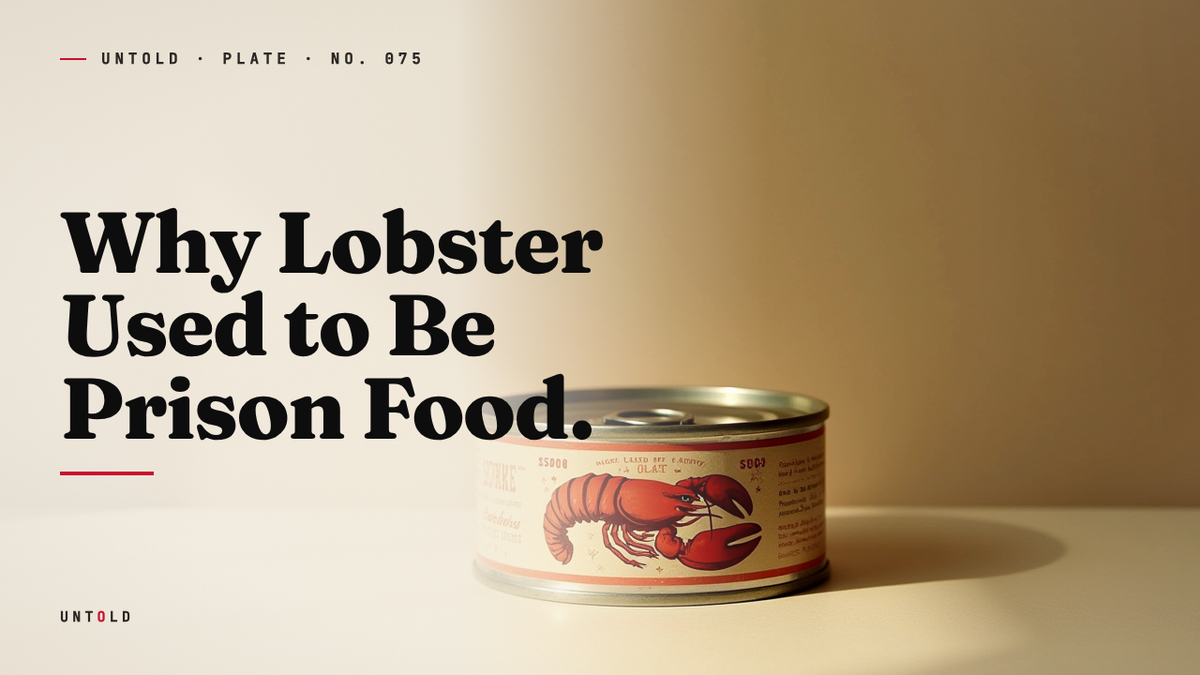
Somewhere in coastal Massachusetts, in the middle of the seventeenth century, a group of indentured servants did something that sounds absurd to the modern ear. They complained. Not about the length of their workdays or the meagerness of their wages, but about being fed lobster too often. The grievance was serious enough that, according to a durable piece of New England folklore, contracts were eventually written to cap the number of times a servant could be served the stuff. No more than three times a week. Anything more felt like abuse.
Today a single lobster dinner can cost the better part of two hundred dollars. The animal has become shorthand for celebration: the meal you order when you get engaged, when you close the deal, when you want the evening to mean something. Its image sits on the menus of restaurants that pride themselves on excess. And yet for most of American history, and for a good deal of history before that, the lobster was the opposite of a treat. It was garbage. It was punishment. It was what you ate when there was nothing else, and what you fed to people you did not respect.
The strange thing about this reversal is that the lobster itself never changed. The same meat that colonists found shameful is the meat we now pay a premium for. What changed was the story wrapped around it, and the story turns out to be one of the more revealing case studies in how humans decide what is precious and what is worthless.
Abundance Breeds Contempt
When the Pilgrims arrived on the New England coast in the early 1600s, the lobster population was almost incomprehensibly large. Accounts from the period describe lobsters piling up along the shoreline in drifts two feet deep after a storm, so plentiful that a person could wade into the shallows and gather them by hand. William Bradford, the governor of Plymouth Colony and its most careful chronicler, recorded the colonists’ discomfort at having so little to offer newcomers. In his account of one meager welcome, the best dish the settlers could set before their guests was lobster, served without bread or anything else, and Bradford noted the shame of it.1
That shame is difficult to translate for a modern reader. To understand it, you have to strip away four centuries of accumulated prestige and see the creature as the colonists saw it: a bottom-dwelling scavenger, armored and alien, washing up in rotting heaps. The English had a category for such things, and lobster fell squarely into it. It was the food of last resort, eaten when the harvest failed and the salted meat ran out.
The Indigenous peoples of the region had a more practical relationship with the animal, though not a more reverent one. Lobster was used as fertilizer, tilled into fields to enrich the soil, and as bait to catch the fish that people actually wanted to eat. The lobster, in other words, was a means to better food rather than food in its own right. It occupied roughly the position that a modern gardener assigns to fish emulsion.
The contempt had a logic to it beyond mere abundance. Fresh lobster spoils with alarming speed. The meat begins to break down within hours of the animal’s death, and eating spoiled shellfish can make a person violently ill. Before refrigeration, the safe window between catch and consumption was brutally short. The practical solution was to boil the lobster quickly and often, reducing it to a grey, overcooked mush that was then ladled out to those who had no standing to refuse it: prisoners, apprentices, servants, the poor. Some accounts hold that feeding lobster to inmates too frequently was eventually regarded as a form of cruelty.2
So the picture that emerges from colonial New England is consistent and unflattering. Lobster was cheap because it was everywhere, ugly because it looked like an insect, and low-status because it spoiled fast and had to be served in a form that made it worse. To be caught eating it was to advertise your poverty. Abundance, as it so often does, had bred contempt.
The Railroads and the Uninformed Palate
The first crack in this reputation appeared not in a kitchen but on a set of iron rails. In the middle of the nineteenth century, the American railroad network expanded rapidly, threading the industrial cities of the interior together and, crucially, connecting them to the coast. With the trains came a new and captive population of diners: passengers on long journeys who ate in dining cars and had no way of knowing what any given region considered respectable food.
This ignorance turned out to be an asset. Railroad managers, looking for cheap ingredients to feed travelers, seized on lobster precisely because it cost almost nothing on the coast. They served it in the dining cars as though it were an exotic specialty, and the passengers, unaware that they were eating what New Englanders regarded as pauper’s fare, found it delicious. They paid handsomely for the experience.3
The geographic distance did the marketing. A traveler from Ohio or Illinois had no cultural memory of lobster as prison food, no inherited embarrassment attached to it. To such a person, the lobster was simply a strange and flavorful creature from the sea, encountered under the pleasant circumstances of a train journey. Freed from its regional stigma, it could be tasted on its own merits, and its merits, it turned out, were considerable. By the 1880s, the demand generated along the rail lines had begun to reshape how the whole country thought about the animal.
Here we encounter one of the quieter truths of how food acquires status. Reputation is local, but appetite travels. Move a despised ingredient far enough from the culture that despises it, and it can arrive somewhere else as a novelty, its baggage left behind at the departure platform.
Cans, Collapse, and the Birth of Scarcity
The railroads had a partner in this transformation, and it was the canning industry. Along the coast of Maine, canneries sprang up to process lobster on an industrial scale. Canned lobster solved the ancient problem of spoilage in a single stroke: sealed in a tin, the meat could travel anywhere in the country and sit on a shelf for months without turning toxic. Factories processed staggering quantities, packing millions of pounds a year and shipping them inland to markets that had never seen a live lobster and never would.4
For a while this looked like an unambiguous success. Cheap protein flowed from the Maine coast into the American interior, and the industry boomed. But the boom carried the seeds of its own reversal. The canneries and the fishery pulled lobsters from the water faster than the population could replenish itself, and by the late nineteenth century the catch had begun to fall. Decades of intensive harvesting crashed the numbers. The creature that had once blanketed the shoreline in drifts was suddenly harder to find.
And then something counterintuitive happened. As the lobster grew scarce, it grew desirable. Scarcity accomplished what abundance never could. The same animal that had been shoveled onto the plates of servants became, within a generation, an object of appetite and even aspiration. When there had been too many to want, nobody wanted them. When there were suddenly too few, everyone did.
This is not a quirk of lobster. It is a recurring feature of how humans assign value, and economists have a term for the way perceived rarity inflates desire. The same meat, unchanged in flavor or texture, became precious the moment it stopped being guaranteed. The lobster had done nothing. The supply had simply contracted, and desire rushed in to fill the space.
Freshness as a Signal of Wealth
As the canned lobster of the interior gave way to a fresh lobster commanding real money, a second transformation was underway in the restaurants of the coastal cities. Chefs discovered what modern diners take for granted: that a live lobster, cooked fresh, tastes dramatically better than one boiled to grey mush hours after death or sealed in a tin for months. The very fragility that had once damned the animal now became its selling point.
Because fresh lobster spoiled so fast, serving it live signaled something about the person doing the serving. It meant access. It meant the money to have the animal shipped or, later, flown while it was still alive, and the connections to get it before it perished. Freshness became a proxy for wealth. A live lobster on the table was proof that you could command the fast, expensive logistics that ordinary people could not.5
Prices climbed as demand outpaced the shrinking supply, and the lobster completed its ascent from the plate of the prisoner to the table of the wealthy. The world wars accelerated the shift. Lobster was never subjected to wartime rationing the way that beef, sugar, and butter were, which meant that during periods of general scarcity the well-off could feast on it freely while their neighbors went without. Soldiers who had encountered fine dining overseas came home with expanded appetites. By the 1950s, lobster had settled comfortably into its modern role as a marker of celebration, romance, and money.6
Within the span of roughly three centuries, the animal had traveled the entire length of the social spectrum, from the food you were ashamed to serve to the food you served precisely because it was expensive.
A Story We Choose to Believe
The crucial fact in all of this is that the lobster did not change. Its biology is the same. The meat that disgusted the colonists is chemically indistinguishable from the meat that now sits under a heat lamp at a steakhouse charging fifty dollars for a tail. What changed was everything around it: the trains that carried it beyond its reputation, the cans that decoupled it from spoilage, the collapse that made it rare, the chefs who learned to cook it well, the wars that spared it from rationing, and the slow accretion of prestige that followed.
Lobster is not alone in this. The same maneuver has been run on a whole catalogue of foods now considered fine dining. Oysters were once cheap street food for the urban poor. Sushi, before it was reengineered into a global luxury, was in part a preservation technique for common fish. Caviar and lobster and a dozen other delicacies share a lineage that leads back to the peasant table or the discard pile. Yesterday’s scraps become tomorrow’s status symbols with remarkable regularity, and almost always for reasons that have nothing to do with how the food actually tastes.
The global lobster market is now worth billions of dollars, a valuation built on a foundation of perception at least as much as flavor. The animal itself remains supremely indifferent to its own price. It goes on doing what lobsters have always done, scavenging the sea floor, molting its shell, living its slow armored life, with no notion that somewhere above the waterline it has become a symbol of the good life.
Taste is real. Some of the lobster’s rise genuinely rests on the fact that fresh, well-cooked lobster is a fine thing to eat. But price is something else. Price is a story, told and retold until we forget it is a story at all, until the two-hundred-dollar plate feels like an expression of natural law rather than the endpoint of a long accident involving railroads and canneries and a population crash. The next time the bill arrives, it is worth remembering that the same creature, in another century, was an embarrassment. It was fed to people who could not say no. It was, quite literally, considered trash.

Sources
- Bradford, William, Of Plymouth Plantation, 1651 (published 1856). — https://www.gutenberg.org/ebooks/24950
- Luzer, Daniel, “How Lobster Got Fancy,” Pacific Standard, 2013. — https://psmag.com/economics/how-lobster-got-fancy-59440
- Townsend, Elisabeth, Lobster: A Global History, Reaktion Books, 2011. — https://press.uchicago.edu/ucp/books/book/distributed/L/bo12080186.html
- Woodard, Colin, The Lobster Coast: Rebels, Rusticators, and the Struggle for a Forgotten Frontier, Viking, 2004. — https://www.penguinrandomhouse.com/books/291988/the-lobster-coast-by-colin-woodard/
- Wallace, David Foster, “Consider the Lobster,” Gourmet, 2004. — https://harpers.org/wp-content/uploads/HarpersMagazine-2004-08-0080259.pdf
- Freeman, Andrea, “How Lobster Went From Prison Food to a Delicacy,” Smithsonian Magazine, 2015. — https://www.smithsonianmag.com/arts-culture/how-lobster-got-fancy-180956256/
Related reading