The Second Genome You Rewrite at Every Meal
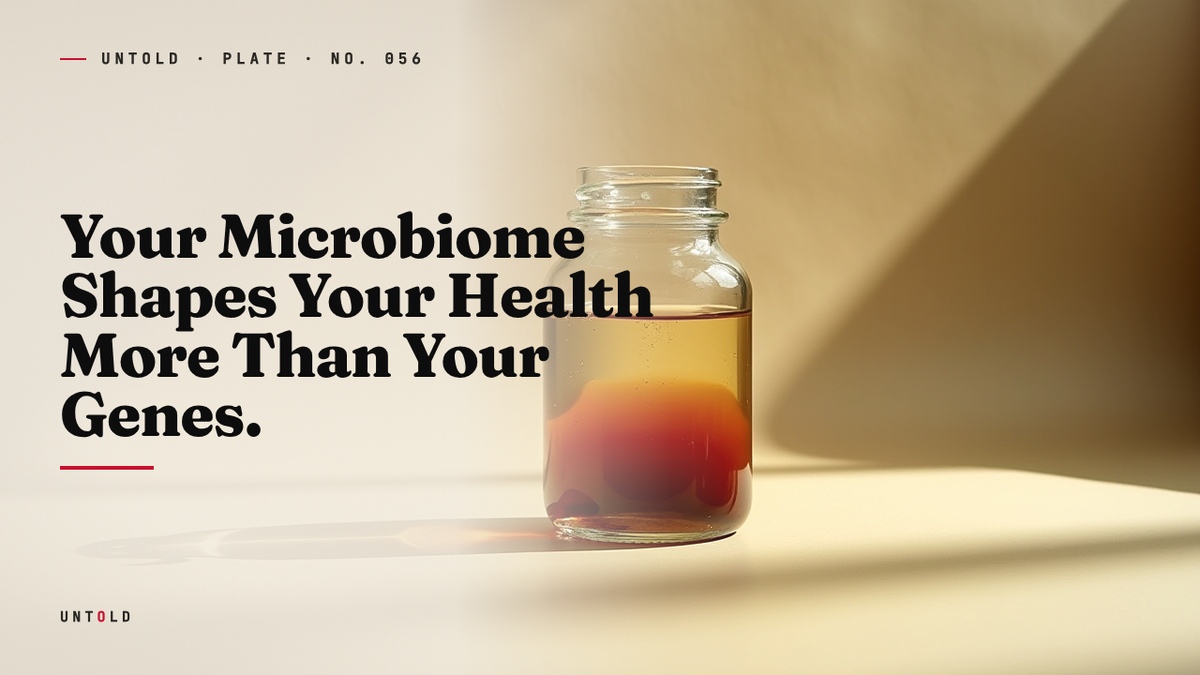
The trillions of microbes in your gut may decide more about your health than the DNA you were born with.
In 1683, a Dutch draper with an obsessive habit of grinding his own lenses scraped a little plaque from between his teeth, smeared it under a microscope of his own design, and saw something that no human had ever seen before. The material moved. It teemed. Antonie van Leeuwenhoek described what he found as animalcules, tiny living things swarming in numbers that dwarfed anything he could count. He noticed, with some embarrassment, that they were most plentiful in the mouths of people who rarely cleaned their teeth. He had, without knowing it, become the first person to look at the human microbiome.1
For the next three centuries, medicine treated Leeuwenhoek’s discovery as a warning rather than a wonder. Microbes were things to be killed. The germ theory of disease, one of the great intellectual triumphs of the 19th century, taught us to see bacteria as enemies at the gate: cholera, tuberculosis, the plague. Antibiotics, arriving in the 20th century, felt like the final victory. We could sterilize a wound, sterilize a gut, sterilize a life. It took until the dawn of the 21st century for a quieter and stranger idea to take hold. Most of the microbes inside us are not invaders. They are residents. And they may be running more of the show than the genes we inherited from our parents.
A body that is only half its own
The arithmetic is disorienting. A human body contains roughly thirty trillion of its own cells. It also carries something on the order of thirty-nine trillion microbial cells, most of them bacteria packed into the dark, oxygen-poor folds of the large intestine.2 By that count, you are, cell for cell, slightly more microbe than person. Earlier estimates ran to a ten-to-one ratio, which turned out to be exaggerated, but even the corrected figure leaves us in unfamiliar territory: a self that is at best a rough majority of the thing wearing your name.
The genetic gap is wider still. The human genome, sequenced with such fanfare at the turn of the millennium, contains roughly twenty-three thousand protein-coding genes. The collective genome of your gut microbes, sometimes called the second genome, carries millions.3 Those microbial genes are not idle passengers. They encode enzymes your own cells cannot make, metabolic pathways your DNA never learned, chemical factories that break down food, synthesize vitamins, and manufacture signaling molecules that travel through your blood and up your nerves.
Here is the part that unsettled the old story of biological destiny. Your human DNA is fixed on the day you are born. It is the hand you were dealt, unchangeable, written in code. The second genome is nothing of the kind. It shifts with what you eat, what you take, how you sleep, whether you were born in a hospital or a bathtub. It can be depleted in a matter of days and rebuilt in a matter of weeks. If genes are a script, the microbiome is closer to improvisation, and the improvisation may matter more.
For most of the 20th century, medicine bet heavily on the script. The dream was genetic determinism: find the gene, find the disease, find the cure. And for a handful of conditions, cystic fibrosis, Huntington’s, sickle cell, that dream came true. But the common diseases that fill hospital wards, obesity, type 2 diabetes, inflammatory bowel disease, depression, refused to cooperate. Genome-wide studies kept finding that inherited variants explained only a modest slice of who fell ill and who did not. Something else was doing the heavy lifting. In 2007, a coordinated effort called the Human Microbiome Project set out to map that something else: the full census of bacteria, fungi, and viruses that share our bodies.4
The man who made a mouse fat
If the field has a founding figure, it is Jeffrey Gordon, a soft-spoken microbiologist at Washington University in St. Louis who spent decades asking a question most of his peers considered slightly absurd. Could the bacteria in an animal’s gut change the shape of its body? Not through infection, not through illness, but through ordinary daily metabolism?
Gordon’s laboratory had a rare and powerful tool: germ-free mice, raised inside sealed isolators, born by cesarean section and never once exposed to a living microbe. These animals are biological blank slates, guts as sterile as distilled water. And they behaved strangely. Fed the same chow as normal mice, they ate more yet stayed stubbornly lean. Something about having no microbes made it hard for them to extract and store energy from food.5
Then came the experiment that reframed the field. Gordon’s team took gut bacteria from ordinary mice and transplanted them into the germ-free animals. Within two weeks, on the very same diet, the recipients’ body fat rose by roughly sixty percent.5 Nothing had changed except the microbes. The bacteria were harvesting calories the mice could not reach on their own, breaking down fibers, releasing energy, tipping the metabolic ledger toward storage.
A skeptic could argue that mice are not people, and that mouse guts are not human guts. So in 2013, Gordon’s group ran a more audacious version. They recruited human twins in which one sibling was lean and the other obese, pairs that shared nearly identical DNA yet carried very different bodies. They took gut microbes from each twin and transplanted them into separate germ-free mice. The result read like a parable. The mice that received microbes from the obese twin gained fat. The mice that received microbes from the lean twin stayed slim.6 Same host genes, in effect. Same diet. Different bacteria, different bodies.
The experiment did something rare in science. It moved a correlation toward a cause. For years, researchers had noticed that lean and obese people tended to carry different gut communities, but correlation is cheap. Fat people might simply eat differently, and different food might shape different microbes. Gordon’s twins-into-mice design cut that knot. Transfer the microbes, transfer some measure of the trait. The bacteria were not merely a symptom of obesity. They were, at least in part, a contributor to it.
Thirty plants a week
If Gordon proved that gut microbes could reshape a body, the next question was obvious and enormous. What shapes the microbes? Here the work moved from the sealed isolator to the messy scale of the whole human population, and its most visible champion was Rob Knight, a computational biologist at the University of California, San Diego.
Knight helped launch the American Gut Project, later folded into a global effort, which invited ordinary people to mail in stool samples and answer detailed questionnaires about their diets and lives.7 It was citizen science on a grand scale, tens of thousands of guts sequenced by post. And out of that sprawling dataset emerged a finding that turned out to be more robust than almost anything else: the single strongest predictor of a diverse, resilient gut microbiome was not whether a person ate meat or avoided it, not whether they were vegan or paleo, but simply how many different plants they ate.
The project’s data suggested a rough threshold. People who ate more than thirty different types of plant per week, counting herbs, spices, nuts, seeds, whole grains, and legumes alongside the obvious fruits and vegetables, carried markedly richer and more varied gut communities than people who ate fewer than ten.7 Diversity on the plate begat diversity in the gut. It was not about a single superfood. It was about breadth.
The reason lies in what those microbes actually do with plant matter. The human gut cannot digest most dietary fiber on its own. We lack the enzymes. But our bacteria do not, and when they ferment fiber in the colon, they release a class of compounds called short-chain fatty acids: butyrate, propionate, acetate.8 These are not waste products. Butyrate is the preferred fuel of the cells lining the colon; it helps maintain the integrity of the gut wall and dampens inflammation throughout the body. A diverse, well-fed microbiome is, in effect, a small pharmaceutical plant producing anti-inflammatory compounds around the clock.
The corollary is grim. When fiber runs short, the fiber-eating bacteria starve. Some of them, rather than dying quietly, turn to the next available carbohydrate source: the mucus layer that coats and protects the gut lining itself. In studies of mice fed fiber-poor diets, researchers watched the protective mucus barrier thin as hungry microbes began to graze on it, leaving the intestinal wall more exposed to pathogens.9 The modern Western diet, heavy in refined and processed food, light in varied plants, is in some sense a slow starvation of the very organisms that keep the gut wall intact.
The conversation between gut and brain
For a long time, the microbiome seemed like a story about digestion and weight. Then it began to reach into places no one expected, and none was stranger than the brain.
The gut and the brain are wired together by the vagus nerve, a thick cable of fibers running from the brainstem down into the abdomen. What surprised researchers was the direction of the traffic. The vagus carries far more signals up, from gut to brain, than down.10 The gut is not simply taking orders. It is reporting, constantly, and much of what it reports is shaped by its microbial tenants.
Consider serotonin, the neurotransmitter most associated with mood. Roughly ninety percent of the body’s serotonin is produced not in the brain but in the gut, and gut microbes play a direct role in prompting that production.11 They also manufacture and modulate other neuroactive compounds, effectively participating in the body’s chemical signaling from the inside of the intestine.
Emeran Mayer, a gastroenterologist at UCLA who has spent his career mapping this exchange, calls it the gut-brain conversation, and he means the word conversation seriously.12 It is bidirectional, continuous, and biochemical. The implications reach into psychiatry and neurology. Researchers have linked particular gut microbial profiles to anxiety and depression, and one of the more startling threads connects gut bacteria to Parkinson’s disease. Some evidence suggests that the misfolded proteins characteristic of Parkinson’s may begin in the gut and travel up the vagus nerve to the brain, which would mean a neurodegenerative disease of the mind might have its first foothold in the intestine.13
The clinical payoff is already real for at least one condition. Clostridioides difficile, or C. diff, is a bacterium that can seize control of a gut whose normal community has been wiped out by antibiotics, causing infections that are sometimes fatal and notoriously resistant to yet more antibiotics. The treatment that works best is not a drug at all. It is a fecal microbiota transplant, the transfer of stool, and with it a whole functioning microbial community, from a healthy donor into a sick patient. For recurrent C. diff, it cures well over ninety percent of cases, a success rate most pharmaceuticals can only envy.14 The medicine, in this case, is a community of living things.
The genome you feed
Here the old story of genetic destiny quietly inverts. Your first microbes are not chosen. You inherit them, seeded largely during birth as you pass through your mother’s birth canal and pick up her bacteria, then enriched by breast milk and early contact with the world. In that sense the microbiome, like the genome, begins as an inheritance. But there the resemblance ends. The DNA in your cells will not change no matter how you live. The community in your gut will change constantly, and it will change in response to you.
That responsiveness cuts both ways. Antibiotics, prescribed for a genuine infection, can flatten gut diversity within days, clearing beneficial species along with the target. Chronic stress reshapes the community. A diet of processed food, low in fiber, narrows it. The good news, borne out repeatedly, is that the community is resilient. Feed it a broad range of plants and fibers, and diversity can begin to rebuild within a few weeks.7 The garden can be replanted.
This is the deepest reframing the microbiome offers. For a century, the genetic model of disease carried a certain fatalism. If your fate was written in code you could not edit, then health was in large part a matter of luck. The microbiome does not erase genetics. Genes still matter, and some diseases remain firmly written in DNA. But for the sprawling category of common chronic illness, where inherited variants explain only a fraction of the risk, the second genome offers something the first never could: leverage. A place where daily choices accumulate into biological consequence.
Every meal, in this light, is a message sent to trillions of living things. A plate of varied plants is an instruction to a diverse and stable community; a week of refined convenience food is a different instruction entirely, and the tenants will respond to both. Leewenhoek, peering at the swarming scrapings from his own teeth, thought he had found a curiosity, a hidden zoo. He had actually found a partner, or rather a whole population of them, so woven into the workings of the human body that the boundary between self and other turns out to be far blurrier than anyone imagined. You are not merely carrying these organisms. You are, in a sense, negotiating with them. And unlike the fixed genome you were born with, this is one conversation you get to steer.

Sources
- Lane, N., “The unseen world: reflections on Leeuwenhoek and his microbiology,” Philosophical Transactions of the Royal Society B, 2015. — https://royalsocietypublishing.org/doi/10.1098/rstb.2014.0344
- Sender, R., Fuchs, S., Milo, R., “Revised Estimates for the Number of Human and Bacteria Cells in the Body,” PLOS Biology, 2016. — https://journals.plos.org/plosbiology/article?id=10.1371/journal.pbio.1002533
- Qin, J. et al., “A human gut microbial gene catalogue established by metagenomic sequencing,” Nature, 2010. — https://www.nature.com/articles/nature08821
- Turnbaugh, P. J. et al., “The Human Microbiome Project,” Nature, 2007. — https://www.nature.com/articles/nature06244
- Backhed, F., Gordon, J. I. et al., “The gut microbiota as an environmental factor that regulates fat storage,” PNAS, 2004. — https://www.pnas.org/doi/10.1073/pnas.0407076101
- Ridaura, V. K., Gordon, J. I. et al., “Gut Microbiota from Twins Discordant for Obesity Modulate Metabolism in Mice,” Science, 2013. — https://www.science.org/doi/10.1126/science.1241214
- McDonald, D., Knight, R. et al., “American Gut: an Open Platform for Citizen Science Microbiome Research,” mSystems, 2018. — https://journals.asm.org/doi/10.1128/mSystems.00031-18
- Koh, A. et al., “From Dietary Fiber to Host Physiology: Short-Chain Fatty Acids as Key Bacterial Metabolites,” Cell, 2016. — https://www.cell.com/cell/fulltext/S0092-8674(16)30592-6
- Desai, M. S. et al., “A Dietary Fiber-Deprived Gut Microbiota Degrades the Colonic Mucus Barrier and Enhances Pathogen Susceptibility,” Cell, 2016. — https://www.cell.com/cell/fulltext/S0092-8674(16)31464-7
- Cryan, J. F., Dinan, T. G. et al., “The Microbiota-Gut-Brain Axis,” Physiological Reviews, 2019. — https://journals.physiology.org/doi/full/10.1152/physrev.00018.2018
Related reading