The Oldest Food on Earth Is Coming Back
Two billion people already eat insects. The rest of us call it disgust and forget it was once dinner.
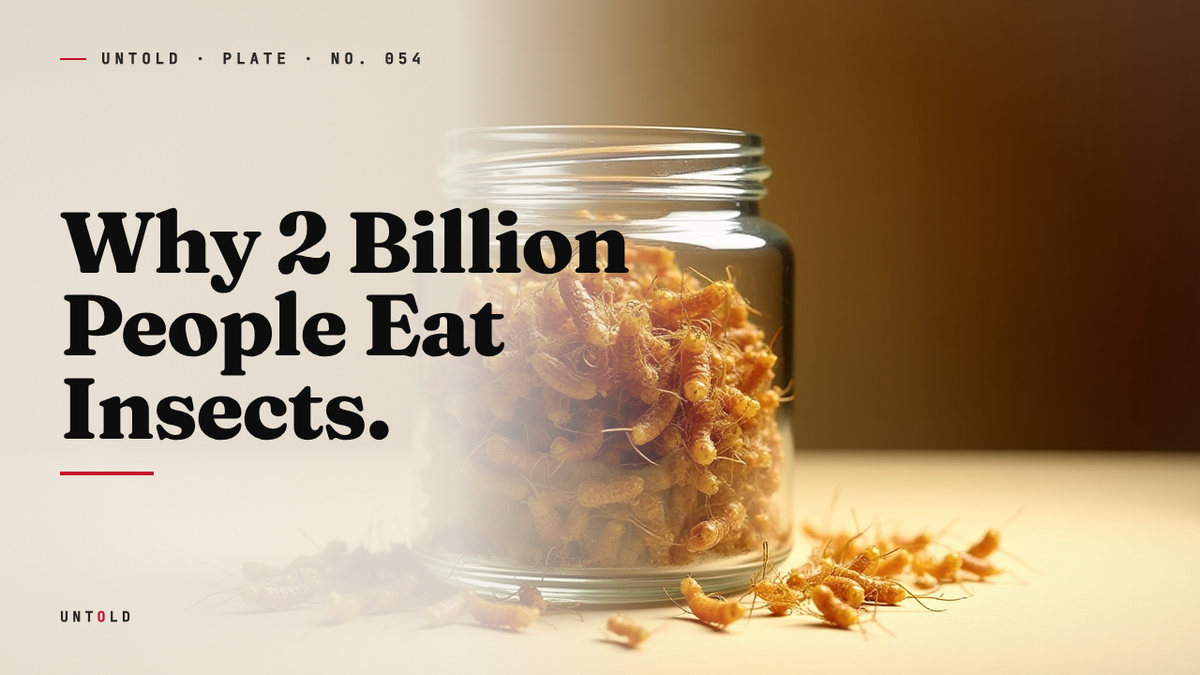
On a sidewalk in Bangkok, a woman ladles crickets from a steel tray the way a cinema worker scoops popcorn. They come golden and lacquered, sold by weight, seasoned with a shake of soy and pepper. A child hands over a few baht, takes a paper cone, and eats while walking to school. Nobody watches. Nobody flinches. Around the cart, vendors sell bamboo worms, silkworm pupae, and fried grasshoppers stacked in glistening pyramids. It is not a spectacle. It is Tuesday.
To a visitor raised in Europe or North America, the scene reads as exotic, maybe even confronting. But the more honest reaction is a question that turns the whole thing around. Of the roughly eight billion people on the planet, an estimated two billion eat insects as a routine part of their diet 1. That is not a fringe survival tactic practiced in the margins. That is a quarter of humanity, spread across Asia, Africa, and Latin America, doing something their ancestors did for tens of thousands of years. Set against that scale, the Western diner staring at a cone of crickets is not the observer of a curiosity. He is the outlier. The strange one at the table is us.
A food older than farming
The practice has a name. Entomophagy, from the Greek for insect-eating, describes the deliberate consumption of insects by humans. Anthropologists who study early human diets place it near the very beginning of the story. Long before our ancestors organized to hunt large mammals, before spears and coordinated pursuit, they gathered what was slow, abundant, and rich in fat. Insects fit that description precisely. Termites, grubs, caterpillars, and grasshoppers offered dense nutrition to anyone patient enough to collect them, and collecting them required no weapons and little risk.
Evidence for this runs from the fossil record into the present. Chimpanzees, our closest living relatives, fish for termites with stripped twigs, which suggests the behavior may predate the human line entirely. Coprolites, or fossilized human feces recovered from caves in the American Southwest, contain the undigested exoskeletons of ants and beetle larvae, hard proof that people were eating insects thousands of years ago 2. Nearly every traditional cuisine that developed outside the temperate grain belt of Europe kept insects on the menu, because insects were simply there, and they were good.
Which raises the puzzle at the heart of the subject. If eating insects is so old, so widespread, and so nutritionally sound, why did half the world quietly decide it was revolting?
How Europe forgot
The answer begins with agriculture, roughly ten thousand years ago, in the fertile crescent and the plains that would become Europe. When people domesticated cattle, sheep, and grain, they made a wager on a particular kind of landscape: open fields of wheat and barley, herds of large animals grazing on pasture. That wager changed the relationship between humans and insects almost overnight.
In a farming economy built on grain, insects stopped being food and became the enemy. Locust swarms did not represent a windfall of protein. They represented the loss of an entire harvest, the difference between a fed village and a starving one. Grasshoppers, beetles, and weevils were the things that destroyed what people had worked all season to grow. The insect became a symbol of ruin, and a symbol of ruin is not something anyone wants to put in their mouth.
Over generations, that practical hostility hardened into something deeper. Disgust, which begins as a learned response to specific threats, tends to fossilize into culture, and then into a kind of moral reflex that feels like instinct. By the time Europeans were writing down their ideas about what civilized people ate, insects had been filed under the category of the unclean, the primitive, the food of desperation. Colonial travelers who encountered insect-eating in Africa or Asia described it as evidence of backwardness, projecting their own recent history onto peoples who had never made the grain wager and had simply kept eating what worked.
Meanwhile, across most of the tropical world, no such forgetting happened. In Mexico, chapulines (toasted grasshoppers) and escamoles (ant larvae) remained prized ingredients, some of them served at the tables of the elite. In parts of central and southern Africa, dried mopane caterpillars were a staple traded across regions. In Thailand, Laos, and Cambodia, the fields that grew rice also grew a second crop of protein, and people harvested both. The habit did not survive on the fringes. It survived because it made sense.
Thailand’s accidental blueprint
Thailand offers the clearest modern illustration of how insect-eating moves from necessity to cuisine to industry. The tradition is strongest in Isan, the country’s poorer northeastern region, where farmers historically ate what the rice paddies provided. When grasshoppers descended on the crops, the response was pragmatic to the point of poetry: the pest became the meal. People caught the insects that threatened their rice and fried them for dinner. What began as a way to salvage something from a bad situation slowly refined itself into a repertoire of dishes, seasonings, and preferences.
Over the decades, that survival food climbed the social ladder. Fried insects moved from the village into the night markets of Bangkok, where they became street food ordinary enough to be unremarkable and popular enough to sustain thousands of vendors. But the more consequential shift happened away from the carts, on farms. Thailand now hosts an estimated 20,000 cricket-farming operations, most of them small family enterprises running low-cost concrete pens or plastic bins 3. This did not happen by accident.
In the early 2000s, researchers at Khon Kaen University in Isan began working with local farmers to systematize what had been informal backyard practice. Together with the Food and Agriculture Organization of the United Nations, they produced some of the first formal guidance on cricket rearing, turning trial-and-error catching into a repeatable method for producing protein at scale 4. The economics were compelling. A cricket reaches harvest weight in roughly six weeks. A cow takes close to two years to reach slaughter. A farmer with a modest setup and little capital could generate a steady income from an animal that needed a fraction of the space, feed, and time of conventional livestock. Insects stopped looking like a marker of poverty and started looking like a rung on a ladder out of it.
The inconvenient arithmetic
For a long time, the Western dismissal of insect-eating went largely unchallenged in scientific terms. That changed in 2013, when a team led by the Dutch entomologist Arnold van Huis published a report for the FAO titled Edible Insects: Future Prospects for Food and Feed Security 1. The document did something the culinary world had not: it treated insects as a serious answer to a serious problem, namely how to feed a growing population without wrecking the planet in the process.
The argument rested on arithmetic that is difficult to wave away. Producing animal protein is enormously resource-intensive, and cattle sit at the extreme end of that spectrum. Beef requires vast quantities of land, feed, and water, and cows belch methane, a greenhouse gas far more potent than carbon dioxide over a short horizon. Insects, reared for the same amount of protein, undercut livestock on nearly every measure. Crickets convert feed to body mass roughly six times more efficiently than cattle, meaning six times less grain to produce the same edible protein 1. They emit a small fraction of the greenhouse gases. And they demand almost none of the water.
The water figure alone reframes the entire debate. Estimates of the water required to produce a single kilogram of beef run to around 15,000 liters once you account for the feed the animal consumes over its life 5. The equivalent protein from crickets requires a tiny share of that. In a century where fresh water is emerging as one of the defining scarcities, an animal that produces high-quality protein while barely touching the water supply is not a novelty. It is a strategic asset.
The nutritional case is, if anything, harder to argue against than the environmental one. On a dry-weight basis, crickets are roughly 60 percent protein, comparable to or better than most conventional meat 1. They deliver all the essential amino acids the human body cannot make for itself, which places them in the rare category of complete protein sources. They carry iron, zinc, and calcium in meaningful quantities. Some studies have found that certain edible insects contain more iron per gram than beef, a finding with real implications for the roughly two billion people worldwide affected by iron deficiency 6. Food scientists studying nutrient density have repeatedly confirmed that insects are not a compromise protein consumed for lack of anything better. They are, by the measures nutritionists use, genuinely excellent food.
Stacked together, these facts produce an uncomfortable conclusion for the cultures that spent centuries mocking entomophagy. The food they called disgusting was, in most respects that matter, outperforming the food on their own plates. It was cheaper to produce, kinder to the climate, easier on the water table, and at least as nourishing. The disgust, it turned out, was not tracking any real defect in the food. It was tracking nothing but unfamiliarity.
The learned reflex
This is the part the science of disgust makes clear, and it is worth dwelling on because it explains the entire Western predicament. Disgust feels like an instinct, a bodily verdict delivered before thought. But the research suggests it is largely learned, calibrated by culture, and, crucially, capable of being unlearned. The psychologist Paul Rozin, who spent a career studying the emotion, showed that disgust responses are acquired in childhood and shaped almost entirely by what a person’s community treats as food and non-food 7. A child raised in Oaxaca finds grasshoppers appetizing for exactly the same reason a child raised in Ohio finds them appalling: each learned what the people around them ate.
The line between delicacy and disgust turns out to be nothing more solid than familiarity, and the proof is already on the Western plate. Honey, prized and expensive, is a substance regurgitated by bees. Shrimp and lobster, served in the finest restaurants, are arthropods with more anatomical kinship to insects than to fish. Blue cheese is milk deliberately colonized by mold. The Western diner draws the boundary of acceptable food in a place that has nothing to do with logic and everything to do with what he saw his parents eat.
There is a further irony that undercuts the disgust entirely. People in industrialized countries are already eating insects, whether they know it or not. Food safety regulators permit small quantities of insect fragments in processed foods, because it is impossible to keep them out entirely during harvesting and milling. The relevant authorities allow, for instance, an average of a certain number of insect fragments per unit of chocolate, wheat flour, and other staples, and the true figure across a typical diet runs to hundreds of fragments a year 8. The question was never whether Westerners eat insects. They do. The only question is whether they will admit it and do it deliberately.
The return
The boundary is now shifting, cautiously, in the very cultures that abandoned insect-eating. In 2021 and 2023, the European Union approved several insect species, including house crickets and yellow mealworms, for sale as human food, following safety assessments by the European Food Safety Authority 9. The approvals were technical and unglamorous, buried in regulatory language, but their significance was hard to miss. A regional bloc that had spent centuries treating insects as pests had formally certified them as dinner.
What has followed is a wave of products engineered to slip past the disgust reflex rather than confront it. Startups now mill crickets into a fine flour that vanishes into pasta, protein bars, and baked goods, delivering the nutritional and environmental benefits without the visible legs and antennae that trigger the learned aversion. The strategy is shrewd. It bets that the fastest way to reintroduce an ancient food to a squeamish culture is to make it look like the food that culture already trusts. Whether that constitutes a triumph or a small surrender depends on your taste for authenticity, but it works.
None of this suggests that the West is about to abandon beef for beetles, or that Bangkok’s cricket carts will be transplanted wholesale onto the streets of London. Cultural change moves slowly, and the grip of a childhood-learned disgust is not loosened by a spreadsheet, however persuasive. But the trajectory is unmistakable. The food that agriculture pushed to the margins ten thousand years ago is being pulled back toward the center, this time not by necessity but by the twin pressures of a crowded planet and a warming climate.
Which returns us to the woman with her steel tray in Bangkok, and to the child eating crickets on the walk to school. The instinct of the visiting Westerner is to see something primitive in that scene, a relic of a poorer past. The instinct is precisely backward. The people at that cart are not clinging to something the modern world left behind. They are quietly practicing something the modern world is, slowly and a little sheepishly, rediscovering it needs. What looks like the oldest food on Earth may turn out to be one of the newest ideas about how to keep feeding it.
Sources
- van Huis, A. et al., Edible Insects: Future Prospects for Food and Feed Security, FAO Forestry Paper 171, 2013. — https://www.fao.org/3/i3253e/i3253e.pdf
- Sutton, M. Q., Insects as Food: Aboriginal Entomophagy in the Great Basin, Ballena Press, 1988. — https://en.wikipedia.org/wiki/Entomophagy
- Hanboonsong, Y., Jamjanya, T., Durst, P. B., Six-legged Livestock: Edible Insect Farming, Collecting and Marketing in Thailand, FAO, 2013. — https://www.fao.org/3/i3246e/i3246e.pdf
- Halloran, A. et al., Cricket Farming as a Livelihood Strategy in Thailand, The Geographical Journal, 2016. — https://doi.org/10.1111/geoj.12184
- Mekonnen, M. M., Hoekstra, A. Y., A Global Assessment of the Water Footprint of Farm Animal Products, Ecosystems, 2012. — https://doi.org/10.1007/s10021-011-9517-8
- Latunde-Dada, G. O. et al., In Vitro Iron Availability from Insects and Sirloin Beef, Journal of Agricultural and Food Chemistry, 2016. — https://doi.org/10.1021/acs.jafc.6b03286
- Rozin, P., Fallon, A. E., A Perspective on Disgust, Psychological Review, 1987. — https://doi.org/10.1037/0033-295X.94.1.23
- U.S. Food and Drug Administration, Food Defect Levels Handbook, FDA, 2018. — https://www.fda.gov/food/current-good-manufacturing-practices-cgmps-food-and-dietary-supplements/food-defect-levels-handbook
- European Food Safety Authority, Safety of Frozen and Dried Acheta domesticus (House Cricket) as a Novel Food, EFSA Journal, 2021. — https://doi.org/10.2903/j.efsa.2021.6779
Related reading