The Second Brain in Your Belly
How trillions of gut microbes may quietly help shape human mood, fear, and the future of psychiatry.
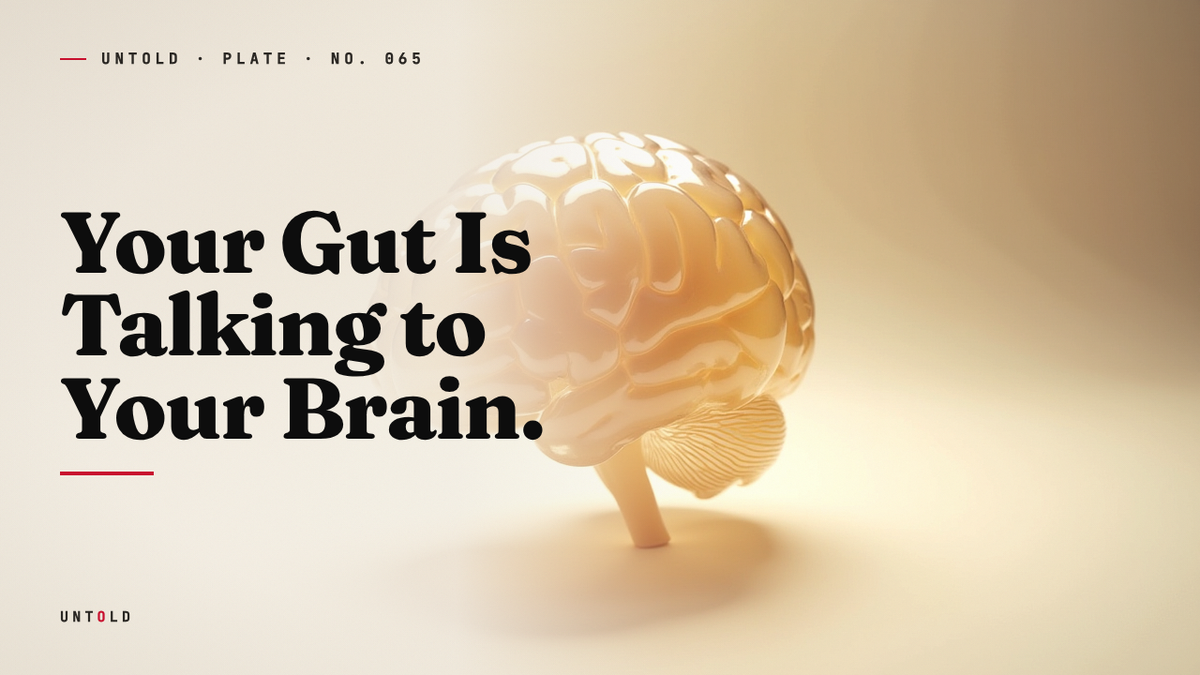
The knot arrives before the news does. A phone rings at an odd hour, an email subject line reads We need to talk, and something tightens low in the abdomen before the conscious mind has assembled a single coherent thought. For most of human history this was treated as metaphor, a figure of speech about butterflies and gut feelings. It turns out to be closer to a wiring diagram.
Inside the human intestines lives a network of roughly 500 million neurons, a tangle of nerve cells so extensive and so autonomous that scientists have taken to calling it the second brain. It manages the choreography of digestion largely without instruction from the head. It secretes neurotransmitters. It reacts, remembers in its own limited way, and above all it talks. Threaded through this system, and through the trillions of bacteria that live alongside it, is one of the most active and least examined conversations in the human body. And a growing number of researchers now suspect that some of what we call depression and anxiety may partly begin there, below the neck, in a place psychiatry spent a century ignoring.
A Correspondence Long Kept Secret
For most of the twentieth century, the mind and the gut lived in separate rooms with the door firmly shut. Psychiatry claimed the territory of thought, memory, and emotion. Gastroenterology took the plumbing. A patient with depression saw one kind of doctor; a patient with an irritable bowel saw another; and it rarely occurred to anyone that the two complaints, which so often appeared in the same person, might be describing a single system from two ends.
The physical evidence against that separation was hiding in plain sight. Running from the brainstem down into the chest and abdomen is the vagus nerve, the longest of the cranial nerves and the principal cable connecting the head to the viscera. It brushes the heart and the lungs on its way down and terminates in a dense fan across the digestive tract. For a long time it was imagined mainly as a command line, the brain issuing orders to slow the heart or stir the stomach. Then anatomists counted the fibers and found the traffic running mostly the other way. Roughly ninety percent of the vagus nerve’s fibers are afferent, meaning they carry information upward, from the gut to the brain, rather than down 1. The organ that was supposed to be taking orders spends most of its bandwidth reporting.
The man who did the most to force this idea into the open was Michael Gershon, a neurobiologist at Columbia University who spent decades studying the enteric nervous system when almost nobody thought it interesting. In 1998 he published a book with a title that was, at the time, faintly provocative: The Second Brain 2. Gershon’s argument was not mystical. It was mechanical and precise. The gut, he showed, contains its own complete nervous system, capable of coordinating the complex work of digestion on its own, and it manufactures and uses many of the same signaling molecules the brain relies on, including the overwhelming majority of the body’s serotonin. The gut, in his memorable phrasing, has a mind of its own.
What Gershon had described was an anatomy. What came next turned it into a story about mental health.
The Mice That Could Not Calm Down
The experimental breakthrough came from an unlikely tool: mice raised in absolute sterility, delivered by cesarean section into isolators and kept in a world scrubbed clean of microorganisms. These germ-free animals carry no gut bacteria at all. They are, in effect, blank pages, and they let researchers ask a question that would be impossible in any ordinary body: what does an animal’s brain and behavior look like when the microbes are simply not there?
In 2004 a team led by Nobuyuki Sudo at Kyushu University in Japan put those animals under mild stress and measured what happened inside them 3. The results were striking. Compared with normal mice, the germ-free animals mounted a wildly exaggerated stress response, pouring out far higher levels of the hormones that signal alarm. Deprived of their microbes, their internal thermostat for stress had come out of the factory badly calibrated, overreacting to challenges that a normally colonized mouse would shrug off. Then Sudo’s team did something that transformed a curiosity into a finding. They reintroduced bacteria. When the sterile mice were colonized early enough with ordinary gut microbes, and in particular with a single reassuring species, the runaway stress response settled back toward normal. The presence of bacteria in the gut was, somehow, tuning the reactivity of the brain.
The implication was hard to overstate. Something as intimate and psychological as an animal’s response to fear appeared to depend, at least in part, on the invisible ecosystem in its intestines. But correlation in a single study is a fragile thing, and the obvious next question was whether the effect could be produced deliberately, and whether anyone could find the wire it traveled along.
Cutting the Phone Line
That work fell largely to John Cryan and Ted Dinan and their colleagues at University College Cork, who over the following decade turned the gut-brain axis from a fringe interest into a serious research program. In one much-cited experiment, Cryan’s team fed healthy mice a particular strain of Lactobacillus, a common probiotic bacterium, and then ran them through the standard battery of rodent anxiety tests: mazes, open spaces, forced swims, the small ordeals that reveal how a mouse handles fear 4.
The treated animals behaved as though something in them had loosened. They were bolder in exposed spaces, less frantic under stress, and their blood carried lower levels of stress hormone. When the researchers looked inside their brains, they found the changes had reached the neural machinery itself, altering the expression of receptors for GABA, one of the main calming neurotransmitters, in regions that govern emotion and fear.
Then came the experiment that made the field sit up. The Cork team severed the vagus nerve in a group of the mice and ran the whole protocol again. This time the probiotic did nothing. The calming effect, the hormonal shift, the changes in brain chemistry, all of it vanished. Without the nerve, the bacteria in the gut and the neurons in the head had no way to reach one another. The vagus, in other words, was the phone line, and cutting it hung up the call. It was one of the cleanest demonstrations available that gut microbes were not merely correlated with the brain’s emotional state but were actively signaling to it along an identifiable physical route.
If bacteria could dial down anxiety, a stranger possibility loomed. Could they carry something like temperament from one animal to another? A team led by Premysl Bercik at McMaster University in Canada set out to test it directly, using two strains of mice with famously different dispositions: one naturally timid and cautious, the other bold and exploratory 5. Bercik’s group transplanted gut bacteria between the strains, giving the anxious mice the microbes of their adventurous cousins. The timid animals grew braver. They ventured further, hesitated less, behaved more like the donors of their new microbial community than like their old selves. Some component of what looked like personality had traveled, quite literally, through the gut.
What the Human Guts Were Missing
Mice are not people, and every honest account of this science has to keep saying so. But the human data, when researchers finally went looking at scale, refused to be dismissed.
The most influential of these studies came from Jeroen Raes and his collaborators at the University of Leuven and the VIB research institute in Belgium. In 2019 they published an analysis of the gut microbiomes of more than a thousand people enrolled in a large Flemish population study, cross-referenced against measures of mental wellbeing and, for some participants, formal diagnoses of depression 6. Two groups of bacteria, from the genera Coprococcus and Dialister, were consistently depleted in people with depression, and the association held even after the researchers accounted for the effects of antidepressant medication. It was, at the time, one of the largest population-level links ever drawn between specific gut microbes and mental health.
What made the finding more than a statistical curiosity was the biology behind it. When Raes’s team examined what these bacteria actually do, they found that gut microbes carry the genetic machinery to produce or influence a range of neuroactive compounds, substances that the nervous system uses or responds to. Some microbes appeared capable of producing a metabolite of dopamine; others were tied to the synthesis of butyrate, a short-chain fatty acid with anti-inflammatory effects on the gut and, potentially, the brain. The microbes were not passive lodgers. They were a distributed chemical factory whose output overlapped, unnervingly, with the very molecules psychiatry has spent decades trying to adjust with drugs.
The serotonin story sharpens the point. Serotonin is the neurotransmitter most associated in the popular imagination with mood, the target of the entire class of antidepressants known as SSRIs. And roughly ninety percent of the body’s serotonin is manufactured not in the brain but in the gut, produced by specialized cells in the intestinal lining in a process that gut bacteria help regulate 7. The molecule most tightly bound up with human happiness is, for the most part, made below the neck. That fact alone does not prove that gut serotonin governs mood, because the serotonin made in the gut cannot cross into the brain directly. But it captures why the old wall between digestion and emotion has come to look less like an anatomical truth and more like a historical accident.
The Restraint the Evidence Demands
Here the story has to slow down, because this is precisely the point at which enthusiasm outruns the data, and where a great deal of wellness marketing has already planted its flag.
Most of the causal evidence, the experiments that can actually show microbes changing a brain rather than merely accompanying a change, still comes from mice. And a germ-free mouse in a sterile isolator is a profoundly artificial creature, its development so distorted by the absence of microbes that generalizing from it to a human being requires real caution. The human studies, meanwhile, are overwhelmingly correlational. Raes and his colleagues were careful to say so. Finding that depressed people tend to be missing certain bacteria does not establish which came first. A depressed mind changes behavior in ways that reshape the gut: it alters what a person eats, how much they sleep, how much they move, how much stress hormone floods their system. Any of those could thin out a bacterial population. The arrow might point from mind to gut as easily as the reverse, and in reality it almost certainly runs in both directions at once, a loop rather than a line.
There is also the uncomfortable fact that the microbiome is staggeringly complex and highly individual. Two healthy people can host wildly different communities of bacteria, and what counts as a good gut for one may not for another. The dream of a single microbial signature for depression, a bug you could test for and a bug you could replace, looks increasingly naive against that variability. The honest summary is that researchers have established a real communication channel, gathered suggestive evidence that it matters for mood, and not yet proven that manipulating it can treat mental illness in humans.
A Slow Reframing
And yet the direction of travel is unmistakable, and it is already changing the questions psychiatry asks.
The frontier now has a name: psychobiotics, a term coined by Cryan and Dinan for live bacteria or the compounds that feed them, taken with the specific aim of benefiting mental health 8. Early human trials are cautious and modest, and their results are mixed, but a recurring signal has appeared: certain bacterial strains seem to blunt the stress response and steady mood in healthy volunteers and in some patient groups. No serious researcher is proposing that a yogurt will replace an antidepressant or a course of therapy. The effects, where they appear, are subtle, and the field is littered with overstated claims that later evaporated.
What is genuinely new is not a treatment but a frame. For a hundred years, mental illness was located almost entirely in the brain, imagined as a chemistry problem confined to the space between the ears. The gut-brain research does not overturn that so much as widen it. It suggests that in at least some people, some of the time, a mood disorder might have a component that begins in the digestive tract, in inflammation, in a depleted microbial community, in signals traveling up the vagus nerve to shape how the brain regulates fear and reward. That is a different kind of illness to imagine, and potentially a different kind to treat, one that might one day be approached through the plate as well as the prescription pad.
Which returns us, finally, to the knot in the stomach before the bad news arrives. That sensation was never only a metaphor, and it was never only the brain broadcasting downward. It is a conversation, and the surprising discovery of the last two decades is how much of the talking is done by the gut. The trillions of microbes carried through a human life are not silent passengers. They are participants in an exchange that reaches, along a single long nerve, all the way to the seat of the self. What ends up on the plate, it turns out, may have something to say about what happens in the mind.
Sources
- Bonaz, B., Bazin, T., Pellissier, S., The Vagus Nerve at the Interface of the Microbiota-Gut-Brain Axis, Frontiers in Neuroscience, 2018. — https://www.frontiersin.org/articles/10.3389/fnins.2018.00049/full
- Gershon, M. D., The Second Brain, HarperCollins, 1998. — https://www.harpercollins.com/products/the-second-brain-michael-d-gershon
- Sudo, N. et al., Postnatal microbial colonization programs the hypothalamic-pituitary-adrenal system for stress response in mice, The Journal of Physiology, 2004. — https://physoc.onlinelibrary.wiley.com/doi/10.1113/jphysiol.2004.063388
- Bravo, J. A. et al., Ingestion of Lactobacillus strain regulates emotional behavior and central GABA receptor expression in a mouse via the vagus nerve, PNAS, 2011. — https://www.pnas.org/doi/10.1073/pnas.1102999108
- Bercik, P. et al., The intestinal microbiota affect central levels of brain-derived neurotropic factor and behavior in mice, Gastroenterology, 2011. — https://www.gastrojournal.org/article/S0016-5085(11)00607-4/fulltext
- Valles-Colomer, M. et al. (Raes lab), The neuroactive potential of the human gut microbiota in quality of life and depression, Nature Microbiology, 2019. — https://www.nature.com/articles/s41564-018-0337-x
- Yano, J. M. et al., Indigenous bacteria from the gut microbiota regulate host serotonin biosynthesis, Cell, 2015. — https://www.cell.com/cell/fulltext/S0092-8674(15)00248-2
- Dinan, T. G., Stanton, C., Cryan, J. F., Psychobiotics: A Novel Class of Psychotropic, Biological Psychiatry, 2013. — https://www.biologicalpsychiatryjournal.com/article/S0006-3223(13)00408-3/fulltext
Related reading