The Diet War That Both Sides Are Winning
A carnivore and a vegan agree on almost nothing, except the thing that actually heals them.
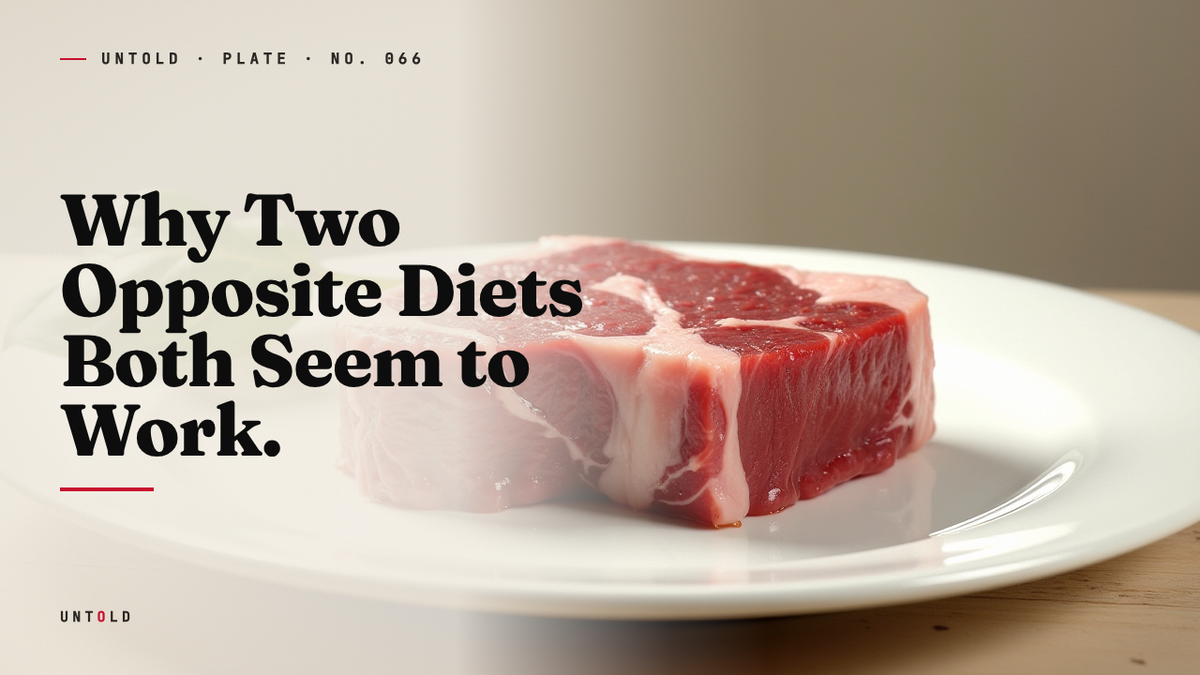
One man eats nothing but steak. Two pounds of beef a day, salted, seared, and swallowed with something close to devotion. He has not touched a vegetable in years. Across the internet, another man eats no animal product whatsoever: not a fried egg, not a drop of milk, not a spoonful of honey. Both men will show you their blood panels. Both will tell you their joint pain vanished, their energy stabilized, their minds cleared. And both are quietly certain that the other is killing himself one meal at a time.
They cannot both be right. Or so it seems. One of them has removed the entire plant kingdom from his life; the other has removed the entire animal kingdom. These are not adjustments. They are opposite amputations of the human food supply, and each is defended with the fervor of a religious convert. Yet the strangest fact in modern nutrition is not that these diets contradict each other. It is that they both appear to work.
Roughly one in five American adults reports having cut out an entire food group in the hope of feeling better. That instinct, to blame a whole category of food for a vague sense of malaise, sits at the center of one of the loudest arguments in contemporary health. The carnivore and the vegan are the two extreme poles of that argument. Understanding why both of them can stand up, point at their bloodwork, and claim victory requires setting aside the influencers and looking at how the body actually reads what we put into it.
The Meat Side Of The Plate
The carnivore diet is exactly what its name promises. Animals only. Meat, eggs, and for some adherents a little dairy. That is the entire grocery list. No fruit, no grains, no leafy greens, no fiber. To a nutritionist raised on the food pyramid, it reads less like a diet than a dare.
Its most visible champion is Shawn Baker, a former orthopedic surgeon who turned the all-meat idea into a sprawling online movement. Baker is not a delicate spokesman. He is a large, athletic man in his fifties who posts rowing records and challenges skeptics to arm-wrestle their assumptions. His followers describe a familiar arc: the bloating that disappeared, the moods that leveled out, the aching joints that simply stopped aching. For people who had spent years cycling through elimination diets and inconclusive doctor visits, the carnivore experience often arrives as relief bordering on revelation.
The underlying claim is provocative. Plants, the carnivore argues, are not the innocent health foods we imagine. They are living organisms that cannot run away from predators, so they defend themselves chemically. Oxalates, which can crystallize in sensitive kidneys. Lectins, proteins that some researchers link to gut irritation. Phytates that bind minerals. Fermentable fibers that, in a compromised digestive system, can trigger bloating and pain. To a person whose gut has been in open rebellion for years, the logic is seductive: remove the plants, remove the irritants, remove the suffering.
And for a small group of people, this is not fantasy. Severe cases of inflammatory bowel disease, certain autoimmune flare-ups, and stubborn digestive disorders sometimes do quiet down when the diet is stripped to its simplest animal components. The mechanism is not mystical. A diet of meat and eggs is extraordinarily low in the fermentable carbohydrates that feed symptoms in conditions like irritable bowel syndrome. Simplicity itself can be therapeutic.
The Plant Side Of The Plate
Now turn the plate over. The vegan diet removes every animal input. Meat, dairy, eggs, and often anything derived from an animal at all. In their place stand grains, beans, nuts, seeds, fruit, and vegetables, which must carry the entire nutritional load of a human life.
The intellectual patron saint of this camp is T. Colin Campbell, a Cornell biochemist whose 2005 book The China Study became something close to scripture for the plant-based movement. Drawing on a vast survey of dietary patterns and disease rates across rural China, Campbell argued that higher consumption of animal protein tracked with higher rates of the chronic diseases that dominate wealthy nations: heart disease, diabetes, certain cancers. His conclusion was blunt. The healthiest diet, he wrote, is one built almost entirely from whole plant foods.
Campbell’s work has been criticized. Correlational data from populations cannot prove that animal protein causes disease, and critics have argued he read his own numbers selectively. But the vegan case does not rest on one book. It rests on decades of population data that the carnivore camp cannot match. The Adventist Health Study, run out of Loma Linda University in California under epidemiologist Gary Fraser, followed tens of thousands of Seventh-day Adventists, a group whose religious practices produce a natural experiment in diet. 1 Some are vegan, some vegetarian, some eat meat, all share similar lifestyles otherwise. The vegetarians and vegans in that cohort showed lower rates of heart disease, type 2 diabetes, and, in some analyses, longer lifespans. 2
The proposed mechanisms are unglamorous and well studied. Fiber that feeds the gut microbiome and steadies blood sugar. Potassium that helps regulate blood pressure. A flood of antioxidants and polyphenols that appear, over decades, to protect the lining of the arteries. Where the carnivore offers dramatic short-term testimonials, the vegan offers something rarer in nutrition science: long-term evidence gathered on tens of thousands of real human beings living ordinary lives.
Yet the plant plate has its own quiet dangers. Vitamin B12 occurs naturally almost exclusively in animal foods, and a vegan who does not supplement it risks nerve damage that accumulates silently over years before it announces itself. 3 Iron from plants is less readily absorbed than iron from meat. Zinc, calcium, and the long-chain omega-3 fatty acids found in fish all require deliberate, informed planning. And there is a category error lurking at the edge of the movement. A person who lives on potato chips, white bread, and soda is, technically, a perfect vegan. He is also, just as technically, eating himself toward disease.
Following The Evidence Instead Of The Influencers
So we have two camps, two heroes, and two opposite definitions of clean eating. The honest move is to follow the evidence rather than the personalities, and when we do, an uncomfortable asymmetry appears.
The strongest data for the carnivore diet is a 2021 survey led by Belinda Lennerz and colleagues at Harvard, published in Current Developments in Nutrition. 4 The researchers recruited more than two thousand adults who had followed a carnivore diet for at least six months and asked about their health and satisfaction. The results were striking. Respondents reported high satisfaction, improvements in wellbeing, and better markers on several measures than expected. The paper was careful and its authors were candid about its limits, but the internet was not, and the survey quickly became ammunition.
Here the trouble begins. A survey of people who have chosen and stuck with a diet for six months captures believers. It does not capture the people who tried the same diet, felt terrible, and quietly returned to eating vegetables. That selection effect, the systematic invisibility of the ones who quit, inflates any picture built from volunteers. Nor was this a controlled trial. Nobody was randomly assigned to eat only meat and tracked for years against a comparison group. We have snapshots of the satisfied, not a longitudinal ledger of the whole.
The vegan side has that ledger, or something closer to it. The Adventist cohorts have been followed for years, their outcomes measured against neighbors living similar lives. That is a fundamentally sturdier form of evidence than a self-selected online survey. But it too has a ceiling. Observational studies, however large, cannot fully separate the diet from everything that travels with it. Seventh-day Adventists also tend to avoid smoking, limit alcohol, exercise, and belong to a tight social community, each of which independently extends life. Untangling the leaf from the lifestyle is genuinely hard.
There is a deeper problem that neither camp advertises. No long-term randomized controlled trial has ever pitted a strict carnivore diet directly against a strict vegan diet, feeding matched groups of people for years and measuring who lives longer and healthier. Such a study would be ferociously expensive, nearly impossible to enforce, and arguably unethical to run to its conclusion. So the direct comparison at the heart of the whole argument simply does not exist. As the old caution goes, absence of evidence is not evidence of absence, but it should make everyone humbler than they are.
What we have instead are studies comparing each diet, separately, to something else. And that something else is almost always the average modern Western plate. This detail is easy to skate past, and it turns out to be the key to the entire mystery.
The Enemy They Share
Here is what neither camp likes to say out loud. They agree far more than they fight.
Watch what actually happens when someone commits to either extreme. The new carnivore stops eating bread, pasta, cereal, pastries, candy, chips, sugary drinks, fast food, and the vast catalog of engineered snacks that fill supermarket shelves. The new vegan stops eating processed meat, cheese-laden convenience foods, and, if he is doing it thoughtfully, most of the same industrial junk. Both diets, whatever their philosophical opposition, begin with an identical act of deletion. They remove ultra-processed food and added sugar.
That shared subtraction may be the real medicine. Consider the backdrop against which both diets are measured. Ultra-processed foods, the packaged, industrially formulated products engineered for maximum palatability, now make up more than half of the calories consumed in the United States and the United Kingdom. 5 These are the foods most consistently linked in modern research to weight gain, metabolic disease, and early mortality. A landmark controlled feeding study by Kevin Hall and colleagues at the National Institutes of Health showed that when people were given free access to ultra-processed meals, they ate around five hundred more calories a day than when given equally available whole-food meals, and they gained weight, even though the two menus were matched for sugar, fat, fiber, and salt. 6 The processing itself, not just the nutrients, seemed to drive overeating.
Against that backdrop, almost any coherent whole-food diet looks like a miracle. The carnivore who was previously living on drive-through meals and now eats only steak has removed an enormous burden of processed calories. So has the vegan who traded frozen dinners for lentils and vegetables. Each attributes his recovery to the food group he kept or the one he banished. Neither tends to credit the thing they both did first, which was to stop eating the industrial food that was quietly making them sick.
Why The Question Was Wrong
When you delete an entire food category, something else happens that has nothing to do with meat or plants. You are suddenly forced to pay attention. You cannot grab whatever is nearest, because most of what is nearest is now forbidden. You start cooking. You start reading labels. You start eating with intention rather than on autopilot. That shift in attention, from passive consumption to active choice, may matter more than the specific category you eliminated.
This is not a small point. Much of what we call diet is really a set of habits, and both extreme diets impose new habits by force. They make the convenient impossible and the deliberate necessary. A person who has to plan every meal because half the grocery store is off-limits is, almost by accident, doing the single most protective thing in modern nutrition: opting out of the ultra-processed default.
Which returns us to the two men we began with, each convinced the other is dying. The likeliest truth is that both improved, and that both are wrong about why. It was probably never the beef and never the beans. It was the absence of everything else.
None of this means the two diets are equivalent in the long run, or that individual biology does not matter. It matters enormously. A person with a specific autoimmune condition may genuinely feel better without plants, while another may thrive on them and would develop a dangerous deficiency without careful supplementation on an all-meat regimen. Genes, gut microbiome, medical history, and personal tolerance all shape what actually works for a given body, which is precisely why cutting an entire food group for the long term is a decision to make with a clinician rather than an influencer.
So who is right, the carnivore or the vegan? The question, it turns out, was built on a false premise. They were never really at war over meat and plants. They were both, unknowingly, fighting the same enemy and claiming the same quiet victory. Real food, prepared with attention, eaten on purpose. The next time two diets swear that the other one is slowly killing you, it is worth looking past the shouting to notice what they threw out first. More often than not, it is the same thing, and it was the thing that mattered all along.

Sources
- Fraser, G. E., “Vegetarian diets: what do we know of their effects on common chronic diseases?” American Journal of Clinical Nutrition, 2009. — https://pubmed.ncbi.nlm.nih.gov/19321569/
- Orlich, M. J. et al., “Vegetarian dietary patterns and mortality in Adventist Health Study 2,” JAMA Internal Medicine, 2013. — https://pubmed.ncbi.nlm.nih.gov/23836264/
- Pawlak, R. et al., “How prevalent is vitamin B12 deficiency among vegetarians?” Nutrition Reviews, 2013. — https://pubmed.ncbi.nlm.nih.gov/23356638/
- Lennerz, B. S. et al., “Behavioral Characteristics and Self-Reported Health Status among 2029 Adults Consuming a Carnivore Diet,” Current Developments in Nutrition, 2021. — https://pubmed.ncbi.nlm.nih.gov/34934897/
- Monteiro, C. A. et al., “Ultra-processed foods: what they are and how to identify them,” Public Health Nutrition, 2019. — https://pubmed.ncbi.nlm.nih.gov/30744710/
- Hall, K. D. et al., “Ultra-Processed Diets Cause Excess Calorie Intake and Weight Gain,” Cell Metabolism, 2019. — https://pubmed.ncbi.nlm.nih.gov/31105044/
Related reading