The Nutrient That Became a Personality
How an essential amino acid supply turned into a 24-billion-dollar anxiety, and why your plate already has enough.
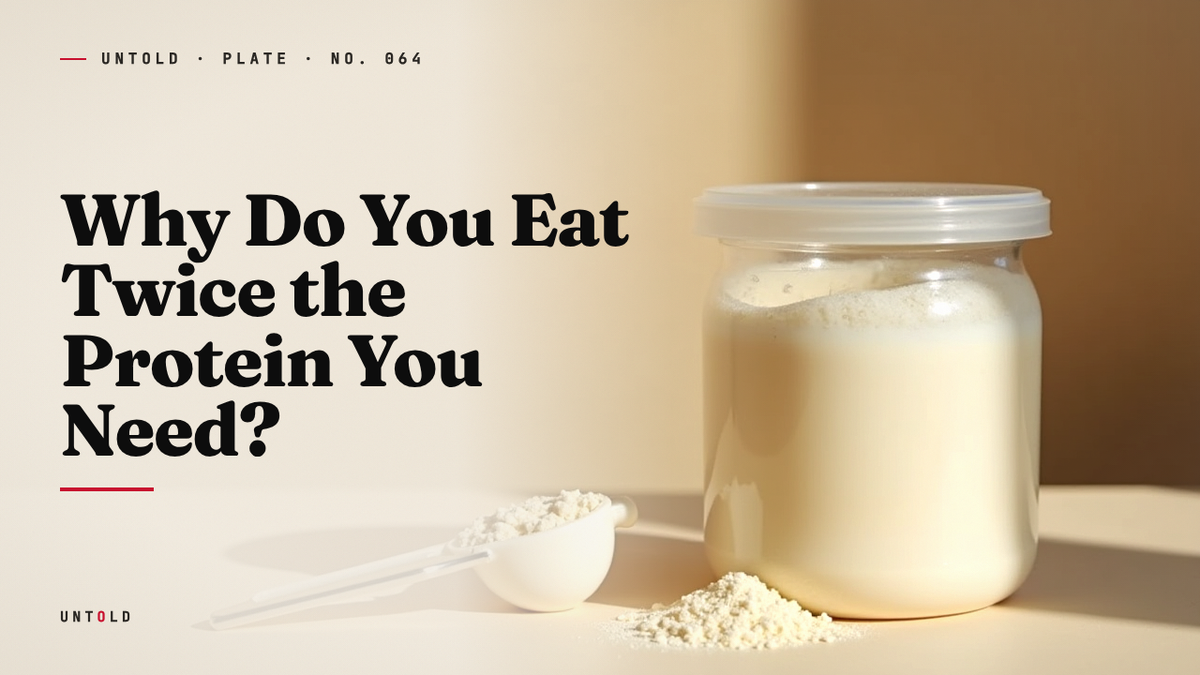
Somewhere in a bag, a drawer, or a jacket pocket, there is a protein bar. There is a decent chance it belongs to the person reading this. If not a bar, then a shaker bottle stained with the chalky residue of yesterday’s whey, or a box of high-protein pasta, or a carton of milk that has been engineered to carry twice the usual load. Protein has colonized the supermarket. It appears on cookies and pancakes, on popcorn and bottled water, on breakfast cereals that once bragged about fiber and now brag about grams. The global protein supplement market is worth more than twenty-four billion dollars a year, and it is still climbing.
The cultural logic behind all this is disarmingly simple. Protein builds muscle. Muscle is good. Therefore more protein must be better, and more still must be better than that. It is one of the few nutritional beliefs that has survived the diet wars intact. Fat was demonized and then rehabilitated. Carbohydrates rose, fell, and splintered into factions. Protein alone has kept its halo, untouched, sacred, the one macronutrient nobody argues about.
Which is exactly why it deserves a second look. Because the uncomfortable truth, well documented and largely ignored, is that most people in wealthy countries are already eating close to double the protein they need. The extra rarely does what the labels imply. And in a handful of cases it may quietly cost something. This is not a story about a dangerous nutrient. Protein is essential, non-negotiable, one of the building blocks of a functioning body. It is a story about how an essential nutrient became a marketing empire, and how the empire outgrew the science.
What the body actually asks for
The official number is smaller than most people expect. Health authorities around the world converge on roughly 0.8 grams of protein per kilogram of body weight per day for the average adult. For a person weighing seventy kilograms, that works out to around fifty-six grams. In practical terms, a single chicken breast and a cup of yogurt will very nearly cover it. A day’s minimum, met before lunch.
That figure did not appear by accident. It rests on decades of careful physiology, and much of the earliest scaffolding came from an American biochemist named William Cumming Rose. Working through the 1930s and 1940s, Rose set out to answer a deceptively difficult question: which of the amino acids that make up protein does the human body need to obtain from food, and which can it manufacture on its own? 1 Through painstaking feeding experiments, first on rats and later on human volunteers who lived for weeks on precisely measured diets, Rose identified the amino acids that humans cannot synthesize internally. He called them essential, meaning essential to eat rather than essential to life, since all of them are vital. He eventually settled on eight such amino acids for adults, and he went further, estimating the minimum daily amount of each that a person requires to stay in balance. 1
Rose’s work is the quiet foundation beneath every protein guideline in use today. When a nutrition panel tells a person how much protein they need, it is echoing, through many intermediaries, the arithmetic he assembled in a laboratory nearly a century ago. And that arithmetic points somewhere modest. The requirement is a floor, not a target to be endlessly exceeded.
Now set that floor against reality. The average American eats roughly one hundred grams of protein a day. 2 Surveys across most developed nations tell a similar story: actual intake runs comfortably above the recommendation, often by a factor approaching two. For the overwhelming majority of people, protein deficiency is not a risk they will ever encounter. They are not scraping toward the minimum. They are sailing well past it, and then reaching for a bar.
How a nutrient escaped the gym
If the need is small and the intake already ample, where did the hunger for more come from? Like a surprising number of food beliefs, it began with advertising, and it began in a fairly narrow place.
Through the 1970s, protein powder was a niche product with a niche audience. It lived in the world of competitive bodybuilding and serious weightlifting, sold in tubs to people who measured their meals in service of visible muscle. It was not a mainstream idea. Most shoppers had no reason to think about grams of protein at all; they thought about calories, or later about fat.
That changed as the low-carbohydrate movement gathered force through the 1990s and 2000s. Diets built around cutting carbs needed a hero to replace the villain, and protein was cast in the role. If bread and pasta were the enemy, then steak and eggs and shakes were the allies. Protein became not merely necessary but virtuous, a marker of discipline and health. And once it carried that meaning, food manufacturers noticed. The word began to migrate onto products that had never needed it. Protein was no longer a spec on a bodybuilder’s tub. It was a selling point on anything.
The marketing worked because it landed on receptive ground. Surveys now find that a large share of shoppers, in some studies approaching sixty percent, actively seek out foods labeled high in protein. 3 The label alone shifts what people buy. And here the marketing quietly parts ways with the biology, because the body does not treat protein the way the shopping cart implies.
Unlike fat, which the body stores in dedicated reservoirs against future need, there is no protein warehouse. The body maintains a modest, constantly turning pool of amino acids, but nothing resembling the fat cells that bank surplus energy for months. When protein arrives in excess of what is needed for building and repair, the body does not save it for a rainy day. It strips off the nitrogen, excretes it, and burns or converts what remains. Extra protein, past a point, is simply expensive fuel.
The ceiling on building muscle
The clearest demonstration of that ceiling comes from the muscle science itself, the very domain the protein industry claims as its home turf. Stuart Phillips, a researcher at McMaster University in Canada, has spent years studying how muscle responds to protein, measuring the rate at which the body assembles new muscle protein after a meal or a workout. 4
What his work and that of allied labs has found is that the muscle-building response to protein saturates. Feed a person a dose of high-quality protein and the machinery of muscle synthesis switches on. Feed them more and the response climbs, but only up to a point. Beyond roughly 0.4 grams of protein per kilogram of body weight in a single meal, adding more does not build more muscle. 4 For a seventy-kilogram person, that is somewhere around twenty-eight grams in a sitting, a portion easily met by an ordinary meal. Pile on a second helping, or chase the meal with a shake, and the muscle does not grow faster. The surplus is oxidized away, its energy used or stored like any other calorie.
This is the detail the labels never volunteer. You cannot force a muscle to grow simply by flooding it with raw material. Muscle growth is driven by demand, by the mechanical stress of training and the body’s response to it. Protein supplies the bricks, but bricks alone do not build a wall. Beyond a modest per-meal dose, more protein is not more muscle. It is more nitrogen in the urine.
The candy bar wearing a lab coat
Set the muscle question aside and there remains the question of the snacks themselves: the bars and cookies and pouches stacked at the checkout, each promising a clean hit of the sacred macronutrient. Here the story turns from the merely unnecessary to the actively misleading.
Many protein bars are, in their essential chemistry, candy bars with whey powder folded in. Read past the front-of-package claim to the ingredient list and the pattern repeats: sugar or sugar alcohols, palm or other oils, binders, flavorings, and a scoop of protein to justify the name. Some bars carry more sugar than a chocolate cookie, dressed in the vocabulary of the gym. The nutritional reality is often closer to dessert than to fuel, yet the bar sells as health.
The reason it works has a name in the research literature. Christina Roberto, a researcher at the University of Pennsylvania who studies how people respond to food marketing, has documented what is called the health halo effect. 5 A single positive claim on a package, high in protein, low in fat, made with real fruit, tends to color the way people judge the entire product. The one virtuous phrase spreads its glow over everything, and shoppers stop scrutinizing the rest of the label. A snack tagged as high in protein is read as healthy overall, its sugar and calories quietly discounted in the mind of the buyer.
The consequence is faintly absurd. People reach for engineered snacks in the belief that they are eating well, feel virtuous for doing so, eat more of them than they otherwise would, and in some cases gain the very weight they were trying to avoid. The halo does not just distort a single purchase. It licenses a pattern of eating that undoes its own premise.
And all of this sits on top of a food supply already saturated with protein. It is easy to picture protein as something that lives only in meat and powder, but it is distributed far more widely than that. Beans and lentils carry substantial amounts. So do eggs, dairy, nuts, and whole grains. Even foods rarely thought of as protein sources contribute across a day: broccoli, rice, bread, potatoes. A person eating an ordinary mixed diet accumulates protein from a dozen quiet sources without ever thinking about it. This is why genuine protein deficiency is vanishingly rare in developed nations. Where it appears, it appears among the severely ill, the frail elderly, or people in outright food scarcity. For the well-fed adult browsing a supplement aisle, deficiency is not a live threat. It is a marketing premise.
What the surplus quietly costs
There is a further point that front-of-package claims are unlikely to raise, for obvious commercial reasons. For most adults the extra protein is merely wasted. For some, sustained very high intake may not be neutral.
The clearest concern involves the kidneys. Processing protein produces nitrogenous waste that the kidneys must filter and excrete, and a very high protein load raises the workload on that system. In people with healthy kidneys this appears to be tolerated without lasting harm; the organs adapt. But in people whose kidney function is already compromised by disease, often without their knowing it, a persistently high protein intake can accelerate the decline. 6 For this group, the casual maximalism encouraged by the culture, more is always better, is precisely the wrong instinct. The caution here is specific rather than sweeping. The point is not that protein damages healthy people. It is that the blanket message of the marketplace, aimed at everyone, ignores the people for whom it is genuinely ill-advised.
The case for slightly more, and for calm
None of this argues that protein is a problem to be minimized. It is essential, and there are real cases where eating more of it is not merely harmless but helpful.
Athletes in heavy training genuinely use more, both to repair the tissue they break down and to support adaptation. People recovering from illness, surgery, or injury benefit from a higher intake while the body rebuilds. And older adults are a particularly important case. With age, the muscle-building machinery grows less responsive to protein, a phenomenon researchers call anabolic resistance: the same dose that lights up a young person’s muscle produces a weaker signal in an older one. 4 To overcome that resistance and defend against the slow erosion of muscle that comes with aging, older adults may need somewhat more protein than the standard guideline, and may need it distributed thoughtfully across the day. For them, protein is a real tool against frailty.
That detail about distribution matters for everyone. Because the muscle-building response saturates per meal, the body makes better use of protein spread across the day than dumped into a single sitting. Three meals each carrying a moderate amount will support the body more effectively than one enormous protein load and two skimpy ones. This is not a reason to buy anything. It is a reason to eat ordinary meals in an ordinary rhythm, which most people already do.
So the balance lands somewhere unglamorous. Some people, at some stages of life, benefit from more protein. The average, healthy, well-fed adult is not one of them. For that person, the panic is manufactured, sold, and largely groundless. The protein arriving on the daily plate, from meat or beans or dairy or grain, is already enough and then some.
What the culture has done is turn a nutrient into an identity. Protein is no longer something a body requires in a certain amount. It has become a signal of virtue, discipline, and health, a word that sells cookies by whispering that they are not really cookies. But a nutrient cannot bear that weight. It is a molecule the body assembles into tissue, useful in a specific quantity and inert past it. The next time a package announces, in bold and urgent type, that it is high in protein, the useful response is not to reach for it. It is to pause and ask why the word is there at all, and who benefits from the asking.

Sources
- Rose, W. C., “The Amino Acid Requirements of Adult Man,” Nutrition Abstracts and Reviews, 1957. — https://pubmed.ncbi.nlm.nih.gov/13465733/
- Berryman, C. E. et al., “Protein intake trends and conformity with the Dietary Reference Intakes in the United States,” American Journal of Clinical Nutrition, 2018. — https://academic.oup.com/ajcn/article/108/2/405/5049121
- International Food Information Council, Food & Health Survey, 2022. — https://foodinsight.org/2022-food-and-health-survey/
- Morton, R. W., Phillips, S. M. et al., “A systematic review, meta-analysis of protein supplementation on resistance training-induced gains in muscle mass and strength,” British Journal of Sports Medicine, 2018. — https://bjsm.bmj.com/content/52/6/376
- Roberto, C. A. et al., research on front-of-package labeling and the health halo effect, University of Pennsylvania. — https://www.med.upenn.edu/robertolab/
- Ko, G. J. et al., “Dietary protein intake and chronic kidney disease,” Current Opinion in Clinical Nutrition and Metabolic Care, 2017. — https://pubmed.ncbi.nlm.nih.gov/27801685/
Related reading