The Quiet Mutiny of a Sleeping Foot
What pins and needles reveal about the body's most underestimated communication system.
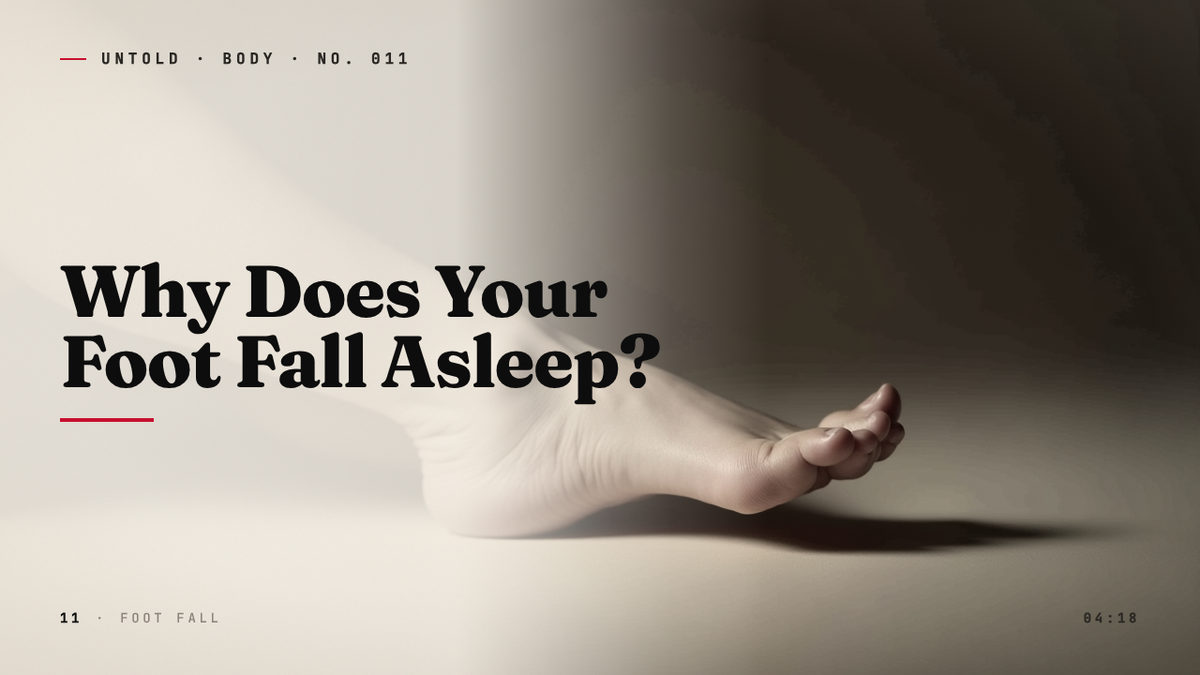
You shift your weight on the couch, stand up to answer the door, and the floor is no longer where you left it. One foot has gone somewhere else. It is not painful, not yet. It is simply absent, as if the limb belongs to a stranger who has wandered off and forgotten to take it. You take a step and the carpet feels like television static. Then come the pins. Then the needles. Then, after a minute or two of low-grade electric panic, the foot returns to you, faintly embarrassed, as if it had been caught napping on the job.
This is one of the most universal sensations in human experience, and one of the least understood. Almost everyone has felt it. Almost no one can explain what is actually happening underneath the skin. The medical name for the tingling phase is paresthesia, and the dead-numb phase that precedes it has its own quieter label: obdormition, from the Latin for falling asleep. The terminology is poetic, but the mechanism is not. What unfolds in a sleeping foot is a small, choreographed crisis involving two of the body’s most essential systems, both of which were briefly and accidentally taken offline.
The Two Things That Go Wrong at Once
A foot does not, of course, fall asleep. Sleep is a brain state, not a leg state. What happens instead is that two separate infrastructures are interrupted in the same moment, and the disruption masquerades as something restful because the limb stops complaining. The first system is mechanical: the bundle of nerve fibers running from the spinal cord down through the buttock, behind the knee, and into the sole of the foot. The second is vascular: the arteries that feed those nerves the oxygen they require to keep firing.
Nerves are often imagined as passive wires, neutral conduits that simply pass information along. They are not. They are metabolically expensive tissue, hungry, demanding, intolerant of neglect. A peripheral nerve consumes oxygen at a rate disproportionate to its mass, and it does so continuously, because the electrical gradients that allow it to fire have to be maintained moment by moment, even when nothing in particular is being signaled. Pinch the artery feeding such a nerve, and within minutes the fibers begin to suffocate. Pinch the nerve itself, mechanically, and you deform the membrane that lets it conduct a signal in the first place. Cross your legs for long enough on a wooden chair and you do both at once.
The peripheral nerves themselves run at speeds that make the rest of biology look sluggish. A signal from the bottom of your foot can reach the spinal cord at roughly two hundred miles per hour, faster than any car you have ever sat in. When that signaling stops, even briefly, the silence is structurally disorienting. The brain has spent your entire life receiving a steady, low-volume hum of input from the foot: pressure, temperature, the precise angle of each toe. When the hum cuts out, the brain does not register absence so much as it registers a vague wrongness, a hole in the map.
A Failure That Happens in Order
One of the strangest and most elegant facts about a sleeping foot is that the sensation does not vanish all at once. It vanishes in a specific sequence, and the sequence is reproducible. The German physiologist Heinrich Frey was among the early observers to notice this pattern in the late nineteenth century, when researchers were first beginning to catalog the different types of fibers within a peripheral nerve. The fibers, it turned out, were not uniform. They came in different diameters, wrapped in different amounts of insulation, conducting at different speeds, and serving different sensory and motor purposes. And under pressure, they failed in a predictable order, from largest to smallest.
The heaviest, most heavily myelinated fibers are the first to go. These are the ones responsible for motor control and for the sensation of light touch and proprioception, the sense of where your limb is in space. Their loss is why a sleeping foot feels weightless and unhitched from the body, as though it were floating somewhere below the knee without a clear address. Next, the medium fibers falter, the ones carrying pressure and temperature information. Last to quit, and most stubborn, are the small unmyelinated fibers that transmit pain. This is why, even when a foot feels entirely dead, a sharp pinch will still register, often more vividly than expected. Pain has a higher tolerance for compression than touch does, a fact that has saved lives in field medicine and contributed, in less dramatic ways, to the misery of long flights.
The rigorous classification of these fiber types was the life work of Joseph Erlanger and Herbert Spencer Gasser, two American physiologists who spent the 1920s and 1930s threading recording electrodes into the nerves of animals and watching what came out. By plotting the speed of conduction against the diameter of the fiber, they produced the first comprehensive map of how a nerve actually carries its many simultaneous messages. They divided fibers into A, B, and C groups, with subdivisions within each, and their taxonomy is still in use today. In 1944, Erlanger and Gasser were awarded the Nobel Prize in Physiology or Medicine for the work1. It is a strange and beautiful piece of trivia that the order in which your foot stops feeling things, on a tedious afternoon at a desk, is the same order that two men in St. Louis once charted with a galvanometer and a cat.
When the Blood Stops Coming
Mechanical compression of the nerve, the kind that happens when you sit on your own ankle, accounts for part of the phenomenon. But the more decisive factor, in most cases of a sleeping foot, is what is happening to the blood vessels alongside the nerve. The femoral and popliteal arteries are unusually superficial in certain postures: cross your legs at the knee and the artery in the upper leg is pinched almost directly against the bone underneath. Squat for long enough, or sit on a hard floor with your legs folded, and the same compression occurs further down. The blood does not stop entirely. It slows. Oxygen delivery drops below the threshold the nerve fibers need to maintain their electrical activity. Within roughly five to ten minutes in most adults, depending on posture and body composition, the nerve below the compression begins to fall silent.
This vascular component is why the sensation can come on slowly, over many minutes, rather than instantly. A truly pinched nerve, the kind a surgeon worries about, can cut out in seconds. A foot that goes numb during a long meeting is mostly suffering from a polite, gradual asphyxiation of its sensory hardware. It is also why moving the limb tends to restore feeling so quickly. The mechanical disruption clears the moment you uncross your legs, but it is the rush of returning blood that wakes the fibers up.
And the waking up is where things get interesting.
The Pins, the Needles, the Reboot
If a nerve simply switched back on the way a lightbulb does, there would be no tingling at all. You would uncross your legs, your foot would resume its quiet reporting, and the whole episode would pass unremarked. That is not what happens. When oxygen returns to a starved nerve, the fibers do not fire in a coordinated, organized way. They fire chaotically, in scattered bursts, at rates far above their normal baseline. Sensory neurons that should be reporting nothing in particular start reporting everything at once, and the brain, faced with a flood of nonsense signals from a part of the body it had nearly given up on, does what brains always do. It tries to make sense of the noise.
What the brain produces is the famous and faintly absurd vocabulary of pins, needles, prickling, fizzing, the sensation of tiny insects walking under the skin, the sense of electrical current, the buzzing of carbonation. None of these is what the foot is actually experiencing. The foot is experiencing the abrupt and unsteady return of its metabolic supply. The translation into pins and needles happens upstream, in the somatosensory cortex, which has no frame of reference for chaotic mass firing and chooses, more or less arbitrarily, to interpret it as a thousand small sharp things. Studies of peripheral nerve recovery have estimated that during the reactivation phase, individual sensory fibers can fire at up to ten times their resting rate, and the disordered chorus typically resolves within two to four minutes as the fibers settle back into their usual rhythms.
In 1951, the Australian neurologist Sir Sydney Sunderland published a classification system for peripheral nerve injuries that remains the standard reference for clinicians today2. Sunderland’s scheme divides nerve damage into five degrees of increasing severity, from a transient block in conduction to complete severance of the nerve and its surrounding sheath. The everyday sleeping foot corresponds to the mildest of these categories, what an earlier neurologist named Herbert Seddon had called neurapraxia, a Greek-derived term meaning, roughly, non-action of the nerve3. In neurapraxia, the architecture of the nerve is entirely intact. No fiber has been torn, no sheath has been disrupted, no scarring has occurred. Only the signal has been paused, and only briefly. Recovery is measured in seconds to minutes, and leaves no trace.
This is worth pausing over, because it is the part of the story that most people never quite absorb. A foot that has fallen asleep is not damaged in any way. No cells have died. No structure has been impaired. The entire phenomenon is functional, reversible, and ordinary, a temporary lapse in service that the body resolves on its own, without intervention, every single time. The pins and needles are not the sound of injury. They are the sound of a system coming back online, slightly noisily.
What the Brain Refuses to Hear
There is a deeper layer to the phenomenon that rarely gets attention in casual descriptions, and it concerns not the foot at all but the brain receiving its signals. When a nerve begins to misfire under compression, it does not always go silent in the way that the simple model suggests. In many cases, the nerve continues to send signals upward, but the signals are increasingly garbled, distorted, unreliable. They are noise rather than information. And the brain, presented with noise from a peripheral source, has a remarkable and somewhat unsettling capacity to simply ignore it.
This is not a unique feature of sleeping feet. The somatosensory cortex spends most of its working life filtering out signals it has decided are not worth attending to: the feeling of clothing on your skin, the pressure of a chair against your back, the steady weight of a watch on your wrist. These inputs do not vanish from the nerves themselves; they vanish from awareness. The brain has learned that they carry no useful information and has stopped reporting them upward to the conscious mind. The same thing happens, on a more compressed timescale, to a sleeping foot. As the signals from below become less coherent, the cortex stops trusting them and effectively mutes the channel. The numbness you feel is partly the nerve going quiet, and partly your own brain choosing to disregard what little the nerve is still saying.
This is why the return of sensation feels so dramatic. The brain has not just regained an input. It has been forced to start trusting the channel again, after a brief period of treating it as broken. The tingling is, in part, the cortex re-learning how to listen to a part of itself it had temporarily written off.
When to Worry, and When to Stand Up
For nearly everyone, nearly all the time, a sleeping foot is a piece of forgettable physiology. It comes, it tingles, it goes. There is no need to do anything except move the affected limb, restore the blood supply, and wait out the brief electrical chaos that follows. The fix, in clinical terms, is to remove the compression. In practical terms, it is to stand up, shake the leg, and walk to the kitchen.
There are, however, edges of the phenomenon worth knowing about. Numbness that arrives without any obvious mechanical cause, or that persists for hours rather than minutes, or that affects both sides of the body symmetrically, is a different animal entirely. Chronic paresthesia in the feet can be an early sign of diabetic neuropathy, a slow degradation of peripheral nerves caused by sustained high blood sugar. It can also indicate vitamin deficiencies, particularly B12, or pinched nerves at the level of the spine, or impaired circulation from vascular disease. None of these resolve when you stand up. All of them benefit from being caught early. The rule of thumb, imperfect but serviceable, is that ordinary numbness comes with an obvious cause and goes away within a few minutes of relieving it. Anything more persistent than that deserves a conversation with a physician rather than a stretch and a shrug.
The vast majority of episodes, though, are mundane in the most literal sense of the word. They are the body operating exactly as designed, including the temporary failure modes that are part of the design. A nerve that can be silenced by pressure is also a nerve that can be protected from overload by the same mechanism. The fibers most sensitive to compression are the ones carrying the most metabolically expensive signals, the heavy motor fibers that move muscles and the touch fibers that report constantly. Their willingness to fall quiet under duress is part of why the system is robust enough to last eighty or ninety years without major maintenance.
The Body That Talks Without Asking
There is something quietly humbling about the phenomenon, once you understand what is actually happening. Your nervous system is faster than your fastest conscious thought, and it operates almost entirely without your permission or attention. It sends millions of signals upward every second from every surface of your body, manages the routing of those signals through ganglia and tracts, prioritizes which ones reach awareness and which do not, and occasionally, when a posture compresses a vessel for too long, it improvises a graceful local shutdown and an only slightly graceful restart. None of this requires your involvement. You did not have to learn how to feel your foot, and you do not have to remember to wake it back up.
The pins and needles, in this light, are not a malfunction. They are one of the few moments in ordinary life when a deeply hidden process briefly surfaces, makes itself felt, and then disappears again into the background. Most of what your nervous system does, it does silently. The sleeping foot is one of the rare occasions when the machine permits you to notice it working, and the noticing is uncomfortable, because the machine was never designed to be observed. It was designed to run.
Next time it happens, in a meeting or on a long flight or in the strange folded posture of reading in bed, pay attention to the sequence. First the foot disappears. Then it returns, badly and loudly, in a rush of electricity. Then it settles. The whole episode takes perhaps three minutes, and in those three minutes you are witnessing something that almost no other technology in existence can do: a complex system that has failed, diagnosed itself, restored its own supply lines, and returned to service without anyone giving it an instruction. The tingling is not the sound of something going wrong. It is the sound of something extraordinary working exactly the way it is supposed to.
Sources
- The Nobel Prize in Physiology or Medicine 1944: Joseph Erlanger and Herbert Spencer Gasser — https://www.nobelprize.org/prizes/medicine/1944/summary/
- Sunderland, S., ‘A classification of peripheral nerve injuries producing loss of function,’ Brain, 1951 — https://academic.oup.com/brain/article-abstract/74/4/491/324901
- Seddon, H. J., ‘Three types of nerve injury,’ Brain, 1943 — https://academic.oup.com/brain/article-abstract/66/4/237/324243
- Erlanger, J. and Gasser, H. S., ‘Electrical Signs of Nervous Activity,’ University of Pennsylvania Press, 1937 — https://www.jstor.org/stable/j.ctv512x9q
- Mogyoros, I., Kiernan, M. C., Burke, D., ‘Mechanisms of paresthesias arising from healthy axons,’ Muscle & Nerve, 2000 — https://onlinelibrary.wiley.com/doi/10.1002/1097-4598(200002)23:2%3C310::AID-MUS24%3E3.0.CO;2-7
- Menorca, R. M. G., Fussell, T. S., Elfar, J. C., ‘Peripheral Nerve Trauma: Mechanisms of Injury and Recovery,’ Hand Clinics, 2013 — https://www.ncbi.nlm.nih.gov/pmc/articles/PMC4408553/
- Hughes, R. A. C., ‘Peripheral neuropathy,’ BMJ, 2002 — https://www.bmj.com/content/324/7335/466
- American Diabetes Association, ‘Diabetic Neuropathy: Standards of Care’ — https://diabetesjournals.org/care/article/46/Supplement_1/S203/148044/
Related reading