The Maddening Sensation of Repair
Why nearly every healing wound demands to be scratched, and what that signal actually means.
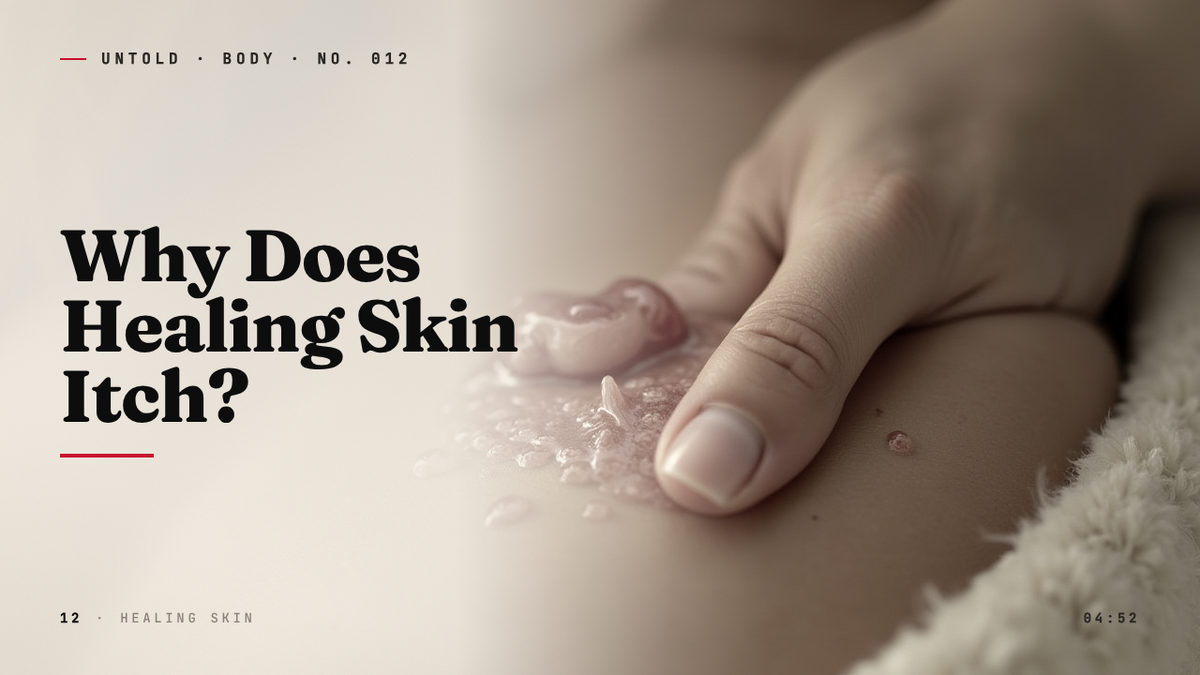
A week after a scraped knee, a kitchen burn, or a surgical incision, something strange happens. The pain fades. The redness recedes. The wound looks, by any reasonable measure, like it is finally getting better. And then it starts to itch. Not a passing tickle but a deep, insistent, almost moral demand for the fingernails. People who have survived third-degree burns routinely describe the itching of recovery as worse than the burns themselves. In clinical surveys, more than eighty percent of patients with healing wounds report significant pruritus during the final phase of repair, and among burn survivors the figure climbs above ninety percent 1.
The sensation feels like sabotage. The wound is closing, the body is doing what it is supposed to do, and yet the brain is broadcasting an emergency signal that demands the exact behavior most likely to undo the work. Scratching reopens microscopic tears, restarts inflammation, and, in serious wounds, can meaningfully extend healing time and worsen scarring. It is one of the more elegant paradoxes in human physiology: the body asking, with increasing urgency, to be interrupted while it finishes a job.
For a long time the itch was treated as a kind of medical footnote, an annoyance rather than a phenomenon worth studying. That has changed in the last twenty years. A small group of dermatologists, neuroscientists, and burn specialists have made itch their life’s work, and what they have found suggests that the healing itch is not a glitch in the repair process. It is the repair process, audible.
A Wound, From the Inside
To understand why healing skin itches, it helps to remember what skin is doing in the days after it breaks. The textbook divides wound healing into four overlapping stages, and every one of them is a small drama.
The first stage, hemostasis, begins in seconds. Damaged blood vessels constrict, platelets swarm to the breach, and a fibrin mesh forms a temporary plug. Within minutes the wound has a roof. The second stage, inflammation, follows almost immediately and lasts for several days. Neutrophils and macrophages arrive in waves, devouring bacteria and clearing out cellular debris. This is the phase responsible for the redness, heat, and tenderness of a fresh injury. It is uncomfortable, but it is rarely itchy.
The third stage is where the trouble starts. Proliferation, which begins around day three and can stretch into weeks, is the rebuilding phase. Fibroblasts pour collagen into the wound bed. New capillaries sprout in a process called angiogenesis. Keratinocytes migrate inward from the edges, knitting the surface closed. And critically, severed nerves begin to regrow.
The fourth stage, remodeling, can last a year or more. Collagen is reorganized, the new tissue strengthens, and the scar gradually softens. In larger wounds, itching can persist deep into this phase, long after the surface looks healed.
The itch tracks the third and fourth stages with remarkable consistency. It is not the sensation of breaking. It is the sensation of building.
The Discovery That Itch Has Its Own Wiring
For most of the twentieth century, itch was considered a poor cousin of pain. The prevailing theory, sometimes called the intensity theory, held that itch was simply weak pain: a low-grade activation of the same nerve fibers, interpreted differently by the brain. This was tidy but, as it turned out, wrong.
The key evidence came from a series of careful electrophysiological studies in the 1990s by the German researchers Martin Schmelz and Hermann Handwerker, who used microneurography to record from single nerve fibers in human volunteers. They identified a population of slow-conducting C-fibers that responded to histamine and produced itch without producing pain 2. These fibers were anatomically distinct, with unusually wide receptive fields and conduction velocities even slower than the C-fibers known to carry pain. Itch, it seemed, had its own dedicated wiring.
The decisive blow to the intensity theory came in 2007, when Zhou-Feng Chen and his colleagues at Washington University in St. Louis published a paper in Nature identifying a gene called GRPR, for gastrin-releasing peptide receptor, that appeared to function as a dedicated itch switch in the spinal cord. Mice lacking GRPR scratched dramatically less in response to itch-inducing chemicals but responded normally to painful stimuli 3. The two sensations could be cleanly dissociated. Itch was not weak pain. It was its own thing.
That distinction matters for understanding the healing itch, because it means the sensation is not a side effect of residual injury. It is the signature of a specific neural pathway being activated, deliberately, by the chemistry of repair.
Histamine and the Chemical Chorus
The most familiar trigger of itch is histamine, the same compound responsible for the misery of hay fever and the wheal of a mosquito bite. During wound healing, mast cells embedded in the skin release histamine in large quantities. They are part of the inflammatory orchestra, helping to dilate blood vessels and recruit immune cells, but their secretions also bind to receptors on the very C-fibers Schmelz and Handwerker identified. The brain reads that input as itch.
If histamine were the whole story, antihistamines would solve the problem. They do not. Patients with chronic healing itch, particularly burn survivors, often report little relief from drugs like diphenhydramine or cetirizine. This was a puzzle for years, and it has driven much of the recent expansion in itch research.
What scientists have come to understand is that histamine is only one voice in a much larger chorus. Healing tissue releases an entire cocktail of pruritogens: substances that provoke itch through receptors other than the histamine pathway. These include tryptase and other proteases, interleukin-31, nerve growth factor, substance P, and bradykinin. Some of them act on a separate class of itch fibers, the so-called non-histaminergic C-fibers, which carry signals through a different receptor (MrgprX1 in humans) and respond to chemicals that antihistamines cannot touch 4.
This matters clinically because it explains why the healing itch is so resistant to ordinary treatment, and it matters scientifically because it reveals how thoroughly the body has wired itch into the repair process. Itch is not an accident of inflammation. It is a feature of it.
The Nerves Are Growing Back, and They Are Confused
There is a second source of the healing itch that has nothing to do with chemistry and everything to do with anatomy. When skin is cut or burned, the small sensory nerves that thread through it are severed along with everything else. In the proliferation phase, those nerves begin to regrow.
Reinnervation is one of the more delicate operations in repair. Axons must extend through unfamiliar tissue, find appropriate targets, and reestablish the orderly density of fibers that healthy skin maintains. It does not always go smoothly. Studies of regenerating peripheral nerves have shown that newly sprouting fibers can be hyperexcitable, firing spontaneously or in response to stimuli that would not normally provoke them 5. They can also form aberrant connections, the neurological equivalent of crossed wires.
In practice this means that a healing wound is densely populated with new nerve endings, many of them firing erratically, all of them feeding into the spinal cord pathways that have been freshly sensitized by the inflammatory chemistry described above. A light touch, a temperature change, the pull of a drying scab, even the small mechanical stresses of ordinary movement can be enough to trigger a sensation the brain interprets as itch. The wound is, quite literally, a construction site full of live wires.
This is why the itch of a healing burn can persist for months after the skin has closed. The chemistry quiets down within weeks, but the nerves take far longer to settle. Burn survivors often describe the itching as fading gradually over a year or more, in step with the slow normalization of nerve density and firing patterns. A 2008 study at Wake Forest tracking post-burn pruritus found that severe itching persisted in a substantial fraction of patients well past the point of apparent surface healing, and that its intensity correlated with the depth and area of the original injury rather than with any visible inflammation 1.
The Scab as a Mechanical Trigger
There is a more pedestrian explanation that overlaps with the neurological one. As a scab forms, it dries and contracts. The keratin and fibrin matrix pulls inward, tugging on the surrounding skin and on the regrowing nerve fibers underneath. Mechanical traction is itself a recognized trigger for itch, particularly on the fine, hyperexcitable C-fibers of healing tissue.
This is partly why occlusive dressings, silicone sheets, and emollients tend to reduce the itching of healing wounds. They keep the surface supple, prevent the scab from drying too aggressively, and reduce the mechanical pull on the nerves below. It is also why scratching feels so satisfying in the moment, and why it almost always makes things worse a few minutes later: the scratch disrupts the scab, restarts a low-level inflammatory response, and primes the next wave of itch.
Why Scratching Feels So Good
The pleasure of scratching is one of the more peculiar facts in sensory neuroscience. Almost everyone agrees that scratching an itchy spot is intensely satisfying, sometimes verging on the erotic, and yet from a purely functional standpoint it is irrational behavior: we are damaging ourselves to relieve a sensation that the damage itself will probably worsen.
The leading explanation is that the brain treats itch and pain as competitors rather than allies. When you scratch, you generate a mild pain signal in the same skin that is currently broadcasting itch. That pain signal travels through different fibers and activates inhibitory circuits in the spinal cord that suppress the itch input. Functional imaging studies have shown that scratching reduces activity in brain regions associated with itch perception, particularly the anterior cingulate cortex, while engaging reward circuits that include the midbrain and the striatum 6.
In other words, your brain prefers a small, manageable pain to a persistent, unscratchable itch. It rewards the trade. The reward is real enough that scratching can become compulsive, and chronic itch is one of the most demoralizing symptoms in dermatology, comparable in its psychological burden to chronic pain.
The trade has a cost, though, and in the case of healing skin the cost is substantial. Each scratch creates microscopic tears in the new epithelium, releases more histamine from disrupted mast cells, restarts low-level inflammation, and prompts the body to lay down additional collagen. A 2014 study examining the role of mechanical stress and scratching in scar formation found that repeated mechanical disruption of healing skin significantly increases hypertrophic scarring, the raised and discolored scars that many patients find more distressing than the original wound 7. The itch-scratch-itch cycle is one of the better-documented contributors to bad cosmetic outcomes in burn and surgical recovery.
The Itch as Announcement
What is the itch for? This is the question that has occupied Gil Yosipovitch, a dermatologist at the University of Miami who has spent more than three decades studying pruritus and is sometimes called, with affection, the godfather of itch. Yosipovitch and others have argued that itch is fundamentally a protective signal, calibrated to draw attention to the surface of the body. Pain says something is broken and you should stop moving. Itch says something is on you and you should remove it. The reflex it elicits is not withdrawal but scratching, an action evolved to dislodge parasites, insects, and debris from the skin 8.
That framework makes sense for an insect bite. It makes less sense for a healing wound, where there is nothing to dislodge and the scratching is actively harmful. The most plausible interpretation is that the healing itch is a kind of category error. The chemistry of repair, with its histamine and proteases and cytokines, looks to the nervous system very much like the chemistry of a small invasion. The regrowing nerves, hyperexcitable and miswired, amplify the signal. The brain, doing its job, raises the alarm.
Seen this way, the healing itch is not a malfunction but a misfire of a generally useful system. It is the body using an ancient protective reflex to flag the location of intense biological activity. The activity happens to be construction rather than invasion, but the chemistry overlaps enough that the alarm goes off anyway.
This interpretation also explains the timing. The itch is rare in the first day or two, when the wound is still raw and pain dominates. It peaks during proliferation and early remodeling, when histamine is high, nerves are regrowing, and the scab is contracting. It fades as the new tissue matures and the nerves settle into normal firing patterns. It is, in effect, an announcement that the most chemically and neurologically active phase of repair is underway.
What Actually Helps
For patients with significant healing itch, the practical advice has converged on a few principles. Keep the wound moist and pliable. Emollients, occlusive dressings, and in the case of burns, silicone gel sheets, reduce mechanical pull on the regenerating nerves and quiet some of the inflammatory input. Cool compresses can blunt the C-fiber response by reducing local temperature and slowing nerve conduction. Antihistamines help a minority of patients, mostly those whose itch is histaminergic; for the rest, newer agents that target different pathways, including gabapentin, pregabalin, and the more recent biologics aimed at interleukin-31 signaling, can be more effective 4.
The most important behavioral intervention is also the hardest. Do not scratch. Tap, pat, or apply cold instead. The relief from scratching is genuine but expensive, paid for in healing time and scar tissue.
A Sensation Worth Listening To
There is something quietly remarkable about the healing itch once you understand what it represents. The same chemistry that closes a wound generates a sensation insistent enough to interrupt sleep. The same nerves that allow us to feel a breeze on intact skin, when severed and regrowing, produce an alarm that can persist for months. The body’s repair process is so chemically and neurologically active that it cannot avoid announcing itself.
For most minor wounds the announcement is brief and quickly forgotten. For larger injuries, particularly burns and major surgeries, it can be among the most difficult parts of recovery, more enduring than the pain and more demoralizing than the visible scar. Patients sometimes describe it as the wound’s last word, the body’s way of refusing to let the injury be entirely past tense until the work is truly done.
The next time a scab demands to be scratched, it is worth pausing for a moment to consider what is happening underneath. Mast cells releasing histamine. Macrophages clearing the last of the debris. Fibroblasts arranging collagen into tensile strength. Capillaries threading themselves into a new microcirculation. Axons, severed days or weeks ago, sprouting tentatively toward their old targets and occasionally firing into the void. The itch is the sound of all of it, translated into a sensation the brain has no other vocabulary for. It is not a sign that something has gone wrong. It is a sign that something is finishing.

Sources
- Vitale, M., et al., “Severe itch in the patient with burns,” Journal of Burn Care & Research / Wake Forest burn pruritus studies, 2008. — https://pubmed.ncbi.nlm.nih.gov/18182919/
- Schmelz, M., Schmidt, R., Bickel, A., Handwerker, H. O., Torebjörk, H. E., “Specific C-receptors for itch in human skin,” Journal of Neuroscience, 1997. — https://www.jneurosci.org/content/17/20/8003
- Sun, Y.-G., Chen, Z.-F., “A gastrin-releasing peptide receptor mediates the itch sensation in the spinal cord,” Nature, 2007. — https://www.nature.com/articles/nature05880
- Yosipovitch, G., Rosen, J. D., Hashimoto, T., “Itch: From mechanism to (novel) therapeutic approaches,” Journal of Allergy and Clinical Immunology, 2018. — https://www.jacionline.org/article/S0091-6749(18)30329-0/fulltext
- Devor, M., “Ectopic discharge in Abeta afferents as a source of neuropathic pain,” Experimental Brain Research, 2009. — https://link.springer.com/article/10.1007/s00221-008-1574-7
- Papoiu, A. D. P., Nattkemper, L. A., Sanders, K. M., Kraft, R. A., Chan, Y.-H., Coghill, R. C., Yosipovitch, G., “Brain’s reward circuits mediate itch relief: A functional MRI study of active scratching,” PLOS ONE, 2013. — https://journals.plos.org/plosone/article?id=10.1371/journal.pone.0082389
- Ogawa, R., “Mechanobiology of scarring,” Wound Repair and Regeneration, 2011/2014. — https://onlinelibrary.wiley.com/doi/10.1111/j.1524-475X.2011.00707.x
- Yosipovitch, G., Bernhard, J. D., “Chronic Pruritus,” New England Journal of Medicine, 2013. — https://www.nejm.org/doi/full/10.1056/NEJMcp1208814
Related reading