The Onion's Defense, and the Tears It Costs You
A buried bulb cannot run from anything, so it learned to fight with chemistry instead.
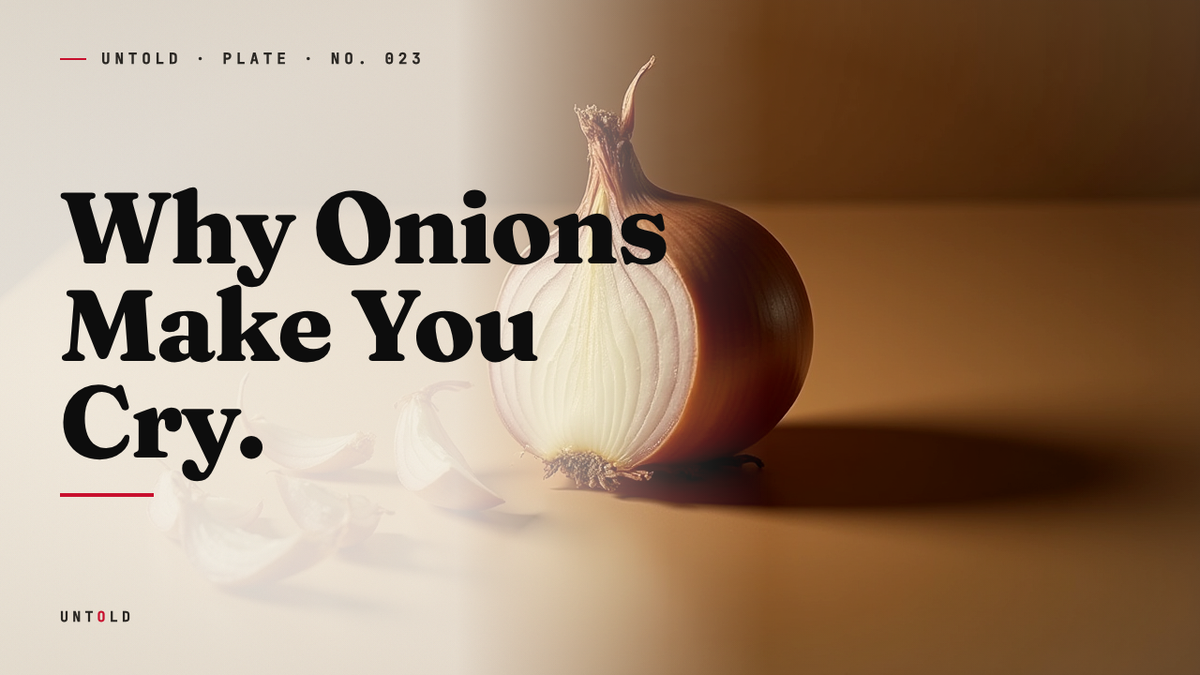
You pick up the knife. You make the first cut. Within seconds, your eyes begin to sting, and then, absurdly, you are weeping over a vegetable. You are not sad. You are not hurt. Nothing about the moment justifies the response, and yet your body reacts as though it has been wounded. Roughly nine out of every ten people who slice into an onion will feel this same sting, this same involuntary flood 1. No other food in an ordinary kitchen attacks the cook quite so reliably, or quite so personally.
For most of culinary history, people blamed the obvious suspects. The smell. The juice. The sharp fumes rising off the board. Cooks reached for folk remedies that ranged from the plausible to the magical: hold a spoon in your mouth, light a candle nearby, cut underwater, breathe through your nose. Some of these work, by accident, for reasons their inventors never understood. Most do nothing at all. The truth is stranger than any of them, and it begins with a fact that reframes the whole encounter. The onion is not leaking an irritant. It is manufacturing one, in real time, specifically because you have hurt it.
A weapon assembled only when the bulb is broken
To understand the tears, you have to start beneath the soil, where the onion spends most of its life. An onion is not really a vegetable in the casual sense. It is a survival organ, a swollen underground bulb that stores energy so the plant can outlast a cold winter and bolt to flower in spring. Like every plant rooted to one spot, it faces a basic strategic problem. It cannot flee a predator. A grazing animal, a burrowing insect, a hungry larva chewing through the soil: against all of these, running is not an option. So plants of the Allium genus, which includes onions, garlic, leeks, and chives, evolved a different answer. They fight with chemistry.
The onion’s defense is built on a clever piece of biological engineering: keep your weapon in two harmless halves, and store them apart. Inside the bulb’s cells sit stable sulfur-containing compounds, amino acid derivatives that on their own do nothing offensive. Locked away separately, in a different cellular compartment, sits an enzyme. As long as the cell stays whole, these components never meet, and the onion remains calm and odorless. You can carry a whole onion in your bag all day and shed not a tear.
The instant a blade ruptures the cell walls, that careful separation collapses. The contents of the broken cells spill together, and the two halves of the weapon finally meet. This is the crucial point that overturned centuries of folk wisdom: the smell and the sting are not stored in the onion at all. They are created by injury. The chemist Eric Block, who spent much of his career decoding the molecular life of garlic and onion and wrote the definitive scientific account of the genus, framed the whole process around this single trigger 2. Damage starts the reaction. The knife is not releasing the irritant. The knife is the on switch.
The enzyme nobody expected
The enzyme that springs into action the moment cells rupture is called alliinase. Within seconds it begins transforming the onion’s stored sulfur compounds into a cascade of reactive new molecules. For decades, this looked like the end of the story. Alliinase made the reactive chemistry; the reactive chemistry made the tears. Scientists assumed that if you wanted a tearless onion, you simply needed to deal with alliinase.
The surprise came from a food laboratory on the other side of the world. In the late 1990s and early 2000s, researchers at the Japanese company House Foods set out to engineer an onion that would not make people cry, partly as a commercial goal and partly out of pure curiosity. Their working theory was the standard one: knock out or suppress the enzyme thought to produce the irritant, and the tears would stop. What they found instead rewrote the mechanism. There was a second enzyme, hidden in the cascade, that no one had accounted for. In a 2002 paper in Nature, the team announced its discovery and gave it a name that doubles as a description: lachrymatory-factor synthase, the synthase that builds the tear factor itself 3.
This changed the picture entirely. Alliinase was not the direct architect of the tear gas. It produced an intermediate compound, and that intermediate could have gone on to become a flavor molecule. But lachrymatory-factor synthase intercepted it and channeled it deliberately toward the irritant, assembling the actual tear-making molecule step by step. The implication was strangely hopeful. If you could disable just that one enzyme, you would lose the tears without necessarily losing the onion’s beloved flavor, because the flavor chemistry runs along a related but separate path. The work was unusual enough, and just whimsical enough, that the team was awarded an Ig Nobel Prize in Chemistry in 2013, the prize given for research that first makes you laugh and then makes you think 4.
The chemistry of a tiny, rising cloud
The molecule at the center of all this has a name as precise as it is unwieldy: syn-propanethial-S-oxide. It is a small, volatile sulfur compound, and volatility is the whole problem. The moment it forms on the cut surface of the onion, it does not stay there. It evaporates, rising invisibly off the cutting board as a faint chemical cloud, drifting upward toward the warmth and moisture of the cook’s face.
What happens next is a small piece of physiology that turns an irritant into agony. The gas reaches the surface of the eye, which is permanently wet with a film of tears. On contact with that moisture, the syn-propanethial-S-oxide reacts and forms, among other things, a mild sulfuric acid. The cornea, the clear dome at the front of the eye, is one of the most densely innervated surfaces in the entire human body. It is packed with nerve endings whose specific job is to detect chemical and physical threats before they can do real damage. They register the acidic irritant almost instantly and fire an alarm straight to the brain.
The brain’s response is not confusion. It is a defense reflex, ancient and automatic. The lacrimal glands, tucked above each eye, are ordered to flood the surface with fluid, washing the irritant away. This is the same reflex that protects you from smoke, from chopped chili fumes, from a gust of grit on a windy day. Within seconds of detecting the gas, the glands can ramp up tear production dramatically. The tears streaming down your cheeks are not a malfunction or a sign of weakness. They are a rescue mission, your body’s emergency rinse cycle, deployed against a chemical it has correctly identified as an attack.
It helps to sit with the irony of this for a moment. The onion has no nervous system, no intent, no awareness of you at all. It is simply executing a defense that evolved over an immense span of time to deter the kind of small chewing creature that would otherwise eat it alive. Your eyes, meanwhile, are executing a defense of their own, equally automatic, equally unaware. Two unrelated survival systems, plant and animal, collide on a kitchen counter, and the result is a grown adult weeping over dinner prep.
How to win the argument
Once you understand the mechanism, the remedies stop being folklore and start being applied chemistry. Almost every effective trick works by interfering with one specific stage of the process: the enzymes, the volatility of the gas, or the number of cells you rupture in the first place.
The first lever is temperature. Enzymes are exquisitely sensitive to it, and they slow down sharply in the cold. Chilling an onion before you cut it dampens the activity of both alliinase and lachrymatory-factor synthase, which means less irritant produced per slice. Fifteen minutes in the freezer or half an hour in the refrigerator can noticeably reduce the sting. The trade-off is that a frozen onion is harder to cut cleanly, so the chill should be brief.
The second lever is the knife itself. This is the remedy most cooks underrate. A sharp blade slices cleanly through cells, severing rather than crushing. A dull blade tears and mashes, rupturing far more cells along its path and spilling far more of the two-part weapon together. More broken cells means more reactive chemistry means more gas. A genuinely sharp knife is one of the most reliable defenses against onion tears, and it makes every other cutting task safer and faster besides.
The third lever attacks the gas in transit. Syn-propanethial-S-oxide is water-soluble, which is why so many water-based folk remedies have a kernel of truth. Cutting near running water, or beside a fan, or under a kitchen vent, scatters and dissolves the rising cloud before it can reach the wet surface of your eyes. Move the air, or give the molecule water to dissolve into, and far less of it completes its journey to your cornea. This is also why the old advice to cut onions underwater works, even if it is wildly impractical.
There is one more structural trick worth knowing. The concentration of the relevant sulfur compounds is not evenly distributed through the bulb. It is highest in the root end, the hairy base where the onion was anchored to the ground. Leaving that root end intact for as long as possible, cutting toward it rather than through it, keeps the most reactive part of the onion sealed until the very end. It is a small adjustment, but it meaningfully reduces the volume of gas you release across the whole job.
The sting and the soul are the same thing
Here is the part that almost no one expects. The very chemistry that assaults your eyes is, in large measure, the chemistry that makes onions worth eating at all, and not only for flavor.
The sulfur compounds that the onion deploys in self-defense belong to the same family of organosulfur molecules that researchers have linked to a range of potential health effects, including anti-inflammatory and cardiovascular benefits 5. The reactive sulfur chemistry that stings a hungry insect is closely related to the reactive sulfur chemistry that gives onions and garlic their reputation as more than mere seasoning. The weapon and the medicine are drawn from the same well. This is not a coincidence. Many of the plant compounds humans prize most, from the heat of chili to the bite of mustard to the sharpness of garlic, began as defenses against being eaten. We have, over thousands of years, cultivated and learned to love the very molecules that plants invented to repel us.
The flavor follows the same logic. When alliinase and its downstream enzymes go to work on a cut onion, they generate not only the tear factor but a whole bouquet of sulfur compounds responsible for the pungency, sweetness, and depth that cooking transforms into something savory and golden. An onion that has lost its capacity to make these molecules has lost a great deal of what makes it taste like an onion. This is the quiet tension at the heart of the tearless-onion project. You cannot fully separate the irritation from the character without risking the character itself.
Researchers have, in fact, succeeded in breeding onions that release far less of the tear gas. Some sweet, low-pungency varieties produce dramatically reduced amounts of the irritant, and dedicated tearless cultivars developed through careful breeding and study of the lachrymatory pathway can cut the relevant emissions substantially 3. For anyone who dreads the cutting board, these are a genuine gift. And yet most cooks, given the choice, still reach for the sharp, eye-watering, unapologetically pungent classic. They reach for it precisely because that fierce chemistry is what gives a humble bulb its presence in a dish, its ability to anchor a stew or sweeten into the base of nearly every cuisine on Earth.
So the next time you find yourself blinking through tears over a cutting board, it is worth remembering what is actually happening, because it is far more remarkable than a kitchen nuisance. You are not the victim of a smell. You are standing in the path of a chemical defense that an underground bulb assembles on the spot, the instant it is injured, drawing on a strategy refined across a span of evolutionary time so vast it predates almost everything you would recognize as life on land. The onion is not crying. The onion is fighting. The tears running down your face are simply the cost of admission to one of the oldest arguments in nature, the long, slow negotiation between a plant that does not wish to be eaten and a creature that very much intends to eat it anyway.
Sources
- Imai, S. et al., Plant biochemistry: An onion enzyme that makes the eyes water, Nature, 2002. — https://www.nature.com/articles/419685a
- Block, E., Garlic and Other Alliums: The Lore and the Science, Royal Society of Chemistry, 2010. — https://pubs.rsc.org/en/content/ebook/978-0-85404-190-9
- Improbable Research, The 2013 Ig Nobel Prize Winners (Chemistry). — https://improbable.com/ig/winners/#ig2013
- Block, E., The Organosulfur Chemistry of the Genus Allium, Angewandte Chemie International Edition, 1992. — https://onlinelibrary.wiley.com/doi/10.1002/anie.199211351
- Griffiths, G. et al., Onions: a global benefit to health, Phytotherapy Research, 2002. — https://onlinelibrary.wiley.com/doi/10.1002/ptr.1222
- Eady, C. C. et al., Silencing onion lachrymatory factor synthase causes a significant change in the sulfur secondary metabolite profile, Plant Physiology, 2008. — https://academic.oup.com/plphys/article/147/4/2096/6107547
Related reading