Engineered to Be Irresistible: Inside the Science of the Potato Chip
The reason the bag empties faster than you meant is not weak willpower. It is decades of deliberate design.
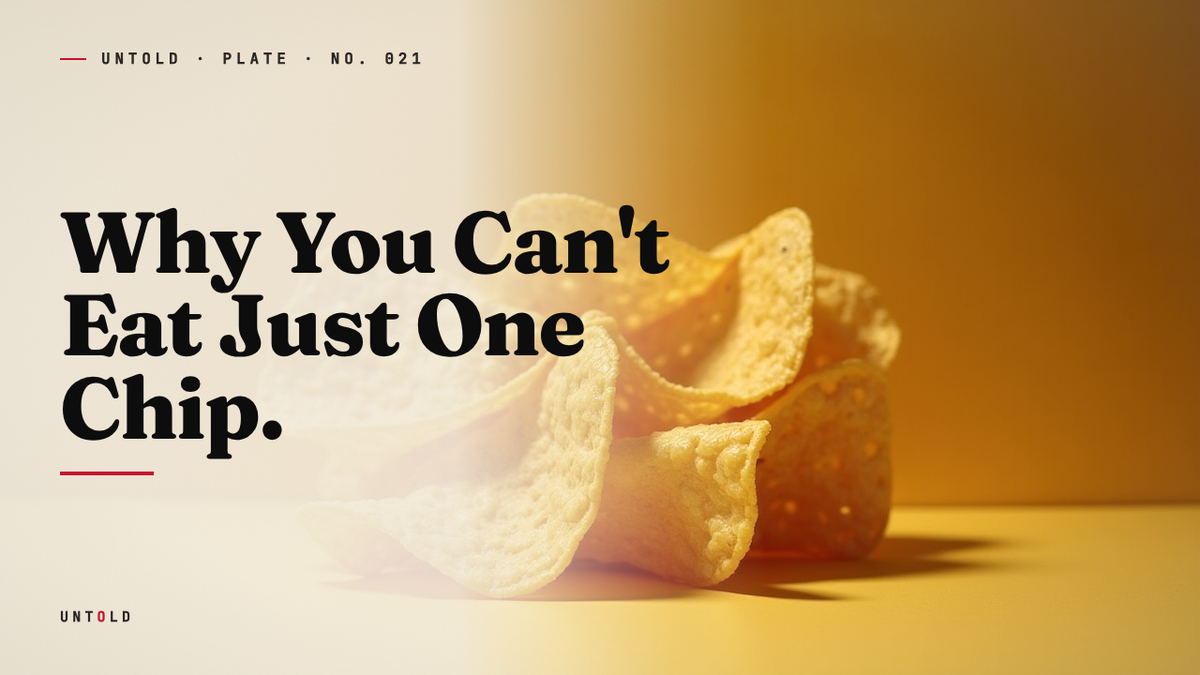
You promised yourself one chip. Maybe two. Now the bag crinkles emptily in your hand, and the strange part is that you can barely remember tasting the last ten. There was no decision, no deliberate reach for more. Your hand simply kept returning to the bag while your attention was elsewhere, until there was nothing left to return to.
It is tempting to read this as a small personal failure, a lapse of discipline that says something quietly unflattering about your character. But that reading gets the story almost exactly backward. The chip was not a neutral object that you failed to resist. It was a designed object, refined over decades by chemists, psychologists, and marketing scientists whose explicit goal was to make stopping feel unnatural. The famous slogan, “Bet you can’t eat just one,” was not a boast. It was a description of the product’s engineering specifications.
Americans eat roughly 1.85 billion pounds of potato chips a year, a figure that has stayed stubbornly enormous through every wave of diet culture and nutritional anxiety. That persistence is not an accident of taste. It is the visible result of an invisible project: the slow, methodical optimization of a snack to fit the contours of human appetite so precisely that resisting it requires constant, conscious effort. Understanding how that project worked does not magically restore your willpower. But it does change what the empty bag means.
The Ancient Logic of Salt and Fat
Before the food scientists arrived, evolution did most of the work. The pull a chip exerts begins with two substances your body has spent millions of years learning to crave: salt and fat.
Salt is essential to life. Sodium regulates fluid balance, nerve signaling, and muscle function, and the body cannot manufacture it. For most of human history, salt was also scarce, valuable enough to be traded as currency and fought over in wars. An organism wired to seek out and consume salt whenever it appeared had a real survival advantage, and so we inherited a deep, almost reflexive pleasure in salty flavor. That pleasure made perfect sense in a world where salt was hard to find. It makes considerably less sense in a world where it arrives by the pound in a foil bag.
Fat carries a similar evolutionary signature. Gram for gram, fat is the most energy-dense thing a person can eat, packing more than twice the calories of protein or carbohydrate. For ancestors who could never be certain when the next meal would come, a taste for fat was a taste for survival. Those who chased dense energy lived longer and left more descendants. The craving was adaptive precisely because it was strong.
A potato chip delivers both of these ancient signals at once, in a concentration that exists nowhere in nature. No wild plant or animal offers fat and salt in this ratio, this density, this immediately available form. The chip is, in a sense, a hyperstimulus: a sensory exaggeration that hits evolved reward circuits harder than anything those circuits were built to handle. The instincts that once kept us alive are turned, with surgical care, against us.
The Man Who Mapped the Bliss Point
The figure who transformed these instincts from a vague advantage into a usable science was an experimental psychologist named Howard Moskowitz. Trained at Harvard, Moskowitz brought the tools of psychophysics, the study of how physical stimuli become subjective sensations, to the problem of how food makes people feel and how much of it they will eat.1
His early work in the 1970s came out of an unlikely client: the United States Army. The military wanted to understand why soldiers in the field ate so little of their rations, leaving them undernourished in conditions where calories mattered enormously. Moskowitz uncovered a counterintuitive answer. Foods with intense, distinctive flavors caused soldiers to tire of them quickly. The flavor was vivid the first few bites and then became tedious, and the soldiers stopped eating. Blander foods, by contrast, never provoked that fatigue. People could keep eating them almost indefinitely without the brain signaling that enough was enough.1
Somewhere between dull and overpowering, Moskowitz reasoned, lay an optimal point: a level of flavor intense enough to be pleasurable but not so intense that the brain registered satiety and called a halt. He devoted much of his career to locating that point with mathematical precision, testing recipe after recipe and plotting how pleasure rose and then fell as a given ingredient increased. The peak of that curve he called the bliss point: the exact concentration of salt, sugar, or fat that maximizes craving while minimizing the impulse to stop.2
The insight was subtle and powerful. The food industry had long assumed that more flavor meant more appeal. Moskowitz showed that the relationship was an inverted U, and that the most profitable products were the ones calibrated to its summit. A chip seasoned to its bliss point gives enough pleasure to keep the hand moving but never enough to satisfy. It is engineered, in other words, to leave you perpetually almost finished.
The Trick That Lives in Your Mouth
Salt and fat tuned to the bliss point were only the foundation. The more ingenious manipulations happen not on the tongue but in the physics of how the food behaves once you bite it.
The food scientist Steven Witherly, who has spent his career studying why certain foods feel impossible to put down, identified a property he calls vanishing caloric density. The idea is that foods which dissolve quickly in the mouth send a confusing message to the brain. A chip melts almost instantly, collapsing into a thin paste of fat and starch that disappears down the throat in seconds. Because the food vanishes so fast, the brain seems to conclude that very little was actually eaten. The usual sensory weight of a substantial mouthful never registers.3
The result is a kind of caloric sleight of hand. You can eat a great deal of a melt-in-the-mouth food without ever feeling that you have eaten much at all. Each chip leaves so little trace that reaching for the next one feels like starting over rather than continuing. The internal accounting that would normally say “you have had enough of this” never gets the data it needs. The chip is gone before your body can tally it.
This is why dense, chewy foods tend to be self-limiting in a way that airy, dissolving foods are not. A handful of nuts demands chewing, sits heavily, and announces its presence. A chip apologizes for existing and then disappears, inviting the next one in with no memory of the last.
The Sound of Freshness
Then there is the crunch, which most people experience as mere texture but which is, on closer inspection, a finely tuned sensory weapon.
Charles Spence, an experimental psychologist at Oxford who studies the way the senses combine to produce flavor, ran an experiment that has become a small classic of the field. In what is now known as the “sonic chip” study, Spence and his collaborator had people bite into potato chips while wearing headphones. The researchers manipulated the crunching sound the participants heard, amplifying or muffling the high-frequency crackle without changing the chip itself in any way.4
The results were striking. When the crunch sounded louder and crisper, tasters judged the very same chips to be fresher and more pleasant, by a margin of up to fifteen percent. The chip had not changed. Only its soundtrack had. Spence’s work, which later earned him an Ig Nobel Prize, demonstrated that what we call taste is in fact a multisensory construction, assembled by the brain from sound and texture and sight as much as from the chemistry on the tongue.4
The practical lesson for food engineers was clear. A loud, crisp crunch is not a side effect of a good chip. It is a signal the brain reads as freshness, vitality, worth, and it can be designed for directly, through the thickness of the slice, the moisture content, the frying temperature. The crunch tells your ears the food is alive and worth eating, and your ears tell the rest of you to keep going.
Wanting Versus Liking
Underneath all of this sits the neurochemistry of desire, and here a common misunderstanding does a lot of damage. Dopamine is often described as the brain’s pleasure chemical, the molecule of reward and enjoyment. That is not quite right. Dopamine is better understood as the chemistry of wanting rather than liking, of pursuit rather than satisfaction.5
The neuroscientist Kent Berridge spent years teasing these two systems apart and showed that they are distinct. Liking is the actual pleasure of a reward, the sensory enjoyment of the thing in your mouth. Wanting is the motivational pull that drives you toward the reward in the first place. Dopamine governs wanting. It spikes in anticipation, before the bite rather than during it, urging you forward toward the next one.5
This distinction explains the eerie experience of eating chips you are no longer really enjoying. The liking may have faded ten chips ago, but the wanting continues, because the dopamine system is responding not to the pleasure of the last chip but to the anticipation of the next. And the chip industry has, perhaps without naming it, learned to exploit a quirk of this system: unpredictable rewards drive wanting harder than reliable ones.
Every chip is slightly different. One is more curled, one carries a heavier dusting of salt, one shatters differently against the teeth. That subtle variation means the reward is never perfectly predictable, and an unpredictable reward keeps the dopamine system more engaged than a predictable one does. It is the same principle that makes a slot machine more compelling than a vending machine. You keep pulling because you never quite know what the next pull will deliver.
Craving by Design
If all of this sounds like a conspiracy, the investigative journalist Michael Moss spent years documenting just how deliberate it actually was. In his reporting and in his book Salt Sugar Fat, Moss obtained internal industry documents and interviewed the scientists and executives who built the modern processed-food landscape. What he found was not accident but engineering.6
Companies, Moss reported, ran exhaustive consumer testing to locate the precise formulations that maximized appeal, treating craving as a problem to be solved rather than a happy byproduct. Recipes were tested across dozens of variables, the shape of the chip, the way it curled, the manner in which it sat and dissolved on the tongue, each measured against its effect on how much people would eat and how much they would want to buy.6
The blunt conclusion that emerges from Moss’s work is that these companies were not, in the end, selling food in the ordinary sense. They were selling craving, optimized and quantified. The product was the desire it produced. And the people designing it understood the human appetite, its evolutionary triggers and its neurological levers, with a precision that the average consumer reaching into a bag could not begin to match.
Why It Was Never About Willpower
This is the part that should reframe the whole experience of the empty bag. The reason you could not eat just one is not that your willpower is feeble. It is that the chip was specifically built to slip past the brain systems that would otherwise tell you to stop.
Think about what those systems are up against. The bliss point ensures the flavor never tips into satiety. The vanishing caloric density ensures your body never registers the weight of what it has eaten. The engineered crunch keeps signaling freshness and reward. The dopamine system, fed by unpredictable variation, keeps generating the urge for the next bite even after pleasure has faded. Every one of the brain’s natural brakes has been quietly disconnected before the bag was ever opened. Your hunger and fullness signals were not overpowered in a fair fight. They were bypassed.
Understanding this matters, because the willpower framing leads people somewhere unhelpful. If the problem is your character, the solution is shame, and shame has never been an effective intervention against a product that was scientifically optimized to defeat it. Recognizing the design behind the craving moves the question from “why am I so weak” to “how does this thing actually work,” which is a far more useful place to stand.
What Awareness Can Actually Do
None of this means the situation is hopeless, or that chips are evil and must be renounced. They are not evil. They are simply expertly designed, and a few small adjustments can shift the balance back toward your own intentions.
The first tool is awareness itself. Naming the trick weakens its grip. When you know that the melt-in-the-mouth quality is engineered to hide calories from your brain, that the crunch is a freshness signal, that the variation between chips is feeding an anticipation loop, the automatic reaching loses some of its automaticity. You can interrupt a process you can see.
The second is to defeat the vanishing-density illusion by forcing your brain to register the amount. Portioning chips onto a plate rather than eating from the bag gives you a visible record of what you have consumed, something the dissolving chip works hard to erase. The plate remembers what the mouth forgets.
The third is patience. The hormonal signals that tell the brain you are full, leptin and the gut peptides that follow a meal, take roughly twenty minutes to register. Eating slowly gives those signals the time they need to arrive before you have finished the entire bag. The faster you eat, the more you can consume before your body has any chance to object.
The factory does not control you. But it studied you, carefully and at great expense, and it built a product that knew your weaknesses better than you did. So the next time the bag empties faster than you meant it to, you might set aside the small, familiar verdict about your own discipline. It was never really a test of your strength. It was a demonstration of their science, and now, at least, you know its name.
Sources
- Moskowitz, H. R., “Mind, Body and Pleasure: An Analysis of Factors Which Influence Sensory Hedonics,” Preference Behaviour and Chemoreception, 1979. — https://pubmed.ncbi.nlm.nih.gov/
- Moss, M., “The Extraordinary Science of Addictive Junk Food,” The New York Times Magazine, 2013. — https://www.nytimes.com/2013/02/24/magazine/the-extraordinary-science-of-junk-food.html
- Witherly, S. A., Why Humans Like Junk Food, iUniverse, 2007. — https://www.iuniverse.com/
- Zampini, M. and Spence, C., “The Role of Auditory Cues in Modulating the Perceived Crispness and Staleness of Potato Chips,” Journal of Sensory Studies, 2004. — https://onlinelibrary.wiley.com/doi/10.1111/j.1745-459x.2004.080403.x
- Berridge, K. C. and Robinson, T. E., “Liking, Wanting, and the Incentive-Sensitization Theory of Addiction,” American Psychologist, 2016. — https://www.ncbi.nlm.nih.gov/pmc/articles/PMC4856044/
- Moss, M., Salt Sugar Fat: How the Food Giants Hooked Us, Random House, 2013. — https://www.penguinrandomhouse.com/books/202909/salt-sugar-fat-by-michael-moss/
Related reading