The Coldest Lie Your Mouth Has Ever Told
Mint feels icy without changing temperature, and the reason rewrites what we thought sensation was.
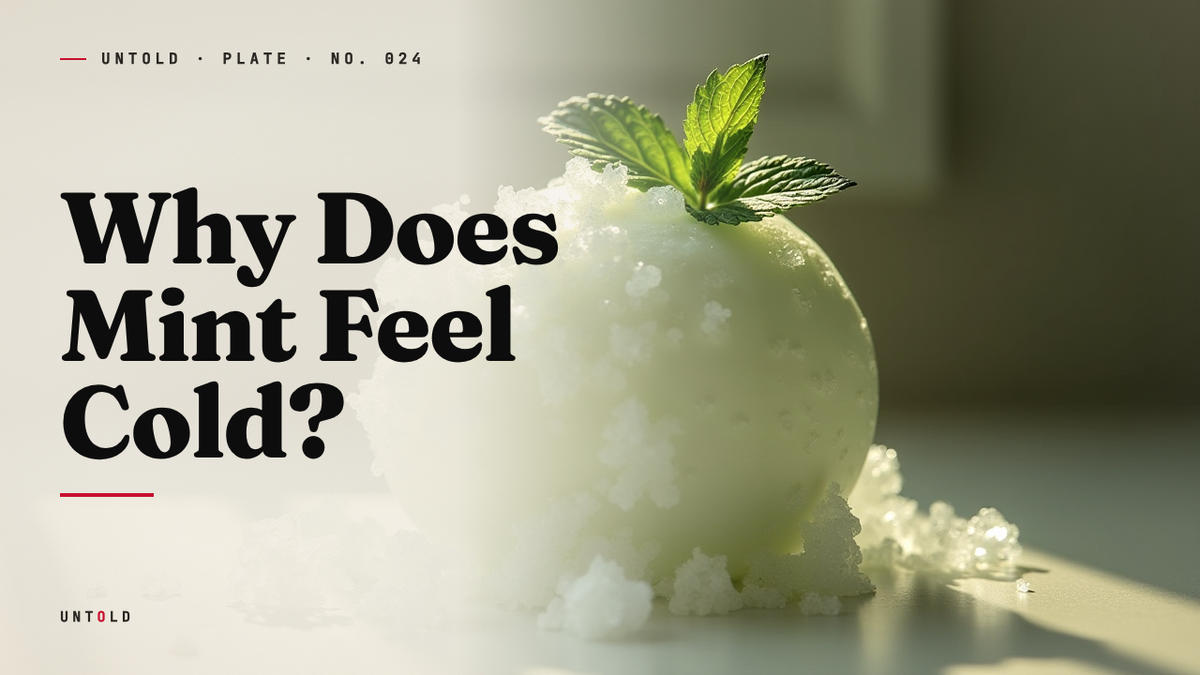
Bite into a fresh mint leaf and your mouth floods with cold. A clean, almost wintry chill spreads across your tongue and the roof of your mouth, sharp enough that you might describe it as refreshing, as if a window had been opened somewhere inside your face.
Now consider an inconvenient fact. Nothing in that leaf is cold. The mint sitting in a warm kitchen is exactly the temperature of the warm kitchen. No ice crystal formed on your tongue. No heat left your body. The thermometer, if you could somehow slip one between your taste buds, would not budge.
And yet the sensation is unmistakable. Breathe in afterward and it intensifies, a second wave of cold rolling across tissue that has not actually dropped a single degree. Your tongue is reporting weather that does not exist. This is one of the more elegant deceptions chemistry plays on the human body, and untangling it requires understanding something strange about how we feel temperature at all. We do not measure it. We infer it. And inference, it turns out, can be hijacked.
The sensors that never touch a thermometer
The skin and the lining of the mouth are studded with microscopic sensors, far more sophisticated than the metaphor of a thermometer suggests. These sensors are proteins called ion channels, and they sit embedded in the membranes of nerve endings like gatekeepers wedged into a wall. Each one is a tiny pore that can open or close. When it opens, charged particles rush through, the nerve fires an electrical signal, and that signal sprints toward the brain carrying a single message.
For cold, the most important of these gatekeepers is a channel with the unglamorous name TRPM8. It belongs to a family of receptors called transient receptor potential channels, a sprawling group involved in everything from pain to vision in other animals. TRPM8 is the body’s dedicated cold detector. Under ordinary conditions it stays shut. But as the temperature around it falls below roughly 26 degrees Celsius, the channel begins to swing open, and the colder it gets, the more insistently it fires.1
This is the honest version of cold. Step outside on a frigid morning and TRPM8 channels across your skin open in a chorus, reporting accurately on a chilly world. The brain receives the signal and assembles the experience we call cold. There is a thermometer-like quality to all of this, a faithful correspondence between the temperature outside and the sensation inside.
But here is the crucial detail, the loophole that the entire mint mystery hinges upon. TRPM8 does not actually measure temperature. It cannot. It is a protein, and proteins do not read thermometers. What TRPM8 detects is its own shape. Cold causes the channel to shift conformation, to flex into the open position, and that physical change is what triggers the signal. The channel reports on its own geometry, and the brain has learned, over millions of years, to interpret that geometry as temperature.
Most of the time this works perfectly. Cold is the only thing in the natural world that reliably bends TRPM8 open, so the shortcut is trustworthy. The brain trusts the shape because the shape almost always means cold.
Almost always. Because one molecule learned how to force that shape open without any cold at all.
A molecule that forges the signature of winter
That molecule is menthol, the compound responsible for mint’s signature bite. It comes mostly from the essential oils of peppermint and spearmint, where it exists as a waxy crystal that happens to melt right around body temperature. Chemically it is an unremarkable alcohol, a ring of carbon atoms with a few branches. There is nothing about its structure that announces cold. It does not lower the temperature of anything it touches.
What menthol does is far sneakier. When it reaches a nerve ending carrying TRPM8 channels, it slips into the channel and binds to it directly. The binding tugs the protein into exactly the same open shape that cold would have produced. The channel cannot tell the difference. It does the only thing it knows how to do when it finds itself open: it fires.2
The nerve sends an identical cold signal toward the brain. No temperature has dropped. No ice exists anywhere. But the message arriving in your cortex is indistinguishable from the message a glass of ice water would send. The brain, having no independent way to verify the report, does what it always does. It believes its sensor. It assembles the experience of cold, vivid and convincing, in a mouth that is perfectly warm.
This is why a mint leaf feels icy in a heated room, why a stick of gum chills the breath, why menthol cigarettes once advertised themselves with images of snow and waterfalls. The molecule has forged the molecular signature of winter. Your nervous system, fluent in that signature and unaccustomed to forgeries, falls for it completely. The lie is not in the brain’s reasoning. The brain reasons correctly. The lie is planted at the very first link in the chain, at the gatekeeper itself.
How two laboratories caught the channel in the act
For most of human history we knew menthol felt cold without having the faintest idea why. The explanation arrived only in the early 2000s, and it came from a chase that began somewhere unexpected: with the burn of chili peppers.
David Julius, a physiologist at the University of California, San Francisco, had spent years asking how the body senses temperature and pain. His first great success concerned heat. In 1997 his lab identified a channel called TRPV1, the receptor that responds both to genuinely high temperatures and to capsaicin, the compound that makes chilies hot.3 The discovery explained a riddle that had puzzled people for centuries: why a pepper, which is not actually hot in any thermal sense, sets the mouth on fire. Capsaicin, like menthol, was forging a signal. It bent the heat sensor open the way menthol would later be shown to bend the cold sensor.
The symmetry was irresistible. If a molecule could counterfeit heat by binding a heat channel, surely menthol counterfeited cold the same way, by binding a cold channel that nobody had yet found. Julius set out to find it. So did a young neuroscientist named Ardem Patapoutian, working independently at Scripps Research in La Jolla, who had become fascinated by how cells sense physical forces and temperatures.
In 2002 both laboratories closed in on the same answer at almost the same moment. Julius and his colleagues used menthol itself as bait, screening for the gene that produced a receptor responsive to the compound. Patapoutian’s team approached from the cold side, hunting for cells that fired when chilled.45 Both arrived at the identical molecule: TRPM8. They showed that a single channel responded to both cold temperatures and to menthol, and that it began to wake up right around 26 degrees Celsius. Two teams, two methods, one molecular answer published within weeks of each other in Cell and in Nature.
The convergence was its own kind of proof. When two independent groups, using different tools and different logic, stumble upon the same protein, the result has a solidity that no single experiment can claim. The mystery of minty cold finally had a name, a gene, and eventually a detailed structure.
Nearly two decades later, in 2021, Julius and Patapoutian shared the Nobel Prize in Physiology or Medicine.6 The citation honored their discoveries of the receptors for temperature and touch, a body of work that began with chili peppers and mint leaves and ended by explaining, at the molecular level, how living things feel the physical world at all. It is a rare prize whose roots a person can taste at any dinner table.
Why a single breath deepens the chill
There is a second act to the mint sensation that the molecular story explains beautifully. Eat something minty, then inhale through your mouth, and the cold sharpens. It deepens, as though the breath itself were arctic. Many people assume this is illusion stacked on illusion, but in fact something real is happening here, woven together with the chemical trick.
When air moves across the moist surface of your mouth, it carries away a little heat through evaporation. The surface genuinely cools, just slightly, just a degree or two. On its own this faint chill would barely register. But your TRPM8 channels are not on their own. They are already primed, already pried partway open by the menthol bound to them. The small dose of real cold lands on a population of sensors that are leaning toward the open position, and it tips them further. The two stimuli, one chemical and one thermal, add together.7
The effect is a chill that feels deeper and more bracing than either input could produce alone. The menthol lowers the threshold; the cool air clears the lowered bar with ease. Each breath delivers another small pulse of genuine cooling onto sensors that menthol keeps reset and ready. The molecule lingers on the tissue, binding and rebinding, so the false alarm never fully quiets. The result is something like a feedback loop of cold, a sensation continually refreshed, built almost entirely on a temperature change that never happened.
A trick worth borrowing
The natural next question is whether any of this matters beyond the curiosity of why gum feels frosty. It matters a great deal, because once you understand that menthol manufactures cold, you can put the counterfeit to work.
The most familiar application sits in the medicine cabinet. Menthol fills cough drops, sore-throat sprays, and chest rubs, and it earns its place there through a kind of sensory sleight of hand. Pain and irritation travel to the brain along nerves, and a flood of cold sensation competes for the brain’s attention along overlapping pathways. The fake chill of menthol can crowd out and distract from the rawness of an inflamed throat, providing genuine relief through an entirely illusory cooling.8 It is a real medical effect built on a sensation that has no thermal basis whatsoever.
The same trick threads through ordinary life more widely than most people notice. Muscle rubs tingle and chill because of it. Lip balms and aftershaves carry it. A large share of the world’s toothpastes rely on menthol or its relatives to deliver the clean, cool finish we have come to associate with cleanliness itself, to the point that a mouth without that chill can feel somehow unwashed. Shampoos, shaving gels, and chewing gums all whisper the same fundamental lie to the same set of channels. A single molecule has persuaded an entire species that a fragment of winter lives inside a leaf.
There is even a final twist that deepens the irony. Menthol does not cool the body in any physical sense, and over time it can do the opposite. By dilating blood vessels near the skin, it may leave the treated area very slightly warmer, all while the brain continues to insist on cold.9 The cooling is pure sensation, untethered from temperature, persisting in defiance of the actual thermometer.
The senses as interpreters, not windows
Step back and the mint story becomes a parable about perception. We tend to imagine our senses as windows, transparent openings onto a world that exists exactly as we experience it. Menthol exposes the metaphor as wrong. The senses are not windows. They are interpreters, and like all interpreters they can be misled by a clever enough forgery.
Chili peppers and mint leaves make the point with unusual clarity because they are mirror images of the same trick. Capsaicin counterfeits heat by binding the heat sensor. Menthol counterfeits cold by binding the cold sensor. In both cases the molecule never changes the temperature of anything. It simply learns the shape of the signal and reproduces it, and the brain, trusting its faithful gatekeepers, builds an experience that corresponds to nothing in the physical world.
What you feel, then, is never the thing itself. It is your nervous system’s best account of the thing, an account that is usually accurate precisely because it can usually be trusted. Cold almost always means cold. Heat almost always means heat. The shortcut works until a molecule comes along that knows the password. So the next time mint floods your mouth and a chill rolls across your tongue, it is worth remembering that nothing got colder. No window opened. You were simply, beautifully, convinced.
Sources
- McKemy, D. D., Neuhausser, W. M., Julius, D., “Identification of a cold receptor reveals a general role for TRP channels in thermosensation,” Nature, 2002. — https://www.nature.com/articles/nature719
- Bautista, D. M. et al., “The menthol receptor TRPM8 is the principal detector of environmental cold,” Nature, 2007. — https://www.nature.com/articles/nature05910
- Caterina, M. J. et al., “The capsaicin receptor: a heat-activated ion channel in the pain pathway,” Nature, 1997. — https://www.nature.com/articles/39807
- Peier, A. M. et al., “A TRP channel that senses cold stimuli and menthol,” Cell, 2002. — https://www.cell.com/fulltext/S0092-8674(02)00652-9
- McKemy, D. D., “How cold is it? TRPM8 and TRPA1 in the molecular logic of cold sensation,” Molecular Pain, 2005. — https://journals.sagepub.com/doi/10.1186/1744-8069-1-16
- The Nobel Assembly at Karolinska Institutet, “The Nobel Prize in Physiology or Medicine 2021: David Julius and Ardem Patapoutian,” 2021. — https://www.nobelprize.org/prizes/medicine/2021/summary/
- Eccles, R., “Menthol and Related Cooling Compounds,” Journal of Pharmacy and Pharmacology, 1994. — https://academic.oup.com/jpp/article/46/8/618/6149327
- Pergolizzi, J. V. et al., “The role and mechanism of action of menthol in topical analgesic products,” Journal of Clinical Pharmacy and Therapeutics, 2018. — https://onlinelibrary.wiley.com/doi/10.1111/jcpt.12679
- Patel, T., Ishiuji, Y., Yosipovitch, G., “Menthol: A refreshing look at this ancient compound,” Journal of the American Academy of Dermatology, 2007. — https://www.jaad.org/article/S0190-9622(07)00738-6/fulltext
Related reading