The Number That Cannot Measure a Mind
Anesthesia works almost every time. When it fails, it exposes how little we know about consciousness.
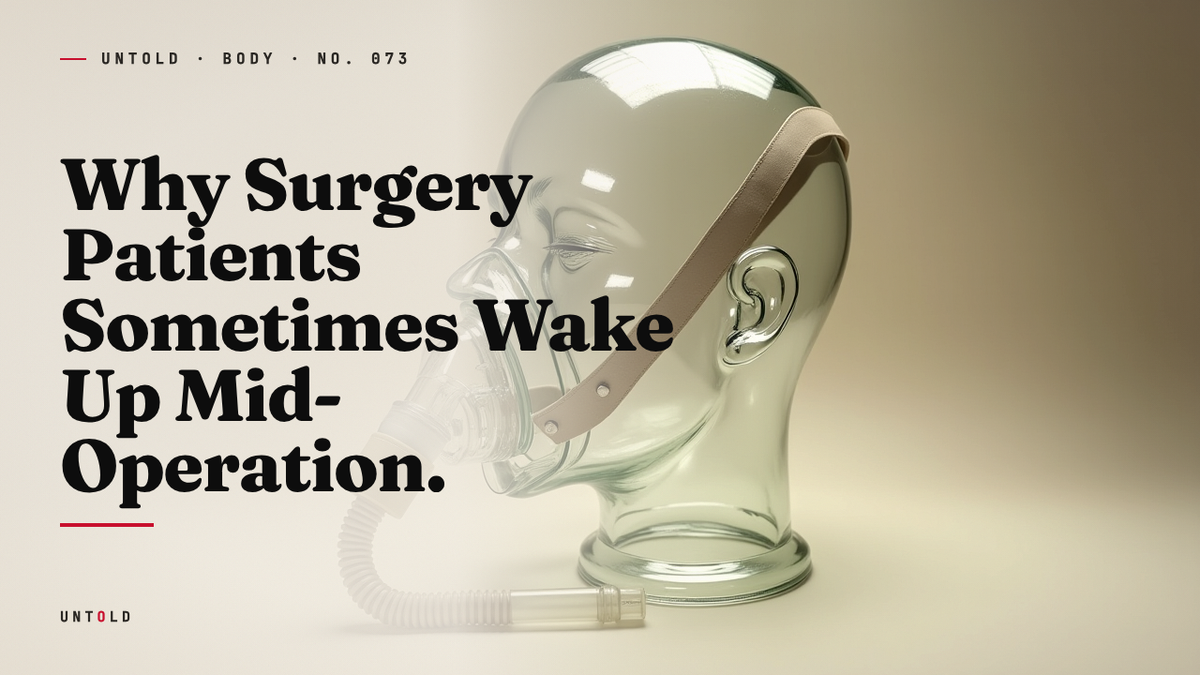
There is a moment, familiar to almost everyone who has ever been wheeled into an operating theatre, when a mask settles over the face and a voice asks you to count backward from ten. Most people never reach seven. Consciousness simply stops, cleanly, like a film cut to black. When it resumes, the surgery is over, hours have vanished, and the body carries a wound it never felt being made. It is one of medicine’s quiet miracles, so reliable that we have stopped marveling at it.
And yet, for a small number of patients, the film does not cut cleanly. Somewhere in the middle of the operation, the projector flickers back on. The patient becomes aware. They hear the surgeons talking. They feel the pressure of hands and instruments, sometimes the pull of a retractor, occasionally the blade itself. And here is the part that turns an unsettling event into a genuine horror: they cannot move. They cannot open their eyes, cannot lift a finger, cannot produce a sound. The drugs that were supposed to erase the experience have failed, but the drug that paralyzes the body has performed perfectly. The mind is awake inside a sealed room.
This phenomenon has a clinical name, accidental awareness under general anesthesia, and it is not a myth or a rare piece of medical folklore. Depending on how it is measured, it occurs in something on the order of one in every thousand to one in every nineteen thousand general anesthetics.1 Across the millions of operations performed each year, that adds up to thousands of people who, on some level, were present for their own surgery. Understanding how this is possible requires understanding what modern anesthesia actually does, and confronting a truth that the medical profession has been circling for more than a century: we still cannot reliably measure a conscious mind from the outside.
Three drugs, three jobs
The popular image of anesthesia is of a single potent substance that switches off the brain. The reality is closer to a chemical orchestra, and the conductor is the anesthesiologist. General anesthesia is not one drug but a deliberate combination, each component assigned a different task.2
The first job is amnesia. A hypnotic agent, often propofol or an inhaled gas such as sevoflurane, is meant to suppress consciousness and prevent the formation of memory. The second job is analgesia. Opioids and related compounds blunt the body’s response to the tissue damage that surgery inevitably causes. The third job, and the most consequential for our story, is muscle paralysis. A neuromuscular blocking agent, descended from the curare that South American hunters once used on their arrows, relaxes the muscles completely so that the surgical field is still and the airway can be controlled.
That third drug is what makes modern surgery efficient and safe. A surgeon cannot operate cleanly on a body that twitches, coughs, or tenses. Paralysis creates the stillness that intricate procedures demand. But it also introduces a hidden flaw into the whole arrangement, a flaw so elegant in its cruelty that it seems designed by a novelist rather than by pharmacology.
The amnesia drug and the paralytic drug are separate substances, delivered on separate schedules, acting on separate systems. There is no law of nature binding them together. If the hypnotic dose is too light, or is not reaching the brain effectively, consciousness can return. But the paralytic, dosed and functioning independently, keeps the body locked in place. The result is a patient who is awake but cannot demonstrate it. Every channel through which a person might signal distress, a flinch, a gasp, a widening of the eyes, has been chemically severed.
Flying blind
When ether was demonstrated publicly at Massachusetts General Hospital in October 1846, it was received as a deliverance. For the first time in human history, a person could be cut open without agony. The surgeon William Morton administered the gas, the patient felt nothing, and the operating surgeon reportedly announced to the room that this was no humbug.3 Surgery without suffering became possible almost overnight.
But the pioneers of anesthesia inherited a problem they could not see. They had a drug that produced unconsciousness, but no instrument that could confirm it. They could not read the brain. They could only read the body’s proxies: blood pressure, heart rate, the dilation of a pupil, a sheen of sweat on the brow. These signs are useful, but they are also easily fooled. A patient can be deeply unconscious yet show a racing heart because of blood loss. A patient can be alarmingly aware yet show stable vital signs because the paralytic and the painkillers have muted every reflex the body would ordinarily use to protest.
The physician Henry Beecher, who spent much of his career at Massachusetts General studying pain and the placebo effect, understood how treacherous these clinical signs could be.4 For a full century after ether’s debut, anesthesiologists were, in effect, guessing at the depth of sleep. They were skilled guessers, trained and experienced, but they were working without a window into the one organ that mattered. The consequences of that blindness would not be documented systematically until the middle of the twentieth century.
The first alarm
The reports began to surface in the 1950s and gathered force in the following decade. Patients, sometimes weeks after an operation, would describe conversations they had overheard in the theatre, the sensation of being cut, and above all a helpless, engulfing terror they had been unable to communicate. For a long time these accounts were dismissed as dreams, or confabulations, or the anxious imaginings of a frightened mind. They were not.
The crucial early evidence came from careful clinical documentation. A well-known British case series in the 1960s described patients who recalled their surgery in vivid and accurate detail, including specific remarks made by the surgical staff, remarks the patient could not otherwise have known.5 The pattern was consistent and chilling. The paralytic had worked exactly as intended. The muscles were still, the airway controlled, the surgical field calm. But the hypnotic had failed. The patient had been present the entire time, screaming into a body that could not scream.
What made these cases so difficult to prevent was precisely the paralysis that made the surgery possible. A patient who was merely sedated and unparalyzed would signal distress the instant awareness returned; they would move, and the anesthesiologist would deepen the dose. Paralysis removed that safety valve. It converted a self-correcting system into a silent one. The very drug that made surgery smooth also made its most terrifying failure invisible.
The isolated forearm
Faced with a phenomenon they could not see, anesthesiologists devised a technique to make it visible. It is called the isolated forearm technique, and its simplicity is almost startling. Before the paralytic drug is administered, a blood-pressure cuff is inflated on the patient’s upper arm, tight enough to cut off circulation to the forearm and hand. The paralytic, carried in the bloodstream, cannot reach the muscles below the cuff. That single limb remains capable of movement even as the rest of the body is frozen.6
The patient can then be asked, during surgery, to squeeze the researcher’s hand if they can hear. If the hand squeezes, the patient is conscious. The unparalyzed forearm becomes a keyhole through which a trapped mind can, for once, speak.
What researchers found through this keyhole reshaped the field. In a large multicenter study using the technique, a striking proportion of patients showed responsiveness at some point during general anesthesia. In one body of research, more than a third of patients undergoing certain procedures made purposeful movements with the isolated hand, responding to spoken commands while their surgery proceeded.6 Most of these patients remembered nothing afterward. The amnesia component had done its work even when the consciousness-suppressing component had not.
This complicated the very definition of the problem. There appeared to be a spectrum of states between full unconsciousness and full, remembered awareness. A patient might be conscious and responsive during the operation, capable of following instructions, and yet retain no memory of it once the drugs cleared. Whether that counts as harm, and how much it matters if a terrible experience leaves no trace, is a question that sits uneasily at the border of neuroscience and philosophy. The isolated forearm did not resolve it. It merely proved that the border existed.
Measuring the mind
By the 1990s, engineers and physiologists set out to do what a century of anesthesiologists had longed for: to read consciousness directly from the brain. The most influential product of that effort was the bispectral index, or BIS, monitor. It gathers the brain’s electrical activity through electrodes on the forehead, runs the signal through a proprietary algorithm, and distills the whole tangled storm of the electroencephalogram into a single number between zero and one hundred.7
The promise of that number was seductive. A reading near one hundred meant a patient fully awake. A reading near zero meant deep suppression, a nearly silent cortex. For surgical unconsciousness, the target was a band between roughly forty and sixty. For the first time, an anesthesiologist could glance at a screen and believe they were watching consciousness itself, quantified and tracked in real time. The window into the brain that Beecher’s generation had lacked seemed, at last, to have opened.
The apparent triumph arrived in 2004. The anesthesiologist Paul Myles and his colleagues published a large randomized trial, known as B-Aware, in The Lancet. They studied patients at high risk of awareness and compared standard care against care guided by BIS monitoring. The result was dramatic. Patients whose anesthesia was managed with the monitor experienced substantially fewer episodes of awareness, a reduction on the order of eighty percent.8 It looked, for a moment, as though the ancient problem had finally been engineered into submission. A number could stand guard over the mind.
The number that failed
But consciousness has never surrendered easily to measurement, and the story turned. In 2008, a larger trial called B-Unaware, led by researchers at Washington University, tested the BIS monitor against a simpler and older method: tracking the concentration of anesthetic gas the patient was exhaling, and sounding an alarm if it dropped too low.9
The result deflated the earlier optimism. BIS monitoring was no better at preventing awareness than the gas-concentration method. The expensive algorithm, the single reassuring number, offered no clear advantage over simply making sure enough anesthetic was present in the patient’s system. Subsequent research reinforced the point. The number on the screen was a useful piece of information, but it was not a reliable sentinel against awareness.
The deeper lesson was humbling. Consciousness, it turns out, resists compression into a single value. The BIS algorithm captures certain statistical features of the brain’s electrical rhythms, but those features are not consciousness itself; they are a shadow of it, cast at an angle, and different anesthetic drugs cast different shadows. A number that tracks unconsciousness well under one drug may mislead under another. The dream of a consciousness meter ran aground on the same reef that had wrecked the crude proxies of the nineteenth century. We are still, in a profound sense, reading the surface and inferring the depths.
Why it still happens
If awareness cannot be reliably banished by a monitor, why does it not happen far more often? The answer lies in margins. For the great majority of surgeries, anesthesiologists administer generous doses of hypnotic drug, comfortably more than enough to keep the brain suppressed, and awareness essentially never occurs. The one-in-a-thousand risk is concentrated in a specific and predictable minority of cases.
Those are the surgeries in which giving a full, comfortable dose of anesthetic would itself endanger the patient. In severe trauma, where a patient is already losing blood and teetering toward collapse, a heavy dose of anesthetic can drop blood pressure to a fatal level. Cardiac surgery presents similar dilemmas. So does emergency cesarean section, where the anesthetic given to the mother also reaches the baby, and where the drug must be kept light to protect the newborn. A large national audit in the United Kingdom found that a substantial share of awareness reports clustered in exactly these high-risk and emergency situations.1
In those moments, the anesthesiologist is caught between two dangers. Too much drug may kill the patient. Too little may leave them aware. There is no dial marked safe. There is only judgment, exercised at speed, under pressure, with a life in the balance. Awareness, in the rare cases where it occurs, is often not a mistake so much as the shadow side of a deliberate decision to keep a fragile patient alive.
The cost to those patients can be severe. For some, the memory fades and little lingers. For others, especially those who experienced pain and understood their helplessness, the aftermath resembles post-traumatic stress: nightmares, flashbacks, a dread of hospitals and medical procedures that can persist for years.1 Recognizing this, modern anesthesiology has begun to take the psychological injury seriously, screening patients who report awareness and referring them for trauma-focused care rather than dismissing their accounts.
Coda
The next time a mask settles over a face and a voice asks for a count backward from ten, the odds remain overwhelmingly kind. The vast machinery of modern anesthesia works, quietly and almost always, sparing millions of people from an experience that terrified every human being who lived before 1846. That reliability is real, and it deserves the trust we place in it. But the rare failures carry a lesson that no amount of engineering has yet erased. We can silence the body with confidence. We can dull pain and erase memory with remarkable precision. What we still cannot do, more than a century and a half into the age of anesthesia, is look directly into a mind and know for certain whether anyone is home.

Sources
- Pandit, J. J. et al., 5th National Audit Project (NAP5) on accidental awareness during general anaesthesia, Royal College of Anaesthetists / AAGBI, 2014. — https://www.nationalauditprojects.org.uk/NAP5report
- Brown, E. N., Lydic, R., Schiff, N. D., General Anesthesia, Sleep, and Coma, New England Journal of Medicine, 2010. — https://www.nejm.org/doi/full/10.1056/NEJMra0808281
- Fenster, J. M., Ether Day: The Strange Tale of America’s Greatest Medical Discovery, HarperCollins, 2001. — https://en.wikipedia.org/wiki/Ether_Day
- Beecher, H. K., The Powerful Placebo, Journal of the American Medical Association, 1955. — https://jamanetwork.com/journals/jama/article-abstract/303530
- Hutchinson, R., Awareness during surgery: a study of its incidence, British Journal of Anaesthesia, 1961. — https://doi.org/10.1093/bja/33.9.463
- Sanders, R. D. et al., Unresponsiveness ≠ Unconsciousness (isolated forearm technique findings), Anesthesiology, 2012. — https://pubs.asahq.org/anesthesiology/article/116/4/946/12742
- Rampil, I. J., A Primer for EEG Signal Processing in Anesthesia (bispectral index), Anesthesiology, 1998. — https://pubs.asahq.org/anesthesiology/article/89/4/980/36385
- Myles, P. S. et al., Bispectral index monitoring to prevent awareness during anaesthesia: the B-Aware randomised controlled trial, The Lancet, 2004. — https://www.thelancet.com/journals/lancet/article/PIIS0140-6736(04)16300-9/fulltext
- Avidan, M. S. et al., Anesthesia Awareness and the Bispectral Index (B-Unaware trial), New England Journal of Medicine, 2008. — https://www.nejm.org/doi/full/10.1056/NEJMoa0707361
Related reading