The Hand That Isn't Yours
A rubber hand, two paintbrushes, and ninety seconds are enough to rewrite where your body ends.
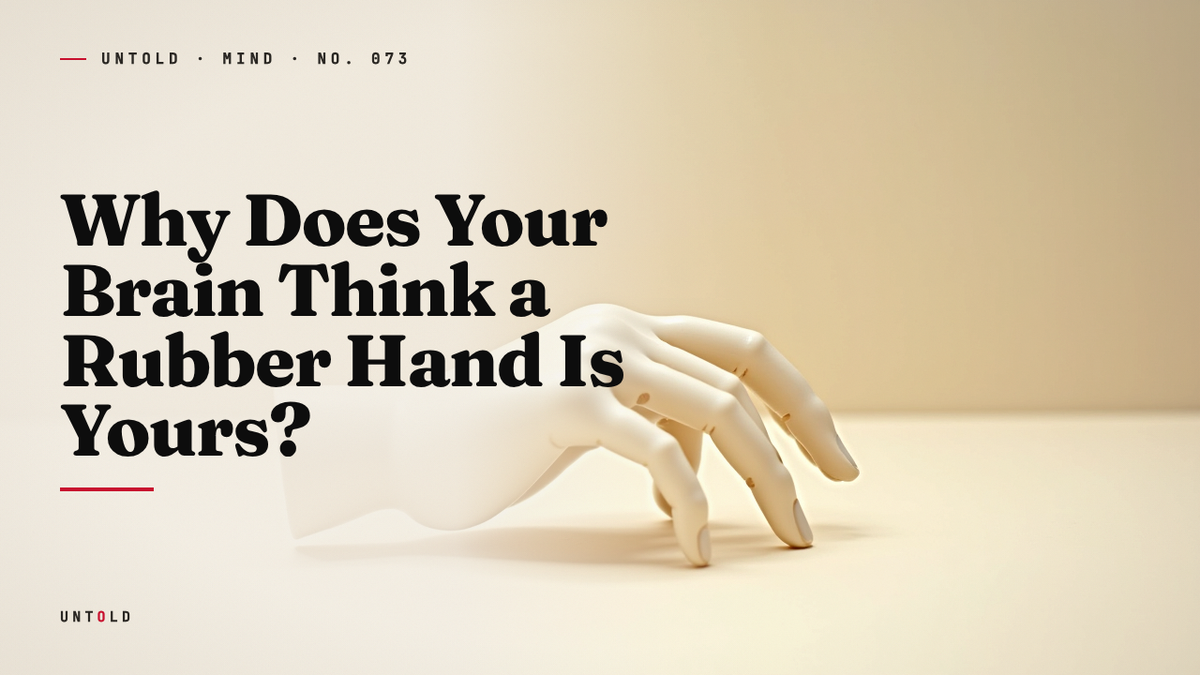
Rest your hand on a table and consider how completely you believe it is yours. There is no argument, no moment of verification. The hand is simply, obviously, undeniably part of you. That certainty feels like one of the few things a person can count on. It is not something you decide; it is something you know in your bones, or seem to.
And yet that knowledge is not a fact reported by your body. It is a conclusion drawn by your brain, and like any conclusion, it can be wrong. Under the right conditions, in roughly a minute and a half, a healthy adult can be persuaded that a lifeless piece of rubber is living flesh. When a hammer swings toward that rubber, they will flinch. When a needle approaches it, their skin will sweat with genuine alarm. The body they were so sure of turns out to be a story, and the story can be edited on the spot.
This is the rubber hand illusion, and for the better part of three decades it has been quietly dismantling one of the oldest assumptions in the study of the mind: that our sense of owning a body is fixed, reliable, and beyond question.
A Question Nobody Thought to Ask
For most of the history of science, the feeling of bodily ownership was not treated as a problem at all. Philosophers worried about how we perceive the external world, about color and sound and the reliability of the senses. But the body itself, the thing doing the perceiving, seemed too obvious to interrogate. You know your hand is your hand. What is there to explain?
The assumption ran deep. The body schema, the internal map of where our limbs are and what belongs to us, was thought to be a stable given, calibrated in infancy and left more or less untouched thereafter. It was the fixed platform from which all other perception proceeded. To question it would have seemed a bit like questioning whether you exist.
Then, in 1998, two researchers at Carnegie Mellon University decided to test the obvious. Matthew Botvinick and Jonathan Cohen were not setting out to overturn a paradigm. They were curious about how the brain reconciles conflicting sensory information, and they built a setup that was almost comically simple. 1
The participant sat at a table with one hand hidden behind a small screen. In its place, positioned where a hand would naturally rest, sat a realistic rubber model. The experimenter took two paintbrushes and began to stroke both hands at once: the hidden real one and the visible fake one, in the same rhythm, at the same moment. The participant could see only the rubber hand being brushed, while feeling the brush on flesh they could not see.
Within a minute or two, most people reported something they had not expected and could not quite explain. The touch they felt seemed to be coming from the rubber hand. The sensation and the sight had fused. As Botvinick and Cohen wrote, subjects experienced the touch as though the rubber hand were their own. 1
The finding ran as a single page in Nature, one of the most competitive journals in science. That one page turned out to be a doorway. It suggested that ownership of the body was not a fixed fact but a perception, and perceptions, unlike facts, can be manipulated. If ownership could be given to a rubber hand, then ownership was something the brain was actively constructing, moment to moment, from whatever evidence it had.
The Brain Is Guessing, Always
To understand why a lump of rubber can pass as living tissue, it helps to abandon a comforting idea: that we experience the world directly. We do not. The brain sits in the dark of the skull and never touches anything. It receives signals, electrical impulses arriving from the eyes, the skin, the muscles and joints. From this raw and ambiguous traffic it must build a coherent picture of a body moving through a world.
Those signals arrive in separate streams. Vision reports where a hand appears to be. Touch reports contact on the skin. Proprioception, the sense of the body’s own position, reports where the limbs are without needing to look. Ordinarily these streams agree, and their agreement is so seamless that we never notice the brain doing the work of reconciliation.
The rubber hand illusion works by making them disagree in a very particular way. The eyes see a hand being stroked. The skin feels a stroke at the same instant. The brain, faced with two synchronized signals, reaches the most economical conclusion available: the thing I see being touched is the thing I feel being touched, and therefore it must be my hand. Vision, the dominant sense, wins the argument. It overrides proprioception, which had been quietly insisting the real hand was somewhere off to the side.
Timing is everything. The illusion depends on the visual and tactile signals arriving close together. Studies have found the effect is strongest when the two touches are synchronized within a few hundred milliseconds of each other. 2 Introduce even a small delay, stroke the rubber hand a half-second before or after the real one, and the whole thing falls apart. The brain notices the mismatch and refuses to merge the streams. Synchrony is the glue, and without it the hand is just rubber again.
This is not a bug in the system. It is the system working exactly as it should. The brain is a prediction machine, forever assembling the best available guess about the state of the body. Under normal conditions that guess is correct, which is why we never catch it happening. The illusion simply feeds the machine deceptive inputs and watches it produce a confident, wrong answer.
Measuring a Feeling
A skeptic might reasonably ask how anyone could study something as private as the feeling of owning a hand. You cannot photograph it. A participant might simply be telling the experimenter what they think is wanted, or getting swept up in the theater of the thing. For the illusion to count as science, it needed a measurement that did not rely on what people said.
Botvinick and Cohen supplied one in their original paper, and it has anchored the field ever since. After the brushing, they asked participants to close their eyes and point, with their other hand, to where they felt their hidden hand was located. People pointed wrong. They pointed toward the rubber hand, as if their real hand had migrated across the table. 1
The felt position of the hand had drifted, sometimes by several centimeters, toward the fake. Researchers named this measurable shift proprioceptive drift. It is a clean, quantifiable number, and it correlates with the strength of the illusion. The stronger someone’s reported sense of ownership, the further their felt hand position had wandered. The feeling, in other words, left a fingerprint you could measure with a ruler.
This mattered enormously. It meant the illusion was not merely a story people told about their experience. It was reshaping the brain’s actual internal map of the body, in a way that showed up in behavior even when the eyes were shut.
Watching Ownership in the Brain
If the felt position of the hand could shift, the next question was where in the brain the shift occurred. That work was carried forward most influentially by Henrik Ehrsson, a neuroscientist who ran versions of the experiment inside brain scanners, first at University College London and later at the Karolinska Institute in Sweden.
Ehrsson’s team induced the illusion while participants lay in a functional MRI machine, tracking which regions grew active as the sense of ownership took hold. One area stood out: the premotor cortex, a region involved in planning movement and, crucially, in representing the body and the space immediately around it. As people came to feel the rubber hand was theirs, this region lit up, and the intensity of its activity tracked the strength of the reported illusion. 3
The stronger the brain activity, the stronger the sense of ownership. This was not a metaphor about the mind. It was a physical signature, visible on a scan, of the brain incorporating a foreign object into its model of the self.
Then Ehrsson’s group ran an experiment that turned the illusion from a curiosity into something visceral. Once a participant felt the rubber hand was theirs, the researchers threatened it. They swung a needle toward the fake fingers, or menaced them with other objects, while the person watched. 4
The response was immediate and involuntary. Anxiety-related regions of the brain fired, and the skin produced a measurable stress response, the same clammy spike of sweat the body generates when something real is in danger. Participants often reported a genuine jolt of fear, and some flinched to pull the hand away, a hand made of rubber that they had owned for barely two minutes.
This was the decisive point. Ownership was not a matter of opinion or suggestion. If it were, the body would not have mounted a full defensive reaction to protect a threatened object. The nervous system had genuinely enrolled the rubber hand into the category of things worth protecting. Belief had become biology.
This Was Never About the Hand
It is tempting to file the rubber hand illusion under strange party tricks, alongside optical illusions and other pleasant curiosities of perception. That would miss the point entirely. The hand was only ever the most convenient place to catch the brain in the act. What the experiment actually reveals is something far larger and more unsettling: the entire sense of inhabiting a body, of being a self located in a particular place, is a construction the brain assembles and updates continuously.
Researchers pressed this logic to its conclusion. If the brain could be fooled about a single hand, could it be fooled about the whole body? Ehrsson and others found that it could. Using head-mounted displays and cameras, they created full-body versions of the illusion, in which people came to feel they inhabited a mannequin, or a body of a different size, or even that they were floating outside themselves in an experimentally induced out-of-body experience. 5 The self, it turned out, could be relocated as easily as a hand.
The implication is genuinely vertiginous. The feeling of being here, in this body, looking out from behind these eyes, is not a direct readout of anatomical fact. It is the brain’s best interpretation of a stream of sensory evidence, and that interpretation can be steered, expanded, shrunk, or moved to another location in the room. The body you feel you own is a conclusion, not a given. Most of the time it happens to be correct, which is precisely why it feels like bedrock.
From Laboratory to Clinic
What began as a single page in Nature has, over the years, found uses that reach well beyond the laboratory bench. If the brain can be persuaded to adopt a rubber hand, it can be persuaded to adopt other things too, and some of those things matter deeply to people living with real difficulty.
Consider prosthetics. One of the great challenges of an artificial limb is that it can feel like a tool the person carries rather than a part of the person themselves. Insights from ownership research have helped designers and clinicians think about how to make a prosthesis feel genuinely incorporated, using synchronized visual and tactile feedback to encourage the brain to accept the device as belonging to the body. The same principles that convince someone a rubber hand is theirs can be marshaled to help an amputee feel that a prosthetic hand is, in a real sense, their own.
The illusion has also been turned against phantom limb pain, the often agonizing sensation that a lost limb is still present and hurting. Related mirror and multisensory techniques, which give the brain new visual evidence about a missing or damaged limb, have been used in clinics to relieve this pain by helping the brain reconcile its outdated body map with reality.
Then there is virtual reality, which is in a sense a machine built to run the illusion at scale. Every time a VR system gives you a body, an avatar whose hands move when yours do, it is exploiting exactly the mechanism Botvinick and Cohen stumbled onto. The synchrony between your real movements and the movements you see convinces your brain that the digital body is, at least a little, yours. The uncanny sense of presence that good VR produces is the rubber hand illusion wearing a headset.
The Editable Self
There is a particular kind of humility that comes from understanding this research. We tend to imagine the self as the one thing we cannot be wrong about, the fixed point from which we judge everything else. The rubber hand illusion suggests that the self is not a fixed point at all but a living draft, revised continuously in light of whatever evidence the senses supply.
This is not cause for alarm. The brain’s constant reconstruction of the body is not a flaw; it is what allows us to grow, to adapt to injury, to learn to use tools as extensions of ourselves, to feel at home in a body that changes across a lifetime. Every time you feel comfortably located inside your own skin, that feeling is an achievement, a conclusion the brain reached from moment to moment. It could have reached a different one, and under the right paintbrush, it will.
So the next time you rest your hand on a table and feel that quiet, total certainty that it is yours, you might let a small doubt in. Not the anxious kind, but the curious kind. That certainty is not a fact your body reported to you. It is a guess your brain made, an excellent guess, made so smoothly and so constantly that you have never once noticed it being made. Ownership is not something you have. It is something your brain is doing, right now, and will keep doing for as long as you are here to feel it.

Sources
- Botvinick, M. & Cohen, J., ‘Rubber hands feel touch that eyes see,’ Nature, 1998. — https://www.nature.com/articles/35784
- Shimada, S., Fukuda, K. & Hiraki, K., ‘Rubber hand illusion under delayed visual feedback,’ PLoS ONE, 2009. — https://journals.plos.org/plosone/article?id=10.1371/journal.pone.0006185
- Ehrsson, H. H., Spence, C. & Passingham, R. E., ‘That’s my hand! Activity in premotor cortex reflects feeling of ownership of a limb,’ Science, 2004. — https://www.science.org/doi/10.1126/science.1097011
- Ehrsson, H. H. et al., ‘Threatening a rubber hand that you feel is yours elicits a cortical anxiety response,’ PNAS, 2007. — https://www.pnas.org/doi/10.1073/pnas.0608589104
- Ehrsson, H. H., ‘The experimental induction of out-of-body experiences,’ Science, 2007. — https://www.science.org/doi/10.1126/science.1142175
- Tsakiris, M. & Haggard, P., ‘The rubber hand illusion revisited: visuotactile integration and self-attribution,’ Journal of Experimental Psychology, 2005. — https://pubmed.ncbi.nlm.nih.gov/15709874/
Related reading