The Face That Almost Passes
A robotics professor sketched a graph in 1970 that still explains why lifelike faces make us recoil.
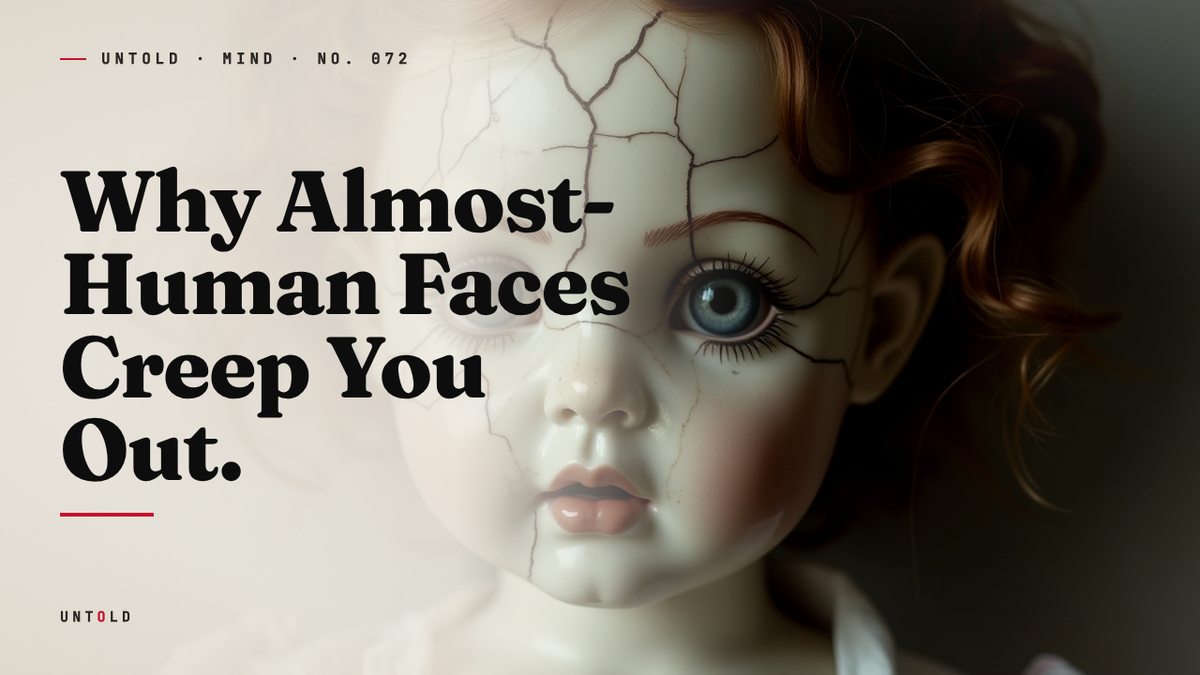
A doll sits on a shelf and looks back at you. Its face is a small triumph of manufacturing. The cheeks curve correctly, the lips have the right sheen, the proportions land somewhere close to a real child’s. And yet the longer you hold its gaze, the more a low, wordless discomfort spreads through you. Nothing about the object is threatening. It cannot move, cannot speak, cannot harm you. But some older part of your nervous system has already filed a complaint, and it filed that complaint long before you could name what was wrong.
The feeling is remarkably fast. In laboratory conditions, human beings distinguish a genuine face from a subtly artificial one in well under a tenth of a second, faster than conscious thought can assemble a reason 1. You do not decide the doll is unsettling. You are informed of it. By the time your rational mind arrives to investigate, the verdict is already in, and it is a verdict of quiet dread.
What makes this reaction so strange is its selectivity. A blocky industrial robot, all exposed joints and blinking indicator lights, provokes nothing. A cartoon character with enormous eyes and no nose is often charming. The revulsion is reserved for a very specific category of object: the thing that is almost, but not quite, one of us. Somewhere between the obviously fake and the genuinely human lies a narrow band where affection curdles into horror. That band has a name, and the story of how it got one begins with a Japanese engineer and a graph.
The engineer who drew the dip
Masahiro Mori was a robotics professor, born in 1927, working in an era when the idea of humanlike machines belonged more to speculation than to laboratories. In 1970 he wrote a short essay for an obscure Japanese journal called Energy, and in it he proposed a simple thought experiment 2. Imagine plotting a graph. Along the horizontal axis, place the degree to which a robot or artificial figure resembles a human being. Along the vertical axis, place how much warmth and affinity people feel toward it. What shape would the line take?
The intuitive answer is a smooth upward slope. The more human something looks, the more we should like it. And for a while, Mori observed, that is exactly what happens. An industrial arm earns indifference. A toy robot with a friendly painted face earns a little affection. A humanoid figure with recognizable eyes and a mouth earns more. The curve rises.
Then, just before the figure reaches full human likeness, the curve does something violent. It plunges. Affinity collapses into revulsion, a sharp downward gash on the graph precisely at the point where the resemblance becomes nearly perfect. Push a little further, achieve true indistinguishable humanity, and affection recovers to its highest peak. But that plunge before the summit remains, a canyon carved into the rising line.
Mori called it bukimi no tani, which translates roughly as the valley of eeriness. In English it became the uncanny valley, and the name has outlived nearly everything else about the essay 3. To illustrate the sensation, Mori offered the example of a prosthetic hand. Modern prosthetics can look convincingly real, matching skin tone and fingernail and the fine creases of a knuckle. But reach out to shake such a hand and feel cold, yielding rubber where warm flesh should be, and a jolt of unease runs up your arm. The illusion was good enough to raise your expectations. The reality was just wrong enough to betray them.
Mori’s essay was, by his own account, a casual piece of speculation. He offered no data, no experiment, only a keen observation and a memorable image. For decades that is all it remained: a curious sketch, passed between roboticists and animators as a rule of thumb, admired but untested. Nobody had asked the harder question. If the valley is real, what is happening inside the brain when we fall into it?
Watching the valley in the brain
The question waited until neuroscience had tools sharp enough to answer it. In 2011, a team led by the cognitive scientist Ayse Pinar Saygin at the University of California, San Diego, set out to find the uncanny valley in the living brain 4. Their method was elegantly direct. They recruited volunteers, placed them in a functional MRI scanner, and showed them videos of three different agents performing ordinary human actions such as picking up a cup or waving.
The first agent was a human being, moving as humans move. The second was a robot that looked unmistakably mechanical, a body of visible metal and plastic, moving with mechanical stiffness. The third was the crucial one: an android built to look convincingly human, with synthetic skin and a lifelike face, but moving with the slightly-off quality of a machine. Its appearance promised a person. Its motion delivered something less than one.
Crucially, the robot and the android performed identical movements. The only difference was the shell. And it was the android, the one caught halfway between machine and human, that produced the most dramatic response in the viewers’ brains. Regions involved in processing bodily movement and biological motion lit up with unusual intensity, particularly a network in the parietal cortex that integrates what a body looks like with how it moves 4.
Saygin interpreted the surge as a kind of prediction error. The brain, presented with a human-looking face, quietly generates an expectation: this thing will move like a person. When the android moved with mechanical imperfection, that expectation was violated, and the mismatch registered as a jarring computational conflict. The robot triggered no such error because it never made the promise in the first place. Nobody expects a metal arm to move like a dancer. The android’s crime was to look like it should, and then to fail.
“The brain doesn’t seem to know what to make of it,” Saygin observed. The eeriness, in this reading, does not live in appearance alone. It lives in the gap between two channels of information that refuse to agree, the seam where a body’s look and a body’s motion come apart.
The tyranny of the eyes
If the valley is a matter of mismatch, one region of the face governs it above all others. Ask people what unsettles them about an almost-human face and the answer, with striking consistency, comes back to the eyes. Dead eyes set into a lively face are among the most reliably disturbing images a person can encounter. A waxwork museum draws its peculiar dread almost entirely from this: the flawless replication of everything except the animating spark behind the gaze.
Research on the composition of faces supports the instinct. Studies have found that figures feel eeriest not when they are uniformly artificial but when their features mismatch in their degree of realism 5. A face with photorealistic skin and cartoonish eyes lands worse than a face that is cartoonish throughout. Human-looking eyes set into obviously plastic skin unsettle more than either extreme on its own. The brain seems to tolerate a fully fake face and a fully real face, but it revolts at a face that cannot decide which it is. Consistency, even in artificiality, is soothing. Contradiction is the trigger.
This returns us to Mori’s original observation from a different angle. The prosthetic hand was disturbing because it combined a realistic surface with an unrealistic substance. The waxwork is disturbing because it combines a realistic form with an absence of the microscopic movements, the pupil shifts and involuntary blinks, that a real face never stops producing. In every case the horror lives in the collision of a met expectation with a broken one.
Corpses, contagion, and the boundary of the human
Why should such a collision feel not merely confusing but threatening? Why does it summon disgust and fear rather than mild puzzlement? Here the theories diverge, and each captures something.
Karl MacDorman, a human-computer interaction researcher at Indiana University who translated Mori’s essay into English and tested the theory experimentally, offered one of the most influential explanations 3. The almost-human face, he suggested, resembles something our ancestors had excellent reason to avoid: a corpse, or a body in the grip of illness. A living face has color, movement, and a certain integrity. A dead or diseased one is pallid, still, and subtly deformed. An android or a waxwork, with its motionless skin and vacant eyes, brushes against those same cues.
Evolution, on this account, wired us to recoil from the signs of death and disease with great speed and no need for conscious reasoning, because hesitation near a source of contagion could be fatal. The uncanny valley may be a false alarm from that ancient system, a corpse-detector firing at a machine 3. The feeling arrives as wordless disgust precisely because disgust is the emotion built to keep us away from rot.
A second theory looks not at biology but at identity. An almost-human machine, some cognitive researchers argue, threatens the category of the human itself. If a manufactured object can wear our face, blink our eyes, and mimic our expressions, the comforting boundary between us and everything else begins to blur. The unease is partly the vertigo of watching that boundary dissolve, a defense of the notion that being human is a special and bounded thing 6. The face that almost passes forces an uncomfortable question: if the difference between one of us and none of us can be this small, how secure was the difference to begin with?
There is reason to think the reaction runs deeper than culture or even than our own species. In a striking experiment, researchers showed macaque monkeys three kinds of monkey faces: real photographs, realistic computer-generated models, and less realistic cartoonish ones 7. The monkeys looked away from the realistic synthetic faces, lingering instead on both the real and the clearly fake versions. They appeared to experience their own version of the valley, avoiding the almost-real with the same unease a human feels before a lifelike doll. If monkeys fall into the valley too, its roots reach back before humanity existed, into an older primate wariness of faces that look right but ring false.
What the flinch is really about
And here the picture shifts. A growing line of thinking proposes that the uncanny valley was never truly about faces at all. It is about minds.
Human beings are compulsive mind-readers. We cannot look at a face without automatically inferring the intentions, moods, and thoughts we assume lie behind it. A glance becomes curiosity, a tightened mouth becomes displeasure, a widened eye becomes surprise. This constant, involuntary attribution of inner life is one of the deepest features of social cognition, and we perform it in milliseconds without ever deciding to.
An almost-human face presents our mind-reading machinery with a paradox. It offers all the outward signals that normally guarantee a mind behind them, and then it delivers nothing. There is a face but no intention, an expression but no experience, a gaze that points at us and yet contains no one. The flinch, in this account, is not revulsion at a broken appearance but distress at an empty one. We reach for the mind we are certain must be there, and our hand closes on air 6.
This reframes the whole phenomenon. We flinch not because the thing looks wrong but because we cannot read its intentions, cannot locate the will we instinctively expect. The uncanny valley becomes a failure of social trust: a face we cannot vouch for because there is nobody home to vouch for it. The silence behind the eyes is the true source of the dread.
The practical world has quietly absorbed this lesson. Animators learned decades ago that the safest way to make an audience love a character is to keep it charmingly, deliberately unrealistic. This is why the stylized figures of Pixar films delight audiences while certain attempts at photorealistic human animation leave them cold and faintly repelled. A creature with saucer eyes and simplified features never promises a real mind, so it never disappoints one. The moment a rendered human reaches for full realism and falls a fraction short, the valley opens beneath it.
But the valley is not fixed in place. With every passing year, as artificial faces grow more sophisticated, the gap narrows. Generative systems now produce still images of people who never existed and who are, to most viewers, indistinguishable from photographs of the living. The mismatches that once triggered our alarms are being sanded away, expression by expression, blink by blink. The day is not far off when a face on a screen will offer no cue at all to betray whether a person or a machine assembled it.
That prospect unsettles for a reason worth naming. The uncanny valley, for all its discomfort, has been a kind of protection. The crawl of your skin before a not-quite-human face is not a malfunction. It is an ancient, precise instrument doing exactly the work it evolved to do: patrolling the fragile border between one of us and none of us, and sounding an alarm the instant something crosses it wearing a stolen face. As our machines learn to silence that alarm, we may find ourselves missing the warning we once could not explain and could not ignore.
Sources
- Mori, M., ‘The Uncanny Valley,’ Energy (translated by MacDorman & Kageki), IEEE Robotics & Automation, 1970/2012 — https://spectrum.ieee.org/the-uncanny-valley
- Saygin, A. P. et al., ‘The thing that should not be: predictive coding and the uncanny valley in perceiving human and humanoid robot actions,’ Social Cognitive and Affective Neuroscience, 2012 — https://academic.oup.com/scan/article/7/4/413/1622197
- MacDorman, K. F. & Ishiguro, H., ‘The uncanny advantage of using androids in cognitive and social science research,’ Interaction Studies, 2006 — https://www.macdorman.com/kfm/writings/pubs/MacDorman2006UncannyAdvantage.pdf
- Seyama, J. & Nagayama, R. S., ‘The Uncanny Valley: Effect of Realism on the Impression of Artificial Human Faces,’ Presence, 2007 — https://direct.mit.edu/pvar/article/16/4/337/58831
- Gray, K. & Wegner, D. M., ‘Feeling robots and human zombies: Mind perception and the uncanny valley,’ Cognition, 2012 — https://www.sciencedirect.com/science/article/abs/pii/S0010027712000844
- Steckenfinger, S. A. & Ghazanfar, A. A., ‘Monkey visual behavior falls into the uncanny valley,’ Proceedings of the National Academy of Sciences, 2009 — https://www.pnas.org/doi/10.1073/pnas.0910063106
- Mori, M., ‘The Uncanny Valley’ (original essay context and history)’, Wikipedia — https://en.wikipedia.org/wiki/Uncanny_valley
Related reading