The Confession in the Black Center of the Eye
A Renaissance beauty trick, a Chicago psychologist, and the involuntary signal your pupils cannot suppress.
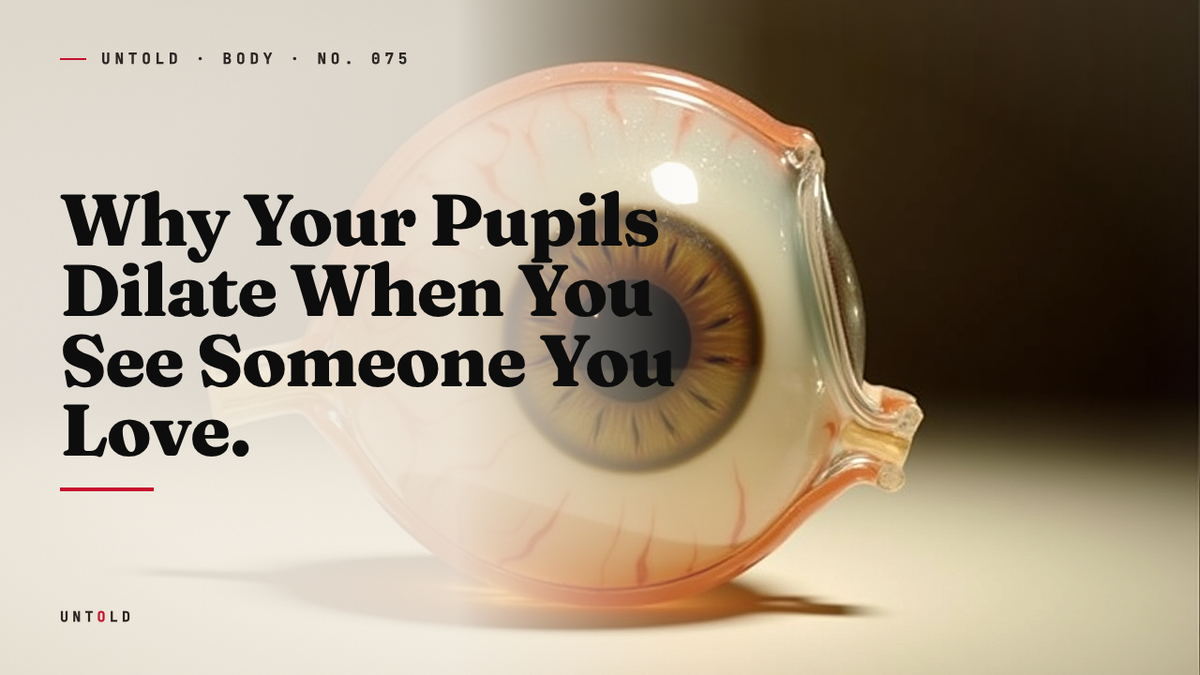
Sometime in the sixteenth century, in the courts and drawing rooms of Renaissance Italy, fashionable women began to poison themselves for beauty. The instrument was a plant, Atropa belladonna, a member of the nightshade family with dull purple flowers and glossy black berries. A few drops of its extract, squeezed into the eye, produced an effect that lasted for hours. The pupils swelled. The dark center of the eye grew large and liquid, giving the wearer a look of soft, dreaming absorption. Men, it was said, found the effect irresistible. The plant took its name from the result: bella donna, beautiful woman.
These women did not know they were manipulating their autonomic nervous systems. They did not know that belladonna contained atropine, a compound that paralyzes the muscle responsible for constricting the pupil, or that they were mimicking a physiological signal the human brain reads without ever announcing that it is reading anything at all. They only knew that it worked. Something about a wide black pupil pulled at male attention with a force that no perfume or gown could match. They had stumbled, centuries early, onto one of the most reliable and least conscious channels of human communication.
The modern science of the pupil confirms what those women intuited, and then complicates it. Your pupils do widen when you look at someone you find attractive. Studies have measured expansions of up to forty-five percent in states of strong interest or arousal. The response is fast, arriving in under a second, and it is almost entirely beyond conscious control. You cannot will your pupils to dilate on cue any more than you can will yourself to blush. But the tidy story that says wide pupils mean love turns out to be only half true. What the pupil actually reveals is stranger, older, and considerably less romantic than a lover might hope.
A hole that lets in the world
The pupil is not an organ. It is an absence, a gap in the center of the iris through which light passes to reach the retina. What makes it interesting is what surrounds it. Two sets of tiny muscles in the iris govern its size in a constant, unconscious negotiation with the world. The sphincter pupillae draws the pupil closed like a purse string. The dilator pupillae pulls it open. Together they adjust the aperture from moment to moment, the way a camera stops down in sunlight and opens wide at dusk.
Light is the obvious driver. Step from a dim room into noon glare and your pupils contract to needle points, protecting the retina from being overwhelmed. Return to shadow and they bloom open again, hungry for whatever photons remain. This is the pupillary light reflex, one of the first things a doctor checks in an unconscious patient, because the pathway runs through the brainstem and a failure there signals catastrophe.
But light is only half the story. The pupil also answers to emotion, and it does so through a hidden route that has nothing to do with brightness. That route is the autonomic nervous system, the vast unseen machinery that runs the body beneath awareness: heartbeat, digestion, sweat, the diameter of blood vessels. The autonomic system divides into two branches that work in opposition. The parasympathetic branch calms and conserves, slowing the heart and constricting the pupil. The sympathetic branch excites and mobilizes, flooding the body for action and pulling the pupil wide.
When something arouses you, whether pleasure, alarm, or intense focus, the sympathetic branch seizes control of the dilator muscle. The pupil opens, not to admit more light, but as a byproduct of a whole-body shift into heightened readiness. This is why the response is impossible to fake and difficult to suppress. It is not a facial expression, which the muscles of the face can shape and perform. It is a valve deep in the autonomic plumbing, wired to states the conscious mind does not govern.
The psychologist who watched his wife notice
For most of history the pupil’s emotional dimension went unstudied. It was too small, too fast, too difficult to measure with any precision. That changed in 1960, and it changed partly because of a domestic observation that most people would have let pass without a second thought.
Eckhard Hess was a psychologist at the University of Chicago. One evening, reading in what he described as dim light, his wife remarked that his pupils looked unusually large. Hess found this odd. The room, he thought, was not dark enough to explain it. Something other than light was moving his pupils, and the something appeared to be the material he was looking at. It was the kind of stray anomaly most people forget by morning. Hess built an experiment around it.
He assembled a set of photographs and showed them to volunteers while measuring their pupils frame by frame from film. The images ranged widely: landscapes, babies, and nude figures among them. The results, published that year in the journal Science with his colleague James Polt, were striking in their patterning. Men’s pupils enlarged, on average by around eighteen percent, when they looked at photographs of women. Women’s pupils widened most at images of babies and of men. The eye was not merely receiving these pictures. It was responding to them, betraying the direction and intensity of interest in a way the viewers themselves never announced 1.
Hess gave the emerging discipline a name. He called it pupillometry, the measurement of the pupil as an index of mental and emotional state. His central claim was disarmingly simple and, for the time, provocative. The pupil, he argued, was a window not only for the light coming in but for the feeling going out. It leaked information the person had no intention of sharing.
The trick that proved the signal ran both ways
The experiment that made Hess famous was the one that closed the loop. If a person’s pupils widen when they see something they desire, does a wide pupil in another person register as more desirable? Does the signal travel in both directions, sent and received, without either party being aware of the exchange?
Hess devised a clever manipulation. He took two photographs of the same woman, identical in every respect but one. In one print, her pupils had been secretly retouched larger. In the other, smaller. He showed both to men and asked them to rate the woman’s attractiveness. The men consistently preferred the version with the enlarged pupils, judging that woman warmer, softer, more appealing. When asked to explain their preference, they could not. Most did not even notice that the two images differed. The larger pupils had done their work below the threshold of awareness, exactly as belladonna had done four centuries earlier 1.
This was the finding that turned a curiosity into a field. It suggested that the pupil operates as a genuine channel of social signaling, a transmitter and a receiver both, running under the floor of conscious perception. The Renaissance women dripping nightshade into their eyes had been broadcasting on a frequency their admirers could hear but not name.
Hess’s methods were crude by later standards. Measuring pupil diameter from film was painstaking and prone to error, and some of his broader claims did not all survive scrutiny. But the core effect proved robust. As eye-tracking technology matured through the following decades, researchers could measure pupil changes in real time, with far greater precision and far less room for the experimenter’s expectations to color the reading. The basic phenomenon held. Pupils dilate with genuine emotional engagement, and the size of the dilation tracks the strength of the response.
Contemporary work has pushed the link toward romance directly. Studies using modern pupillometry have found that pupil dilation correlates with reported feelings of romantic interest and attraction, and that gaze patterns combined with pupil response can even distinguish, in group settings, sexual interest from the desire for companionship 2. The more drawn a person feels, in short, the wider the aperture opens. The instrument that once required a poisonous berry now requires only an infrared camera.
What the pupil is actually doing
Underneath the behavior lies a chemical story. When arousal takes hold, a region deep in the brainstem called the locus coeruleus releases a surge of norepinephrine, a neurotransmitter that doubles as a stress hormone. Norepinephrine is the brain’s signal for salience, the chemical announcement that something out there matters and deserves the full resources of attention. It sharpens focus, quickens processing, and primes the body to respond.
The pupil is tightly coupled to this system. Decades of research have established pupil diameter as one of the most reliable external readouts of locus coeruleus activity and of norepinephrine-driven arousal more generally 3. When the brain flags something important, the sympathetic branch fires, the dilator muscle pulls, and the pupil widens. Researchers who study attention and decision-making now use pupil size as a live gauge of mental effort and engagement, watching it swell as a task grows harder or a stimulus grows more compelling 4.
Seen this way, the widening pupil is less a declaration of love than a marker of significance. The eye opens because the brain has decided that whatever it is looking at is worth the cost of full engagement. It is drinking in more of the scene, quite literally, admitting more light while the whole nervous system tilts toward the object of interest. The romantic reading, that you open your eyes to let more of the beloved in, is poetically accurate and physiologically incomplete. You open your eyes to let more of what matters in. Sometimes what matters is a person you love.
The signal that means everything and nothing
Here the tidy story falls apart, and something more interesting takes its place. Dilation is not proof of love. It is not even proof of pleasure. Fear dilates the pupils. So do surprise, pain, disgust, and cognitive strain. The gambler watching the roulette wheel, the soldier under fire, the student wrestling a difficult sum, the person recoiling from a spider: all of them show the same widening at the center of the eye. The pupil is not a lie detector for the heart. It is a general-purpose arousal meter, and arousal is a category vast enough to hold both ecstasy and terror.
This is the twist that both deflates and enriches the romance. The pupil signals intensity, not sentiment. It reports that the nervous system has been activated, that something has crossed the threshold from background to foreground, that the body has committed its attentional resources. It does not report whether that something is a lover or a threat. The autonomic system speaks in a single dialect of arousal, and it leaves the interpretation to a higher authority.
That authority is context, and by extension the mind that reads it. The brain decides what a widened pupil means by consulting everything else it knows about the moment. A dilated pupil across a candlelit table reads as desire. The same dilation in a dark alley reads as fear. The physiological event is identical. Only the frame differs. This is why a famous line of psychological research on emotion has argued that arousal is a raw material that the mind labels according to circumstance, the same bodily surge becoming love or dread depending on the story we tell about where it came from.
Which returns us, finally, to the electricity of a held gaze across a crowded room. What passes between two people in that moment is not a message the pupils compose. It is a message the pupils cannot help but leak. Two autonomic nervous systems, each responding to the other, each broadcasting the same silent report of heightened arousal, and each brain reading the widening it sees and interpreting it, correctly or not, as invitation. The signal is real. Its meaning is a collaboration.
The Renaissance women knew only that belladonna made them beautiful. Hess knew that the pupil confessed the direction of interest. What the fuller science reveals is subtler than either. The eyes do not confess love. They confess that something has taken hold, that the body has decided to pay attention with its whole self. The rest, the naming of that intensity as desire rather than fear, as tenderness rather than mere fascination, is the work of two minds meeting and agreeing on what the black centers of their eyes were always going to say anyway. Next time you meet someone’s gaze, watch the center. It is telling a truth. It simply will not tell you which one.

Sources
- Hess, E. H. & Polt, J. M., ‘Pupil Size as Related to Interest Value of Visual Stimuli,’ Science, 1960. — https://www.science.org/doi/10.1126/science.132.3423.349
- Rieger, G. & Savin-Williams, R. C., ‘The Eyes Have It: Sex and Sexual Orientation Differences in Pupil Dilation Patterns,’ PLoS ONE, 2012. — https://journals.plos.org/plosone/article?id=10.1371/journal.pone.0040256
- Joshi, S. et al., ‘Relationships between Pupil Diameter and Neuronal Activity in the Locus Coeruleus, Colliculi, and Cingulate Cortex,’ Neuron, 2016. — https://www.cell.com/neuron/fulltext/S0896-6273(15)01100-9
- Kahneman, D. & Beatty, J., ‘Pupil Diameter and Load on Memory,’ Science, 1966. — https://www.science.org/doi/10.1126/science.154.3756.1583
- Hess, E. H., ‘Attitude and Pupil Size,’ Scientific American, 1965. — https://www.scientificamerican.com/article/attitude-and-pupil-size/
- Lee, E. J. & Kim, Y. H., ‘Belladonna and the History of Cosmetic Mydriasis,’ Survey of Ophthalmology / historical review. — https://en.wikipedia.org/wiki/Atropa_belladonna
Related reading