The Clock Inside Your Liver
The midnight snack is not a moral failing. It is a question of timing.
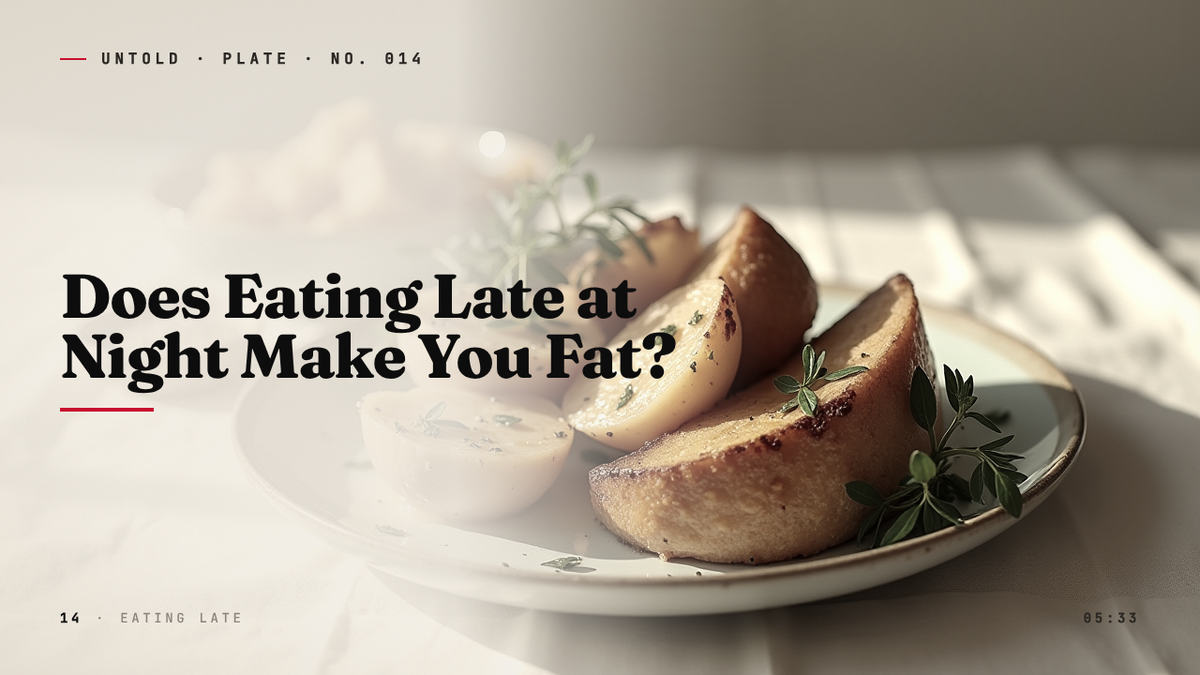
It is eleven o’clock at night. The house is quiet, the refrigerator hums its low industrial drone, and a plate of leftover pasta sits behind the door like a confession waiting to happen. A voice arrives, as it always does, with the authority of decades of magazine covers and gym-locker wisdom: this will go straight to your hips. Eat now, the voice insists, and you will pay for it.
The voice is partly right and almost entirely wrong, and the gap between those two facts contains one of the more interesting reversals in modern nutrition science. For most of the twentieth century, the question of when you ate was treated as superstition, a diet-culture fixation with no biological footing. A calorie consumed at noon and a calorie consumed at midnight were assumed to be identical units of energy, indistinguishable to the body that processed them. That assumption turns out to be incomplete. The truth, as it usually does, lives somewhere stranger than either the dieters or the skeptics imagined. Your body keeps time. And the timekeeping, it turns out, keeps score.
A calorie is not always a calorie
The orthodoxy was elegant in its simplicity. Weight was a ledger, energy in against energy out, and the only thing that mattered was the size of the entries. Eat fewer calories than you burn and you lose weight; eat more and you gain it. The hour on the clock was irrelevant accounting. For decades this was sound advice, and in the broad strokes it remains true. Nobody has overturned thermodynamics.
But beneath that ledger lies a more complicated machine. In the early 2000s a field began to coalesce around a question that earlier nutritionists had dismissed almost reflexively: does the timing of a meal change what the food actually does once it enters the body? The discipline acquired a name, chrono-nutrition, and with it a slow accumulation of evidence that the body is not a passive furnace burning fuel at a constant rate around the clock. It is a system that anticipates, that prepares, that opens and closes metabolic doors according to a schedule it sets for itself.
The first persuasive clues did not come from human dieters at all. They came from mice.
What the mice revealed
At the Salk Institute in California, the circadian biologist Satchidananda Panda ran an experiment in 2012 that was almost provocatively simple in its design 1. He took two groups of mice and fed them the same high-fat diet. Same food. Same composition. Crucially, same number of calories. He changed exactly one variable.
One group of mice was allowed to eat whenever it pleased, nibbling around the clock as mice tend to do. The second group could eat only within an eight-hour window each day; outside that window, the food was unavailable. Beyond the schedule, nothing distinguished the two groups. They consumed identical quantities of identical fuel.
The results refused to obey the calories-are-calories doctrine. The free-feeding mice grew obese. They developed fatty livers, high cholesterol, the rodent equivalent of type 2 diabetes: the full constellation of metabolic disease. The time-restricted mice, eating exactly the same food in exactly the same amount, stayed lean. Their livers were healthier, their cholesterol lower, their glucose handling intact. Two groups of animals, identical inputs, profoundly different bodies. The only thing that separated them was when they ate.
Panda’s experiment did not break the laws of energy balance. The time-restricted mice were not magically burning calories they had consumed. What the study illuminated was something physiologists had understood in principle but rarely connected to weight: the body runs on an internal clock, and feeding it off-schedule throws a wrench into machinery that was never designed to operate at all hours.
The clock inside your cells
The word circadian comes from the Latin circa diem, roughly a day, and most people associate it with sleep: the master clock in the brain that tells you to feel drowsy at night and alert in the morning. That clock, housed in a cluster of neurons called the suprachiasmatic nucleus, is real and important. But it is not the only one. It is closer to a conductor than a soloist.
Nearly every cell in the body keeps its own clock. Liver cells, fat cells, the cells lining the gut, the pancreas that secretes insulin: each runs on a roughly twenty-four-hour cycle of activity and rest, governed by a feedback loop of genes that switch on and off in sequence. These peripheral clocks are not abstractions. They physically alter what a cell does. The liver, for instance, gears up to process incoming nutrients at certain hours and winds down to perform repair and maintenance at others. The pancreas calibrates its insulin output to the time of day. Fat cells adjust their willingness to store or release energy.
When you eat in alignment with these clocks, the machinery hums. The liver is primed to handle the glucose; the pancreas releases insulin efficiently; the fuel is shuttled where it belongs. Eat off-schedule, however, and you ask organs to perform tasks they have already shut down for the night. The result is not catastrophe but friction, a metabolic inefficiency that, repeated day after day, accumulates into something visible on a scale and in a blood panel.
The insight was clarifying. The relevant clock was never the one on the kitchen wall. It was the one inside the liver, and the two do not always agree.
The Spanish dieters
Mice are mice, and the leap from a controlled rodent experiment to a complicated human life is considerable. People do not live in cages with timed food dispensers. So the question hung open: did any of this matter for actual humans trying to lose actual weight?
In 2013, Frank Scheer of Harvard Medical School, working with collaborators in Spain, produced one of the studies that turned the field from curiosity into something dietitians had to take seriously 2. Scheer followed 420 overweight adults enrolled in a twenty-week weight-loss program in the Spanish region of Murcia. All of them ate broadly similar diets, expended similar energy, and consumed similar calories. The researchers divided them not by what they ate but by when they ate their main meal of the day.
In Spanish culture, lunch is the largest meal, and it tends to fall in the early afternoon. Scheer split the participants into early eaters, who had their main meal before three in the afternoon, and late eaters, who sat down after three. On paper, a couple of hours should not matter. Calories are calories.
After twenty weeks, the early eaters had lost significantly more weight than the late eaters, roughly twenty-five percent more, despite eating the same number of calories, sleeping similar hours, and exercising comparably 2. The difference was not in the food. It was in the timing. And the late eaters did not simply lose less; they lost more slowly throughout the study, as though their bodies were quietly resisting the same effort that the early eaters’ bodies rewarded.
The Spanish study had the texture of real life rather than the sterility of a lab, which made it both messier and more convincing. Here were ordinary people, eating ordinary meals, and the only meaningful variable separating success from frustration was the position of the sun when they ate lunch.
Insulin after dark
To understand why, it helps to follow a single bowl of pasta on two different journeys: one eaten at eight in the morning, the other at eight at night.
The central character in both stories is insulin, the hormone the pancreas releases to escort glucose out of the bloodstream and into cells. In the morning, the body is metabolically awake. Insulin works efficiently; the sugar from breakfast leaves the blood quickly, ushered into muscle and liver where it is burned or stored as glycogen. The system is calibrated for incoming fuel.
At night, the picture changes. The body’s sensitivity to insulin declines as the evening wears on, by as much as a quarter compared with the morning, according to studies of circadian metabolism 3. The same bowl of pasta, eaten under the same conditions but at a different hour, produces a higher and more prolonged spike in blood sugar. The pancreas, working against the grain of its own clock, has to secrete more insulin to clear the glucose. And because elevated insulin is itself a signal to store rather than burn, fat cells become more willing to hold onto energy. The food is not different. The body receiving it is.
This is the mechanism that turns a vague cultural anxiety into a measurable physiological event. The midnight pasta does not carry extra calories. It arrives at an hour when the body is poorly equipped to deal with it, and it lingers in the bloodstream longer as a consequence.
When the scale does not move
The most intriguing evidence that timing matters independently of calories came from a study that produced almost no weight loss at all. In 2018, Courtney Peterson at the University of Alabama tested a regimen she called early time-restricted feeding on a group of men with prediabetes 4. The men ate all of their food within a six-hour window, finishing their last meal by three in the afternoon. Critically, the researchers fed them enough to maintain their weight: this was not a diet in the conventional sense. Nobody was meant to get thinner.
And nobody did. The scale held steady. Yet inside their bodies, the men were transformed. Their insulin sensitivity improved. Their blood pressure dropped, by a margin comparable to what a medication might achieve. Their oxidative stress declined. Even their appetite eased, their evening hunger blunted in a way that surprised the participants themselves 4. The benefits arrived without a single pound lost, which meant they could not be attributed to weight change. They came from the timing alone.
“Meal timing may be as important as meal content,” Peterson observed, a sentence that would have read as heresy to a nutritionist of an earlier generation 4. The study reframed the entire question. Late eating was not merely a path to weight gain. It was a metabolic stressor in its own right, one whose costs showed up in blood pressure and insulin long before they showed up on a bathroom scale.
There is a hormonal coda to all this. Leptin, the hormone fat cells release to signal fullness and satiety, also follows a daily rhythm. Eating at hours when leptin signaling is muted, deep in the biological night, appears to confuse the body’s sense of satisfaction, leaving appetite dysregulated not just for that evening but for days afterward. Late eating, in other words, can quietly recalibrate hunger itself, making the next late-night raid on the refrigerator feel more necessary than it is.
The mismatch, not the hour
Here the story performs its most important reversal, and it is worth stating plainly because the diet-culture version of this science has already begun to ossify into a new commandment: nothing after seven o’clock. That rule is a misreading.
The villain was never a fixed hour on the clock. It is the mismatch between when you eat and when your body expects to eat. Consider the night-shift nurse who has dinner at two in the morning. She is not committing a metabolic sin. If her sleep-wake cycle has genuinely shifted, if her biological day runs through the small hours, then a two a.m. meal may fall squarely within her body’s feeding window. Her clocks have moved, and her food has moved with them. The problem arises only when the two fall out of step: when food arrives during the hours her body has set aside for sleep and repair.
This is a subtle but liberating distinction. The relevant question is not what does the kitchen clock say? but where am I in my own biological day? For most people on a conventional schedule, those two readings roughly align, which is why the advice that emerges sounds, on the surface, like the old commandment. Finish eating two to three hours before bed. Push the bulk of your calories toward the morning and early afternoon, when your insulin works hardest and your liver is primed to receive fuel. Treat the evening as a wind-down for the metabolism as much as for the mind.
But the reasoning beneath the advice is entirely different, and the difference matters. The midnight snack is not evil. It carries no special moral weight, no extra calories, no inherent capacity to betray you. It is simply out of sync, a meal delivered to a body that has already begun to close up shop. Eaten occasionally, it is trivial. Eaten habitually, it becomes a small daily friction, a repeated demand that organs perform on a schedule they were not built to keep.
The science of chrono-nutrition is young, and honesty requires acknowledging its limits. Many of the human studies are small. Time-restricted eating is not a miracle, and for a great many people the simple discipline of an earlier eating window may matter less than the older, duller truths about overall diet quality and total energy. A person who eats well and moves regularly is unlikely to be undone by an occasional late dinner. The clock is a refinement, not a replacement, for the fundamentals.
Still, the refinement is real, and it restores a kind of dignity to a question that diet culture had reduced to guilt. The next time the refrigerator hums at midnight and the familiar voice arrives with its warning about your hips, the more useful thing to consult is not the magazine wisdom or the moral panic. It is the quieter machinery underneath: the liver winding down, the pancreas growing reluctant, the cells dimming their lights one by one. Listen to that, and the question answers itself. Not because the snack is wicked, but because the body, like the rest of the house at that hour, has already gone to sleep.

Sources
- Hatori, M. et al., “Time-restricted feeding without reducing caloric intake prevents metabolic diseases in mice fed a high-fat diet,” Cell Metabolism, 2012. — https://www.cell.com/cell-metabolism/fulltext/S1550-4131(12)00189-1
- Garaulet, M., Gomez-Abellan, P., Scheer, F. et al., “Timing of food intake predicts weight loss effectiveness,” International Journal of Obesity, 2013. — https://www.nature.com/articles/ijo2012229
- Morris, C. J., Scheer, F. et al., “Endogenous circadian system and circadian misalignment impact glucose tolerance,” PNAS, 2015. — https://www.pnas.org/doi/10.1073/pnas.1418955112
- Sutton, E. F., Peterson, C. M. et al., “Early Time-Restricted Feeding Improves Insulin Sensitivity, Blood Pressure, and Oxidative Stress Even without Weight Loss,” Cell Metabolism, 2018. — https://www.cell.com/cell-metabolism/fulltext/S1550-4131(18)30253-5
- Panda, S., “Circadian physiology of metabolism,” Science, 2016. — https://www.science.org/doi/10.1126/science.aah4967
- Scheer, F. A., Hilton, M. F., Mantzoros, C. S., Shea, S. A., “Adverse metabolic and cardiovascular consequences of circadian misalignment,” PNAS, 2009. — https://www.pnas.org/doi/10.1073/pnas.0808180106
Related reading