The Audience That Was Never There
How a yellow Barry Manilow t-shirt revealed the quiet vanity of being human.
In the autumn of 1996, in a nondescript psychology building at Cornell University, a graduate student stood in a corridor pulling a bright yellow t-shirt over his head. The shirt was large, unflattering, and featured a high-resolution photograph of the singer Barry Manilow. He paused. He took a breath. Then he walked into a room of strangers and tried to act normal.
The room contained four or five other students, all filling out questionnaires at small desks. The latecomer was instructed to sit down, fill out his own questionnaire, and leave after a few minutes. Once outside, he was asked a single question: how many of the people in that room, do you think, noticed your shirt?
His answer, like the answer of nearly every student who repeated the procedure, hovered around half. About fifty percent. He was certain of it. The shirt was so loud, so deliberately embarrassing, so impossible to ignore, that of course half the room had clocked it. The researchers thanked him and let him go.
Then they walked into the testing room and asked the other students. How many of you, just now, noticed that the late student was wearing a Barry Manilow t-shirt?
The answer, on average, was twenty-three percent. Roughly one in four. The wearers had imagined an audience twice the size of the one that actually existed 1.
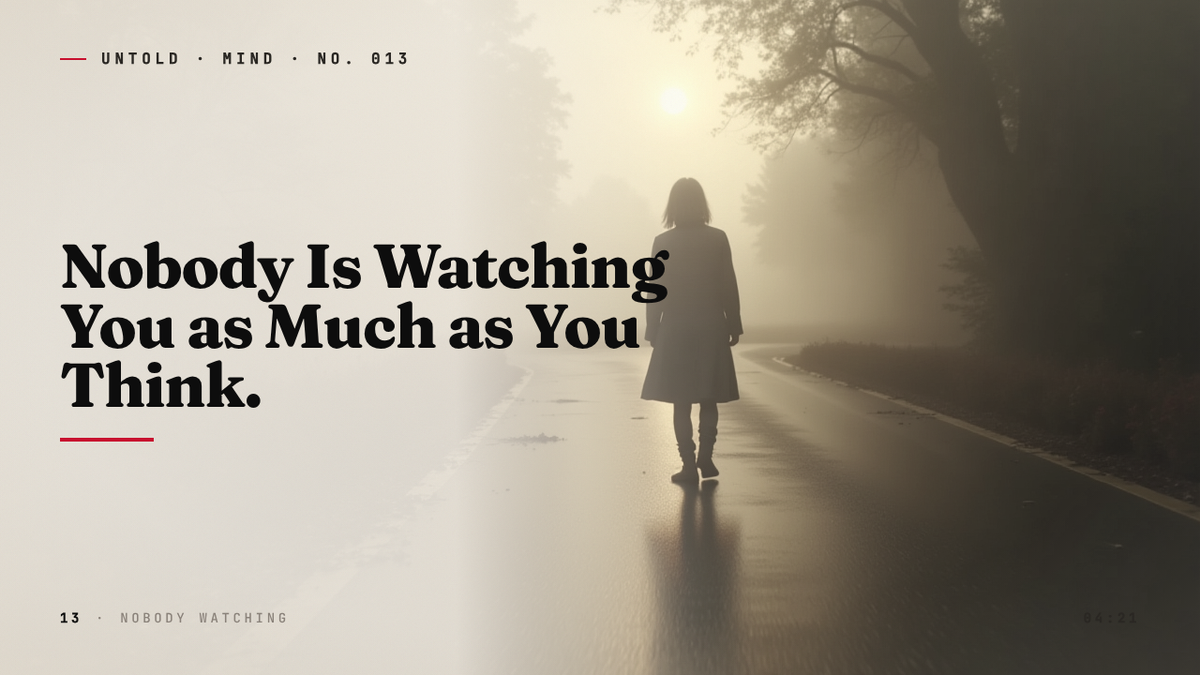
The man behind the experiment was Thomas Gilovich, a social psychologist who had been quietly building a case for something he suspected was one of the most common and least examined distortions in human life. He called it the spotlight effect. The name was almost too apt. We move through the world, Gilovich argued, under the persistent illusion that a beam of attention follows us everywhere, recording our stumbles and stains and verbal misfires for an audience that, in reality, has already turned away.
A Shirt, A Room, A Number
The Manilow study, published in the Journal of Personality and Social Psychology in 2000, was not Gilovich’s first attempt to put a number on private embarrassment. But it was the cleanest. The design had the virtue of being almost cartoonishly simple: a deliberately humiliating shirt, a room of distracted strangers, a single question asked twice.
What made the result striking was its consistency. Across multiple runs of the experiment, with different shirts and different humiliations (including ones featuring icons the students said they admired, such as Martin Luther King Jr. and Bob Marley), the same pattern held. People consistently believed they had been seen by roughly twice as many observers as had actually noticed them 1.
The gap, Gilovich pointed out, was not small. It was not a matter of being off by a few percentage points. The imagined audience was, on average, twice the real one. Half of the witnesses to your most embarrassing moment do not exist. They are extras you have hired in your own mind, paid in the currency of self-consciousness.
The finding was so robust that Gilovich began to suspect it was not really about shirts at all. It was about a more fundamental feature of how the human mind builds models of other minds. We start, always, from inside our own head. And we cannot quite get out.
The Anchor That Will Not Lift
The technical name for the mechanism Gilovich proposed is anchoring and adjustment. It is a cognitive shortcut that the psychologists Daniel Kahneman and Amos Tversky had identified decades earlier in entirely different contexts: people estimating how many African countries belong to the United Nations, or the year Mahatma Gandhi died 2. When asked to guess at something uncertain, the mind grabs the nearest available number, an anchor, and adjusts from there. The trouble is that the adjustment is almost always insufficient.
In the case of the spotlight effect, the anchor is your own experience of the moment. The shirt feels enormous on your back. The flush feels hot on your face. The fumbled sentence rings in your ears for the rest of the afternoon. From the inside, the event is vivid, detailed, surround-sound. So when you try to estimate how it looked to someone else, you start from that vividness and adjust downward. But you do not adjust enough. You cannot. You have no real access to how unremarkable the moment was from the other side of the room.
Gilovich and his collaborator Kenneth Savitsky tested this idea by running variations of the procedure. They had students recall recent embarrassing events from their own lives and estimate how many of the people present would remember the incident later. They asked students to play sports, sing songs, and contribute to group discussions, and then to predict how their performance would be ranked by others. In every condition, the pattern held. The actor inflated. The observer shrugged 3.
One of the more elegant follow-ups involved a video game. Students played a round of a then-popular video game, then estimated how their performance compared to that of others in the room. The participants who had done well overestimated how much credit they would receive. The participants who had done badly overestimated how much they would be judged. The spotlight, in other words, was not just about humiliation. It was about visibility itself. We assume we are being watched, whether the performance is good or bad.
The Skin We Think We Can See Through
If the spotlight effect concerns the outside, its close cousin concerns the inside. Gilovich gave it a name in 1998: the illusion of transparency 4. The idea is that we systematically overestimate the degree to which our internal states leak out through our facial expressions, our voice, our posture. We think our nerves are showing. We think our lies are written on our forehead. We think the bored thought we had during a meeting was somehow telegraphed across the table.
In one of the early studies, participants were asked to taste a series of drinks while being filmed. Some of the drinks were pleasant. Others had been doctored to taste foul. The participants were instructed to keep a neutral expression regardless of what was in the cup. Afterwards, the tasters watched the footage back and predicted how many observers would be able to identify which drinks had been disgusting.
The tasters guessed that roughly half of viewers would correctly identify the bad drinks. The actual figure, when independent observers watched the same footage, was closer to a quarter 4. The tasters were certain their revulsion had been visible. To everyone else, the face they had thought was screaming had looked perfectly composed.
The implications, Gilovich noted, extend well beyond grimaces in a lab. The illusion of transparency is the engine of much social anxiety. The person giving a presentation feels their heart pounding and assumes it is audible. The person telling a small lie feels their pulse quicken and assumes the listener can hear it. The person at the dinner party hiding boredom feels their face going slack and assumes it is being read. In each case, the inner storm is dramatic. The outer signal is not.
Researchers later applied the finding to public speaking, one of the most reliably terrifying activities in human life. Savitsky and Gilovich found that anxious speakers consistently rated their own performance as far more visibly nervous than audiences did. The trembling hands, the dry mouth, the catch in the voice that felt like a klaxon to the speaker were often invisible, or close to it, from a few rows back 5.
More interestingly, Savitsky and Gilovich discovered that simply explaining the illusion of transparency to anxious speakers improved their subsequent performance. Telling people that their nerves were not as visible as they feared seemed to short-circuit a feedback loop. The speakers became aware that they had been monitoring themselves on behalf of an audience that was not, in fact, monitoring them quite so closely. Once the imagined surveillance loosened, the actual performance improved.
The Network That Cannot Stop Thinking About You
Why is the mind built this way? Why do we walk around carrying an imagined audience that overstates its own attention by a factor of two? The answer, at least in part, lives in a part of the brain that was not properly mapped until the turn of this century.
In 2001, Marcus Raichle, a neurologist at Washington University in St. Louis, was sifting through brain imaging data when he noticed something odd. Certain regions of the brain consistently became more active when subjects were doing nothing in particular. The pattern lit up reliably during the intervals between tasks, when participants were simply lying in the scanner, waiting. Raichle and his colleagues gave the network a name: the default mode network 6.
The regions involved (the medial prefrontal cortex, the posterior cingulate cortex, parts of the parietal lobe) turned out to be heavily implicated in what neuroscientists call self-referential processing. When the mind has no external task, it does not go quiet. It turns inward. It thinks about itself. It rehearses past conversations, anticipates future ones, runs simulations of what other people might be thinking. It ruminates. It is, in a precise neurological sense, obsessed with the person whose skull it inhabits.
In 2010, the Harvard psychologists Matthew Killingsworth and Daniel Gilbert published a study in Science that used a smartphone app to sample people’s thoughts at random moments throughout the day. They found that adults spend roughly forty-seven percent of their waking hours thinking about something other than what they are currently doing. Almost half of conscious life, in other words, is spent mind-wandering, and most of that wandering is self-focused 7.
This is the quiet engine behind the spotlight effect. Each of us carries a brain that, given any spare second, returns to the subject of itself. And so does everyone else. Two strangers passing on a sidewalk are each, on average, half-absent from the encounter, lost inside their own internal monologue. Neither is watching the other with anything like the attention each one fears.
This is the strange asymmetry that makes the spotlight effect so durable. We know, intellectually, that other people are absorbed in their own lives. But we cannot feel it. Our own consciousness is the only one we have direct access to, and it is loud. Theirs, by inference, must be loud too, and presumably focused on us, because we are, after all, right here.
The Crowd Is Watching Itself
There is a quiet philosophical consequence to all of this, one that Gilovich, a careful scientist, has been hesitant to spell out in public. If everyone is overestimating the attention others pay to them by roughly a factor of two, then the whole social world is operating under a shared delusion. Each person is performing for an audience that is, at that very moment, performing for an audience of their own. The room is full of people convinced they are being watched, watching no one.
The sociologist Erving Goffman, writing in the 1950s, described social life as a theatre, with each of us managing impressions for an audience of others 8. Gilovich’s work refines the picture. The theatre is real. The audience is not. Or rather, the audience is composed entirely of other actors, each rehearsing their own lines, each convinced that the spotlight is on them.
This sounds, at first, like a lonely conclusion. If no one is watching, the argument seems to run, then no one cares. But that is not quite the lesson the research supports. The point is not that other people are indifferent to us. It is that their attention is divided, distracted, and largely turned inward, the same way ours is. They notice us in flashes. They forget what they noticed. They are kind, sometimes, and judgmental, sometimes, but mostly preoccupied. The version of them that lives in our head, the one taking meticulous notes on our every misstep, does not exist.
There is freedom in that. Gilovich has called it, in interviews, the freedom of being slightly invisible. The version we feared, in which every awkward moment was being photographed for posterity, was a fiction. The actual world is messier and kinder and more forgetful. The stain on your shirt is not a permanent mark on your reputation. It is a thing that no one quite registered, that will be gone from the few who did by lunchtime, that will not feature in any conversation that anyone has about you next week.
The Quiet Use of Invisibility
What does one do with this knowledge? The literature on the spotlight effect is unusually practical. Unlike some findings in social psychology, which can feel like party tricks, this one has a clear behavioural payoff. Once people understand that they are overestimating the attention paid to them, they often act differently.
The Savitsky study on public speaking is one example. Speakers who were briefed on the illusion of transparency performed better in subsequent talks, because they stopped trying to manage an internal state they had wrongly assumed was visible 5. Similar interventions have been tested in clinical settings for social anxiety, where the spotlight effect appears to be amplified into something pathological. Patients with social anxiety disorder do not merely overestimate the attention paid to them; they overestimate it dramatically, and they ruminate on it for hours or days afterward 9. Cognitive behavioural therapy for social anxiety often involves explicitly teaching patients about the spotlight effect and the illusion of transparency, as a way of loosening the grip of imagined observation.
For the rest of us, the application is gentler. The research does not suggest that we should become reckless about our self-presentation, or that other people are entirely unobservant. It suggests, instead, that the cost-benefit calculation we make about looking foolish is systematically miscalibrated. The cost we are imagining (the lingering judgment of a watching crowd) is twice the size of the cost that actually exists. The benefit we are forgoing (the question we did not ask, the dance we did not join, the conversation we did not start) is real and recoverable. The arithmetic has been wrong our whole lives.
Gilovich, asked once what he hoped people would take from his decades of work on the subject, gave a characteristically modest answer. He hoped, he said, that they would be a little less afraid. Not unafraid. Not bold. Just a little less convinced that the spotlight was on them.
There is an aphorism, often misattributed to Eleanor Roosevelt and probably belonging to no one in particular, that captures the same idea more memorably: you would worry less about what people think of you if you knew how seldom they do. The line predates the research by half a century. But Gilovich has, in effect, given it a number. The spotlight is on you about half as often as you feared. And the half that remains is dimmer than you imagined.
Walk into the room. Wear the shirt. Ask the question. The crowd is not watching you. The crowd, like you, is watching itself.
Sources
- Gilovich, T., Medvec, V. H., & Savitsky, K., “The spotlight effect in social judgment: An egocentric bias in estimates of the salience of one’s own actions and appearance,” Journal of Personality and Social Psychology, 2000. https://psycnet.apa.org/record/2000-13853-002
- Tversky, A., & Kahneman, D., “Judgment under Uncertainty: Heuristics and Biases,” Science, 1974. https://www.science.org/doi/10.1126/science.185.4157.1124
- Gilovich, T., & Savitsky, K., “The Spotlight Effect and the Illusion of Transparency: Egocentric Assessments of How We Are Seen by Others,” Current Directions in Psychological Science, 1999. https://journals.sagepub.com/doi/10.1111/1467-8721.00039
- Gilovich, T., Savitsky, K., & Medvec, V. H., “The illusion of transparency: Biased assessments of others’ ability to read one’s emotional states,” Journal of Personality and Social Psychology, 1998. https://psycnet.apa.org/record/1998-02892-002
- Savitsky, K., & Gilovich, T., “The illusion of transparency and the alleviation of speech anxiety,” Journal of Experimental Social Psychology, 2003. https://www.sciencedirect.com/science/article/abs/pii/S0022103103000564
- Raichle, M. E., et al., “A default mode of brain function,” Proceedings of the National Academy of Sciences, 2001. https://www.pnas.org/doi/10.1073/pnas.98.2.676
- Killingsworth, M. A., & Gilbert, D. T., “A Wandering Mind Is an Unhappy Mind,” Science, 2010. https://www.science.org/doi/10.1126/science.1192439
- Goffman, E., The Presentation of Self in Everyday Life, Anchor Books, 1959. https://www.penguinrandomhouse.com/books/167626/the-presentation-of-self-in-everyday-life-by-erving-goffman/
- Clark, D. M., & Wells, A., “A cognitive model of social phobia,” in Social Phobia: Diagnosis, Assessment, and Treatment, Guilford Press, 1995. https://psycnet.apa.org/record/1995-98641-004
Related reading