The Wartime Footnote That Built a Hydration Industry
How a single sentence from 1945 became the most repeated, least examined rule in modern wellness.
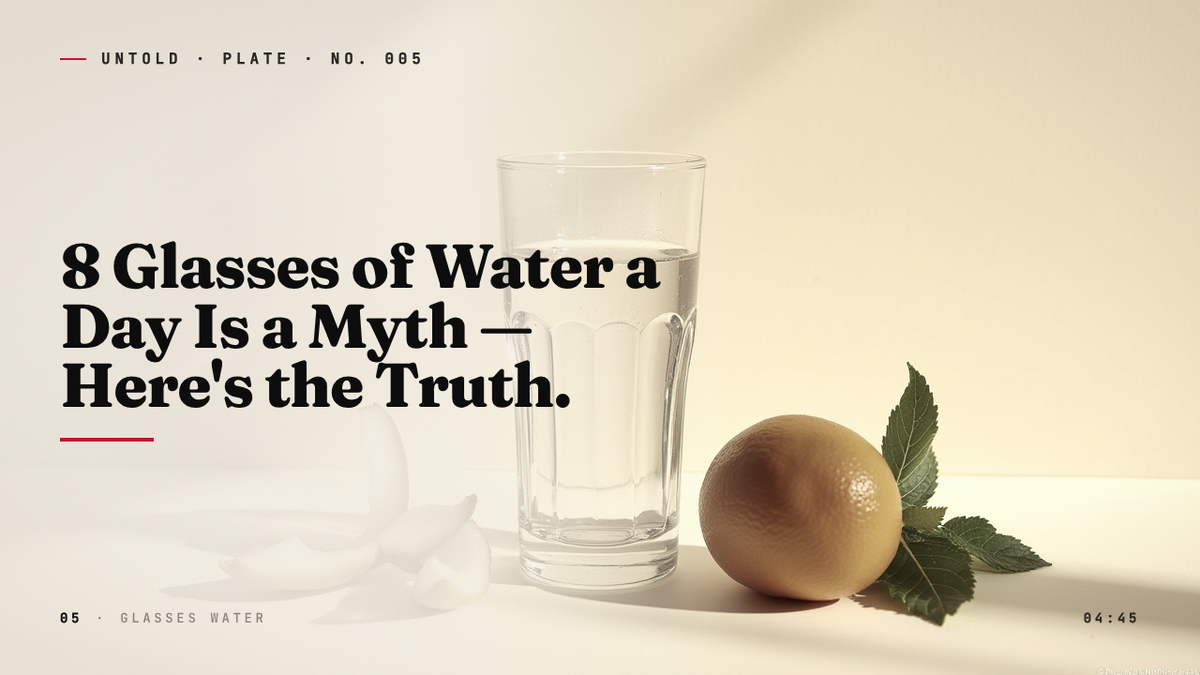
On any given morning in any given city, a particular ritual is underway. Someone is filling a 32-ounce bottle marked with hourly intervals: 7 a.m., 9 a.m., 11 a.m., a small motivational phrase floating near the bottom (“You’re almost there!”). Someone else is opening an app that buzzes politely every ninety minutes. A third person, halfway through a coffee, has just been told by a wellness influencer that the cup in their hand doesn’t count, may in fact be working against them, and should be “chased” with an equivalent volume of water.
All of this activity is in service of a number: eight glasses a day, roughly two liters, sometimes rounded up to a gallon by the more devout. The figure is so embedded in contemporary health folklore that it requires no source. It is simply known, in the way one knows that carrots are good for the eyes or that we use only ten percent of our brains. It appears in pediatricians’ offices and on the back of cereal boxes. It is repeated by yoga instructors, executive coaches, and morning television hosts. It has launched a global bottled-water market worth more than three hundred billion dollars annually 1.
There is, however, a small problem with the eight-glasses rule. No one can find the study behind it. Not because the study is obscure or hard to locate. Because, as a Dartmouth physiologist demonstrated more than two decades ago, it does not exist.
A Sentence Lost in Translation
The most plausible origin of the eight-glasses figure traces back to 1945, in the closing months of the Second World War. The United States Food and Nutrition Board, a subcommittee of the National Research Council, was tasked with publishing dietary recommendations for a country still on rationing. Their bulletin covered calories, protein, vitamins, and, almost as an afterthought, fluid intake. Tucked inside was the sentence that would launch a thousand wellness brands: “A suitable allowance of water for adults is 2.5 liters daily in most instances.” 2
Two and a half liters works out to roughly eight eight-ounce glasses. The math was clean. The phrasing was authoritative. And so, somewhere between the typewriter and the dinner table, the recommendation began its journey into common knowledge.
What almost no one noticed, then or since, was the sentence that followed. “An ordinary standard for diverse persons,” the bulletin continued, “is 1 milliliter for each calorie of food. Most of this quantity is contained in prepared foods.” 2
That second clause is doing extraordinary work. It says, in effect, that the 2.5-liter figure is not a drinking target at all. It is a total intake target, the sum of every fluid the body absorbs in a day, including the water bound up in oatmeal, in steamed vegetables, in soup and stew and a slice of bread. Subtract the food, and the actual volume to be sipped from a cup falls dramatically: closer to one liter, sometimes less, depending on what was on the plate.
The board did not invent a rule. They observed an average. The rule was invented later, by a chain of well-meaning misquotation, each link forgetting a little more of the original context until only the number remained.
The Doctor Who Went Looking
For more than half a century, no one in the medical establishment seems to have noticed the slippage. Then, in 2002, a kidney physiologist named Heinz Valtin decided to find the original evidence for the eight-glass rule.
Valtin was an unusual figure to undertake the task. He had spent his career at Dartmouth Medical School studying the physiology of water balance, written one of the standard textbooks on the subject, and was, by the time he turned to the question, formally retired. Retirement seems to have freed him to ask a question that practicing clinicians, busy and incurious, had not. Where exactly did this number come from?
He searched the medical databases. He worked backward from contemporary nutrition guidelines, tracing each citation to its source, and from those sources to their sources. He read decades of hydration research, from Cold War-era studies of soldiers in the desert to modern work on endurance athletes. He looked for any controlled trial that had tested whether healthy adults benefit from drinking eight glasses of water over and above what they consume in food and other beverages.
He found nothing. “Not only is there no scientific evidence that we need to drink that much,” he wrote in the American Journal of Physiology in 2002, “but the recommendation could be harmful, both in precipitating potentially dangerous hyponatremia and in inducing exposure to pollutants, and also in making many people feel guilty for not drinking enough.” 3
The paper was titled, with the dry exasperation of a senior scientist who has spent too long looking for a unicorn, “Drink at least eight glasses of water a day. Really? Is there scientific evidence for ‘8 x 8’?” The answer, after twenty pages of careful review, was no. There was none. The rule had never been tested because the rule had never been formally proposed in the first place. It had simply ossified into common knowledge by repetition.
Valtin’s paper attracted some attention in medical circles. It changed almost nothing about public behavior. The bottle industry kept growing. The apps kept buzzing.
What the Body Actually Wants
To understand why the eight-glasses rule is unnecessary, it helps to understand what is actually happening inside the body when it manages its water budget. The system is more sophisticated than most people imagine, and considerably older.
Deep in the hypothalamus, the small almond-shaped region at the base of the brain that governs much of the body’s involuntary housekeeping, sits a cluster of specialized neurons known as osmoreceptors. Their job is to monitor the concentration of sodium and other solutes in the blood. When that concentration rises by even a fraction of a percent, indicating that the body is losing water faster than it is taking it in, the neurons fire. Two things happen almost simultaneously. The pituitary gland releases vasopressin, a hormone that signals the kidneys to conserve water. And the brain generates the conscious sensation of thirst.
This system is fast, precise, and remarkably ancient. Charles Bourque, a neuroscientist at McGill University who has spent his career studying the circuitry of thirst, has described it as “one of the most exquisitely tuned regulatory systems in biology,” capable of detecting shifts in blood osmolality of around one percent and triggering behavioral correction within minutes 4. Variations of the same machinery exist in lizards, in fish, in mammals as small as shrews and as large as elephants. It has been keeping vertebrates alive for somewhere on the order of two hundred million years.
The implication is straightforward. A healthy adult human, possessed of a functioning hypothalamus and access to fluids, does not need to count glasses. The body counts. It has been counting since before language existed to describe the activity.
There is one important caveat. The thirst response weakens with age. By the time most people reach their seventies, the sensation arrives later and less insistently than it did at thirty, and older adults are genuinely more vulnerable to mild dehydration, particularly during heat waves or illness 5. Children, conversely, often forget to drink when absorbed in play. For most of the adult lifespan in between, the system is reliable to the point of being boring.
The Coffee That Counts
A companion myth, almost as durable as the eight-glasses rule, holds that coffee and tea do not count toward daily fluid intake. Worse, the folklore goes, caffeinated drinks are diuretics, actively pulling water out of the body, so each cup of coffee must be offset by a cup of water just to break even.
The claim has the appealing ring of complexity. It also turns out to be largely wrong.
Lawrence Armstrong, a hydration researcher at the University of Connecticut, spent years running controlled studies on caffeine and fluid balance. His lab measured blood, urine, and total body water in regular coffee drinkers consuming their habitual doses, then compared those measurements to the same subjects drinking only water. The results were unambiguous. Habitual coffee drinkers showed no significant net water loss attributable to caffeine. Their bodies had adapted; the mild diuretic effect that does occur in caffeine-naive subjects largely vanished with regular exposure 6.
A 2014 randomized trial published in PLOS ONE reached the same conclusion. Men who drank four cups of coffee a day showed no measurable difference in hydration status compared to men drinking the same volume of water 7. Coffee, in other words, hydrates. Tea hydrates. Milk hydrates, and is in fact one of the more efficient beverages for sustained rehydration after exercise, owing to its mix of water, electrolytes, and protein. Even beer, in modest quantities, contributes more water than it removes, though the calculus tips against you somewhere past the second pint.
The broader point is that the body does not distinguish between water arriving in a glass and water arriving via a bowl of soup or a slice of watermelon. Watermelon is roughly ninety-two percent water by weight. Cucumber is ninety-six percent. Lettuce, strawberries, yogurt, and most cooked grains carry substantial fluid loads. A person who eats a varied diet has already consumed a meaningful fraction of their daily water before they pick up their first glass.
The Industry Built on a Footnote
If the science is this settled, why does the eight-glasses rule persist? The answer is partly cultural inertia. Health folklore, once established, is notoriously hard to dislodge; the body of evidence required to overturn a piece of common knowledge tends to be much larger than the evidence required to establish it in the first place. But there is also a more straightforward economic explanation.
Bottled water is one of the most profitable consumer categories in the world. Global retail sales now exceed three hundred and fifty billion dollars annually, with growth rates that have outpaced soft drinks for over a decade 1. In the United States alone, Americans drink more bottled water by volume than any other packaged beverage. Each of those bottles depends, however indirectly, on a sense that ordinary tap consumption is insufficient, that hydration is a project requiring vigilance, equipment, and purchase.
The wellness industry has built a parallel economy around the same premise. Smart water bottles track ounces and sync to phones. Subscription services deliver electrolyte powders in sachets calibrated to morning, midday, and post-workout windows. Influencers post photographs of one-gallon jugs and credit them with clear skin, mental sharpness, weight loss, and the disappearance of headaches that may or may not have existed in the first place.
None of this is necessarily malicious. Some people genuinely feel better when they drink more water, and the placebo effect is, as always, real and powerful. But the architecture is striking. An entire commercial ecosystem, worth in the hundreds of billions, rests on a sentence written in 1945 by a wartime nutrition board, divorced from its qualifier and repeated until it became gospel.
The eight-glass rule is now one of the most successful pieces of unverified health advice in the modern era. It has outlived the war that produced it, the rationing system that contextualized it, and the careful researcher who tried, two decades ago, to set the record straight.
The Hidden Risk on the Other Side
There is a final wrinkle, and it is the one Valtin worried about most. The standard assumption, both in popular health writing and in casual conversation, is that the risks of hydration are asymmetric. You can drink too little water and suffer; you cannot really drink too much. Excess simply passes through. This is not true.
The condition is called hyponatremia, and it occurs when blood sodium concentration falls below a critical threshold, usually because the body has been flooded with more water than the kidneys can process. Symptoms begin with nausea, headache, and confusion. In severe cases, fluid moves into brain cells, which swell against the rigid container of the skull. Seizures follow. Sometimes coma. Occasionally death.
The condition is rare in ordinary life, but it is not theoretical. It has killed marathon runners who drank too aggressively during races, fraternity pledges forced to consume water as a hazing ritual, and at least one woman who participated in a 2007 radio contest in California that promised a Nintendo Wii to whichever caller could drink the most water without urinating 8. The contest was called, with grim aptness in retrospect, “Hold Your Wee for a Wii.”
The broader epidemiological picture is harder to pin down because mild cases often go undiagnosed, presenting as a vague malaise the patient and physician both attribute to other causes. But endurance medicine has taken the threat seriously enough that race organizers now actively warn runners against drinking by schedule rather than by thirst, reversing decades of advice that pushed athletes to “stay ahead” of dehydration. The current guidance, distilled from a generation of sports medicine research, is almost embarrassingly simple. Drink when you are thirsty.
A Quieter Rule
So what should a thoughtful person actually do?
The answer, stripped of marketing and folklore, fits on a postcard. Drink when you are thirsty. Stop when you are not. If you are curious about your hydration status, glance at the color of your urine; pale straw indicates that the kidneys have water to spare. Dark amber suggests they are conserving and you should probably drink something. On hot days, during sustained exercise, during a fever or stomach illness, the body’s losses increase and the thirst signal will follow. Trust it.
This advice is unsatisfying because it lacks the geometry of a rule. There is no number to track, no app to install, no bottle to buy. It asks the drinker to attend to a signal rather than to obey a target. In a culture that has spent a century outsourcing bodily self-knowledge to scales, step counters, calorie trackers, and sleep apps, the suggestion that you might already know what your kidneys want feels almost transgressive.
It is also, as far as the evidence allows us to say, correct. The body did not wait for the National Research Council to begin managing its water budget. It has been at the job for two hundred million years, refining the machinery through every drought and feast and migration, every fever and every long swim. Eight glasses was a number lifted from a footnote, stripped of its qualifier, and sold back to the population that already had a working system in place.
The next time you find yourself drinking a glass of water because an app has buzzed, or because the bottle has a line on it indicating you are behind schedule, it is worth pausing for a moment to ask the older question. Are you thirsty? If yes, drink. If no, the wartime footnote can wait.
The hypothalamus already knows what it is doing.
Sources
- Statista, Bottled Water Market Worldwide, 2023. — https://www.statista.com/outlook/cmo/non-alcoholic-drinks/water/bottled-water/worldwide
- National Research Council, Recommended Dietary Allowances, Reprint and Circular Series No. 122, 1945. — https://www.nap.edu/catalog/13286/recommended-dietary-allowances
- Heinz Valtin, ‘“Drink at least eight glasses of water a day.” Really? Is there scientific evidence for ‘8 x 8’?’, American Journal of Physiology, 2002. — https://journals.physiology.org/doi/full/10.1152/ajpregu.00365.2002
- Charles Bourque, ‘Central mechanisms of osmosensation and systemic osmoregulation’, Nature Reviews Neuroscience, 2008. — https://www.nature.com/articles/nrn2400
- Phillips PA et al., ‘Reduced thirst after water deprivation in healthy elderly men’, New England Journal of Medicine, 1984. — https://www.nejm.org/doi/full/10.1056/NEJM198403153101101
- Armstrong LE et al., ‘Caffeine, fluid-electrolyte balance, temperature regulation, and exercise-heat tolerance’, Exercise and Sport Sciences Reviews, 2007. — https://journals.lww.com/acsm-essr/Fulltext/2007/07000/Caffeine,_Fluid_Electrolyte_Balance,_Temperature.7.aspx
- Killer SC, Blannin AK, Jeukendrup AE, ‘No Evidence of Dehydration with Moderate Daily Coffee Intake’, PLOS ONE, 2014. — https://journals.plos.org/plosone/article?id=10.1371/journal.pone.0084154
- Associated Press, ‘Woman dies after water-drinking contest’, NBC News, 2007. — https://www.nbcnews.com/id/wbna16614865
Related reading