The Sound of Someone Else Eating
Why a soft chewing noise can feel like a physical assault, and what the brain is really doing.
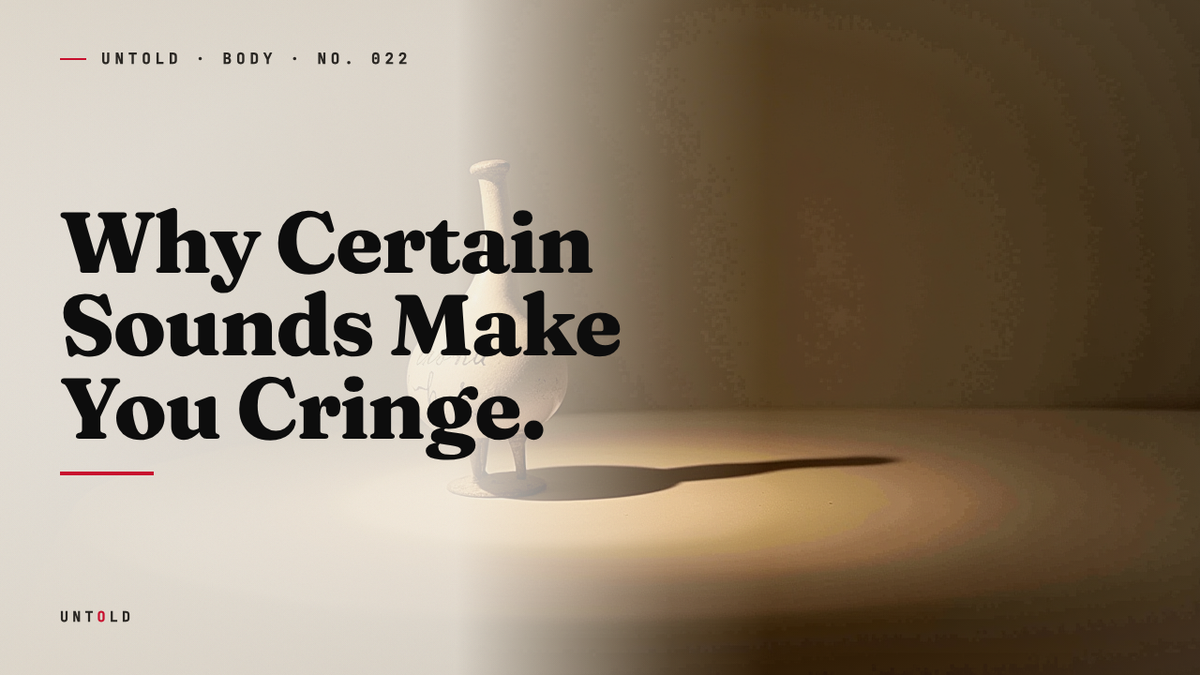
Picture a quiet kitchen at the end of an ordinary evening. A bowl of cereal, a spoon, someone you love sitting across the table. The scene is the very image of domestic calm. And yet for a particular kind of listener, this is not calm at all. It is closer to an ambush. The sound of the spoon scraping the bowl, the wet rhythm of chewing, the small percussion of a jaw working through food: these arrive not as background noise but as something invasive, something that floods the body with a heat that has no obvious name.
The reaction is immediate and physical. The heart accelerates. The shoulders tighten. The hands curl. A wave of irritation rises so fast it overruns thought, and behind it comes a strange and bitter aftertaste of guilt, because the person making the sound has done nothing wrong. They are eating. That is all. And yet the listener wants, with an intensity that frightens them, for the sound to simply stop.
For most of medical history, people who described this experience were not believed, or were quietly told they were difficult. They were advised to relax, to develop patience, to stop letting small things bother them. The advice missed the point entirely, because the reaction was never a matter of patience. It was a matter of wiring. The condition now has a name, a small but growing body of research, and as of recently, official recognition as a genuine disorder. It is called misophonia, from the Greek for the hatred of sound.
A word invented for an experience no one could explain
The term was coined in 2001 by two American audiologists, Pawel Jastreboff and his wife and collaborator Margaret Jastreboff, who had spent years working with patients troubled by their ears 1. Many of these patients did not have a typical hearing complaint. They were not bothered by volume. What undid them was something quieter and more specific: certain ordinary sounds, often produced by other human beings, that provoked a response wildly out of proportion to the noise itself.
The Jastreboffs needed language for it, and the existing vocabulary did not fit. This was not hyperacusis, the condition in which sounds are physically painful because they are simply too loud. Nor was it phonophobia, a fear of sound in the general sense. The patients were reacting to particular sounds with a particular emotional charge, and the charge was not fear so much as something hotter and more aggressive. The Jastreboffs settled on misophonia. It was an honest name. These people did not fear the sounds. They hated them.
The triggers tended to cluster around a recognizable set. Chewing was almost universal. So were breathing, sniffing, throat-clearing, lip-smacking, the click of a pen, the tap of a fingernail, the percussion of typing. What united them was not loudness. It was the opposite. These are soft sounds, repetitive sounds, and above all human sounds, the small involuntary noises that bodies make simply by existing in a room. A jackhammer outside the window rarely triggered anyone. A partner softly working through a bag of crisps could end a marriage.
For years the medical response was skepticism. Without a clear physical lesion or a recognizable diagnostic category, the complaint sat in an uncomfortable space, neither fully psychological nor obviously neurological. Patients were sent home. Some came to believe the problem really was a character flaw, some moral failure of temperament. But the reaction was too uniform across strangers, and too bodily, to be a simple failure of manners. People who had never met one another described the same racing pulse, the same clenched jaw, the same sudden flood of rage followed by shame. Something consistent was happening, and it was not happening by choice.
What the scanner found
The first real evidence arrived in 2017, when a team in Britain led by the neuroscientist Sukhbinder Kumar set out to look directly at what was occurring inside the misophonic brain 2. The approach was straightforward in concept. Place people with misophonia inside a functional MRI scanner, place a control group of people without it inside the same scanner, and play all of them three categories of sound: neutral noises like rain, broadly unpleasant noises like a baby crying or a person screaming, and the specific personal trigger sounds that misophonic listeners dread.
For the neutral and the conventionally unpleasant sounds, the two groups looked essentially the same. Everybody dislikes a screaming infant, and everybody’s brain handled it in roughly the expected way. The difference appeared only with the trigger sounds, and when it appeared, it was dramatic. In misophonic listeners, the trigger sounds produced a surge of activity in a brain region called the anterior insula.
The insula is not a region most people have heard of, but it does quiet and essential work. It is a hub for interoception, the sense of the body’s internal state, and it acts as a kind of salience detector, flagging which of the thousands of signals reaching the brain at any moment actually deserve attention. The insula is what tells you that a particular sensation matters urgently, that something inside or around you requires a response right now. In the misophonic brain, a trigger sound flipped this switch hard. A spoon against a bowl was being tagged, in effect, as a genuine emergency.
Kumar’s team found that the overactive insula was not firing in isolation. It was overconnected to the rest of the emotional brain, talking too loudly to the regions that govern fear, memory, and the body’s response to threat 2. A network designed to handle danger was being recruited by a chewing sound. The salience detector said this matters, and the threat machinery answered as if a predator were in the room. The result, lived from the inside, was the familiar cascade: the quickened heart, the tightened muscles, the surge of something that felt like the beginning of a fight.
This reframed the whole problem. Misophonia was not a disorder of the ears. The ears worked fine, conducting sound to the brain exactly as they should. The trouble lay further in, in the way the brain assigned meaning to what the ears delivered. It was a problem of interpretation, of a network deciding that an ordinary sound carried an extraordinary stakes.
The brain that mimics what it hates
Four years later, a second clue emerged, stranger and in some ways more illuminating than the first. In 2021, a team including the researcher Phillip Gander, working with collaborators at Newcastle and Iowa, mapped how the misophonic brain processed trigger sounds in finer detail 3. They were not only interested in the emotional response. They wanted to understand the mechanics of how the sound was handled in the first place, and they found something no one had predicted.
There was a bridge, unusually strong in misophonic listeners, between the brain’s auditory system and the motor cortex, specifically the orofacial region that controls the muscles of the mouth, jaw, and throat. When a misophonic person heard someone else chewing, the part of their own brain that controls chewing lit up. Hearing the sound of a mouth activated the listener’s own mouth, at the level of neural command if not visible movement.
This suggested a profound shift in how to understand the condition. The leading interpretation became that misophonia may be less about sound as such and more about a kind of mirrored intrusion. The mirror system, a network that activates when we watch or hear others perform actions and which underlies much of how we read and empathize with other bodies, appeared to be overengaged. The misophonic listener was not simply hearing another person chew. At some neural level they were involuntarily enacting the chewing themselves, their own orofacial muscles drawn into the rhythm of someone else’s jaw.
If that is true, then the rage starts to make a darker kind of sense. The unbearable thing is not the acoustic signal arriving at the eardrum. It is the sensation of another person’s body intruding into one’s own, of being made to mirror an action one did not choose and cannot escape. The brain experiences a small loss of bodily sovereignty, a foreign rhythm forced into the self, and it responds the way bodies respond to intrusion: with the impulse to repel.
The pattern of who triggers whom fits this reading. Misophonia is most often set off by the people we live closest to. The parent across the dinner table, the sibling breathing in the next bed, the partner chewing gum in the passenger seat. Studies suggest the condition frequently begins in childhood, often somewhere between the ages of roughly nine and twelve, and that the trigger person is commonly a family member 4. The closer the relationship, paradoxically, the sharper the reaction can become. The people whose bodies we share the most space with are the ones whose involuntary sounds most reliably breach the wall.
A connection problem, finally named
What all of this amounts to is a quiet correction of the original assumption. Misophonia is not a hearing problem. The auditory apparatus is intact. It is, more precisely, a connection problem, a matter of how brain regions that should remain calmly separate have instead become wired into one another too tightly. Sound feeds into emotion feeds into threat feeds into the muscles of the face, and the loop runs hot. The ears report accurately. It is the brain’s internal traffic that has gone wrong.
That distinction is not merely academic. It carries the difference between blame and understanding. If the problem were impatience, then the obvious response would be to demand more patience. But you cannot will an overconnected insula to quiet down any more than you can will yourself to stop flinching at a sudden touch. The reaction is generated below the level of deliberate control, by circuitry doing what it has been wired to do, even though the conclusion it reaches is wrong.
In 2022, after two decades of slow accumulation of evidence, a panel of experts published a consensus definition of misophonia, formally describing it as a disorder of decreased tolerance to specific sounds 5. The recognition matters. It moves the experience out of the territory of personal failing and into the territory of legitimate clinical attention, where it can be studied, named to a patient without judgment, and approached with something better than the old advice to simply toughen up.
Living alongside the storm
There is, as yet, no cure. No drug switches off the overconnected loop, and no procedure rewires the bridge between hearing and emotion. But understanding the mechanism has already changed the way the condition is treated, and that change is meaningful. If misophonia is a misfiring threat response rather than a problem of the ears, then the goal of treatment is not to alter what the person hears but to lower the intensity of the alarm the sound sets off.
The approaches that show promise reflect this logic. Sound enrichment, the use of gentle background noise to soften the prominence of triggers, can reduce how sharply a trigger cuts through. Cognitive and behavioral counseling can help loosen the automatic link between a sound and the surge of threat, teaching the nervous system, slowly, that the spoon is not in fact an emergency. Reframing the experience, understanding it as ancient wiring misreading a signal rather than as a personal defect, can itself lower the storm, because much of misophonia’s suffering comes wrapped in the shame of believing one is simply broken or cruel.
There is something worth saying plainly to anyone who lives this from the inside. The reaction is not drama, and it is not a moral failure. It is a measurable difference in how a particular brain assigns meaning to sound, and it is shared by a great many people who have suffered it quietly for years without a name for it. And to those on the other side, the ones whose ordinary breathing or chewing sets off a person they love, the rage is not really aimed at them. It is the brain mistaking dinner for danger, an old alarm system firing at the wrong target.
That, in the end, is the strange tenderness buried in the science. The fury that feels so personal, so much like contempt, is nothing of the kind. It is a body defending itself against an intrusion that was never an intrusion, a 500-million-year-old threat response activated by the soft, involuntary noise of someone simply being alive in the same room. The next time a small sound fills a person with an outsized fury, the most accurate thing they can do is pause and recognize it for what it is. Not hatred. Not weakness. A signal, misread.

Sources
- Jastreboff, P. J. and Jastreboff, M. M., Components of decreased sound tolerance: hyperacusis, misophonia, phonophobia, ITHS Newsletter, 2001. — https://www.tinnitus.org/MISOPHONIA_PHONOPHOBIA_2001.pdf
- Kumar, S. et al., The Brain Basis for Misophonia, Current Biology, 2017. — https://www.cell.com/current-biology/fulltext/S0960-9822(16)31530-2
- Kumar, S., Gander, P. E. et al., The motor basis for misophonia, Journal of Neuroscience, 2021. — https://www.jneurosci.org/content/41/26/5762
- Rouw, R. and Erfanian, M., A Large-Scale Study of Misophonia, Journal of Clinical Psychology, 2018. — https://onlinelibrary.wiley.com/doi/10.1002/jclp.22500
- Swedo, S. E. et al., Consensus Definition of Misophonia: A Delphi Study, Frontiers in Neuroscience, 2022. — https://www.frontiersin.org/articles/10.3389/fnins.2022.841816/full
- Brout, J. J. et al., Investigating Misophonia: A Review of the Empirical Literature, Frontiers in Neuroscience, 2018. — https://www.frontiersin.org/articles/10.3389/fnins.2018.00036/full
Related reading