The Quiet Sweetening of the Western Diet
Sugar in bread was never about taste. It was about profit, chemistry, and a decades-long mistake.
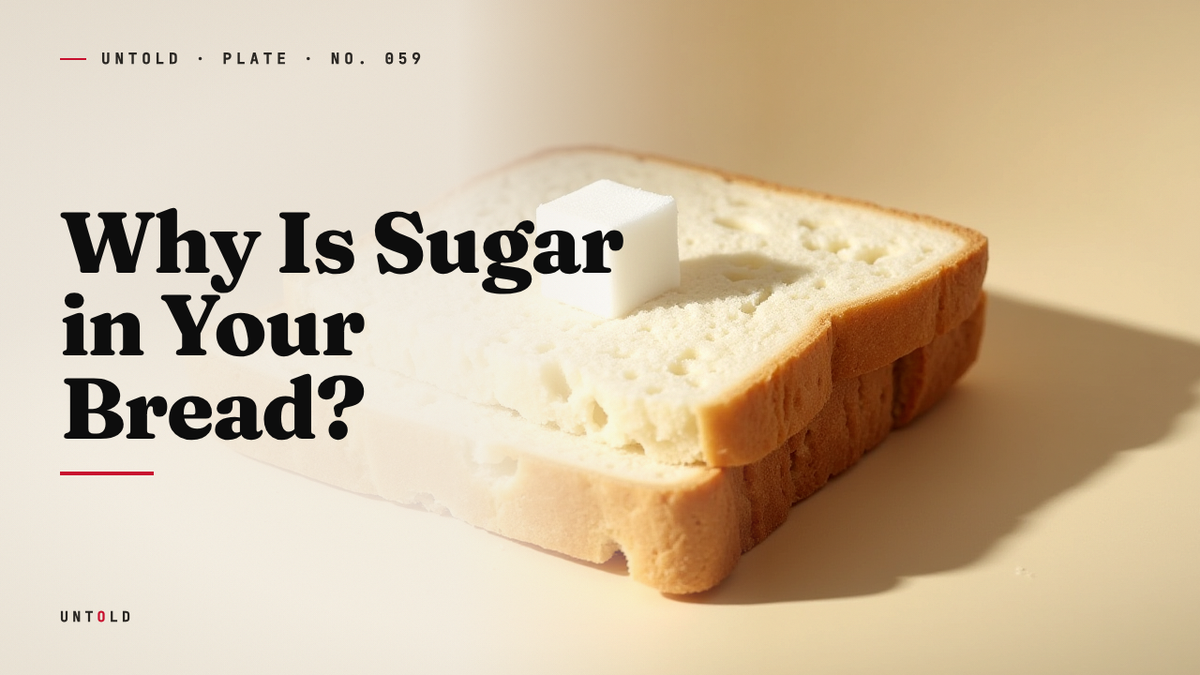
Pull the loaf out of the drawer and read the fine print. Somewhere on that ingredient list, usually two or three items down, sits sugar. It might be called dextrose, or cane crystals, or barley malt, or simply sugar, but it is there. This is not a fluke of one careless brand. Roughly three-quarters of the packaged foods on an American supermarket shelf contain added sugar 1. It is in the ketchup and the crackers, the pasta sauce and the salted peanuts, the deli turkey and the whole-grain toast marketed as the responsible choice.
Bread is the strange one. A loaf does not need sugar to be bread. Flour, water, salt, and yeast will produce something perfectly edible, as bakers proved for several thousand years before anyone thought to sweeten the dough. So the sugar in your sandwich is not an accident and it is not, for the most part, there to make the bread taste sweet. It is there for reasons that have almost nothing to do with pleasure and almost everything to do with the way food became an industry.
The short version is that sugar turned out to be the most useful cheap tool a factory ever found. It preserves. It browns. It feeds yeast. It hides in plain sight under dozens of names. And at some point in the twentieth century it stopped being an ingredient and became a strategy. To understand how a substance once rarer than gold ended up in your morning toast, you have to follow three threads at once: money, science, and a public health mistake that reshaped the entire grocery store.
From luxury to landfill-cheap
For most of recorded history, sugar was a spice, and an expensive one. In medieval Europe, refined sugar was a pharmacist’s item, sold by weight and reserved for the tables of the very rich. A spoonful could cost a laborer more than he earned in a day. It was so precious that it functioned as a status symbol, sculpted into elaborate centerpieces at banquets meant to display wealth rather than to be eaten.
What changed was not taste but geography, and it changed through violence. The plantation economies of the Caribbean and the Americas, built on enslaved labor, turned sugar from a rarity into a commodity. Cane was crushed, boiled, and shipped north in ever-greater volumes, and prices collapsed. What had been medicine for kings became a staple for the working poor, dissolved into tea and spread across bread. By 1900 the average American was eating something on the order of forty pounds of sugar a year, a quantity that would have seemed obscene to a person living two centuries earlier 2.
The flood of cheap sugar coincided with the rise of industrial food manufacturing, and factory chemists noticed something their medieval predecessors never had the volume to exploit. Sugar was not merely sweet. It was a preservative, binding water so that mold and bacteria struggled to grow. It caramelized under heat, giving baked goods their golden crust through the browning reactions that make crust smell like crust. And in bread specifically, a small dose of sugar gave the yeast a head start, speeding fermentation and producing a softer, more uniform loaf that stayed fresh longer on a shelf and traveled better in a truck.
For a business selling millions of identical loaves, every one of those properties translated into money. Longer shelf life meant less waste. Faster fermentation meant faster production. A softer crumb meant a product that felt fresh even days after baking. Sugar was, in effect, a cheap technology that solved several problems at once. That alone would have secured its place in the modern loaf. But the twentieth century was not finished with sugar. It was about to make it central.
The man who found the bliss point
In the early 1970s, the food industry hired a Harvard-trained experimental psychologist named Howard Moskowitz to answer a question that sounds almost naive: exactly how sweet should a product be? Not sweet enough to sell, or sweet enough to be popular, but the precise, mathematically optimal amount of sweetness that a human tongue would find maximally pleasurable.
Moskowitz was a psychophysicist, a specialist in the measurable relationship between a physical stimulus and the sensation it produces. He approached sweetness the way an engineer approaches a load-bearing beam. He would take a product, say a soda or a spaghetti sauce, and manufacture dozens of variations, each with a slightly different level of sugar, and have test subjects rate them. Plotted on a graph, the ratings did not climb forever. Too little sugar and people found the product bland. Too much and they found it cloying, sickly, unpleasant. Somewhere in between was a peak, a single optimal dose where pleasure was highest. Moskowitz called it the bliss point 3.
He would test up to sixty formulations to locate that peak for a single product, and once he found it, the manufacturer could tune the recipe to sit exactly on top of it. This was not marketing intuition. It was optimization, the deliberate engineering of a food to be as compelling as the human reward system would allow. Moskowitz was fond of pointing out that there was no such thing as the perfect product, only perfect products, meaning that different populations had different bliss points and a clever company could hit all of them.
The implications rippled outward across the grocery store. If you could calculate the exact dose of sweetness that made a product irresistible, why would you sell anything less? Sodas, sauces, cereals, dressings, and yes, breads were all quietly tuned toward their bliss points. The sugar was no longer just a preservative or a yeast feed. It was a lever on human desire, calibrated with laboratory precision. And crucially, hitting the bliss point in a savory product like bread or pasta sauce did not require the food to taste sweet. It only required enough sugar to make the whole thing more compelling than the version without.
The war on fat and the sugar that filled the gap
The second great force pushing sugar into everything was, ironically, a campaign to make people healthier. Beginning in the late 1970s and accelerating through the 1980s, public health authorities in the United States and Britain identified dietary fat, and saturated fat in particular, as the chief villain behind rising rates of heart disease. The advice was blunt: eat less fat. Manufacturers heard it as a marketing opportunity.
Across thousands of products, fat was stripped out and the words low-fat or fat-free were stamped on the front of the package. The problem was that fat does an enormous amount of work in food. It carries flavor, it provides a rich mouthfeel, it makes things taste like something. Remove it and you are left with a product that tastes flat, thin, and vaguely of cardboard. Consumers noticed, and they did not buy it twice.
So the industry reached for the cheapest available fix. To replace the flavor and body that fat had provided, they added sugar. A low-fat yogurt that would otherwise taste sour and thin could be rescued with several spoonfuls of sweetener. The result was a genuinely bizarre inversion of the health message: some low-fat and fat-free products ended up carrying as much or more sugar than the full-fat versions they were meant to improve upon, and in a few cases a cup of flavored low-fat yogurt could rival ice cream for sugar content. The label promised virtue. The recipe delivered the opposite.
There had been a warning. In 1972, the British physiologist John Yudkin published a book with the memorable title Pure, White and Deadly, arguing that it was sugar, not fat, that was driving the epidemic of heart disease and metabolic illness in wealthy nations 4. Yudkin was not a crank. He founded the department of nutrition at the University of London and had spent years studying the metabolic effects of dietary sugar. He argued that if only a fraction of what was known about sugar’s effects were known about some other food additive, that additive would be swiftly banned.
Yudkin’s thesis ran directly against the fat hypothesis championed by the American physiologist Ancel Keys, whose influence over nutrition policy was immense. What followed was not a fair scientific debate so much as a rout. Yudkin was ridiculed, his work marginalized, his conclusions dismissed as alarmist. The sugar industry, for its part, was quietly funding research that steered blame away from sucrose. Documents unearthed decades later revealed that a sugar trade group had in the 1960s paid Harvard scientists to publish a review minimizing sugar’s role in heart disease and emphasizing fat instead 5. Yudkin’s book went out of print. His reputation faded. It would take roughly forty years for researchers to dust off his arguments and conclude that he had, in the essentials, been right.
A cheaper sweetness and sixty different names
While the war on fat was reshaping what went into food, a piece of industrial chemistry was reshaping what the sweetener itself was made of. In the late 1950s, chemists worked out how to convert the glucose in cornstarch into fructose, producing a syrup that was as sweet as cane sugar but derived from corn. By 1971, Japanese researchers had refined the enzymatic process enough to make it commercially viable at scale, and high-fructose corn syrup was born 6.
The appeal was almost entirely economic. In the United States, corn was abundant and heavily subsidized, while imported cane sugar was kept expensive by tariffs and quotas. The result was that corn syrup could cost a fraction of cane sugar, by some estimates dramatically cheaper per unit of sweetness. For a manufacturer, this meant that adding sweetness to a product cost almost nothing. When an ingredient becomes nearly free, the incentive to use it everywhere becomes nearly irresistible.
And so it went everywhere. Into soft drinks, obviously, where it largely replaced cane sugar in the American market. But also into bread, hamburger buns, canned soups, salad dressings, breakfast cereals, and cured deli meats, products where no one was asking for sweetness but where a cheap dose of it improved shelf life, texture, or bliss-point appeal. The sweetening of the food supply accelerated precisely because the sweetener had become so cheap that using it was the path of least resistance.
This created a labeling problem for the industry, one it solved with characteristic ingenuity. Regulations required ingredients to be listed in descending order by weight. If a product contained a large amount of a single sweetener, that sweetener would appear near the top of the list, advertising itself to anyone who read the label. The workaround was to split the sweetness across several different sugars. Sugar hides on ingredient lists under at least sixty distinct names: dextrose, maltose, sucrose, fructose, fruit juice concentrate, barley malt, corn syrup solids, cane crystals, evaporated cane juice, and so on. By using three or four of them instead of one, a manufacturer could ensure that no single sweetener carried enough weight to climb to the top of the list, even though the combined total might be substantial.
The average loaf of white bread can carry roughly a teaspoon of sugar across the whole loaf, distributed so cleverly that it registers only as a faint background sweetness, if it registers at all 1. This is the point. The sugar in bread was never meant to announce itself. It works quietly, doing its several jobs, while the label offers just enough plausible deniability to keep the shopper from noticing.
The product was never the sugar
Here is where the story turns, because the deepest reason sugar is in everything is not preservation or texture or even cheapness. Those are the mechanics. The strategy underneath them is that sugar sells the one thing every food company most wants to sell: the desire to buy the product again.
Sugar acts on the brain’s reward circuitry, triggering the release of dopamine in the same pathways engaged by other pleasurable and habit-forming stimuli. This is not a metaphor. In rodent studies, intermittent access to sugar produces behavioral and neurochemical signs that researchers have compared to dependence, including bingeing, tolerance, and signs of withdrawal, alongside measurable changes in dopamine signaling 7. Whether sugar meets the strict clinical definition of an addictive substance in humans remains genuinely contested among scientists. But the direction of the effect is not in doubt. Sweetness reliably activates reward, and reward reliably reinforces the behavior that produced it.
This is the mechanism behind the ordinary experience of finding that one cookie has somehow become an empty sleeve. The first bite delivers a reward, the reward reinforces the reaching, and the product is engineered to sit at exactly the point of maximal pleasure that keeps the loop running. From a manufacturer’s perspective, a food that people merely enjoy is far less valuable than a food that people crave. Sugar is the cheapest, most reliable route from the first to the second.
Which reframes the whole question. Bread does not contain sugar because bread needs to be sweet. It contains sugar because a product that gently pulls the eater back for another slice is worth more than a product that does not, and because sugar is the most efficient tool ever discovered for building that pull. The sweetener in the loaf is not there to please your tongue. It is there to shape your habit.
Reading the label as an act of resistance
The institutions charged with public health have, belatedly, caught up with Yudkin. The World Health Organization now recommends that adults keep added sugar below ten percent of daily calories, and suggests that dropping below five percent would bring additional benefit 8. For a typical adult that lower threshold amounts to roughly six teaspoons a day, a figure easily exceeded before lunch by a single sweetened drink and a couple of slices of ostensibly savory bread.
Meeting that target in a food supply where three of every four packaged products contain added sugar is not a matter of willpower so much as literacy. The single most useful defense is the one most shoppers skip: turning the package over and reading the list. Scan for the sixty names. Notice when three or four different sweeteners appear in the same product, a near-certain sign that the total has been deliberately fragmented to keep any one of them off the top of the list. Look at the grams of added sugar, now broken out separately on nutrition labels in some countries precisely because regulators recognized how effectively the old rules concealed it.
None of this requires abandoning bread, or treating sugar as poison, or submitting to the joyless nutritional puritanism that the industry, funnily enough, exploited so profitably in the low-fat years. It requires only knowing what is in the drawer. The faint sweetness in a plain slice of sandwich bread has a history behind it that runs through medieval apothecaries, colonial plantations, a Harvard psychophysicist’s optimization curves, a mistaken war on fat, a cornfield, and a laboratory in Japan. It is not there because you asked for it. Once you know that, you can decide for yourself whether you want it.
Sources
- Popkin, B. M. & Hawkes, C., “Sweetening of the global diet, particularly beverages,” The Lancet Diabetes & Endocrinology, 2016. — https://www.thelancet.com/journals/landia/article/PIIS2213-8587(15)00419-2/fulltext
- Mintz, S. W., Sweetness and Power: The Place of Sugar in Modern History, Viking, 1985. — https://archive.org/details/sweetnesspowerpl0000mint
- Moss, M., Salt Sugar Fat: How the Food Giants Hooked Us, Random House, 2013. — https://www.penguinrandomhouse.com/books/205263/salt-sugar-fat-by-michael-moss/
- Yudkin, J., Pure, White and Deadly: The Problem of Sugar, Davis-Poynter, 1972. — https://en.wikipedia.org/wiki/Pure,_White_and_Deadly
- Kearns, C. E., Schmidt, L. A. & Glantz, S. A., “Sugar Industry and Coronary Heart Disease Research,” JAMA Internal Medicine, 2016. — https://jamanetwork.com/journals/jamainternalmedicine/fullarticle/2548255
- White, J. S., “Straight talk about high-fructose corn syrup: what it is and what it ain’t,” American Journal of Clinical Nutrition, 2008. — https://academic.oup.com/ajcn/article/88/6/1716S/4617107
- Avena, N. M., Rada, P. & Hoebel, B. G., “Evidence for sugar addiction,” Neuroscience & Biobehavioral Reviews, 2008. — https://www.ncbi.nlm.nih.gov/pmc/articles/PMC2235907/
- World Health Organization, Guideline: Sugars intake for adults and children, WHO, 2015. — https://www.who.int/publications/i/item/9789241549028
Related reading