The Midnight Pull Toward Sugar and Fat
After dark, your hormones, your reward circuits, and your tired brain quietly conspire against the salad.
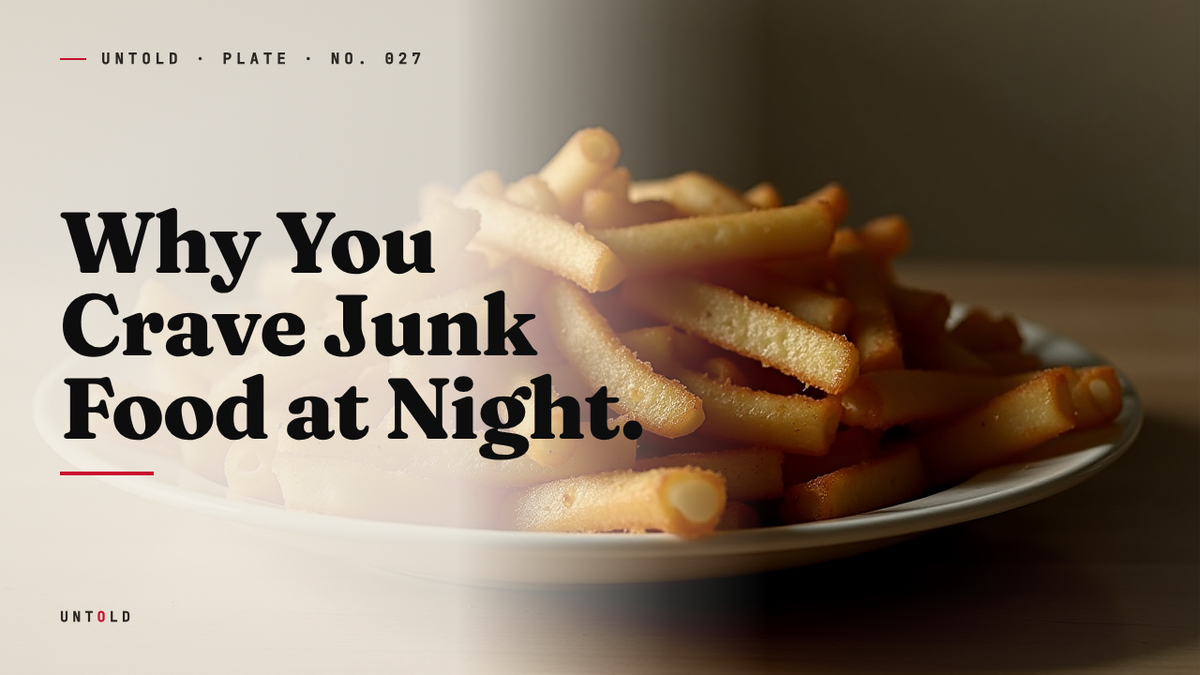
It is ten o’clock at night. The kitchen is dark, the dishes are done, dinner ended hours ago. And yet here is the hand, reaching into the cupboard, past the apples and the rice cakes, closing around the cookies. An hour earlier there was no hunger at all. Now there is something more insistent than hunger, a specific and narrow appetite that wants exactly one category of thing: sweet, salty, soft, energy-dense. Nobody stands in a dark kitchen at midnight craving steamed broccoli. The craving knows what it wants, and what it wants is never the vegetable.
The usual story we tell about this moment is a story about character. We failed to resist. We lack discipline. The willpower that held all day finally cracked, and the cracking is a kind of moral verdict on the person doing the snacking. It is a tidy story, and it has the advantage of putting us in charge, which is to say of making the whole thing our fault. The trouble is that the evidence points somewhere else entirely. The late-night reach for sugar and fat is not primarily a failure of will. It is a predictable output of a body running on a clock we cannot see, a clock that, after dark, quietly rewrites the rules of appetite.
Surveys of habitual night eaters bear this out. A striking share of their daily snacking calories arrive after eight in the evening, and when they reach into the cupboard, they reach overwhelmingly for the sweet and the starchy rather than anything a nutritionist would applaud. The pattern is too consistent across too many people to be a coincidence of personality. Something systematic is happening, and it is happening to all of us in roughly the same way at roughly the same hour.
Two hormones in constant conversation
Appetite is not a single signal but a negotiation between two opposing voices. The first is ghrelin, produced mainly in the stomach, which travels to the brain carrying a single message: seek food. When ghrelin rises, attention narrows toward eating, the thought of a meal grows vivid, and the body prepares to take on fuel. The second voice is leptin, secreted by fat cells, which carries the opposite message: you have had enough, you can stop now. Leptin is the brake to ghrelin’s accelerator, and in a well-regulated body the two stay in rough balance, hunger arriving when energy runs low and fullness arriving once it has been replenished.
What makes this system interesting is that neither hormone holds steady through the day. Both ride a daily wave, rising and falling on a rhythm that has little to do with whether you happen to have eaten recently. This is where the unseen clock enters the picture. Nearly every cell in the human body carries a molecular timekeeper, a set of genes that switch on and off across roughly twenty-four hours, and these countless local clocks are coordinated by a master clock in the brain’s hypothalamus. Together they form the circadian system, and one of the things it governs, it turns out, is when we feel hungry.
Satchin Panda, a circadian biologist at the Salk Institute, has spent much of his career mapping how this internal clock shapes metabolism. His work helped establish a deceptively simple idea: when you eat may matter nearly as much as what you eat, because the same food meets a different metabolic body depending on the hour. The digestive machinery, the insulin response, the way nutrients are stored or burned, all of it shifts across the day on a schedule set by the clock rather than by the menu. The body that receives a cookie at noon is not the same body, biochemically, that receives one at midnight 1.
And the clock, as it happens, tips heavily toward eating in the evening. Hunger does not simply respond to an empty stomach. It follows a curve, and that curve has a peak.
The experiment that isolated the clock
The difficulty with studying nighttime hunger in ordinary life is that everything happens at once. By evening we are tired, we have eaten dinner, the day’s stresses have accumulated, the lights have changed, and we are usually within reach of a kitchen. Any one of those factors could explain the craving, and in daily life they are hopelessly tangled together. To know whether the internal clock itself drives evening hunger, a researcher would have to peel all the other factors away, which sounds impossible. In 2013, a team led by Steven Shea at Oregon Health and Science University found a way to do exactly that.
Their method was deliberately strange. Volunteers lived for nearly two weeks on what is called a forced desynchrony protocol, a schedule built around a twenty-eight-hour day rather than a twenty-four-hour one. Stretched across a recurring twenty-eight-hour cycle of sleep and waking, the participants’ behavior gradually slid out of step with their internal clocks, so that meals and waking hours landed at every possible point on the body’s true biological cycle. Living in a windowless environment without sunlight or external time cues, the volunteers had no way of knowing what hour it actually was. The researchers, meanwhile, could read the body’s internal clock directly and track how appetite changed against it 2.
The result was clean and, for anyone who has lost a battle with the fridge, deeply familiar. Independent of when the volunteers had last eaten, independent of how active they had been, self-reported appetite followed a clear circadian curve. Hunger ran lowest in the biological morning, around the equivalent of eight a.m., and climbed steadily through the day to peak in the biological evening, roughly eight p.m. The desire to eat was strongest precisely when, in ordinary life, the dishes are done and the body supposedly has no metabolic reason to want more food.
And the cravings were not indiscriminate. The volunteers did not simply want more of everything. The hunger sharpened in the evening toward sweet, starchy, salty foods specifically, the same narrow category that calls from the cupboard at ten p.m. The internal clock, in other words, does not just turn appetite up after dark. It aims it.
Why sugar, why fat, why never broccoli
The targeting points toward a second system working alongside the hormones: the brain’s reward circuitry. Eating is not only a matter of refueling but of pleasure and motivation, and that pleasure is carried largely by dopamine moving through deep midbrain structures. Foods rich in sugar and fat light up this reward pathway more intensely than a stalk of celery ever could, which is part of why we evolved to seek them in a world where dense calories were scarce and valuable. After dark, with appetite already cresting, the brain becomes more responsive to exactly these high-reward foods. It is not looking for nutrition in the abstract. It is looking for the specific hit that quick energy provides.
This nighttime tilt becomes far steeper when sleep is in short supply, and here the research grows more pointed. Eve Van Cauter, a sleep and metabolism researcher at the University of Chicago, was among the first to ask what happens to appetite when sleep is taken away. In a 2004 study published in the Annals of Internal Medicine, her team restricted healthy young men to about four hours of sleep across several nights and measured their appetite hormones. The effect was substantial and ran in exactly the wrong direction. Ghrelin, the hunger hormone, rose sharply. Leptin, the fullness signal, fell. The accelerator was pressed and the brake released at the same time 3.
The men did not merely report being hungrier in general. Their increased appetite was aimed, once again, at calorie-dense, high-carbohydrate foods, the sweets and starches and salty snacks that promise fast energy. A brain running short on sleep behaves as though it is in an energy emergency, and it reaches for the food that resolves the emergency most quickly. The body’s logic is not stupid. It is simply optimized for a problem, sudden energy shortage, that a cookie does not actually solve.
The rational brake goes quiet
The hormones explain why a tired body wants more. To see why it wants worse, you have to look inside the brain itself. In 2013, a team led by the neuroscientist Matthew Walker at the University of California, Berkeley, did precisely that, sliding sleep-deprived volunteers into an MRI scanner and watching their brains respond to images of food. Published in Nature Communications, the study captured the craving as it formed 4.
Two things happened together. In the frontal regions of the cortex, the seat of judgment, planning, and self-restraint, activity dropped. This is the part of the brain that weighs consequences and applies the brake, the voice that says perhaps not the whole pint. After a night of poor sleep, that voice went quiet. At the same time, deeper reward structures grew more active in response to the most calorie-dense foods, blazing brighter than they did in the well-rested brain. The rational manager had stepped out of the office, and the part of the brain that simply wants was left running the show. Predictably, the tired volunteers chose higher-calorie foods, again and again. Walker’s summary of the work was blunt: the less you sleep, the more your brain wants to eat.
Lay these findings side by side and a coherent picture emerges. The circadian clock raises hunger in the evening and points it toward sugar and fat. Sleep loss amplifies the hunger hormones still further while suppressing the fullness signal. And the sleep-deprived brain mutes its own restraint while turning up the volume on reward. By the time the hand reaches for the cookies, three separate systems have already aligned against any decision to resist.
Cortisol, depletion, and the empty battery
There is one more contributor worth naming, because it explains why a hard day in particular ends at the cupboard. Cortisol, the stress hormone, also follows a circadian rhythm, and it prepares the body to mobilize and store fuel. A demanding, stressful day keeps cortisol elevated and, separately, drains the mental reserves that self-control depends on. Psychologists have long observed that the capacity for restraint behaves something like a battery, robust in the morning and noticeably depleted by evening after a day of decisions, frustrations, and small acts of discipline. By night, with that reserve nearly spent, impulsive food choices become markedly more likely.
So the familiar scene resolves into something close to inevitability. The clock has lifted appetite to its daily peak and aimed it at sweets. The hormones, especially if sleep has been short, are calling for dense energy. The brain’s brake is faint and its reward centers are loud. The stress of the day has emptied the willpower battery. The cookie does not win because the person standing in the kitchen is weak. It wins because biology, timing, and exhaustion have quietly stacked the deck.
The craving is about repair, not appetite
It is tempting to read all of this as a depressing verdict, proof that we are helpless against our own chemistry. The more accurate reading is gentler and more useful. The midnight craving is not, at its root, about the food. When it is driven by sleep loss, it is about repair. A brain running a sleep deficit is trying to survive the gap, and quick energy is the most immediate tool it knows. The hunger that feels like a personal failing is closer to a distress signal, a body asking for fuel because it has been denied the rest it actually needed.
That reframing points toward responses that work with the system rather than against it. The single most powerful lever is sleep itself. Seven to eight hours steadies ghrelin and leptin, restores the frontal brake, and quiets the exaggerated reward response, defusing the craving before it forms. Eating enough during the day matters too, since a body that arrives at evening genuinely underfed will be ambushed all the harder by the clock’s natural peak. A firm kitchen cutoff a few hours before bed removes the easy fuel for a craving that runs strongest at precisely that hour, working alongside the circadian rhythm instead of fighting it. And perhaps most usefully, it helps to drop the moral story altogether. This is chemistry, not character.
None of this makes the pull toward the cupboard disappear. The craving is real, and on a given night it may still win. But there is a meaningful difference between being defeated by a mysterious weakness and being briefly outvoted by a system you understand. The next time the refrigerator hums its invitation at midnight, the pause that matters is the one in which you recognize what is actually calling. It is not hunger in any simple sense. It is your clock, your hormones, and your tired brain, doing exactly what evolution built them to do.
Sources
- Panda, S., ‘Circadian physiology of metabolism,’ Science, 2016. — https://www.science.org/doi/10.1126/science.aah4967
- Scheer, F. A. J. L., Morris, C. J., Shea, S. A., ‘The internal circadian clock increases hunger and appetite in the evening independent of food intake and other behaviors,’ Obesity, 2013. — https://onlinelibrary.wiley.com/doi/10.1002/oby.20351
- Spiegel, K., Tasali, E., Penev, P., Van Cauter, E., ‘Brief Communication: Sleep curtailment in healthy young men is associated with decreased leptin levels, elevated ghrelin levels, and increased hunger and appetite,’ Annals of Internal Medicine, 2004. — https://www.acpjournals.org/doi/10.7326/0003-4819-141-11-200412070-00008
- Greer, S. M., Goldstein, A. N., Walker, M. P., ‘The impact of sleep deprivation on food desire in the human brain,’ Nature Communications, 2013. — https://www.nature.com/articles/ncomms3259
- Walker, M., Why We Sleep: Unlocking the Power of Sleep and Dreams, Scribner, 2017. — https://www.simonandschuster.com/books/Why-We-Sleep/Matthew-Walker/9781501144325
- Klok, M. D., Jakobsdottir, S., Drent, M. L., ‘The role of leptin and ghrelin in the regulation of food intake and body weight in humans: a review,’ Obesity Reviews, 2007. — https://onlinelibrary.wiley.com/doi/10.1111/j.1467-789X.2006.00270.x
- Baumeister, R. F., Tice, D. M., ‘Ego depletion and self-regulation: a review,’ Journal of Personality, 2008. — https://onlinelibrary.wiley.com/doi/10.1111/j.1467-6494.2008.00531.x
Related reading