The Bread That Crystallized Itself
Stale bread has not lost its water. It has quietly rebuilt its own skeleton, one starch molecule at a time.
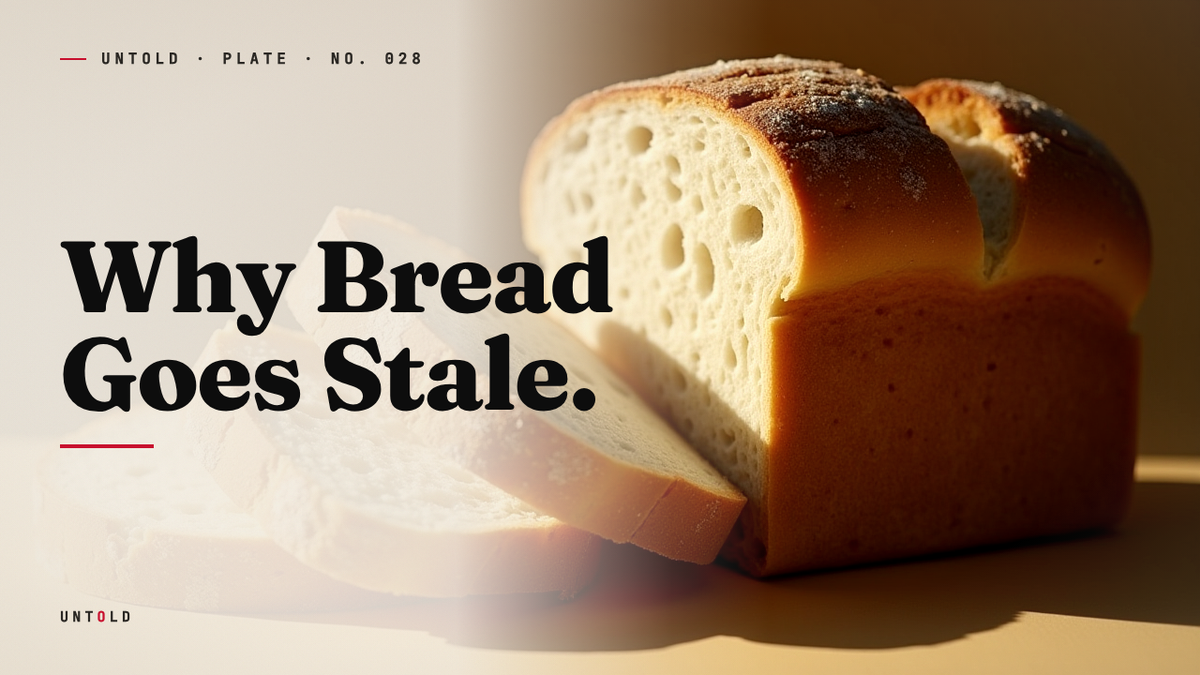
Leave a loaf in a sealed plastic bag overnight, with the air pressed out and the knot pulled tight, and the result is the same one bakers have puzzled over for centuries. By morning the crust has lost its snap, the crumb resists the thumb, and the whole thing feels somehow older than it was the night before. The obvious explanation, the one nearly everyone reaches for, is that the bread dried out. The water escaped. The moisture wicked away into the air.
It is a tidy story. It is also wrong.
Weigh a fresh loaf, leave it to go stale in a sealed container, and weigh it again. The number barely moves. The water has not gone anywhere. If the bread were genuinely drying, the scale would betray it, and it does not. Something far stranger is happening, something invisible to the eye and to the kitchen scale alike, operating at the level of single molecules. The bread is not losing anything. It is reorganizing.
The most telling clue arrives when you do the one thing that seems to defy the drying theory entirely. You take a hard, stale slice, drop it in the toaster, and watch it come back to life. For a moment it is soft again, tender, almost convincingly fresh. If staling were really about lost water, no amount of heat could conjure that water back from the air. Yet heat reverses it, briefly, reliably. The water was there all along. It was simply trapped in a new arrangement, and heat set it loose.
To understand how a sealed loaf hardens without losing a gram of moisture, you have to look inside the crumb, down to the molecules that give bread its body.
What Bread Is Made Of
Strip bread down to its essentials and it is, overwhelmingly, starch. Flour is roughly seventy percent starch by weight, and starch is the engine of texture. The proteins that form gluten get most of the attention in baking lore, the stretchy network that traps gas and gives dough its rise. But once the loaf is baked, it is the starch that decides whether the crumb feels soft or stiff, fresh or old.
Starch itself is not one substance but two, packed together inside microscopic granules. The first is amylose, a long, mostly straight chain of glucose units. The second is amylopectin, a vast, sprawling, heavily branched molecule, far larger than amylose and shaped more like a bush than a thread. In raw flour these molecules sit coiled and ordered inside their granules, tightly packed and largely inert. They are waiting for two things: heat and water.
Baking supplies both. As the dough warms in the oven and the starch granules take up water, they begin to swell. Somewhere around sixty degrees Celsius they reach a threshold and burst open, a process food scientists call gelatinization 1. The ordered packing inside the granule comes apart. The amylose and amylopectin chains unwind, spill out, and tangle loosely with one another, forming a swollen, water-rich, disordered mesh. Water is everywhere inside this network, held in the gaps between chains that no longer have any particular arrangement.
That chaotic, swollen, water-soaked tangle is what we recognize, when it cools just enough to slice, as fresh crumb. Its softness is the softness of disorder. The molecules are not organized into anything. They are simply suspended, holding water in their loose embrace, and that looseness is exactly what the tongue reads as freshness.
Then the bread cools. And the moment it does, the process that softened it begins to run in reverse.
The Quiet Work of Retrogradation
Gelatinization was the unwinding. What follows cooling is the rewinding, and it has a name of its own: retrogradation.
The loose starch chains, freed from their granules and floating in the cooling crumb, do not stay loose. Glucose chains prefer order. Given time and a little molecular freedom, they begin to find one another again, lining up side by side, snapping into tight, ordered, crystalline regions. Where the fresh crumb was a tangle, the staling crumb is slowly becoming a lattice. And as the chains pack themselves into these crystalline zones, they squeeze out the water that had been resting between them.
This is the crux of the whole mystery. The water is not lost to the air. It is pushed aside, expelled from the tightening crystalline regions into the surrounding spaces, no longer bound up in the soft mesh that made the bread feel moist. The crumb stiffens around it. To the hand, and to the mouth, the bread feels dry. But the water remains inside the loaf, every gram of it, just rearranged along with everything else 2.
The insight that staling was a matter of arrangement rather than loss is surprisingly old. In 1852 the French chemist Jean-Baptiste Boussingault, better known for his pioneering work on plant nutrition and the nitrogen cycle, turned his attention to the homely question of why bread goes stale. He sealed old loaves so that no moisture could escape, then heated them, and found that they turned soft again 3. The water had never left. Heat had simply undone whatever had happened on cooling. Boussingault grasped the essential truth more than a century before the molecular machinery was understood: staling was not drying, but a reversible change in the internal state of the bread.
What he could not have known was which molecule was doing the rearranging. Amylose or amylopectin? For decades the question went unanswered, and it turned out the answer was: both, but on very different timescales.
Two Molecules, Two Clocks
Amylose, the long straight chain, is the impatient one. Straight molecules align easily, and amylose recrystallizes fast, within hours of the bread cooling. This is why even a loaf eaten the same afternoon it was baked has firmed noticeably from the moment it came out of the oven. The first stiffening, the loss of that just-baked tenderness, is largely amylose snapping into order.
Amylopectin is the slow one. Its enormous, branched structure cannot line up quickly; the branches get in the way. But over hours and then days, the outer branches of amylopectin gradually find their neighbors and crystallize too, and this slow recrystallization is what drives the long, creeping staling that turns a day-old loaf into a hard one 4. Amylose sets the first firmness. Amylopectin carries the bread the rest of the way into staleness.
The person who mapped this most carefully was the American chemist Thomas John Schoch, who in the 1940s conducted some of the foundational studies on starch retrogradation. Schoch showed that the slow recrystallization of amylopectin tracked the firming of bread with striking precision: as the amylopectin crystals grew, the crumb hardened in lockstep 5. He gave the field its working picture of staling as a starch-crystallization phenomenon, separable into a fast amylose phase and a slow amylopectin one.
Schoch’s framework also explained something that defies kitchen intuition. If staling is crystallization, then anything that helps the starch chains move and align should speed it up, and anything that locks them in place should slow it down. Temperature, it turns out, is the master variable, and it does not behave the way most people assume.
Why the Refrigerator Is the Enemy
Ask most people where to keep bread fresh and they will say the fridge. It is, for bread, almost the worst possible advice.
Retrogradation does not proceed fastest at warm temperatures or at freezing ones. It proceeds fastest in the cold-but-not-frozen range, right around the temperature of a domestic refrigerator. Near the freezing point of water but above it, the starch chains retain just enough mobility to find one another, and the lower temperature favors the formation of crystalline order. The result is that bread stales several times faster in the fridge than it does on the counter at room temperature 6. The cold does not preserve it. The cold accelerates the very crystallization that is making it stale.
Freezing, by contrast, does preserve it, and for the opposite reason. Drop the temperature below the freezing point of the water in the crumb and the molecules can no longer move at all. The starch chains are locked in whatever arrangement they held at the moment of freezing. Retrogradation, which depends entirely on molecular movement, simply stops. A loaf frozen fresh and thawed weeks later is far closer to fresh than the same loaf would have been after a few days in the fridge.
This is why the best advice for storing bread is also the most counterintuitive. Keep it at room temperature if you will eat it within a day or two. If you will not, freeze it solid, ideally sliced, and pull out what you need. The refrigerator, that comfortable middle ground that seems to preserve everything else, is precisely the zone where bread suffers most.
The Reversal in the Toaster
Which brings us back to the toaster, and to the small daily miracle of stale bread coming briefly back to life.
If retrogradation is crystallization, then reversing it means melting the crystals. Retrograded starch crystals are not especially robust. They come undone with heat, and the melting point is low enough to be reached easily in a toaster or oven. Heat the bread past roughly fifty to sixty degrees Celsius and the crystalline regions that formed on cooling melt apart 7. The chains loosen. The water that had been squeezed out into the surrounding crumb is drawn back into the softening mesh. For a moment the bread is, structurally, something close to fresh again.
This is the molecular meaning of warm toast feeling reborn. It is not that the toaster added moisture; the water was always inside. It is that the heat undid the order, returning the crumb to something nearer the disordered, water-rich state it held when it left the oven. Boussingault’s sealed and reheated loaves were doing exactly this in 1852.
The catch is that it does not last. The melting is real but the order is patient. As the toast cools, the same chains that just released their water begin, within minutes, to find one another again. The crystals reform. Toast goes leathery faster than fresh bread goes stale, because the starch chains have already been organized once and slip back into their preferred arrangement all the more readily. The reversal is genuine but temporary, a brief reprieve rather than a cure.
How Industry Cheats the Clock
If staling is crystallization, then the way to keep bread soft for a long time is to physically prevent the starch chains from lining up. This is exactly what industrial baking does, and it is why a wrapped supermarket loaf can stay improbably soft for a week or more while an artisan loaf is stiff by the second day.
The food scientist Yael Vodovotz, who studies how fats and emulsifiers affect bread staling, has described how additives slow retrogradation by interfering with the recrystallization itself 8. The key players are emulsifiers, particularly monoglycerides. These molecules slip in among the starch chains and coat them, physically blocking the chains from packing together into crystals. If amylose and amylopectin cannot reach one another, they cannot recrystallize, and the bread stays soft.
The same logic explains why enriched doughs stale more slowly than lean ones. Fat, sugar, and milk all interfere with the orderly realignment of starch. Fat coats the chains much as emulsifiers do. Sugar competes for the water and disrupts the crystallizing network. A brioche or a milk bread, heavy with butter and enriched with dairy and sugar, resists staling far better than a simple flour-and-water baguette, which is essentially a fast-staling machine by design. The crisp baguette that is glorious in the morning and disappointing by evening is paying, in shelf life, for the purity of its ingredients.
Understanding this also dissolves a common confusion between staling and spoilage. Stale is not rotten. A staled loaf has not been colonized by mold or bacteria; it has simply crystallized. Nothing about it is unsafe or even, fundamentally, degraded. It is the same bread, with its molecules in a tidier arrangement, and a few minutes of heat can undo days of that quiet reorganization.
What We Throw Away
The practical stakes of all this are larger than they might seem. Enormous quantities of bread are discarded every year, much of it not because it spoiled but simply because it stiffened. Estimates of bread waste run into the billions of dollars, and a great deal of that bread was never spoiled at all 9. It was merely retrograded, thrown out for a hardness that a toaster or a warm oven could have reversed in seconds.
The knowledge that staling is reversible reframes the whole problem. A hard loaf is not a ruined loaf. Sliced and frozen at the moment of freshness, then toasted straight from frozen, bread can be kept in something close to its original state almost indefinitely, the staling clock stopped by the cold and then briefly rewound by the heat. The fight to keep bread fresh is not a fight against drying. It is a fight against molecular order, against the patient tendency of starch chains to find their lowest-energy arrangement and lock into it.
There is something quietly remarkable in this. We tend to think of freshness as a kind of fullness and staleness as a kind of loss, the bread depleted, dried up, used up. The truth is almost the opposite. Fresh bread is bread in disorder, its molecules tangled and chaotic and full of trapped water, and that chaos is what we taste as softness. Staling is not depletion. It is the loaf becoming, slowly and silently, more organized than it was, building itself a crystalline skeleton one starch molecule at a time. When bread hardens overnight in a sealed bag, nothing has left it. It has simply grown more ordered while you slept, and a little heat is all it takes to coax it back into the comfortable chaos of the morning it was born.
Sources
- Atwell, W. A. et al., ‘The Terminology and Methodology Associated with Basic Starch Phenomena,’ Cereal Foods World, 1988. — https://www.aaccnet.org/publications/plexus/cfw/
- Gray, J. A. and Bemiller, J. N., ‘Bread Staling: Molecular Basis and Control,’ Comprehensive Reviews in Food Science and Food Safety, 2003. — https://onlinelibrary.wiley.com/doi/10.1111/j.1541-4337.2003.tb00011.x
- Boussingault, J. B., ‘Experiences ayant pour but de determiner la cause de la transformation du pain frais en pain rassis,’ Annales de Chimie et de Physique, 1852. — https://gallica.bnf.fr/ark:/12148/cb343780820/date
- Schoch, T. J. and French, D., ‘Studies on Bread Staling. I. The Role of Starch,’ Cereal Chemistry, 1947. — https://www.cerealsgrains.org/publications/cc/Pages/default.aspx
- Zobel, H. F. and Kulp, K., ‘The Staling Mechanism,’ in Baked Goods Freshness, Marcel Dekker, 1996. — https://www.taylorfrancis.com/books/9780367401757
- Hug-Iten, S., Escher, F. and Conde-Petit, B., ‘Staling of Bread: Role of Amylose and Amylopectin and Influence of Starch-Degrading Enzymes,’ Cereal Chemistry, 2003. — https://onlinelibrary.wiley.com/journal/19435185
- Fadda, C. et al., ‘Bread Staling: Updating the View,’ Comprehensive Reviews in Food Science and Food Safety, 2014. — https://onlinelibrary.wiley.com/doi/10.1111/1541-4337.12064
- Vodovotz, Y. et al., research on lipids, emulsifiers and bread staling, The Ohio State University Department of Food Science and Technology. — https://fst.osu.edu/our-people/yael-vodovotz
- Food and Agriculture Organization, ‘Global Food Losses and Food Waste,’ FAO, 2011. — https://www.fao.org/3/mb060e/mb060e.pdf
Related reading