The Man Whose Left Hand Kept Secrets
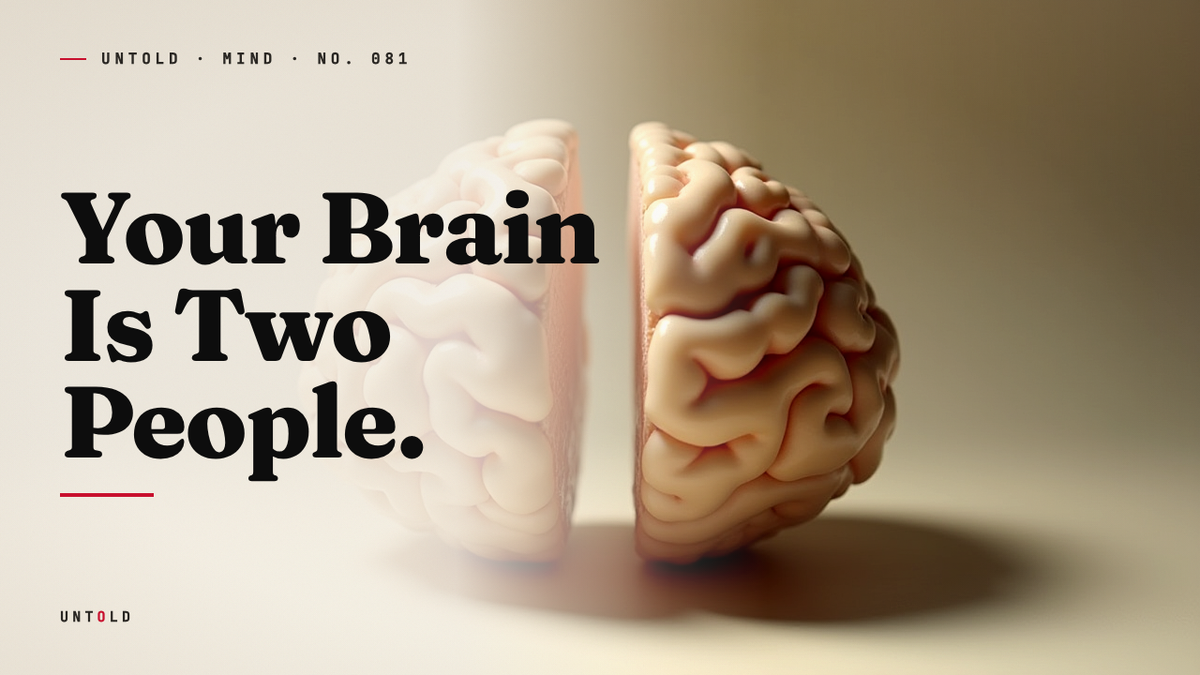
When surgeons cut the brain in two, they found not one mind inside the skull but the negotiated fiction of one.
In a quiet laboratory at the California Institute of Technology in the early 1960s, a man sat before a screen and watched a word flash to the left of a small fixation dot. Asked what he had seen, he said, calmly and with complete sincerity, that he had seen nothing. Then, without prompting, his left hand reached across the table and closed around exactly the object the word had named. He did not know why. Some part of him had read the word, understood it, and acted on it. Another part, the part that spoke, was oblivious. Watching this happen, the scientists in the room understood they were looking at something no one had ever quite seen before: a single human being who was, in a strict and measurable sense, two.
The experiment sounds like a thought experiment, the kind philosophers construct in armchairs to torment students. But it was real, and the men and women who made it possible were not hypotheticals. They were patients with epilepsy so severe that surgeons had cut the great bridge of nerve fibers connecting the two halves of their brains. The operation stopped their seizures. It also, quietly and without anyone at first noticing, divided their inner lives.
A bridge of two hundred million fibers
The structure the surgeons cut is called the corpus callosum, and it is the largest bundle of nerve fibers in the human body. Roughly two hundred million axons run through it, threading the left hemisphere of the brain to the right, keeping the two halves in constant, dense conversation. For most of medical history no one knew quite what it did. Its sheer size suggested importance, yet patients born without it, or who lost it to injury, often seemed to function normally. In the 1950s the physiologist Karl Lashley joked that its only real purpose might be to keep the two hemispheres from sagging.
The joke had teeth, because it captured a genuine mystery. The brain is a profligate organ. It does not waste two hundred million connections on nothing. But the callosum kept its function hidden, in part because the mind it served was so good at hiding the seams.
The first surgeon to cut it deliberately in humans was William Van Wagenen, a neurosurgeon in Rochester, New York, who in 1940 reasoned that if seizures spread across the brain by traveling from one hemisphere to the other, then severing the bridge might contain the electrical storm to a single side 1. He was right, at least partly. Several of his patients improved. And here the mystery deepened, because the patients who came out of that radical surgery seemed, to their families and their doctors, entirely unchanged. They spoke normally. They walked, dressed, joked, remembered. Whatever had been divided did not announce itself. For two decades the operation remained a curiosity, tried occasionally, understood by no one.
The reason no one saw the division was almost comically simple. In ordinary life, the two halves of the body cooperate on nearly everything, and the eyes rove freely across the world, feeding both hemispheres the same scene a hundred times a second. To expose the split you would have to do something no one does in daily life: deliver information to only one half of the brain and prevent the other half from ever finding out. It took a particular kind of scientific imagination to build a situation that unnatural.
The wiring that made it visible
That imagination belonged to Roger Sperry, a neurobiologist who had spent his career obsessed with a single question: how does the nervous system wire itself with such precision? Sperry had already done landmark work on how severed nerves regrow toward their correct targets, work that overturned the prevailing belief that neural connections were shaped mainly by experience. By the early 1960s his attention had turned to the divided brain, and he had a graduate student, a young and ferociously ambitious researcher named Michael Gazzaniga, eager to test what the split actually meant in a living human mind.
Their method exploited an elegant accident of anatomy. The human visual system is crossed. Everything in your left visual field, the part of the world to the left of wherever your eyes are fixed, is processed by the right hemisphere of your brain. Everything in your right visual field is processed by the left hemisphere. In a normal brain this division is invisible, because the corpus callosum instantly shares whatever each side sees. But in a patient whose callosum has been cut, the division becomes absolute. Flash an image to the left of a fixation point, and only the right hemisphere will ever know it was there. The left hemisphere, and crucially the speaking apparatus that lives there, remains genuinely blind.
The first patient Sperry and Gazzaniga studied in depth was a man known in the literature by his initials, W.J., a former paratrooper who had undergone the surgery to control seizures that had plagued him for years 2. They sat him before a screen, asked him to fix his gaze on a central dot, and flashed a word to the left. W.J. reported seeing nothing at all. His speaking brain had received no signal. Yet when they asked his left hand, controlled by the right hemisphere that had in fact seen the word, to reach beneath the screen and select the matching object from a hidden array, the hand found it without hesitation.
One half of the man knew. The other half had no idea. And the half that spoke, the half we tend to identify with the person himself, was entirely unaware that anything had been withheld. Sperry described it in language that still unsettles: each hemisphere, he wrote, seemed to have “its own private sensations, perceptions, thoughts, and ideas, all of which were cut off from the corresponding experiences in the opposite hemisphere” 3.
The silent hemisphere
The experiments quickly revealed a lopsidedness in the divided mind. For the overwhelming majority of people, language lives almost entirely in the left hemisphere. Estimates vary, but roughly ninety-five percent of right-handed people process speech and grammar on the left side of the brain 4. This is why the left hemisphere could always announce what it saw, and the right hemisphere never could.
But the right hemisphere was far from empty. Show it a spoon in the left visual field, and the patient would deny having seen anything, because the verbal left brain had received nothing. Ask the left hand to find the object by touch, though, and it would retrieve the spoon at once. The right hemisphere had seen, understood, and remembered. It simply had no voice. The knowledge was real and complete. It could not reach the microphone.
This was the finding that in 1981 earned Roger Sperry a share of the Nobel Prize in Physiology or Medicine 5. He had demonstrated, in living human beings, that the two hemispheres are functionally specialized and, when disconnected, capable of independent awareness. The mind was not the seamless, indivisible unit that centuries of philosophy and common sense had assumed. It could be split, and when it was split, there appeared to be two of something inside the skull where everyone had always assumed there was one.
What that something was, and whether it deserved to be called a self, became the harder question. And it was Gazzaniga, working for decades after Sperry’s foundational studies, who found the detail that turned an anatomical curiosity into a story about the nature of consciousness itself.
The narrator in the left brain
Gazzaniga refined the technique until he could feed each hemisphere a different picture simultaneously. In one now-famous trial, he flashed a snow scene to a patient’s right hemisphere and a chicken claw to the left. Then he laid out an array of pictures visible to both hands and asked the patient to point to something related to what he had seen 6.
The patient’s left hand, guided by the right hemisphere that had seen the snow, pointed to a shovel. His right hand, guided by the left hemisphere that had seen the chicken claw, pointed to a chicken. So far, unsurprising. Each hemisphere had chosen sensibly given what it alone had seen. Then Gazzaniga asked the patient, out loud, why he had chosen those two things.
Here the answer had to come from the speaking left hemisphere, which had seen the chicken claw and knew nothing whatsoever about the snow. It had watched its own left hand point to a shovel and had no idea why. A person might reasonably have said, “I don’t know why my hand did that.” The patient did not say this. Instead, without hesitation and with total confidence, he explained: “Oh, that’s easy. The chicken claw goes with the chicken, and you need a shovel to clean out the chicken shed.”
The left hemisphere had not registered its own ignorance. Faced with a behavior it could not account for, it manufactured a reason that felt, to the patient, entirely true. Gazzaniga named the mechanism responsible for this the interpreter, a module in the left hemisphere whose job is to weave the flood of the brain’s actions, sensations, and impulses into a single coherent narrative 7. The interpreter does not report the truth. It constructs a plausible story, and it does so continuously, and the story it tells is the one we experience as our conscious life.
“The interpreter,” Gazzaniga wrote, “is what everyone uses to seek explanations for events, tie together the past and the present, and set the stage for future action” 7. It is relentless. Confronted with a gap in its own knowledge, it does not pause or confess. It fills the gap, smoothly, and the confabulated reason arrives feeling exactly as authentic as any reason we ever give for anything.
What is a self that can be halved
Fewer than a hundred split-brain patients have ever been studied in genuine depth, which makes the field one of the smallest and strangest in all of neuroscience. Yet the implications ripple far beyond that tiny cohort. If a brain can be cut in two and produce two centers of awareness, and if the talking half will confidently narrate reasons for actions it did not initiate and cannot explain, then the unity we all feel, the sense of being one continuous author of our own lives, starts to look less like a fact and more like an achievement. A story the brain tells itself so fluently that we mistake it for the truth.
This does not mean you are secretly two people fighting for control. In an intact brain the callosum does its work, and the hemispheres share so completely that the seam never shows. But the split-brain patients revealed the machinery underneath. They showed that the self we experience is assembled, moment by moment, out of many parallel systems that do not report to a central command, and that a great deal of what we do is decided before the narrating part of us has any idea it is happening. The interpreter arrives afterward, tidying up, offering reasons, taking credit.
The picture is not fully settled, and honest science should say so. In recent years some researchers have challenged the classic account, reporting that certain split-brain patients retain a surprising degree of unified awareness across the two visual fields, able to detect and respond to stimuli on both sides even when they cannot name them consistently 8. These findings suggest the division may be less total than the early experiments implied, that subcortical pathways beneath the severed callosum may carry more traffic than anyone expected. The divided brain, in other words, has not surrendered all its secrets. It may be that the two hemispheres, even cut apart, find quieter ways to remain one.
What endures is the humility the experiments demand. We move through the day trusting the reasons we give ourselves, certain that we chose this job, this partner, this sentence, for the causes we can articulate. The split-brain work suggests that certainty is itself a product, manufactured by a hemisphere that would rather invent an explanation than admit it does not have one. The next time you catch yourself explaining, with perfect confidence, exactly why you did something, it is worth a pause. The reason may be true. Or it may be the interpreter, doing what it always does, writing the story after the fact and handing it to you as though you had known all along.
Sources
- Van Wagenen, W. P. and Herren, R. Y., ‘Surgical division of commissural pathways in the corpus callosum,’ Archives of Neurology and Psychiatry, 1940. — https://jamanetwork.com/journals/archneurpsyc/article-abstract/648017
- Gazzaniga, M. S., Bogen, J. E., and Sperry, R. W., ‘Some functional effects of sectioning the cerebral commissures in man,’ PNAS, 1962. — https://www.pnas.org/doi/10.1073/pnas.48.10.1765
- Sperry, R. W., ‘Cerebral organization and behavior,’ Science, 1961. — https://www.science.org/doi/10.1126/science.133.3466.1749
- Knecht, S. et al., ‘Handedness and hemispheric language dominance in healthy humans,’ Brain, 2000. — https://academic.oup.com/brain/article/123/12/2512/402561
- The Nobel Prize in Physiology or Medicine 1981, Roger W. Sperry, Nobel Foundation. — https://www.nobelprize.org/prizes/medicine/1981/sperry/facts/
- Gazzaniga, M. S., ‘The Split Brain in Man,’ Scientific American, 1967. — https://www.scientificamerican.com/article/the-split-brain-in-man/
- Gazzaniga, M. S., ‘The Ethical Brain’ and ‘Who’s in Charge? Free Will and the Science of the Brain,’ Ecco/Dana Press, 2005/2011. — https://www.harpercollins.com/products/whos-in-charge-michael-s-gazzaniga
- Pinto, Y. et al., ‘Split brain: divided perception but undivided consciousness,’ Brain, 2017. — https://academic.oup.com/brain/article/140/5/1231/2951052
Related reading