The Honest Sugar Pill
For fifty years we believed the placebo needed a lie. It never did.
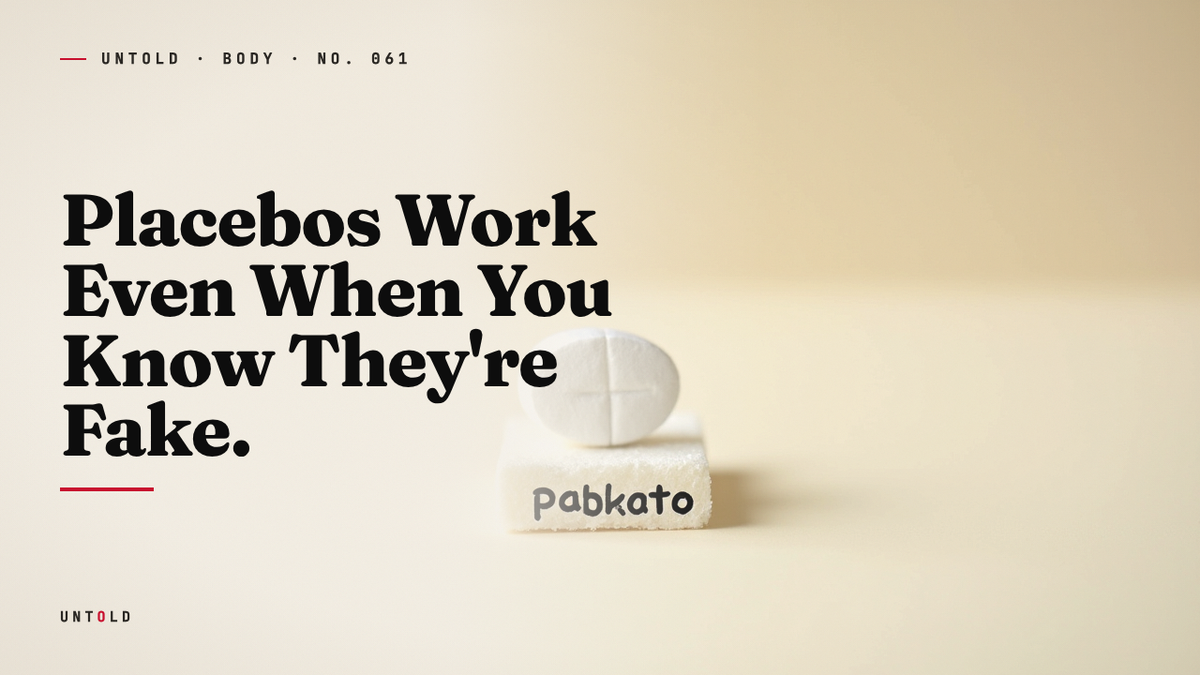
A woman sits in a clinic in Boston, turning a small bottle over in her hands. The label does not hide anything. It reads, in plain type, that the capsules inside contain no active medicine. They are, it says, inert. Sugar, essentially. She has irritable bowel syndrome, a condition that has cramped and disrupted her life for years, and a Harvard researcher has just told her, to her face, that these pills are pharmacologically empty. Take two, twice a day, he says. She does. Within three weeks, her symptoms ease by a measurable margin.
By every rule that governed medicine for the better part of a century, this should not have happened. The placebo, we were taught, is a trick. It works because the patient is deceived, because belief has been smuggled in under false pretenses. Remove the deception and you remove the effect. That was the logic, clean and self-evident, and it held for fifty years. What the woman in Boston demonstrated, along with dozens more like her, is that the logic was wrong. The lie was never the active ingredient.
A word that began as an insult
The term itself carries a faint sneer. Placebo is Latin for “I shall please,” and it entered the medical vocabulary as a slur rather than a concept. In the eighteenth century, physicians used it to describe a treatment offered not because it worked but because it soothed a demanding patient. A placebo was what you gave to please someone you could not actually help. It was a courtesy dressed as a cure, and the word carried the same contempt a modern doctor might reserve for a useless supplement.
For most of medical history this dismissiveness made sense, because so much of what physicians prescribed was, functionally, placebo. Bloodletting, purges, tonics of dubious mineral content: the pharmacy of the past was mostly theater. And yet patients often improved. This was easy to wave away as coincidence, as the body healing itself on its own schedule while the doctor took the credit. The idea that the theater itself might be doing something, that ritual and expectation could reach into the body and change it, was not taken seriously as science until the middle of the twentieth century.
The man who forced the change was an anesthesiologist named Henry Beecher, and the setting was war. During the Second World War, working near the front lines, Beecher confronted a shortage that no textbook prepared him for. He was running out of morphine. Wounded soldiers arrived in agony and there was nothing to give them. According to the account he later built his career upon, a nurse, or Beecher himself, began injecting some of these men with saline solution, plain saltwater, while telling them it was a powerful painkiller. And some of them settled. Their pain, they reported, genuinely eased. Faced with the alternative of untreated shock, the deception seemed both merciful and revealing.
Beecher took the observation home and, in 1955, published a paper in the Journal of the American Medical Association with a title that announced its ambition: “The Powerful Placebo.” 1 He argued that inert treatments produced real, quantifiable relief in a substantial fraction of patients, and that any honest clinical trial therefore had to account for this baseline of belief. His statistics have since been criticized as inflated, his wartime anecdotes as embellished, and modern reanalyses suggest he overstated the raw size of the effect. But the paper’s cultural work was done. It established the placebo as a phenomenon worth studying and, crucially, it enshrined the randomized double-blind trial as the gold standard of medicine. To test whether a drug worked, you had to compare it against a placebo, and neither patient nor doctor could know which was which. The lie was baked into the method.
The rule that everyone assumed
Out of Beecher’s framework grew an assumption so intuitive that almost no one bothered to test it. The placebo effect, everyone agreed, depended on deception. The patient had to believe the pill might be real. Belief was the mechanism, and belief required ignorance. A patient who knew the pill was empty had nothing to believe in, and so nothing would happen. It was, on its face, obvious.
This assumption had a quietly corrosive effect on how medicine understood itself. If the placebo response was just a byproduct of being fooled, then it was a nuisance to be subtracted out of trial data, an inconvenient noise floor rather than a signal. It certainly could not be used ethically as a treatment, since deceiving patients violated the entire architecture of informed consent that modern medicine had spent the century building. And so the placebo occupied a strange limbo: acknowledged to be real, powerful enough to shape billion-dollar drug approvals, and yet clinically untouchable because using it honestly seemed like a contradiction in terms.
The question that no one asked out loud was whether the deception was actually doing the work, or whether it had simply been present at the scene of the crime. Correlation had been mistaken for cause. For fifty years the placebo and the lie traveled together, and everyone assumed they were the same passenger.
The experiment that sounded absurd
Ted Kaptchuk arrived at this problem from an unusual direction. Before he became a professor at Harvard Medical School and the director of its program in placebo studies, he trained for years in Chinese medicine, spending time in Macau and studying traditions in which the relationship between healer and patient was understood as therapeutic in its own right. He was less invested than his colleagues in the pharmacological model of healing, and more curious about what he called the ritual of medicine. That perspective let him ask the question the field had avoided: what happens if you tell the patient the truth?
In 2010, Kaptchuk and his team recruited eighty patients suffering from irritable bowel syndrome, a chronic and notoriously placebo-responsive condition, and ran what looked like a joke of an experiment. 2 Half the patients received no treatment at all, only the usual attention of the research staff. The other half received a bottle of pills. But the bottle was labeled, unambiguously, “placebo pills,” and the patients were told directly that the capsules were made of an inert substance, like sugar, and contained no medication whatsoever. The researchers went further. They explained that placebos had been shown in studies to produce significant healing through mind-body self-healing processes. Take them faithfully, they said, twice a day, even though you know they are fake.
The result did not merely reach statistical significance. It was large. By the end of the three-week trial, fifty-nine percent of the patients taking the open-label placebo reported adequate relief from their symptoms, compared with thirty-five percent of those receiving no treatment. The honest sugar pills had nearly doubled the response. Patients who had been told, in plain language, that they were swallowing nothing, improved anyway, and improved substantially.
Kaptchuk understood that a single study could be a fluke, so he and others set about repeating it across different conditions. Open-label placebos were tested against chronic lower back pain, where a 2016 trial published in the journal Pain found that patients who added honest placebo pills to their usual care saw their pain scores drop by roughly thirty percent, while the control group barely moved. 3 Similar signals appeared in studies of cancer-related fatigue, of episodic migraine, of allergic rhinitis. A 2021 meta-analysis pooling the growing literature concluded that open-label placebos produced a small but genuine positive effect across a range of complaints. 4 The pattern was too consistent to dismiss. Honesty, it turned out, did not switch the placebo off.
The chemistry beneath the ritual
To understand why, it helps to leave the clinic and enter the laboratory of Fabrizio Benedetti, a neuroscientist at the University of Turin who has spent decades doing something more radical than measuring whether placebos work. He has been measuring what they do inside the brain, molecule by molecule. His research dismantles the lazy notion that the placebo effect is imaginary, a matter of patients merely talking themselves into feeling better.
Benedetti’s early work focused on pain. When a person expects relief, he found, the brain releases its own opioids, endorphins, the endogenous painkillers that morphine imitates. This was not a metaphor. He proved it with a molecule called naloxone, the same drug used to reverse heroin overdoses by blocking opioid receptors. When Benedetti administered a placebo and the patient’s pain eased, then gave naloxone, the relief evaporated. 5 The placebo response had been running on a real, measurable, pharmacologically interruptible chemical pathway. Block the chemistry and you block the healing. There was nothing imaginary about it.
The evidence widened from there. In patients with Parkinson’s disease, whose symptoms stem from a shortage of dopamine, Benedetti and collaborators showed that a placebo could trigger the brain to release its own dopamine. Brain imaging captured surges in the striatum that rivaled the response to actual anti-Parkinsonian medication, and in some patients the placebo quieted the abnormal firing of individual neurons that Benedetti was recording directly with electrodes. 6 The pill was empty. The dopamine it unlocked was as real as any that a drug could have delivered. The body was manufacturing its own medicine on cue.
That phrase, on cue, is the key to the whole mystery. If the placebo works through the brain’s own chemistry, then the question becomes what triggers the release, and the answer is not belief in the sense of intellectual conviction. It is something closer to a learned reflex. Every pill a person has ever swallowed, every injection, every visit to a doctor who then made them feel better, has trained the body to associate the ritual of treatment with the arrival of relief. This is classical conditioning, the same mechanism by which Pavlov’s dogs salivated at a bell. The bell contained no food. The pill contains no drug. But the body, having learned the pattern, responds to the signal.
This is why honesty changes so little. The conscious mind can be told, and can fully accept, that the pill is inert, while the older, conditioned machinery of the body keeps its own counsel. The ritual is intact. The patient still opens the bottle, still counts out the capsules, still swallows, still waits. A researcher has still paid attention, explained something with care, and issued a prescription. All the cues that the body has spent a lifetime learning to read remain present, and they fire regardless of what the intellect has been told. The relief does not require the deception because it never depended on the deception. It depended on the theater.
What the honest pill reveals
Seen this way, the open-label placebo is less a paradox than a correction. For a century, medicine assumed that the pill was doing the work and the ritual around it was mere packaging. The truth appears to be closer to the reverse, or at least more balanced than we admitted. The chemical in the bottle matters, enormously, for the conditions that chemicals can touch. But wrapped around every effective drug is an apparatus of meaning, the diagnosis, the authority of the prescriber, the ceremony of taking the medicine, and that apparatus has therapeutic power of its own. Kaptchuk has argued that we should stop treating this power as a contaminant and start treating it as a tool.
The practical implications are being explored cautiously. Researchers are running trials of open-label placebos for anxiety, for chronic fatigue, for the fatigue and hot flashes that follow cancer treatment. The appeal is obvious. A treatment with no pharmacological content has no pharmacological side effects, no risk of dependency, no interaction with other drugs, and negligible cost. For conditions where the available medications are heavy with downsides, an honest placebo could, in principle, offer real relief at almost no biological expense.
The limits, though, are just as real and deserve to be stated plainly. Placebos work on symptoms mediated by the brain and nervous system: pain, nausea, fatigue, the felt sense of illness. They do not clear infections. They do not shrink tumors. They do not repair a fracture or reverse the biochemical failure of an organ. A conditioned dopamine surge can ease the tremor of Parkinson’s for a while, but it does not restore the dying neurons that cause the disease. Anyone tempted to substitute belief for treatment should understand exactly where the boundary lies, and no one should alter a real prescription without a real physician. The placebo is an adjunct to medicine, not an escape from it.
What remains, once the hype and the cautions are set aside, is a quiet and slightly unsettling fact about the human body. The relief that the woman in Boston felt was not a delusion. Her brain, responding to a lifetime of conditioning and to the ritual unfolding in front of her, produced its own chemistry, opened its own pharmacy, and dosed her accordingly. The empty capsule was only the switch. The medicine came from inside. For centuries we thought we had to fool people to reach that inner pharmacy, and it turns out we merely have to give them a reason to open it. The next time a ritual soothes you, a warm cup, a familiar remedy, a doctor’s unhurried attention, it is worth remembering that the comfort is not simply in your head. It is in your bloodstream, measurable and real, waiting only for the right signal to arrive.
Sources
- Beecher, H. K., “The Powerful Placebo,” Journal of the American Medical Association, 1955. — https://jamanetwork.com/journals/jama/article-abstract/303530
- Kaptchuk, T. J. et al., “Placebos without Deception: A Randomized Controlled Trial in Irritable Bowel Syndrome,” PLoS ONE, 2010. — https://journals.plos.org/plosone/article?id=10.1371/journal.pone.0015591
- Carvalho, C. et al., “Open-label placebo treatment in chronic low back pain: a randomized controlled trial,” Pain, 2016. — https://journals.lww.com/pain/fulltext/2016/12000/open_label_placebo_treatment_in_chronic_low_back.15.aspx
- Charlesworth, J. E. G. et al., “Effects of placebos without deception compared with no treatment: a systematic review and meta-analysis,” Journal of Evidence-Based Medicine, 2017. — https://onlinelibrary.wiley.com/doi/10.1111/jebm.12251
- Levine, J. D., Gordon, N. C., Fields, H. L., “The mechanism of placebo analgesia,” The Lancet, 1978. — https://www.thelancet.com/journals/lancet/article/PIIS0140-6736(78)91230-8/fulltext
- Benedetti, F. et al., “Placebo-responsive Parkinson patients show decreased activity in single neurons of subthalamic nucleus,” Nature Neuroscience, 2004. — https://www.nature.com/articles/nn1250
Related reading