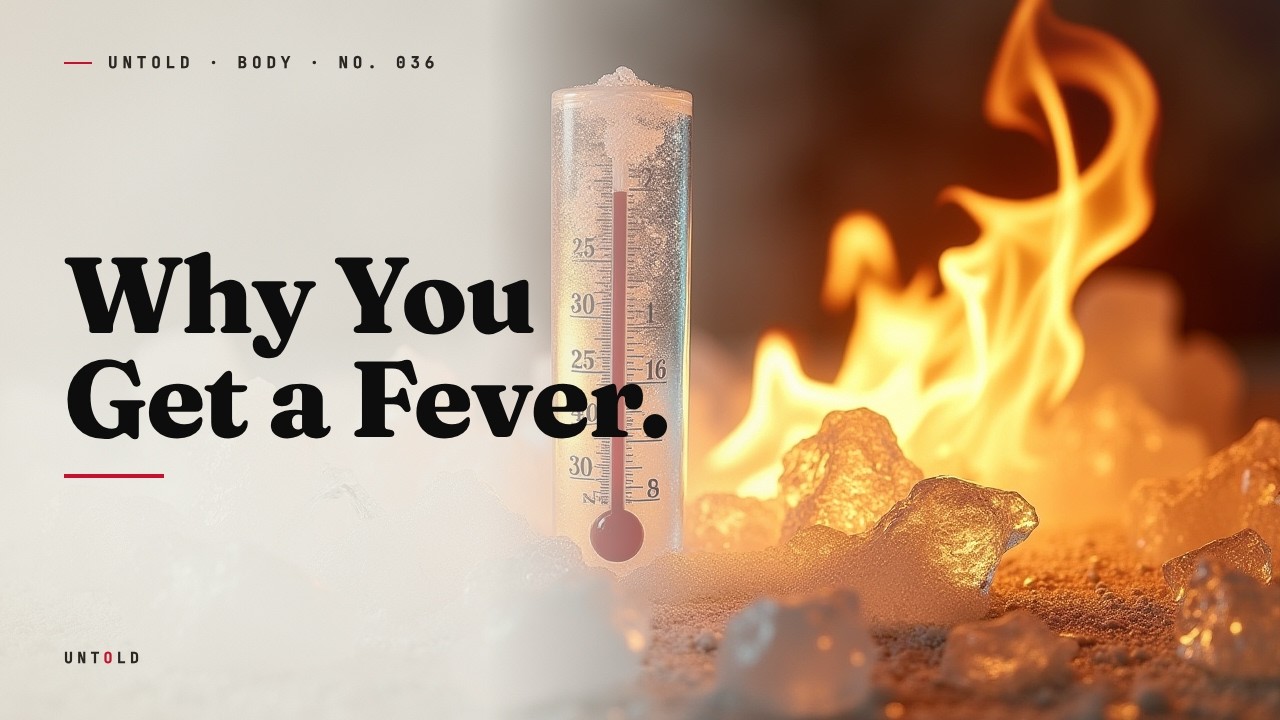
The Fire That Heals
For two thousand years doctors fought fever. The lizards knew better.

You wake at three in the morning, burning and shivering at the same time. The sheets are damp. Your skin radiates heat, yet you cannot stop trembling, and you pull the blanket tighter against a cold that seems to come from inside your own bones. You reach for the thermometer on the nightstand. The number climbs past 101 and keeps going. Something, you decide, has gone badly wrong.
It has not. The heat coursing through you at that hour is not an accident, not a malfunction, not the infection itself scorching your tissues. It is a decision. Somewhere behind your eyes, a small cluster of brain cells has read the chemical alarm bells of your immune system and made a calculation: this body needs to get hotter. Every degree of that misery was issued as a command. Your body is on fire, and it lit the match on purpose.
This is one of the stranger facts of human physiology, and one of the most misunderstood. For most of recorded medical history, fever was treated as the enemy, the thing to be conquered, cooled, and driven out. The truth is closer to the opposite. The fire that makes you feel like you are dying is, in most cases, the same fire trying to keep you alive.
A Thermostat, Not a Furnace
To understand why fever helps, you have to abandon the intuition that heat simply leaks into a sick body the way warmth seeps through a window on a summer afternoon. That is not what happens. Your temperature is not rising because something external is cooking you. It is rising because your own regulatory system has changed its mind about what normal should be.
Deep in the brain sits the hypothalamus, a structure no larger than an almond that governs hunger, thirst, sleep, and, crucially, temperature. It functions as a thermostat, holding the body at a set point. The familiar figure is 98.6 degrees Fahrenheit, though in reality healthy people drift a degree or so in either direction across the day. When the hypothalamus decides the body should be warmer, it does not wait for the weather to cooperate. It issues orders.
This reframes everything you feel during the onset of a fever. The chills, the violent shivering, the desperate reach for another blanket: these are not symptoms of being cold. They are the machinery of getting hot. Shivering is muscle activity converted almost entirely into heat, and your body deploys it to climb toward the new, higher target the hypothalamus has set. The sweating that arrives later, the soaked sheets and the sudden clammy relief, comes only when the thermostat resets back down and the body must shed the heat it no longer wants. Fever, in other words, is not heat invading the body. It is the body raising its own ceiling.
Ancient physicians watched this process unfold for thousands of years without grasping the mechanism. They had no concept of a hypothalamus, no microscope to reveal the invaders, no theory of immunity. What they had was observation, and they observed that fever accompanied sickness with grim reliability.
Two Thousand Years of Cooling the Patient
Hippocrates, writing in Greece around 400 BC, placed fever near the center of his medical thinking. In the framework he and his successors developed, the body was governed by four humors, and fever was understood as a kind of internal cooking, a process that burned away corrupt or excess fluids. There was a strange logic to it, and even a thread of accuracy in the notion that the heat was doing something rather than merely happening. But the prevailing instinct that followed was to fight the fire. If the patient was too hot, the obvious remedy was to cool the patient down, and to do it fast.
That instinct hardened into doctrine and persisted, astonishingly, for roughly two thousand years. Cold baths, exposure, and an array of cooling regimens dominated the treatment of fevers well into the modern era. The heat was the problem. Lower it, and you helped the patient. The idea was so intuitive, so confirmed by the sufferer’s own desperate wish to feel cooler, that almost no one thought to question whether the fever might be on their side.
The questioning began, as it often does, with someone willing to do the tedious work of measurement.
The Doctor Who Took a Million Temperatures
In the German city of Leipzig in the 1860s, a physician named Carl Wunderlich set out to do something no one had attempted at scale: to actually measure fever, systematically, in enormous numbers of patients. Working with a thermometer nearly a foot long that took some twenty minutes to register a reading, he gathered temperature data from an estimated 25,000 patients and accumulated, by various accounts, well over a million individual measurements.1
The sheer volume of his work allowed Wunderlich to do what no anecdote ever could. He established that human body temperature clustered tightly around a normal value, a figure he fixed at 98.6 degrees Fahrenheit, a number that would dominate medicine for the next century and a half. More importantly, he reframed fever itself. It was not, he argued, a disease in its own right, the thing to be treated as the central malady. It was a symptom, a measurable sign of some underlying process, a number that rose and fell in patterns that could be tracked and read like a chart of the body at war.2
Wunderlich gave fever a language and a logic. But he could not answer the deeper question his own data raised. If heat was a reliable companion of infection, was it merely a side effect of the body laboring against disease, or was it part of the labor itself? Was the fire incidental, or was it a weapon? The answer would come not from a hospital ward but from the desert, and not from a human patient but from a lizard.
What the Iguanas Knew
In the 1970s, the physiologist Matthew Kluger turned to an unlikely model organism: the desert iguana. Reptiles are ectotherms, often called cold-blooded, which means they cannot generate significant body heat from within the way mammals do. To warm up, a lizard must move, basking on a sun-struck rock to soak in warmth, retreating to shade to cool down. Its temperature is set largely by where it chooses to sit.
This quirk made the iguana a perfect natural experiment. Kluger infected iguanas with bacteria and watched what they did. The animals did not lie still. They crawled toward warmer parts of their enclosures, deliberately seeking out heat, and in doing so they drove their body temperatures upward. They were, in effect, giving themselves a fever by behavior, choosing the equivalent of climbing into a hot bath.3
The results were stark. Iguanas allowed to warm themselves survived infection at dramatically higher rates than those kept from heat. Lizards prevented from reaching warmer ground, held at lower temperatures, died from the same bacterial infections that warm lizards shrugged off.3 The fever was not incidental. It was so valuable to survival that an animal incapable of producing its own heat would expend energy and take risks to chase it across a cage.
Here was the answer Wunderlich could not reach, written in the behavior of reptiles. Fever had to be doing real work against infection, or evolution would never have wired a cold-blooded animal to seek it out at the cost of comfort. And if the response was old enough and deep enough to govern the instincts of a desert lizard, it was old indeed. Some form of the fever response appears across an extraordinary range of animals, a survival strategy with hundreds of millions of years of evolutionary history behind it.3
How Heat Wins the War
So what, precisely, does the heat accomplish once it arrives? The popular explanation is that fever cooks the invaders, and there is a kernel of truth in it. Many bacteria and viruses are adapted to replicate efficiently within a fairly narrow temperature range. Push the body a few degrees beyond their comfort zone and their machinery falters; they multiply more slowly, struggle to reproduce, and lose ground in the race against an organism trying to clear them.
But this is only half the story, and arguably the less important half. The deeper magic of fever happens not in the germs but in your own blood. Higher temperatures act as a catalyst for the immune system, sharpening and accelerating the cells whose job is to find and destroy invaders. White blood cells move faster, hunt more aggressively, and respond more decisively in the warmth. The fever is less a flamethrower aimed at the enemy than a war drum that drives your own army into faster motion.
The mechanism became clearer in 2019, when the immunologist Sharon Evans and her colleagues published research detailing how fever-range temperatures speed immune cells on their way to the fight. Their work showed that heat activated molecular machinery on the surface of T-cells, the adaptive immune system’s targeted assassins, allowing them to cross blood vessel walls and reach sites of infection far more efficiently.4 In effect, the fever opened express lanes through the body, helping immune cells travel to where they were needed faster than they otherwise could.4
This is the reframing that overturns two thousand years of cooling baths. The fever is not fighting the germ directly so much as unleashing the body’s own defenders. The heat is a force multiplier for the immune response, which is why an experience that feels purely destructive turns out to be so productive.
It also explains the exhaustion. A fever is expensive. Raising and holding an elevated body temperature increases the metabolic rate substantially, by something on the order of ten percent for each degree Celsius of fever. That bone-deep fatigue, the way illness flattens you into the mattress, is in part the experience of energy being diverted, pulled away from ordinary activity and routed toward the battlefield burning inside you.
The whole cascade begins with a signal. When immune cells detect an invader, they release chemical messengers called pyrogens, literally fire-makers. These molecules travel through the bloodstream to the brain, where they reach the hypothalamus and instruct it to raise the set point. The thermostat clicks higher, the body begins to shiver, and the fire is lit. Every fever is the end of a conversation that began with a few cells sounding an alarm.
The Tool and Its Limits
All of this raises an uncomfortable question. If fever genuinely helps the body heal, should anyone be taking medicine to lower it? Should we stop reaching for the pills that bring the number down?
The honest answer is more careful than the romance of the science might suggest. Some studies do indicate that suppressing mild fevers can, in certain illnesses, slightly prolong the course of the sickness, which fits neatly with the idea that the heat is doing useful work.5 But fever is a tool, not a cure, and like any tool it can be misused or simply pushed too far. A modest elevation is one thing. A very high temperature is another, and at the extreme, heat itself becomes the danger, capable of damaging tissue and threatening the brain.
This is why the discovery that fever helps should never be read as a license to let it run unchecked. High or persistent fevers warrant medical attention, and the threshold for concern is lower in young children, whose bodies tolerate temperature extremes less well. The goal of treatment, properly understood, is comfort and safety rather than the erasure of every last degree. There is a meaningful difference between easing a patient’s suffering and reflexively stamping out a defense the body raised on purpose.
What the long arc from Hippocrates to Sharon Evans reveals is not that fever is good and medicine is bad. It is that the body is rarely doing something for no reason. The misery of a fever is not evidence that the body has broken. It is evidence that the body is working, expensively and deliberately, mobilizing a response refined across hundreds of millions of years of evolution. The next time you wake at three in the morning, burning and shaking and certain something has gone wrong, it may help to remember what the heat is actually for. Your body is not failing you. It is fighting, and the fire is on your side.
Sources
- Wunderlich, C. R. A., On the Temperature in Diseases: A Manual of Medical Thermometry, New Sydenham Society, 1871. — https://archive.org/details/ontemperaturein00wundgoog
- Mackowiak, P. A., “Carl Reinhold August Wunderlich and the Evolution of Clinical Thermometry,” Clinical Infectious Diseases, 1994. — https://academic.oup.com/cid/article-abstract/18/3/458/331776
- Kluger, M. J., Ringler, D. H., Anver, M. R., “Fever and Survival,” Science, 1975. — https://www.science.org/doi/10.1126/science.1114347
- Lin, C., Evans, S. S., et al., “Fever promotes T lymphocyte trafficking via a thermal sensory pathway involving heat shock protein 90 and alpha4 integrins,” Immunity, 2019. — https://www.cell.com/immunity/fulltext/S1074-7613(18)30521-2
- Evans, S. S., Repasky, E. A., Fisher, D. T., “Fever and the thermal regulation of immunity: the immune system feels the heat,” Nature Reviews Immunology, 2015. — https://www.nature.com/articles/nri3843
Related reading