The Chemistry of Being Delicious
Why mosquitoes single out some people and ignore others, and what the answer reveals about the skin we live in.
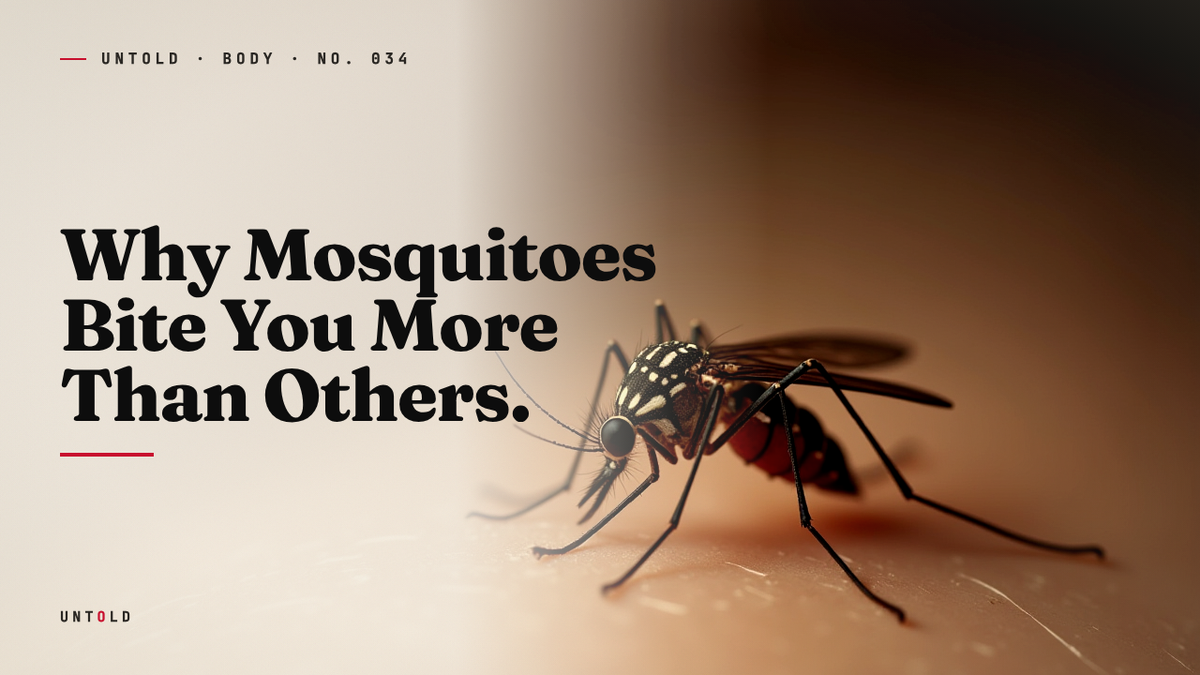
The evening ends the way it always does. You stand up from the picnic blanket scratching a constellation of welts across your ankles and forearms, while the friend who shared that same blanket, that same humid dusk, that same drifting swarm, walks to the car without a single bite. It feels like a cosmic unfairness, the kind of small injustice that lodges in memory precisely because it is so consistent. You are always the one. They are never the one.
For most of human history this was filed under bad luck, the same drawer that holds rained-out weddings and missed trains. But mosquitoes do not deal in luck. They deal in chemistry, and over the past two decades a handful of laboratories have pulled apart the precise molecular reasons why a mosquito will fly past one human to reach another. The short version is unsettling and oddly intimate: the insect is not choosing at random. It is reading you, and you are easy to read.
Mosquitoes are the deadliest animals on the planet, responsible for more human deaths than any predator, snake, or rival species, largely through the diseases they carry: malaria, dengue, yellow fever, Zika 1. The World Health Organization attributes well over 700,000 deaths a year to mosquito-borne illness 2. So the question of why they prefer certain people is not a curiosity for the itchy and aggrieved. It is a frontier of public health. If we understand attraction, we can interrupt it. And the answer, when scientists finally assembled it, turned out to live not in your blood but on your skin.
The hunt begins with breath
First, a correction that surprises almost everyone: only female mosquitoes bite. The males spend their short lives sipping nectar and never trouble a human at all. The female drinks nectar too, for her own energy, but she needs something the flowers cannot offer. To develop her eggs she requires a dose of animal protein, and that protein comes from blood. When she lands on your arm she is not feeding herself. She is provisioning the next generation 3. Your blood is, in the bluntest possible terms, raw material for more mosquitoes.
To find that raw material she runs a search, and the search has a structure. It begins long before she can see you, at a distance of up to thirty feet, with a single chemical cue: carbon dioxide. Every time you exhale you release a plume of CO2 into the air, and the mosquito’s antennae are exquisitely tuned to detect changes in its concentration. A rising tide of carbon dioxide tells her that an animal, something warm and full of blood, is breathing nearby 4.
This first filter already explains some of the unfairness. Larger bodies exhale more carbon dioxide, which is part of why adults are bitten more often than small children, and why a tall, heavily built person tends to attract more attention than a slight one. It also explains why exercise turns a person into a beacon. When you work out your breathing deepens and quickens, your CO2 output climbs, and your body temperature rises along with it. You become, briefly, the loudest signal in the field.
But carbon dioxide is a coarse instrument. It only gets the mosquito into the neighborhood. It cannot tell her which of several breathing humans on a picnic blanket is worth the risk of a landing. For that she needs a finer sense, and here the story moves from the air to the skin.
A cage in Zambia
For years the leading figure in this work has been Leslie Vosshall, a neurobiologist at Rockefeller University who has spent much of her career decoding the mosquito’s sense of smell. Her central finding, repeated across many experiments, is that the mosquito’s nose is far harder to fool than anyone assumed. It does not rely on a single chemical it can be tricked into ignoring. It reads a whole bouquet, with redundancy built in, so that knocking out one receptor barely dents the insect’s ability to find a human 5.
The most striking demonstration came in 2022, when Vosshall’s team, led by the researcher Maria Elena De Obaldia, built a remarkable apparatus in Zambia. They constructed a large outdoor screened arena and ran tubing from a row of small tents in which human volunteers slept. Each volunteer’s body odor was piped into the arena through a separate port, and the mosquitoes inside were free to fly toward whichever human scent they found most appealing. The setup let the insects vote with their wings, in something close to natural conditions, over many nights 6.
The mosquitoes did not vote randomly. Night after night they showed clear, stable preferences. Some volunteers were swarmed; others were nearly ignored. When the team ranked everyone, the gap was enormous. The single most attractive person in the study drew roughly a hundred times more mosquitoes than the least attractive 6. This was not a slight statistical lean. It was a chasm. Some people really are, in the cold language of the data, mosquito magnets, and they stay magnets across weeks and months.
The obvious next question was what made the favorites irresistible. The team analyzed the chemical profile of each volunteer’s skin and found the answer in a class of compounds called carboxylic acids. These molecules are produced naturally by human skin in large quantities, and they vary enormously from person to person. The volunteers who pumped out the most carboxylic acids were the ones the mosquitoes chased. “There’s a strong association between high carboxylic acids and being a mosquito magnet,” De Obaldia said of the work 6.
What made the finding feel almost fated was its stability. The team retested some volunteers months later, and the high producers were still high producers, the low producers still low. This is not a mood or a meal that shifts day to day. It is a fixed feature of your personal chemistry, a scent signature as durable as a fingerprint. Your skin is a perfume, and some perfumes are simply louder.
The microbes do the talking
There is a twist hidden inside the carboxylic acid story, and it complicates the tidy idea that your fate is sealed by your genes. Carboxylic acids on their own are not especially fragrant. What turns them into the rich, distinctly human odor a mosquito can recognize is the work of bacteria. Your skin hosts trillions of microbes, an entire ecosystem of organisms feeding on the oils and acids your glands secrete. As they metabolize those carboxylic acids, they release the volatile byproducts that drift off your skin and into a mosquito’s antennae 7.
This means the smell that attracts a mosquito is not strictly yours. It is a collaboration between your body and the microbial colony living on it. An older line of research, by the Dutch entomologist Niels Verhulst and colleagues, had already pointed in this direction, showing that people with a more diverse skin microbiome were less attractive to malaria mosquitoes, while those dominated by certain bacterial species were more attractive 8. The bacteria, in other words, may matter as much as the genes that feed them.
That reframing is more than academic. If your attractiveness to mosquitoes is partly written by your microbiome, then in principle the microbiome could be edited. Researchers have begun to ask whether shifting the balance of skin bacteria, or starving the particular species that produce the most appealing volatiles, might quietly rewrite a person’s scent to a mosquito’s nose. Imagine a cream that did not repel insects so much as render you chemically invisible, by changing the conversation happening on your skin. That product does not exist yet, but the science underneath it is no longer fantasy.
Scent, though, is still only one layer of the search. As the mosquito closes the last few inches she switches to other senses entirely.
Heat, sweat, and the final approach
Once a mosquito is hovering above your skin, smell hands off to temperature. Mosquitoes detect infrared heat, and warm skin signals exactly what they are looking for: fresh blood flowing close to the surface, an easy target to tap. A 2024 study from researchers at the University of California, Santa Barbara confirmed that the mosquito Aedes aegypti uses infrared cues to locate hosts, integrating heat with CO2 and scent to home in on a landing site 9. The warmth of living skin is the final confirmation that she has found something worth biting.
This is why heat-generating states make people more attractive. Exercise raises skin temperature; so does pregnancy, which elevates both body heat and the volume of exhaled breath, and which has been associated with increased mosquito attraction in field studies. Moisture matters too. The humidity that rises off sweating skin, along with the lactic acid that sweat contains, gives the mosquito additional cues that she has reached a living, breathing animal rather than a warm rock.
A few attractors have entered folklore on thinner evidence. One small Japanese study reported that drinking a single bottle of beer measurably increased a person’s attractiveness to mosquitoes, though the researchers could not explain why; it was not, as one might guess, a simple matter of ethanol in sweat or a change in skin temperature 10. The effect was real in the data but the mechanism stayed stubbornly unclear, a reminder that not every correlation in this field comes with a clean story attached.
The most persistent piece of folklore concerns blood type. A frequently cited 2004 study suggested that mosquitoes landed more often on people with type O blood than type A, and proposed that the difference came from chemical markers of blood type secreted through the skin in some individuals 11. The idea is appealing because it feels concrete, and it has been repeated endlessly. But the underlying evidence is thin, the studies small, and later researchers have been openly skeptical that blood type plays any meaningful role in attraction. Among scientists who study this seriously, the blood type story remains far from settled, and most regard it as marginal at best next to the towering signal of skin chemistry.
It was never about the blood
Stack all of this together and a clear hierarchy emerges. From far away, carbon dioxide draws the mosquito into your orbit. As she nears, the carboxylic acids on your skin, transformed by your resident bacteria, tell her whether you are a meal worth pursuing. In the final inches, heat and moisture confirm the landing. The decision to bite you is made, almost entirely, before she has tasted a single drop of what is inside.
That is the quiet revelation buried in this research. We tend to imagine mosquitoes as connoisseurs of blood, sampling and selecting like wine tasters. They are nothing of the kind. They are connoisseurs of skin, and the blood is simply the reward at the end of a search run entirely on surface chemistry. The popular phrase “my blood is just sweeter” turns out to be exactly wrong. Your blood has almost nothing to do with it. Your skin, and the invisible ecosystem flourishing across it, is the whole story.
This matters because the things we can change are mostly on the surface. You cannot easily lower your baseline carboxylic acid output, which appears to be largely fixed. But the microbial community that converts those acids into scent is more malleable, and that is where the next generation of mosquito control may be headed: not poisons and not the brute-force chemistry of DEET, which works by jamming and confusing the insect’s senses, but subtle edits to the bouquet your skin presents to the world.
For now, the practical advice is modest. Cover up at dusk, when many species feed most heavily. Eliminate the standing water where larvae develop. Use the repellents that work, because in much of the world a mosquito bite is not an itch but a vector for a potentially fatal disease, and the 700,000 deaths a year are concentrated among people with the fewest defenses. The science of attraction is not a parlor game for the unlucky picnicker. It is a search for the leverage point that might one day make a person invisible to the deadliest animal alive.
So the next time you rise from the blanket pocked with bites while everyone around you is untouched, you can let go of the idea that you are cursed. You are not unlucky in any meaningful sense. You are simply, chemically, unforgettable: a particular arrangement of acids and microbes and warmth that a half-billion years of mosquito evolution has learned to find delicious. It is not a flaw. It is a signature, written in a language you cannot read but cannot stop broadcasting, to the one reader who has been listening all along.

Sources
- Gates, B., “The Deadliest Animal in the World,” GatesNotes, 2014. — https://www.gatesnotes.com/the-deadliest-animal-in-the-world
- World Health Organization, “Vector-borne diseases” fact sheet, 2024. — https://www.who.int/news-room/fact-sheets/detail/vector-borne-diseases
- Clements, A. N., The Biology of Mosquitoes, Volume 1: Development, Nutrition and Reproduction, Chapman & Hall, 1992. — https://www.cabidigitallibrary.org/doi/book/10.1079/9780851993744.0000
- McMeniman, C. J. et al., “Multimodal integration of carbon dioxide and other sensory cues drives mosquito attraction to humans,” Cell, 2014. — https://www.cell.com/cell/fulltext/S0092-8674(13)01515-X
- Vosshall, L. B. (Rockefeller University), Laboratory of Neurogenetics and Behavior research overview. — https://www.rockefeller.edu/our-scientists/leslie-vosshall/
- De Obaldia, M. E. et al., “Differential mosquito attraction to humans is associated with skin-derived carboxylic acid levels,” Cell, 2022. — https://www.cell.com/cell/fulltext/S0092-8674(22)01199-8
- Verhulst, N. O. et al., “Composition of human skin microbiota affects attractiveness to malaria mosquitoes,” PLoS ONE, 2011. — https://journals.plos.org/plosone/article?id=10.1371/journal.pone.0028991
- Verhulst, N. O. et al., “Differential attraction of malaria mosquitoes to volatile blends produced by human skin bacteria,” PLoS ONE, 2010. — https://journals.plos.org/plosone/article?id=10.1371/journal.pone.0015829
- Chandel, A. et al., “Thermal infrared directs host-seeking behaviour in Aedes aegypti mosquitoes,” Nature, 2024. — https://www.nature.com/articles/s41586-024-07848-5
- Shirai, Y. et al., “Alcohol ingestion stimulates mosquito attraction,” Journal of the American Mosquito Control Association, 2002. — https://pubmed.ncbi.nlm.nih.gov/12083361/
- Shirai, Y. et al., “Landing preference of Aedes albopictus on human skin among ABO blood groups,” Journal of Medical Entomology, 2004. — https://pubmed.ncbi.nlm.nih.gov/15311475/
Related reading