The Emergency Field Hospital on Your Heel
A blister is not a wound your body failed to prevent. It is a repair strategy, engineered in minutes.
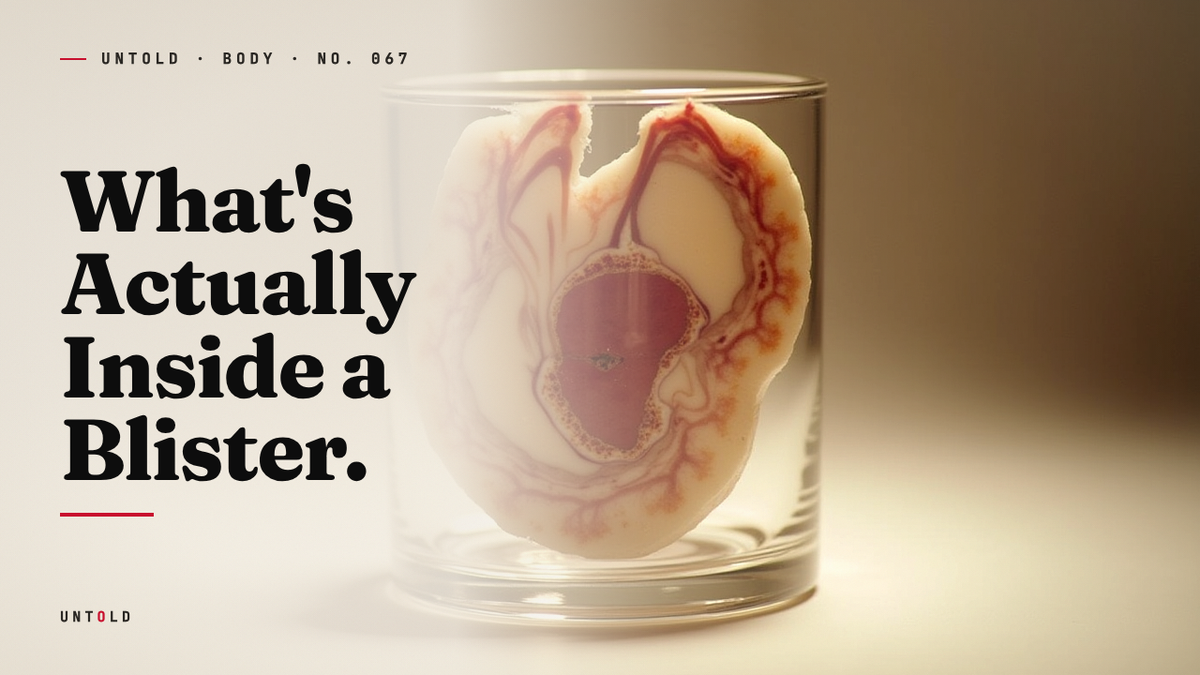
There is a good chance that somewhere on your body, right now, a small dome of skin is quietly filling with fluid. Perhaps it is on the back of a heel after a new pair of shoes, or across a palm after an afternoon of digging, or on a fingertip pressed too long against a hot mug. Whatever the cause, the object forming there is easy to dismiss as damage: a minor failure of skin, an inconvenience to be popped and forgotten.
That reading gets it almost exactly backwards. A blister is not the injury. It is the response to the injury, and a remarkably sophisticated one. In the space of an hour or less, the body identifies a specific kind of mechanical assault, separates its own tissue along a precise internal seam, floods the resulting cavity with a filtered blood product, and seals the whole thing under a sterile roof. Inside that dome, protected from the outside world, a repair crew begins laying down new skin. The bubble on your heel is less a wound than a temporary building site, complete with its own water supply and its own weatherproof cover.
Understanding what is actually happening in there changes how you should treat it. It also reveals something about how the body handles a threat that has followed humans across every mile they have ever walked.
The Seam That Friction Finds
Skin is not a single sheet. It is layered, glued surface upon surface, in a way that has often been compared to plywood. The outermost layer, the epidermis, is the shield: a stack of cells that are progressively flatter and deader toward the top, forming a tough, water-resistant barrier against the world. Beneath it lies the dermis, a very different territory: living, richly supplied with blood vessels, threaded with nerve endings and the machinery of sweat and sensation.
Between these two provinces runs a boundary, and within the epidermis itself there is a plane of relative weakness. This matters, because a blister is not simply the top of your skin lifting away from the flesh. When researchers examined the anatomy of friction blisters, they found that the split does not happen at the obvious junction between epidermis and dermis. It happens higher up, inside the epidermis, at a layer called the stratum spinosum. The cells there are torn apart, and the tissue cleaves cleanly along that internal seam.1
What produces the tear is not what most people assume. It is tempting to blame pressure: the weight bearing down on a foot, the grip of a tool against a palm. But pressure alone rarely raises a blister. The true culprit is shear, the sideways drag that occurs when one layer of skin is pulled in one direction while the layer beneath it stays put. Rub your skin back and forth against a stiff surface and those layers begin to slide against each other. On the surface, nothing dramatic seems to be happening. Deep inside, cells are being stretched and ruptured until the weak plane finally gives way.2
The result is a hollow. A microscopic empty space opens where solid tissue used to be. And a body, like the physicists who first coined the phrase, abhors a vacuum.
The Man Who Studied How Feet Break Down
Much of what we understand about how repeated friction wears down the human body traces back to a British surgeon named Paul Brand. Brand spent decades working with patients who had leprosy, a disease that destroys the nerves and, in doing so, robs people of the ability to feel pain. Watching hands and feet break down in patients who felt nothing, he made an observation that reframed the whole problem.3
The damage, Brand realized, was rarely the result of a single dramatic injury. It came from repetition: the same ordinary friction, applied over and over to tissue that never got the warning signal to stop. A person with healthy nerves feels the hot spot forming, shifts their weight, adjusts the shoe, and spares the skin. A person who cannot feel it keeps walking until the tissue simply fails. Pain, Brand argued in his later writing, was not the enemy. It was a gift, a protective system whose absence proved catastrophic.3
The blister sits squarely inside this logic. It is the body’s response to friction detected in time, the intervention that fires before the tissue is destroyed outright. The discomfort of a forming blister is itself a signal, part of the same protective apparatus Brand spent his life defending. The dome on your heel is what happens when the warning system is working.
Filling the Pool
Once the cavity opens, the body moves quickly. Fluid begins to seep from the small blood vessels of the dermis into the new empty space. This liquid is not water, and it is not quite blood. It is serum, sometimes called plasma with the clotting factors and the red cells left behind: clear, faintly straw-colored, and at first surprisingly clean. It is essentially the liquid fraction of blood, filtered of the cells that would make it red.4
This is where the accidental-damage reading falls apart entirely. The fluid is not leaking in by mistake. It is a cushion, and a deliberate one. By flooding the cavity, the body floats the torn upper skin above the raw, exposed layer beneath it, keeping the two apart so the delicate wound bed is not ground further by continued movement. The serum carries proteins, glucose to fuel the cells doing the repair, and elements of the immune system ready to fight any infection that breaches the walls.4 Under hard, sustained friction, the pool can fill in under an hour.
Above all, the sealed dome is sterile. As long as the roof stays intact, bacteria cannot reach the wound bed. The body has, in effect, built itself a private operating theatre: a clean, enclosed, fluid-filled chamber in which the actual reconstruction can proceed undisturbed. It is difficult to design a better emergency dressing, and the body assembles this one in minutes, without instruction.
Why Damp Skin Is a Blister’s Best Friend
Not all skin blisters equally, and the difference turns out to hinge on moisture in a way that is genuinely counterintuitive. British research into friction blisters, associated with the podiatric work of James Hutchinson and others who studied the mechanics of skin, found that the relationship between wetness and blistering is not a simple straight line.5
Bone-dry skin resists blistering reasonably well, because dry surfaces do not grip and drag against each other with the same force. Soaking-wet skin, oddly, also blisters less, because a film of water can act almost like a lubricant, letting surfaces slide past one another instead of catching. The danger zone is in between. Damp skin, the kind produced by a sweaty sock over a long afternoon, generates the highest friction of all. As skin moisture climbs toward a moderate level, roughly around the point where the surface is tacky rather than wet, the friction coefficient rises sharply, and with it the risk that shear will find the weak seam and tear it open.5
This is the physiological reason behind advice that hikers and soldiers have traded for generations. Wet feet are dangerous, but so are perpetually damp ones. The worst outcome is the slow accumulation of sweat that keeps skin in that high-friction middle state for hours. Dry socks, moisture-wicking fabrics, and the discipline of changing footwear on a long march are not fussiness. They are direct interventions in the physics of shear.
What the Army Learned From Sore Feet
Few institutions have paid closer attention to blisters than the military, and for a blunt reason: feet win and lose campaigns. For most of the history of warfare, armies moved at the pace of walking, and a soldier crippled by blistered feet was as removed from the fight as one who had been wounded. Poorly fitted boots have disabled troops before an enemy ever came into range, and the problem was serious enough to fund real science.6
Studies of marching soldiers and long-distance walkers have consistently confirmed the shear model over the pressure model. It is not the weight of the pack pressing down that raises the blister; it is the repeated sideways motion of the foot inside the boot, sliding a fraction of a millimeter with every step, thousands of steps into a long day. This is why blisters cluster at the heel and the ball of the foot, the places where the skin is dragged hardest against the shoe. And it is why the fit of a boot matters more than its cushioning. A well-fitted boot holds the foot in place and minimizes the internal slide; a loose one turns every stride into another cycle of shear.6
The scale of the problem is not trivial. On long treks, roughly one in three hikers develops foot blisters, and among military populations the rates during extended marches can be higher still. A single ill-fitting shoe can raise a blister within half an hour of hard walking. For a soldier, that is the difference between a functioning unit and a column of stragglers. The lesson the military distilled is one anyone can use: prevention is cheap and repair is expensive. Fit the shoe, dry the foot, and the seam never tears in the first place.
The Repair Crew Beneath the Dome
While the fluid cushions and the roof protects, the real work is happening on the floor of the cavity. The exposed base of the wound, the raw layer left behind when the epidermis split, becomes a construction site. New epidermal cells begin dividing at the margins and crawling inward across the wound bed, a process called re-epithelialization. Within a day or two, a fragile new surface layer starts to form beneath the fluid, the beginnings of a replacement for the skin that tore away.4
As this new floor firms up, the body no longer needs its temporary pool. The serum is gradually reabsorbed, the dome slowly flattens, and the old roof, that dead layer of blistered skin that felt so precarious, dries out and eventually peels away. By then it has done its job. It served as the body’s own bandage, holding the sterile chamber closed for exactly as long as the reconstruction underneath required. Most small blisters complete this cycle within seven to ten days, the whole process running on autopilot beneath a cover the body built for itself.4
Seen in sequence, the blister is not a single event but a coordinated project with a beginning, a middle, and a clean handover. Detect the shear. Split along the weak seam. Flood the cavity. Seal the roof. Rebuild the floor. Drain the pool. Shed the cover. Each step follows the last with a logic that looks, in retrospect, almost engineered.
The Case Against Popping
All of which leads to the counterintuitive conclusion, the one that runs against nearly universal instinct. Popping a blister does not help it heal faster. In most cases, it does the opposite.
The intact roof is the single best defense the wound has. It is a sterile, custom-fitted cover that keeps bacteria out of an open injury. Break that seal, and you have converted a clean, closed system into an exposed wound with a direct route for infection into the raw tissue beneath. The fluid you drain away was not waste; it was the cushion and the nutrient supply for the cells rebuilding the floor. This is why dermatologists overwhelmingly advise leaving small blisters alone.7
There are exceptions, made carefully. A blister that is very large, painfully tense, or positioned where it will certainly be torn open by continued use may reasonably be drained. But even then, the guidance is specific: use a clean, sterilized needle, make a small hole at the edge, let the fluid escape, and crucially, leave the roof in place. Do not peel it off. The dead skin stays as a natural dressing over the healing wound, precisely the role the body assigned it.7 Clean the area, cushion it against further friction, and let the enclosed system finish its work.
The better move, almost always, is upstream. Blisters are far easier to prevent than to treat. Well-fitted shoes, dry and low-friction socks, and attention to the first faint hint of a hot spot will stop most blisters before the seam ever splits. The body’s repair system is impressive, but it is a response to a threat that did not need to arrive.
A Small Dome, Fully Understood
It is worth sitting for a moment with what the blister actually represents. The next time one forms, you are not looking at a defect or a piece of bad luck. You are watching a rapid, layered, self-organizing repair, the kind of thing that would take a team of engineers and a supply chain to reproduce deliberately.
The body detected a specific mechanical injury, split its own tissue along a precise plane to relieve it, manufactured a sterile fluid dressing from its own blood, and sealed the whole operation under a cover that would protect the reconstruction for exactly as long as it took. Then, when the new skin was ready, it dismantled the whole apparatus and reabsorbed it, leaving nothing behind but a patch of fresh epidermis. That small, unglamorous bubble on your heel is a field hospital, built from scratch, staffed and stocked and sealed, in the time it takes to finish a walk. The least we can do in return is leave the roof alone.
Sources
- Naylor, P. F. D., “The skin surface and friction,” British Journal of Dermatology, 1955. — https://onlinelibrary.wiley.com/doi/10.1111/j.1365-2133.1955.tb12735.x
- Knapik, J. J. et al., “Friction blisters: pathophysiology, prevention and treatment,” Sports Medicine, 1995. — https://pubmed.ncbi.nlm.nih.gov/7784757/
- Brand, P. and Yancey, P., The Gift of Pain, Zondervan, 1997. — https://www.google.com/books/edition/The_Gift_of_Pain/qcYtnwEACAAJ
- Kirkham, S. et al., “The blister as a wound: structure and healing,” reviewed in Wounds UK, 2014. — https://www.wounds-uk.com/journals/issue/45/article-details/the-management-of-blisters
- Hutchinson, J. and coworkers, studies on skin hydration and friction, cited in Knapik et al., Sports Medicine, 1995. — https://pubmed.ncbi.nlm.nih.gov/7784757/
- Knapik, J. J. et al., “Influence of boot-sock systems on frequency and severity of foot blisters,” Military Medicine, 1996. — https://pubmed.ncbi.nlm.nih.gov/8935512/
- American Academy of Dermatology, “How to treat blisters,” AAD patient guidance, 2023. — https://www.aad.org/public/everyday-care/injured-skin/burns/treat-blisters
Related reading