The Voice That Speaks While You Sleep
Two in three of us talk in our sleep, and the reason has nothing to do with our secrets.
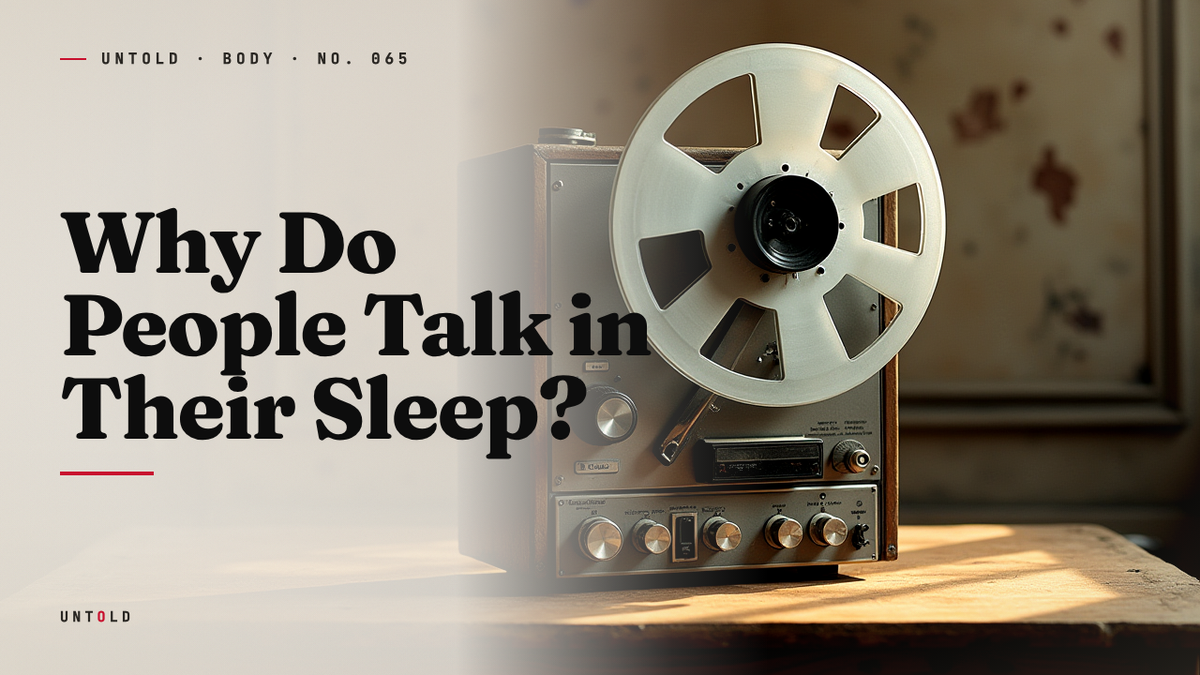
At three in the morning, in a bedroom somewhere, a person begins to speak. Not a mumble or a sigh, but full sentences. They laugh at a joke no one told. They argue with an absent adversary. They answer questions that no one asked, pausing afterward as if waiting for a reply. By every measure that matters, they are profoundly asleep: eyes closed, breathing slow, unresponsive to the room around them. And in the morning, when someone repeats their words back to them, they remember nothing at all.
This is sleep-talking, and doctors have a clinical name for it: somniloquy. It is one of the most ordinary strange things the human body does. Roughly two in three people will talk in their sleep at least once in their lives, which means the phenomenon is less an anomaly than a near-universal feature of the sleeping brain 1. Most of us have either done it or slept beside someone who has. And yet the underlying question remains genuinely peculiar. How does a brain that is, by all appearances, offline manage to produce grammatical speech? Who, exactly, is talking when nobody is awake?
The answer turns out to be far stranger than the folk theories that surround it. Sleep-talking is not a window into buried confessions or hidden desires. It is not the unconscious blurting out what the waking mind conceals. It is something quieter and more mechanical: a brain caught in the act of running its language machinery while the rest of the mind has powered down. To understand it, we have to follow the voice into the architecture of sleep itself.
The Nightly Descent
Sleep is not a single flat state that we switch on and off. It is a cycle, and we move through it several times each night. When we first drift off, we enter light sleep, the shallow border country between waking and unconsciousness. From there we descend into deep sleep, also called slow-wave sleep, the phase named for the long, rolling brain waves that sweep across the cortex. And then, most famously, we enter REM: rapid eye movement sleep, the stage where the eyes flick beneath closed lids and where most vivid dreaming occurs. Over the course of a night, we spiral through these phases in roughly ninety-minute loops, each one carrying us up and down through the layers of unconsciousness.
In healthy sleep, the body is meant to remain silent and still through all of it. That stillness is not an accident. During REM in particular, a switch in the brainstem effectively paralyzes the voluntary muscles. This state, known as REM atonia, is one of the more remarkable pieces of neural engineering in the human body. It exists for a very good reason: to stop us from physically acting out our dreams. Without it, a person dreaming of running would run, and a person dreaming of a fight would swing their fists. The paralysis is a safety lock, a nightly form of self-restraint imposed by the sleeping brain on the sleeping body 2.
The muscles of speech are part of what that lock is supposed to hold. And so sleep-talking presents a puzzle. If the brain silences the body precisely to keep dreams from leaking into the world, how does the voice slip past the barrier? Something, somewhere, is failing to hold the line, and the result is a person carrying on a conversation with no one, in a language they will not remember having spoken.
For a long time, the assumption was that sleep-talking belonged to dreaming, that the muttered words were the audible edge of a dream narrative bleeding through the paralysis. It was a tidy story. It was also, as a team of French researchers would eventually show, mostly wrong.
What the Microphones Heard
To find out when the talking actually happens, you have to catch it in the act, and that is not easy. Sleep-talking is unpredictable. It can happen once a month or several times a night, and it rarely obliges an observer by occurring on schedule. The neurologist Isabelle Arnulf and her colleagues at the Pitie-Salpetriere Hospital in Paris took on the problem with a straightforward but ambitious approach: gather a large group of chronic sleep-talkers, put them in a sleep laboratory, and record everything.
Their 2017 study, published in the journal Sleep, followed 232 adults across multiple nights of monitored sleep 3. Microphones ran through the dark, capturing every whisper, murmur, and shout, while the standard instruments of a sleep lab tracked brain waves, eye movements, and muscle activity. The haul was enormous. In total, the team recorded more than nine thousand distinct spoken episodes, an unprecedented archive of the sleeping voice.
The first surprise was about timing. Most of the sleep-talking did not happen during REM, the dreaming stage where researchers had long expected to find it. Instead, a large share occurred during non-REM sleep, the deeper, supposedly quieter phases where vivid dreaming is less common. The old assumption that sleep-talk was simply dream narration escaping through the paralysis did not survive contact with the data. Whatever the sleeping brain was doing, it was doing a great deal of it outside the dream state entirely.
The second surprise was about content, and it was even stranger. The speech was not garbled or nonsensical. It was startlingly ordinary. The sleepers used real grammar, correct syntax, and the ordinary structure of conversation. They took turns. They left silent gaps in their speech, pauses that seemed to hold space for a reply, as if the sleeper were talking to a partner only they could perceive. The rhythm of dialogue survived even when the dialogue itself had no other participant. The brain was not just producing words. It was producing the shape of a conversation.
An Attitude in the Dark
When the researchers looked closely at what people actually said, a curious personality emerged from the data. The single most common word recorded across all those thousands of episodes was, fittingly, the word “no.” The sleeping mind, it seemed, spent a great deal of its time refusing, objecting, and pushing back. Negation dominated the nighttime lexicon in a way it does not dominate ordinary waking speech.
And the sleepers had an edge to them. Nearly a quarter of the recorded episodes, close to 24 percent, contained profanity of some kind 3. This is a strikingly high rate. In ordinary daytime conversation, swearing accounts for a tiny fraction of what most people say. The proportion in sleep speech was dramatically higher, which suggests that whatever governs our verbal restraint while awake loosens considerably in the dark. The sleeping brain, it turns out, has something of an attitude. It argues, it refuses, and it curses at phantoms.
There is a tempting reading here, one that runs straight toward the idea of a hidden self. Perhaps the swearing and the refusals reveal the real person underneath the polite waking mask. Perhaps sleep-talk is the id speaking. The Paris researchers were careful not to endorse that leap, and for good reason. A more grounded interpretation is that these features reflect the state of the brain rather than the state of the soul. Regions that handle emotionally charged and reactive language may simply be more prone to firing when the higher controls that normally filter our speech are offline. Swearing is verbally salient and emotionally loaded, exactly the kind of material a disinhibited system might surface. It is a signature of loosened restraint, not of concealed truth.
When Part of the Brain Wakes
So why does the voice escape at all? The clearest way to understand sleep-talking is to see it not as an isolated quirk but as one member of a family. It rarely travels alone. It tends to cluster with sleepwalking, with night terrors, with the teeth grinding known as bruxism, and with a range of other nighttime events. Doctors group these phenomena together under a single umbrella term: parasomnias, meaning intrusions into sleep, behaviors that erupt where stillness should be 4.
The unifying idea behind parasomnias is deceptively simple. In a parasomnia, part of the brain wakes up while the rest of it stays asleep. The sleeping brain is not a uniform block of unconsciousness. It is a collection of regions, and those regions do not always switch states in perfect unison. During a parasomnia, one system comes partly online, activating some capacity, movement, or speech, while the network that supports full conscious awareness remains dark. In the case of sleep-talking, the brain’s speech regions fire and drive the muscles of the mouth and throat, but the person doing the talking is not conscious, not aware, and lays down no memory of any of it. Speech without a speaker. The machinery runs, but no one is home to hear it.
This is why sleep-talkers remember nothing in the morning. Memory formation depends on the very awareness that stays offline during the episode. The words are produced, spoken into the room, and then gone, never encoded, never available for recall. The conversation happens, and then it does not exist.
Written Into the Family
If a partial awakening is the immediate mechanism, the deeper question is why some brains are prone to it and others are not. Here the evidence points firmly toward inheritance. A 1998 Finnish study of twins examined how often sleep-talking co-occurred within pairs and found that it runs strongly in families 5. Identical twins, who share essentially all their genes, were far more likely to both be sleep-talkers than fraternal twins, who share only about half. That gap is the classic fingerprint of a heritable trait. The genetic loading is real and substantial. If your parents talked in their sleep, the odds are good that you do too.
Genetics sets the stage, but it does not act alone. A range of ordinary circumstances can raise the likelihood of an episode on any given night. Stress is a well-documented trigger, as is fever, which is part of why sleep-talking often spikes during illness. Sleep deprivation itself makes episodes more likely, a small irony given that the phenomenon lives inside sleep. Alcohol and certain medications loosen the brain’s nighttime controls, making the barriers between sleep states more porous and easier to breach. None of these causes the underlying tendency. They simply lower the threshold at which the latent trait expresses itself.
Sleep-talking is also, importantly, a phenomenon of childhood as much as adulthood. It is extremely common in the young and almost always entirely harmless. Estimates suggest that up to half of young children talk in their sleep at least occasionally, a rate far higher than in adults 4. For most of them, it fades on its own. The great majority outgrow it by their teenage years, as the sleeping brain matures and the boundaries between its states grow firmer. For parents, a child narrating in the dark is rarely cause for alarm. It is a passing feature of a developing nervous system.
No Confession in the Dark
The most persistent belief about sleep-talking is that it reveals something hidden. If a sleeper speaks without a filter, the reasoning goes, then surely the words carry truths the waking mind would never admit. It is a compelling story, and it is the reason people lean in when a partner starts murmuring in the night, half hoping and half fearing they will overhear a secret.
The evidence does not support it. Studies of sleep speech have found no reliable link between what a person says asleep and any meaningful reality in their waking life 3. The words rarely connect to genuine events, buried desires, or concealed confessions. They are not coded messages from a truer self. The midnight monologue is not a confession booth, and the sleeper is not on trial.
What it appears to be instead is something almost mundane by comparison, and in its own way more interesting. The sleeping brain is replaying the machinery of language, running the circuits of speech through their paces with no conscious mind at the controls. It is a rehearsal with no audience, no memory afterward, and no meaning to be decoded. The grammar is intact because grammar is deeply automatic, wired into systems that can operate without oversight. The turn-taking survives because conversation is a pattern the brain knows so well it can perform the steps in its sleep, literally.
For the overwhelming majority of people, sleep-talking requires no treatment at all. It becomes worth a doctor’s attention only when it seriously disrupts rest, either the sleeper’s own or a partner’s, or when it arrives alongside more dramatic behaviors. Violent movement during sleep, in particular, can signal a disorder in which the REM paralysis fails more completely, and that is worth investigating. But a person quietly arguing with the dark, cursing at a phantom, or refusing an invisible request is simply a brain doing what brains do when part of them wakes too soon.
So the next time someone mumbles beside you in the night, there is no need to strain for the hidden meaning, and no reason to feel you have overheard something you shouldn’t. Listen gently, if you listen at all. What you are hearing is not a secret escaping. It is a mind alone in the dark, practicing the oldest human trick of all, still rehearsing how to speak to someone who is not there.
Sources
- Bjorvatn, B. et al., Prevalence of parasomnias in the general population, Sleep Medicine, 2010. — https://pubmed.ncbi.nlm.nih.gov/21036661/
- Peever, J. and Fuller, P. M., The Biology of REM Sleep, Current Biology, 2017. — https://www.cell.com/current-biology/fulltext/S0960-9822(17)31329-8
- Arnulf, I. et al., What Does the Sleeping Brain Say? Syntax and Semantics of Sleep Talking in Healthy Subjects and in Parasomnia Patients, Sleep, 2017. — https://academic.oup.com/sleep/article/40/11/zsx159/4160168
- American Academy of Sleep Medicine, International Classification of Sleep Disorders, 3rd Edition, 2014. — https://aasm.org/clinical-resources/international-classification-sleep-disorders/
- Hublin, C. et al., Sleeptalking in twins: epidemiology and psychiatric comorbidity, Behavior Genetics, 1998. — https://pubmed.ncbi.nlm.nih.gov/9803020/
- Bassetti, C. L. et al., Sleep Medicine Textbook (parasomnias section), European Sleep Research Society, 2021. — https://esrs.eu/sleep-medicine-textbook/
Related reading