The Disease That Became a Comfort
For three centuries doctors tried to cure nostalgia. Then a lonely psychologist asked what it was actually for.
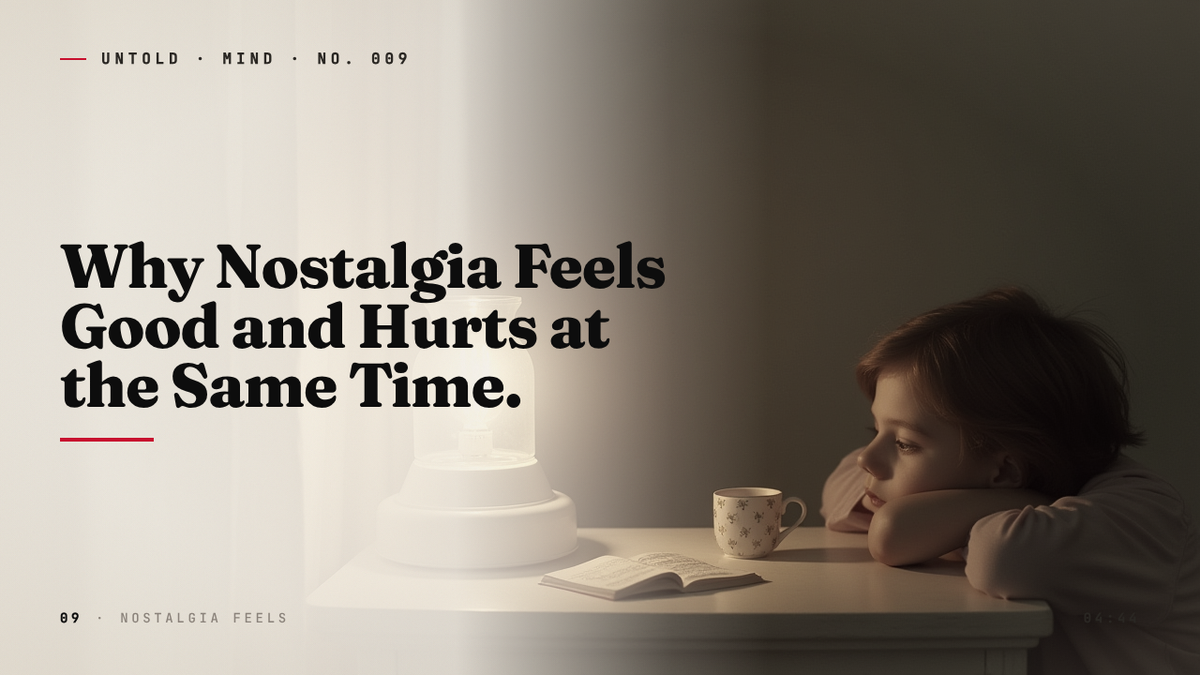
A song slips out of a passing car. Three notes in, you are no longer on the street. You are seventeen, in a kitchen that no longer exists, looking at a person who has since moved away or grown old or stopped speaking to you. Your chest tightens. You smile. Something close to grief moves through you, but it is not grief, exactly. It is warmer than that, and stranger.
This feeling has a name in nearly every language ever surveyed by psychologists, and for almost three hundred years European doctors treated it as a disease. They diagnosed it in soldiers. They prescribed leeches for it. A handful of patients, according to military medical records, are said to have died of it. The cure, physicians agreed, was simple: send the sufferer home, immediately, before the condition deepened.
The disease was nostalgia. The fact that we now chase it on purpose, in curated playlists and shoeboxes of photographs and the slow scroll through a decade-old camera roll, is one of the stranger reversals in the history of human emotion.
A Swiss Student Invents a Disease
The word was coined in 1688 by Johannes Hofer, a medical student at the University of Basel, in a dissertation that reads today like a cross between epidemiology and homesickness poetry. 1 Hofer had been observing Swiss mercenaries fighting on foreign payrolls, particularly young men from the alpine cantons stationed in the lowlands of France and Italy. Something was happening to them. They wept without provocation. They refused food. They developed fevers, heart palpitations, persistent insomnia. Some of them, posted far from the mountains they had grown up in, simply wasted away in their barracks.
Hofer believed he had identified a discrete medical condition, and he named it by stitching together two Greek roots: nostos, the return home, and algos, pain. Nostalgia. The pain of wanting to return.
For the next two centuries, European medicine took the diagnosis entirely seriously. Physicians debated whether nostalgia was caused by atmospheric pressure, by a thickening of the blood, by overstimulation of the imagination, or by an excessive love of one’s birthplace. Military surgeons saw it as an occupational hazard. During the American Civil War, Union army doctors recorded thousands of cases, and at least seventy-four soldiers were officially listed as having died of nostalgia by the end of the conflict, their deaths attributed to the condition itself rather than to the dysentery, exhaustion or pneumonia that almost certainly killed them. 2 Confederate field hospitals reported similar numbers.
Treatments ranged from the cruel to the merely useless. Leeches and bloodletting were standard. Some surgeons prescribed opium, others stern lectures on military discipline, others outright ridicule, on the theory that shaming a soldier out of his longing was kinder than letting him drown in it. The most reliable cure, everyone agreed, was furlough. Put the man on a train back to his village and the symptoms usually lifted within days.
Then, somewhere between the end of the nineteenth century and the rise of modern psychiatry, the diagnosis quietly vanished. Nostalgia stopped being a disease and became, instead, a personality flaw. Freud’s followers reframed it as a regressive impulse, a refusal to grow up. Cold War sociologists called it sentimentality, the soft thinking of people who could not face the present. By the middle of the twentieth century, the word had drifted into the territory of advertising jingles and the dusted-off photo album, and serious researchers had stopped paying it any attention at all.
The Psychologist Who Took It Seriously Again
In the late 1990s, a social psychologist named Constantine Sedikides found himself, somewhat awkwardly, in the grip of the very emotion his discipline had stopped studying. Sedikides had recently moved from the United States to the University of Southampton in England, and he was missing his old colleagues, his old apartment, the specific texture of his old life. He mentioned this, casually, to a colleague in the clinical psychology department.
The colleague’s response was a warning. Nostalgia, he was told, was simply depression dressed up in nicer clothes. It was a symptom, not a feeling. He should probably see someone.
Sedikides did not see someone. He suspected the colleague was wrong, and more importantly, he suspected the entire field had quietly accepted an assumption no one had ever bothered to test. So he did what experimental psychologists do when they are annoyed. He designed a study. 3
The protocol was simple. Participants were asked to recall a nostalgic memory in vivid detail, then complete questionnaires measuring mood, self-esteem, sense of belonging, and perceived meaningfulness of life. A control group was asked to recall an ordinary memory from the past week. The hypothesis Sedikides expected to disprove was the clinical-psychology consensus: that nostalgic recall would depress mood and indicate vulnerability.
The results, when they came back, were the opposite. People who had spent five minutes immersed in a nostalgic memory reported higher self-esteem afterwards, not lower. They felt more socially connected, more loved, more confident that their lives meant something. The effect was small but consistent, and it replicated across follow-up studies in different countries, age groups, and cultural contexts.
Nostalgia, it turned out, was not the wound. It was the bandage the mind reached for when something was wrong.
When the Mind Reaches for It
Once Sedikides and his collaborators began looking, they found nostalgia surfacing in a remarkably specific set of circumstances. It rose after social rejection. It rose after reminders of mortality. It rose during periods of loneliness, after long days spent without conversation, after rumination on failure or loss. In a now well-replicated finding, it rose when people were physically cold: participants in colder rooms reported more nostalgic feelings, and nostalgic recall in turn made people feel physically warmer. 4
The pattern suggested something almost mechanical. Nostalgia behaved less like a mood and more like a thermostat. When some psychological need dropped below a threshold, whether belonging, warmth, meaning, or self-worth, the mind reached back into the archive for evidence that the need had once been met. The evidence, replayed in detail, partially restored the missing thing.
This is a different theory of memory than the one most people carry around. We tend to think of remembering as a passive act, a kind of involuntary haunting. What the Southampton group’s work suggests is that certain kinds of remembering are active and adaptive: the brain is not merely replaying the tape but using it, deploying selected scenes from the past as raw material for psychological repair.
The ache that comes with the warmth is not a bug in the system. It is part of how the system works.
The Bittersweet Signature
When researchers began running nostalgic recall under functional MRI, the neural picture clarified the emotional one. 5 Two large systems light up at the same time, and they are not systems that ordinarily cooperate.
The first is autobiographical memory: the hippocampus and surrounding medial temporal structures, replaying the scene, reconstructing the kitchen, the face, the weather. The second is the reward network, principally the ventral striatum and parts of the substantia nigra, the same circuitry that responds to food, music, and the prospect of money. The brain, in other words, is paying itself to remember. Each replay is reinforced, and the reinforcement is what gives nostalgia its peculiar pull, its tendency to deepen the longer you let it run.
But a third region is also active, and this is the part that confused researchers initially: areas associated with sadness and loss, including parts of the anterior cingulate. The simultaneous firing of reward and loss circuitry is the neural correlate of what psychologists have come to call the bittersweet signature of nostalgia, the felt sense that pleasure and grief are not alternating but fused, two ingredients of a single emotion rather than a rapid oscillation between two.
The ache, on this account, is functional. It is the part of the signal that reminds you the scene is over, that the kitchen is gone, that the person is no longer reachable by phone. Without the ache, nostalgia would collapse into mere pleasant recollection, and the mind would have no reason to do anything about the longing it surfaces. With the ache, it becomes a kind of instruction.
The Soundtrack You Will Mourn
The instruction usually arrives through a sense, and the sense is usually hearing. Music is the most reliable trigger of nostalgic experience in laboratory studies, far more potent than photographs, more reliable than written description. Smell runs a close second, owing to the unusual neuroanatomy of olfaction, which routes directly into limbic structures without the cortical detour that other senses take. But it is music that does most of the work.
The songs that do it best, almost without exception, are the ones a person first encountered between the ages of roughly fifteen and twenty-five. Memory researchers call this phenomenon the reminiscence bump, and it has been documented in samples on every continent. 6 When older adults are asked to recall the most vivid autobiographical memories of their lives, the distribution does not slope smoothly back into childhood. It spikes, sharply, in late adolescence and early adulthood, and the spike is particularly pronounced for music, films, and books.
There are several theories about why. The cognitive theory holds that the brain is still maturing during these years and encodes experience with unusual richness. The identity theory holds that this is the period during which a self is being constructed, so the material being encoded is, by necessity, marked as important. The novelty theory holds that more things are happening for the first time during these years than at any other point in a normal life, and first-time experiences are encoded more durably.
Whatever the mechanism, the consequence is that everyone walks around with a soundtrack they did not choose. The songs of those ten years will follow a person into their eighties, surfacing in supermarkets and dentists’ waiting rooms and the speakers of passing cars, and each surfacing will produce the same small fissure of warmth and loss. This is why a generation can be identified, with surprising accuracy, by what makes its members cry in elevators.
Cross-cultural work suggests the underlying feeling is essentially universal. The Portuguese have saudade, the Welsh hiraeth, the Romanians dor, the Japanese a constellation of related concepts including natsukashii. The vocabulary differs, sometimes substantially. The phenomenology, when researchers probe carefully, does not. Every culture so far measured produces the same basic profile: a longing for a personal past, mingled with affection, mingled with the recognition that the past is closed. 7
The Twist That Changes Everything
The finding that has most reshaped how psychologists think about nostalgia is also the most counterintuitive, and it took fMRI work to make it visible. Nostalgia, on the neural evidence, is not primarily about the past at all.
When the brain enters a nostalgic state, the regions that activate include the default mode network, a constellation of midline structures that is also responsible for prospection, imagining the future, mental time travel forward as well as backward. The same machinery the mind uses to rehearse tomorrow is the machinery it uses to revisit yesterday, and during nostalgia the two functions appear to bleed into one another.
This fits with a body of behavioural work showing that nostalgic recall does not, as one might expect, leave people passive or withdrawn. The opposite tends to happen. After a nostalgic induction in the laboratory, participants are more willing to approach strangers, more generous in donation tasks, more optimistic about their own future prospects, more tolerant of risk in service of long-term goals. 8 One study found that nostalgia increased people’s willingness to give blood. Another found that it reduced the influence of mortality reminders, the death-anxiety primes that ordinarily make experimental subjects more defensive and self-protective.
The interpretation that has emerged is that nostalgia functions, in part, as a psychological resource for forward motion. The mind is not retreating into the past when it summons a vivid memory of being loved. It is borrowing warmth from a confirmed source and using that warmth as currency for whatever uncertain thing it is about to attempt next. The kitchen at seventeen is collateral. The courage is for tomorrow.
This reframing helps make sense of a peculiar feature of the emotion that anyone who has felt it can recognise. Deep nostalgia rarely leaves a person feeling defeated. It leaves them, more often, with a quiet sense that something matters, that they have been someone, that the next phone call is worth making. Pure sadness has no such residue. Depression, the condition for which nostalgia was once mistaken, hollows out the future. Nostalgia, on the current evidence, refurnishes it.
What the Swiss Mercenaries Were Actually Telling Us
The Swiss soldiers Hofer studied in 1688 were almost certainly not dying of homesickness in any direct medical sense. They were dying of dysentery, of cold, of poor sanitation, of the ordinary slaughter of seventeenth-century military life. What Hofer saw in their faces and in their refusal to eat was something subtler than a disease, but he was not entirely wrong to take it seriously.
What he was watching, almost certainly, was the failure mode of the very system Sedikides would identify three centuries later. The mind reaches into the archive to compensate for missing belonging, missing warmth, missing meaning, and ordinarily the compensation works. The replayed kitchen, the remembered face, the song carried in the head, these are usually enough to keep a person upright until they can find the real thing again. But if the missing thing stays missing for long enough, and the replays are all a person has, the system can tip from regulation into rumination. The longing stops being fuel and becomes its own kind of starvation. This, almost certainly, was what the army surgeons were watching when they saw a young man stop eating.
The mistake the seventeenth-century doctors made was not in taking nostalgia seriously. The mistake was in thinking the longing itself was the pathology, rather than the conditions that had made the longing impossible to act on. Send the man home and the symptoms resolved, not because the disease had been cured, but because the system had been allowed to do what it was designed to do, close the loop between memory and the present, between the kitchen at seventeen and a kitchen tonight.
Most people, most of the time, are not Swiss mercenaries. The kitchens they remember are still reachable by phone, the people still alive, the songs still on whatever platform they pay for now. For those people, the small fissure that opens when three notes drift out of a passing car is not a disease and never was. It is the mind, doing maintenance, drawing a thread between who a person has been and who they are about to try to be next.
The ache is the part of the signal that hurts because it works. It hurts because the moment is gone, and the gone-ness is what makes it precious, and the preciousness is what gives the warmth its leverage. A song that did not also wound a little would not also matter. The next time it happens, on a street or in a supermarket or in the dark before sleep, there is nothing to push away. Something ancient is stitching a person back to themselves, across decades, in a single breath. Nostalgia hurts because it matters. It matters because they do.
Sources
- Hofer, J., ‘Medical Dissertation on Nostalgia’ (1688), trans. Anspach, Bulletin of the History of Medicine, 1934. — https://www.jstor.org/stable/44437799
- Anderson, D., ‘Dying of Nostalgia: Homesickness in the Union Army during the Civil War,’ Civil War History, 2010. — https://muse.jhu.edu/article/396750
- Sedikides, C., Wildschut, T., & Baden, D., ‘Nostalgia: Conceptual Issues and Existential Functions,’ Handbook of Experimental Existential Psychology, 2004. — https://psycnet.apa.org/record/2004-19514-013
- Zhou, X., Wildschut, T., Sedikides, C., Chen, X., & Vingerhoets, A., ‘Heartwarming Memories: Nostalgia Maintains Physiological Comfort,’ Emotion, 2012. — https://psycnet.apa.org/record/2011-23598-001
- Yang, Z., Wildschut, T., Izuma, K., et al., ‘Patterns of brain activity associated with nostalgia: a social-cognitive neuroscience perspective,’ Social Cognitive and Affective Neuroscience, 2022. — https://academic.oup.com/scan/article/17/12/1131/6582315
- Rubin, D. C., & Schulkind, M. D., ‘The distribution of autobiographical memories across the lifespan,’ Memory & Cognition, 1997. — https://link.springer.com/article/10.3758/BF03211324
- Hepper, E. G., Wildschut, T., Sedikides, C., et al., ‘Pancultural nostalgia: prototypical conceptions across cultures,’ Emotion, 2014. — https://psycnet.apa.org/record/2014-04602-001
- Stephan, E., Sedikides, C., Wildschut, T., et al., ‘Nostalgia-Evoked Inspiration: Mediating Mechanisms and Motivational Implications,’ Personality and Social Psychology Bulletin, 2015. — https://journals.sagepub.com/doi/10.1177/0146167215596985
- Boym, S., ‘The Future of Nostalgia,’ Basic Books, 2001. — https://www.basicbooks.com/titles/svetlana-boym/the-future-of-nostalgia/9780465007080/
- Routledge, C., ‘Nostalgia: A Psychological Resource,’ Routledge, 2015. — https://www.routledge.com/Nostalgia-A-Psychological-Resource/Routledge/p/book/9781848724228
Related reading