The Elixir That Ate a Man's Jaw
How the deadliest health craze of the twentieth century was not a fraud but a triumph of applied science.
In the spring of 1932, a reporter for The Wall Street Journal filed a story with one of the most quietly devastating headlines in the history of American journalism. “The Radium Water Worked Fine Until His Jaw Came Off.” 1 The man in question was Eben Byers, a Pittsburgh steel heir, an amateur golf champion, and for a brief period one of the most fashionable invalids in the United States. He had spent the better part of three years drinking a patent tonic called Radithor, a bottle of distilled water infused with two isotopes of radium. By the time he died, his skull was riddled with holes, most of his jaw had been surgically removed, and his bones had begun to break apart from within.
The most unsettling detail is not that Byers was swindled. He was not. Radithor contained exactly what its label promised: certified, measurable, genuine radium. The tonic did precisely what its chemistry dictated it would do. This was not the story of a con man selling colored water to the gullible. It was something stranger and more disturbing: real science, correctly applied, marketed as medicine, and consumed as fashion. For roughly a decade, the most glamorous path to health in the Western world was slow, luminous poison.
The Age of the Miracle Element
To understand how a lethal isotope became a lifestyle, one has to return to the moment radium entered human awareness. In 1898, working in a converted shed in Paris, Marie and Pierre Curie isolated a new element from tons of uranium ore. 2 It was extraordinarily rare, extraordinarily expensive, and it glowed. In the dark, a speck of radium salt threw off a faint blue-green light that seemed to come from nowhere. It gave off heat without burning, radiated energy without any visible source, and appeared, to the scientists studying it, almost alive.
Marie Curie herself kept a vial of the stuff by her bedside to admire its glow. She and Pierre would win the Nobel Prize in Physics in 1903, and Marie a second, in Chemistry, in 1911. The element became a symbol of the new century’s boundless promise. If a substance could produce light and warmth apparently for free, defying the laws that governed ordinary matter, then surely the old limits no longer applied. The public did not grasp the physics. What they grasped was the poetry. Radium was energy made visible, and energy was vitality, and vitality was youth.
From that intuition, an entire industry bloomed. By 1920, radium had migrated from the laboratory onto the shelves of respectable pharmacies. There was radium toothpaste, sold on the promise of a brighter smile. There was radium chocolate, radium bread, radium face cream marketed to smooth the skin. There were radium suppositories advertised, without irony, as a cure for flagging masculine vigor. There was radium-infused water, and there were even radium-lined jars into which consumers could pour ordinary tap water overnight to render it, supposedly, therapeutic. Doctors prescribed these products. Department stores stocked them. Newspapers ran breathless features on the healing rays of the miracle element. Almost no one asked what radiation actually did to living tissue, because almost no one yet understood it, and the few who suspected were easy to ignore against the tide of enthusiasm.
The logic was seductive precisely because it was simple. Radium glowed. Living things pulsed with energy. Therefore radium, taken into the body, must transfer some of its inexhaustible vigor to the person consuming it. It was the kind of reasoning that feels obvious right up until the moment it kills you.
The Man Who Bottled It
Into this atmosphere stepped William J. A. Bailey, a figure who embodied the strange respectability of the radium boom. Bailey styled himself a doctor, though he was not one. He had attended Harvard but never graduated, and he had already left a trail of failed and fraudulent ventures behind him, including one selling a supposed aphrodisiac. 3 What Bailey understood, better than most trained physicians of his day, was the commercial power of certification. His genius, if it can be called that, was to sell a product that was not fake.
The tonic he created in the mid-1920s was called Radithor: triple-distilled water containing a carefully measured dose of two radium isotopes, radium-226 and radium-228. Bailey did not water down his product to cheat his customers. On the contrary, he guaranteed its potency, and independent testing after his customers began dying confirmed that the bottles contained precisely the radium he claimed. He marketed Radithor as a cure for more than a hundred ailments, from fatigue and high blood pressure to impotence and mental decline. A single bottle sold for one dollar, roughly twenty dollars in today’s money, and the customer was invited to drink the contents like a health tonic, one small bottle at a time.
For a certain kind of wealthy, worried, self-improving American, this was irresistible. And no one embraced it more completely than Eben Byers.
Fourteen Hundred Bottles
Byers was, by the standards of 1927, a man who had everything. He had won the U.S. Amateur golf championship in 1906. He ran a steel company. He moved through society with the ease of the very rich, kept racehorses, and cultivated a reputation for physical vigor. Then, returning by train from a football game late in 1927, he fell from an upper berth and injured his arm. The pain lingered and interfered with his golf, and a physician, casting about for something to restore his famous energy, suggested he try Radithor. 4
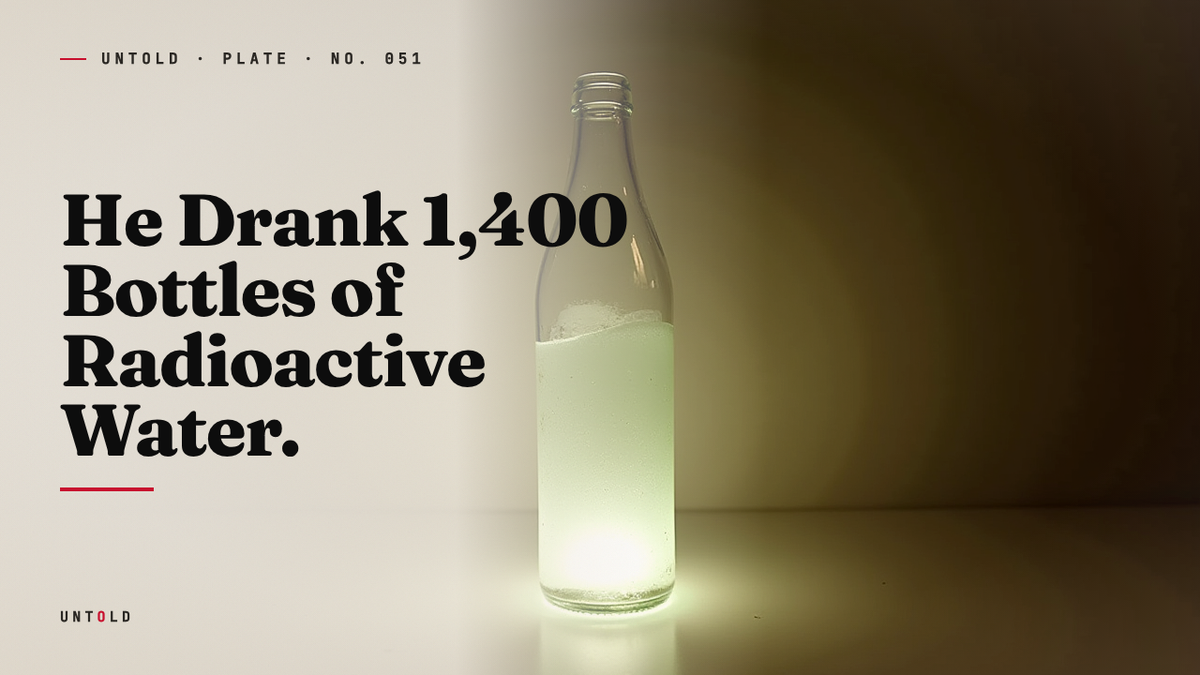
Byers did more than try it. He was, by his own account, transformed. He felt stronger, sharper, more alive. He began drinking the tonic in earnest, several bottles a day at his peak, and he did not stop. Over roughly three years he consumed nearly fourteen hundred bottles. He recommended it to friends and business associates. He sent cases of it to his mistresses and even, reportedly, gave it to a favorite racehorse. He was not being poisoned against his will. He was, in the most literal sense, a satisfied customer, right up until the poison announced itself.
The mechanism of what happened inside his body is a quiet horror of biochemistry. Radium sits directly below calcium on the periodic table, and the body cannot tell the two apart. When Byers drank Radithor, his system treated the radium as though it were dietary calcium and deposited it in the one place calcium belongs: his bones. There it stayed, lodged permanently in his skeleton, emitting alpha and gamma radiation into the surrounding tissue day and night, for the rest of his life. He was, in effect, irradiated continuously from the inside, in the marrow and the jaw and the skull, with no way to stop it and no way to remove it.
The damage surfaced first in his mouth. By 1930 his teeth began to loosen and fall out. His jawbone, saturated with radium, developed the necrosis that would come to be called radium jaw: the bone tissue simply dying and rotting away. Surgeons removed most of his upper and lower jaw in an attempt to slow the destruction. It did not slow. One physician who examined him described the radium as having eaten holes clean through his skull. By the time he died in March 1932, Eben Byers weighed barely ninety pounds, could no longer speak clearly, and was suffering kidney failure and abscesses of the brain. He was buried in a coffin lined with lead, because his corpse was radioactive enough to warrant it. Decades later, when his remains were exhumed and measured, his bones still registered radiation.
The Girls in the Dial Factories
While the rich poisoned themselves for pleasure, a quieter and larger catastrophe was unfolding among the working poor, and it had begun even earlier. During the First World War, watch and instrument manufacturers discovered that radium paint, luminous and self-glowing, was perfect for dial faces that soldiers needed to read in the dark. Factories in New Jersey, Illinois, and Connecticut hired young women, many of them still teenagers, to paint the tiny numerals and hands by hand.
The work required extraordinary precision, and to keep their brushes fine enough to paint a hairline stroke, the women were taught to shape the bristles with their lips. Lip, dip, paint. Lip, dip, paint. With every point they drew across their tongues, they swallowed a trace of radium, hour after hour, day after day. Some of them, enchanted by the glow, painted their fingernails and teeth with the luminous stuff for fun, or dabbed it on their faces so they would shine at evening dances. 5
The consequences arrived a few years later and mirrored what would happen to Byers. The women, who came to be known to history as the Radium Girls, began to suffer aching teeth and swollen jaws. Their dentists pulled infected teeth only to find the sockets would not heal. Bone crumbled. In one now-notorious case, a woman’s jaw came away in her doctor’s hands. Others suffered spontaneous fractures of the leg and spine simply from standing or walking, their skeletons hollowed out by radiation. Several died before anyone connected their illnesses to the paint they had been swallowing.
What made the story a scandal rather than merely a tragedy was what the companies knew. Executives and chemists at the United States Radium Corporation handled the same material behind lead screens, wearing lead aprons, using tongs and masks. The men who ran the plants protected themselves scrupulously while assuring the women on the line that the paint was harmless, even wholesome. A group of five stricken workers, led by Grace Fryer, sued the corporation in the late 1920s. Fryer had to fight simply to find a lawyer willing to take the case, and by the time the suit was heard, some of the women were too ill to raise their arms to swear an oath. 6 They settled in 1928, receiving lump sums and medical costs, but the deeper victory was not financial. Their case, and the public fury it generated, helped establish the principle that employers bear responsibility for the safety of their workers and helped seed the field of occupational health that would shape labor law for the rest of the century.
Real Science, Correctly Applied
The temptation, looking back, is to file all of this under quackery, to imagine that the victims were fooled by a fraud that any sensible person would have seen through. But that reading gets the horror exactly backwards. Radithor was not snake oil. The dial paint was not a hoax. Both products contained genuine radium and did precisely what the physics of radium dictates. The very property that made the element seem miraculous, its ceaseless emission of energy, was the property that destroyed the tissue around it. The glow that promised life was the mechanism of death. There was no gap between the marketing and the chemistry. The advertising was, in a grim sense, accurate. Radithor really did fill the body with radiant energy. That was the problem.
This is what separated the radium craze from ordinary fraud and made it so effective and so lethal. A fake tonic fails to work and is eventually exposed by its own inertness. Radithor worked. Customers felt the effect, or believed they did, and the delay between consumption and catastrophe, often years, meant the harm was invisible during the window when a person might have stopped. By the time Byers’s jaw disintegrated, the radium was already in his bones, and there was nothing to be done. Real science, applied to a question no one had thought to ask about consequences, proved far deadlier than any charlatan’s water ever could.
The Pattern That Outlives the Poison
Eben Byers’s death did what a decade of scattered warnings had failed to do. The grotesque, well-documented end of a wealthy and famous man, complete with the removal of his jaw and the lead-lined coffin, could not be ignored. It galvanized regulators and gave the Food and Drug Administration and the Federal Trade Commission the political momentum to pursue radioactive patent medicines and, more broadly, to strengthen the federal power to protect consumers from products sold as cures. 7 Radithor and its glowing cousins vanished from the shelves. Bailey, remarkably, never expressed remorse, insisted his tonic was safe, and continued to promote radium products in various forms until his own death in 1949. When his body was exhumed decades later for study, it too was found to be riddled with radiation.
The tonics disappeared, but the shape of the story did not. Every era manufactures its own miracle: a substance, a diet, a product that seems to offer effortless vitality and arrives wrapped in the authority of the latest science. In the decades since radium, that pattern has repeated with a dull persistence. Partially hydrogenated oils, the trans fats once celebrated as a clean modern substitute for animal lard, were engineered into the food supply for half a century before their contribution to heart disease was fully reckoned. Cigarettes were advertised by physicians. Detox cleanses and megadose supplements still promise to flush and fortify bodies that were flushing and fortifying themselves perfectly well.
What the radium craze offers is not a lesson about foolishness but a lesson about the seduction of incomplete knowledge. The people who drank Radithor were not stupid. They were living inside the certainties of their moment, and their moment was certain that a glowing element must be good for you. The uncomfortable truth is that we live inside our own certainties now, and some of them will look, to our descendants, as reckless as licking a radium brush. The most useful question to carry away from Eben Byers is not whether a new marvel works. Radithor worked. The question is quieter and harder: what do we not yet understand about what it does to us?
Sources
- Macklis, R. M., “The Great Radium Scandal,” Scientific American, 1993 — https://www.scientificamerican.com/article/the-great-radium-scandal/
- Curie, M. and Curie, P., Nobel Prize in Physics biographical notes, NobelPrize.org, 1903 — https://www.nobelprize.org/prizes/physics/1903/marie-curie/facts/
- Frame, P., “Radioactive Curative Devices and Spas,” Oak Ridge Associated Universities Health Physics Historical Instrumentation Collection — https://www.orau.org/health-physics-museum/collection/quackcures/radithor.html
- Macklis, R. M., “Radithor and the Era of Mild Radium Therapy,” JAMA, 1990 — https://jamanetwork.com/journals/jama/article-abstract/380858
- Moore, K., The Radium Girls: The Dark Story of America’s Shining Women, Sourcebooks, 2017 — https://www.sourcebooks.com/the-radium-girls.html
- Clark, C., Radium Girls: Women and Industrial Health Reform, 1910-1935, University of North Carolina Press, 1997 — https://uncpress.org/book/9780807846407/radium-girls/
- U.S. Food and Drug Administration, “When It Comes to Radiation, the FDA Learned Its Lessons the Hard Way” (history of radium regulation) — https://www.fda.gov/consumers/consumer-updates
Related reading